



Marvel Rivals Ranked Explained: Why Climbing Feels Random
Marvel Rivals — Ranked Explained: How Climbing Works and Why It Feels Random
Marvel Rivals ranked can feel confusing even when you are improving. One day you queue into coordinated teammates, clean objective play, and fast wins. The next day you get awkward comps, late swaps, poor target focus, and a loss streak that makes you question whether the ladder is measuring skill at all. That emotional swing is exactly why so many players describe ranked as random.
But “random” is usually a mix of several different things happening at once: team dependence, small sample sizes, hero matchup variance, map variance, tilt, patch volatility, and the invisible difference between making a useful play and making a stat-padding play. In other words, climbing is not as simple as “play well and instantly go up.” It is closer to “play well enough, often enough, across enough games, while avoiding the mistakes that destroy consistency.”
This guide breaks that down in a practical, timeless way. Instead of overfitting to one patch, one hero pool, or one season, it focuses on the parts of Marvel Rivals ranked that usually remain true even when balance changes. You will learn what climbing is actually measuring, why matches can feel chaotic, why some players plateau despite strong mechanics, and how to make your rank move more reliably without relying on luck.
If you want to keep up with official updates, seasonal changes, and patch-level details, it is smart to cross-check the official Marvel Rivals website, the official news page, and the Steam page for Marvel Rivals. If your goal is simply to reach a target division faster, you can also compare current options on the Boosteria Marvel Rivals pricing page.
Why Marvel Rivals Ranked Feels Random
Marvel Rivals is a team game with overlapping layers of variance. You are not only playing your hero. You are also playing your team composition, enemy composition, map geometry, objective timing, ultimate economy, communication level, player confidence, and how well both teams understand what the win condition is. That is a lot of moving parts for one ranked result to summarize.
When players say ranked feels random, they usually mean one of five things. First, they do not feel fully in control of the outcome because one weak teammate can collapse a fight. Second, they feel that personal performance is not rewarded enough when the team loses. Third, they experience dramatic streaks that seem too extreme to be explained by skill alone. Fourth, different lobbies feel wildly different in coordination and pace. Fifth, some games are decided by draft comfort, hero familiarity, or objective discipline before raw aim becomes the main factor.
All of that is real. But none of it automatically means the system is broken. Team-based ranked ladders are noisy by nature. Noise is not the same as unfairness. Noise means each individual match contains more variance than players would prefer. Over time, though, the ladder still tends to sort players by how often they create winning conditions compared with others at the same level.
This distinction matters. If you believe every bad streak is proof that matchmaking is fake, you stop looking at what you can improve. If you understand that short-term variance is normal, you make better choices: smaller champion pools, cleaner positioning, better objective timing, smarter queue windows, and fewer emotional losses.
The biggest emotional trap in Marvel Rivals ranked is expecting a straight line. Players assume that if they improve this week, the ladder should reward them immediately. In reality, improvement often appears before rank movement does. You may start making better positioning decisions today, become more reliable with ability timing tomorrow, and only see the rank result a week later after enough matches have accumulated. That delay makes the game feel more random than it really is.
What Ranked Actually Measures
Most players think ranked measures who had the best stats. It does not. Ranked primarily measures who helps their team win often enough against stronger and stronger opposition. That sounds obvious, but it changes how you should think about performance.
In Marvel Rivals, winning is not just about damage, eliminations, healing, or tanking. It is about when that impact happens and whether it converts into fight wins, objective control, and map progress. A Duelist who farms meaningless damage on safe targets may look impressive on the scoreboard but contribute less than a calmer player who secures two high-value picks right before objective pressure. A Strategist with huge healing numbers may still be making poor fight decisions if they are healing after the fight is already lost instead of enabling a proactive win. A Vanguard may absorb massive pressure yet still underperform if they create no stable space for the team to actually play around.
So what is ranked measuring underneath all that? It is measuring repeatable influence. Can you produce the kind of decisions that raise your team’s chance to win across many different lobbies? Can you do it on good maps and bad maps? With teammates who communicate and teammates who do not? With comfortable matchups and awkward ones? That is the real test.
Repeatable influence has several layers:
- Mechanical reliability: can you land what matters when it matters?
- Positioning quality: do you stand where you can pressure without feeding?
- Fight selection: do you know when to commit, kite, disengage, or re-angle?
- Objective understanding: can you convert kills into space, time, and progress?
- Adaptation: can you adjust if your original plan is failing?
- Mental stability: can you keep your level through a bad start or a shaky team?
Once you understand that ranked measures repeatable influence rather than isolated brilliance, the ladder becomes easier to read. Some games still feel absurd, but your goal changes from “I need every match to feel fair” to “I need my average impact to stay high enough across a large set of games.” That is how serious climbing works in almost every team-based competitive title.
This is also why some flashy players stagnate. They chase highlight moments instead of stable value. They overpeek after getting one pick. They take ego duels instead of preserving positional advantage. They refuse swaps that would stabilize the team. Their highs look incredible, but their lows are destructive. Ranked punishes volatility more than it punishes a lack of flair.
What Really Moves Your Rank
To climb, you need a simple mental model: your rank moves when your contribution to wins is more consistent than the average player in your current pool. Not louder. Not more dramatic. More consistent.
That means the true question is not “How do I carry every game?” It is “How do I reduce the number of games I personally throw, while increasing the number of games I help stabilize or convert?” This sounds less exciting than hard-carry fantasy, but it is a far better climbing philosophy.
Here are the biggest drivers of rank movement over time:
1. Fewer bad deaths
In team shooters, players often underestimate how expensive one death can be. A mistimed death is not just one error. It can mean lost objective pressure, a delayed regroup, a forced ultimate, a weak respawn timing, or a lost angle for your support line. Removing just one or two bad deaths per game can matter more than adding extra damage.
2. Better fight timing
Many players lose rank because they arrive late. They take duels after the team has disengaged. They use cooldowns when allies are still rotating. They push when the team is down resources. You do not need perfect mechanics to gain rating if your timing is cleaner than your opponents’ timing.
3. Better target priority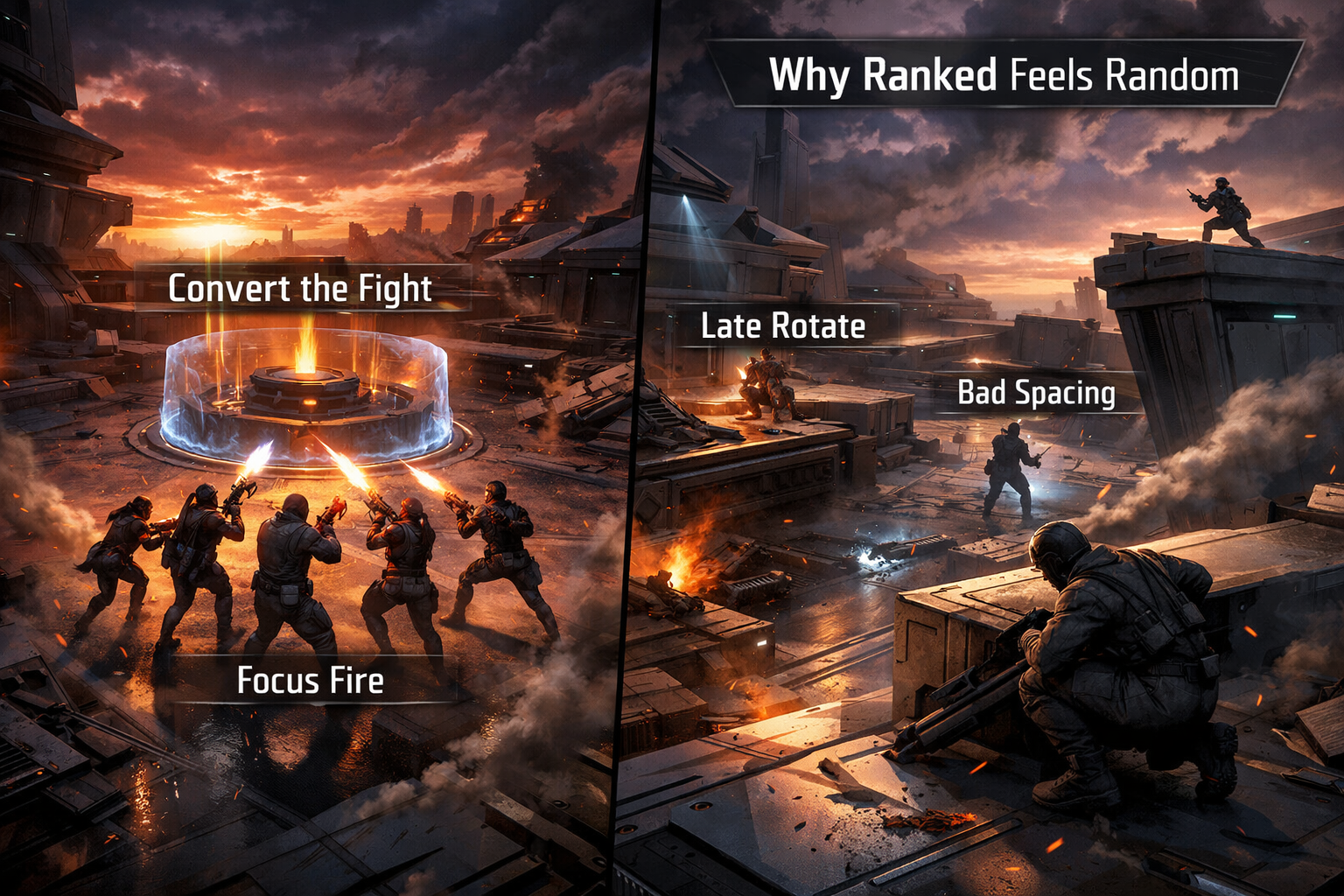
Hitting the wrong enemy at the wrong moment is a quiet way to lose. Good target priority often beats raw aim. Pressure the enemy that changes the fight if they are displaced, low, isolated, or overextended. Stop wasting your strongest tools on the least punishable target.
4. Better ultimate value
Ultimate economy creates the illusion of randomness because many teams use big resources emotionally instead of deliberately. If your side routinely stacks ultimates into won fights or panics them into lost fights, your matches will feel chaotic. The player who helps their team pace key ultimates properly often climbs faster than the player with prettier aim clips.
5. Stronger hero pool discipline
You do not need to master the whole roster. In fact, trying to do that often slows improvement. Most players climb faster with a small pool of comfort picks, a few flexible answers, and a clear understanding of when not to force their favorite hero. Comfort wins more games than shallow versatility.
6. Faster adaptation between rounds and fights
The strongest ranked players do not assume the original plan will always work. They ask better questions sooner. Are we losing to backline access? Are we getting out-poked before the engage? Are we taking long fights against better sustain? Is our off-angle unsupported? Adaptation is the bridge between “I know how to play” and “I know how to win this lobby.”
When your rank is not moving, it is usually because one of these layers is unstable. The fix is almost never “play more randomly until the system finally likes you.” The fix is identifying which part of your influence is too inconsistent for your current bracket.
Why Good Players Still Get Stuck
Many Marvel Rivals players are genuinely better than their rank in some dimensions, but not all the dimensions that matter. That is why “I am clearly better than this elo” can be emotionally true and competitively useless at the same time.
For example, a player may have strong mechanics but poor pathing. Another may understand macro decisions but lose too many close duels. Another may perform well with a coordinated team but collapse in messy solo queue conditions. Another may dominate on comfort maps but underperform on vertical or high-pressure objective maps. Another may be excellent in neutral fights but terrible at protecting leads.
Ranked rewards complete enough performance, not perfection in one category. So if you are stuck, it does not automatically mean the game is underrating you. It often means your strongest strength is easy to notice, while your bottleneck is less visible. Players remember the triple elimination they got. They forget the bad re-peek that gave the enemy first control. They remember topping damage. They forget failing to touch objective on time. They remember the support that missed a save. They forget they broke line of sight during a winnable fight.
This is especially common in hero shooters because the scoreboard is seductive. It offers numbers, and numbers feel objective. But not all valuable actions are captured equally by scoreboard totals. Rotating early, peeling at the right moment, marking a flank route, delaying a dive, refusing a bad chase, or trading one death for key objective time can all be decisive without looking glamorous.
If you want to break a plateau, stop asking only “How good am I?” and start asking “Where does my game become unreliable?” That is the real ranked question.
Match Randomness vs Ladder Truth
One of the healthiest ideas for climbing is this: individual matches can be noisy while the ladder is still directionally correct. Both things can be true at once.
Imagine flipping a weighted coin. If it is only slightly favored, short runs can look weird. You can still get surprising streaks. But if you flip it enough times, the underlying pattern appears. Ranked works in a similar way. The better player does not win every match. The better player tends to produce a higher win rate over enough matches because their average contribution is more valuable.
This is why strong players can lose multiple games in a row without it proving the system is fake. In Marvel Rivals, one tilted session, one bad queue window, one patch discomfort period, or one set of awkward maps can temporarily hide real skill. The ladder’s job is not to reward you instantly for being better in theory. It is to gradually sort players by actual repeated outcomes.
That is also why players misread streaks. A five-game loss streak feels enormous. In a noisy team game, it can still be normal. A five-game win streak feels like proof you solved the game. Often it just means the variance moved in your favor while you played well enough to capitalize. The dangerous part is overreacting to either one.
When you get emotional after streaks, you start changing things that did not need changing. You swap heroes too often. You take queues while tilted. You overforce flanks. You stop trusting simple fundamentals because your brain is searching for a dramatic fix. That is how variance becomes self-inflicted.
The practical takeaway is simple: judge your ranked level over blocks of games, not single sessions. Ten games can tell you how you felt. Thirty games tell you more about your habits. Fifty games start to reveal your actual consistency. One match tells you almost nothing except whether you won that one lobby.
How to Climb by Role
Marvel Rivals climbing gets easier when you stop thinking in generic terms and start asking what your role must provide for the team to function. Every role can carry, but each carries differently.
Vanguard: carry by creating stable space
Vanguard players often misread their job. The goal is not simply to absorb damage forever. The goal is to shape the fight so your team can take better positions, survive pressure, and actually use their damage safely. If you push too early, your team cannot follow. If you hold too passively, your team never gets room to play. The best Vanguard play is controlled initiative.
To climb as Vanguard, focus on these questions:
- Am I entering when my team can see and support me?
- Am I protecting the angles that matter most?
- Am I spending cooldowns for space or just for survival?
- Am I forcing fights when my backline is not ready?
- Am I overchasing after we already won space?
Low- and mid-level tank play often throws by impatience. The Vanguard gets one advantage, smells blood, and turns a controlled fight into a scattered brawl. If you can stay disciplined after first contact, you will climb faster than many mechanically stronger players.
Duelist: carry by turning pressure into conversions
Duelist players usually think in terms of damage and eliminations, but the more useful lens is conversion. Are you turning openings into secured fight wins, or just creating noise? Can you punish isolated targets without overextending? Can you threaten backline access without disappearing from the real fight?
To climb as Duelist:
- Take angles that create pressure without cutting yourself off from resources.
- Use mobility and burst to finish vulnerable targets, not to start reckless coin flips.
- Respect when the enemy composition is waiting for exactly the flank you want.
- Reload, reset, and reposition before greed turns a good fight into a throw.
- Understand when your team needs sustained pressure versus quick assassination.
The Duelist who climbs is often not the flashiest one. It is the one whose pressure arrives at the correct time, on the correct target, from a survivable angle. Precision is stronger than drama.
Strategist: carry by controlling tempo and survivability
Strategist players often get trapped between two bad extremes: heal-botting and ego-fighting. The stronger approach is tempo control. You are not only restoring health. You are deciding whether your team can continue a fight, re-enter a fight, or survive long enough to convert a lead.
To climb as Strategist:
- Prioritize saving allies whose survival changes the fight, not whoever screams loudest.
- Use line of sight intelligently so you are hard to dive but still effective.
- Do not stand in places that force your whole team to overprotect you.
- Contribute proactive pressure when safe instead of becoming passive value only.
- Track enemy dive routes and pre-position before the engage lands.
Many Strategists lose rank not because they lack healing output but because they create fragile team structures. If your positioning constantly invites collapse, your matches will feel random. If your positioning makes your team hard to break, your matches become more stable.
Universal role advice
No matter which role you main, the same principles win games:
- Be where your next fight matters, not where your last duel happened.
- Use cover even when you are ahead.
- Stop forcing hero plays after the team plan has changed.
- Value trade efficiency over stat volume.
- Understand that preserving an advantage is a skill, not passive play.
Solo Queue vs Duo vs Full Stack
The way Marvel Rivals ranked feels depends heavily on how you queue. Solo queue emphasizes adaptability, composure, and fast reads. Duo queue adds stability if your partner reliably fills a complementary role and communicates clearly. Larger coordinated groups can reduce chaos, but they also raise the importance of synergy and shared decision-making.
Solo queue is where the game feels most random because you have the least control over communication and trust. That does not mean solo queue is impossible. It means your win conditions must be more self-contained. Pick heroes you can pilot confidently without needing perfect peel or complex setup every fight. Use simple plans. Avoid emotional comms. Stabilize before you try to carry.
Duo queue is often the sweet spot for climbing. A strong duo can cover core needs like engage plus sustain, backline defense plus pressure, or frontline stability plus conversion damage. Two players with a repeatable plan can significantly reduce lobby volatility.
Full stacks can be powerful, but only if the stack actually has structure. A stack with conflicting ideas can lose to calmer teams because internal confusion is still confusion. Stacking does not automatically create quality. It only amplifies whatever habits the group already has.
How to Build Consistency Instead of Chasing Streaks
If the ladder feels random, the best response is not to search for secret tricks. It is to make your own performance less random.
Start by reducing variables. Pick a small hero pool for ranked. Know your primary, your backup, and your emergency adaptation pick. Learn their best maps, worst matchups, core cooldown rhythm, and ideal fight distances. The more automatic your basics become, the more mental space you have for reading the lobby.
Next, use pre-game intentions. Before each match, decide one thing you want to do well: hold safer off-angles, protect line of sight, track one key enemy ultimate, or avoid unnecessary re-peeks. This keeps your mind anchored to process instead of panic. Players who enter matches with no process goals are much more likely to spiral emotionally after a bad opening.
After that, manage your sessions. Two focused wins and one clean loss are better than grinding seven tilted matches because you feel “due.” Ranked does not care whether you think your luck should turn. It only records what happened. Session quality matters more than session length.
You should also review with one question at a time. Do not watch a replay looking for everything. Pick one category:
- Where were my bad deaths?
- Did I enter fights too early or too late?
- Did my positioning protect or expose my backline?
- Was I using my biggest cooldowns reactively or intelligently?
- Did I swap too late?
This kind of review is powerful because it reveals patterns. You are usually not losing for ten different reasons every game. You are losing repeatedly for two or three recurring reasons that show up in different clothes.
Another major consistency tool is respecting momentum without worshipping it. If you are sharp, calm, and reading fights well, keep playing. If you notice yourself blaming teammates before reviewing your own timing, your ranked value is already falling. Stop there. A session ended early is not lost value. It is protected MMR.
Consistency also means understanding your carry threshold. In some brackets, slightly better fundamentals are enough. In others, you need noticeably superior adaptation, cleaner target priority, and fewer wasted resources to actually separate. That is why the same habits that earned easy wins at one rank may suddenly plateau. The answer is not despair. The answer is refining the margin.
Common Myths About Ranked
Myth 1: “If I top the scoreboard, I should gain anyway.”
Not necessarily. Scoreboards are useful, but ranked ladders are built around winning. If your numbers came from low-value pressure, late cleanup, or stat inflation during lost fights, they may not represent real carry impact. Great stats can absolutely reflect great play, but they are not proof by themselves.
Myth 2: “I need to hard-carry every game to climb.”
No. You need to outperform your bracket on average. Some games require takeover energy. Others are won by not throwing, enabling the correct teammate, peeling one dive, or making one disciplined swap. Trying to hard-carry every match often turns stable games into unnecessary risks.
Myth 3: “Loss streaks mean the system decided I should lose.”
Loss streaks can happen naturally in a high-variance team environment. They often get worse because players change behavior under emotional pressure. The streak is real. The conclusion is often wrong.
Myth 4: “I just need better teammates.”
Better teammates would help anyone. That is not a useful climbing framework. The better question is: what kind of teammate am I being for this bracket? Do I make my team easier to play around? Do I bring structure into messy games? Do I keep my value when the lobby is awkward?
Myth 5: “More games always solves everything.”
Only if those games are reasonably focused. Mindless volume can reinforce bad habits. A smaller number of reviewed, intentional games often improves rank faster than endless tilted grinding.
Myth 6: “Hero swapping is always the answer.”
Swapping can fix real problems, but panic swapping can also destroy your own consistency. Change when your current hero no longer fits the lobby or map, not just because one fight felt ugly.
A Simple Improvement Plan for Faster Climbing
If you want Marvel Rivals ranked to feel less random, use a structure like this for your next thirty games.
Games 1–10: stabilize
Pick your main role and keep your hero pool narrow. Track only two stats for yourself: bad deaths and late fight arrivals. Do not worry about rank yet. Your goal is to create a cleaner baseline.
Games 11–20: convert more
Now focus on target priority and objective conversion. After every win, ask why it became easy. After every loss, ask whether your team failed because it lacked damage, space, survivability, timing, or clarity. This teaches you to read lobbies instead of playing every match the same way.
Games 21–30: adapt faster
At this stage, focus on between-round or mid-match adjustment. Swap earlier when needed. Change your angle sooner. Respect recurring enemy win conditions. Learn to solve the current match, not the match you wish you were playing.
Throughout all thirty games, keep notes under these headings:
- My best maps
- My worst maps
- Comfort matchups
- Uncomfortable enemy patterns
- Most common reason I die
- Most common reason fights slip away
By the end of this block, ranked will usually feel less mysterious because your own errors will be easier to see. That is the moment improvement accelerates.
When outside help makes sense
Some players enjoy the learning process and want to grind through every stage themselves. Others care more about saving time, securing seasonal rewards, or reaching a target tier for prestige, matchmaking quality, or account goals. If you fall into the second group, it can be worth comparing reputable services and checking current Marvel Rivals boosting prices. Even if you decide not to buy anything, looking at service structures can help you estimate the time cost of climbing on your own versus outsourcing part of the grind.
FAQ
Does Marvel Rivals ranked reward individual performance or only wins?
In practice, ranked ladders are win-centered. Individual performance matters because it helps produce more wins over time, not because any one flashy scoreboard necessarily overrides match outcome.
Why do some lobbies feel impossible?
Usually because several variables stack together: awkward composition, poor objective understanding, early tilt, map discomfort, or teammates who cannot coordinate around the same plan. Impossible-feeling matches are real, but they are not the whole ladder.
Is solo queue worth it in Marvel Rivals?
Yes, if you play self-sufficient heroes, avoid long tilt sessions, and focus on stable value instead of highlight hunting. Solo queue is noisier, but it still rewards consistent players over time.
Should I one-trick to climb faster?
Usually not. A narrow hero pool is good, but total rigidity becomes a liability in a game with varied maps, team needs, and patch changes. A main pick plus a few practical alternatives is healthier.
How many games does it take to know my real level?
There is no perfect number, but very small samples are misleading. Think in blocks of at least 30 games when evaluating trends, and use replay review to identify recurring weaknesses inside those blocks.
What is the fastest way to make ranked feel less random?
Reduce your own volatility. Die less stupidly, arrive to fights on time, make fewer emotional swaps, and stop queueing while tilted. Personal stability makes the ladder easier to read.
Final Thoughts
Marvel Rivals ranked feels random because hero shooters compress a lot of complexity into one visible result: win or loss. That creates emotional whiplash. It also makes players overvalue the last match instead of the larger pattern. But once you understand what the ladder is actually testing, the chaos becomes easier to navigate.
Climbing is not about eliminating randomness. You cannot do that in a team game. It is about becoming the player whose value survives randomness better than the average player at your rank. That means cleaner timing, fewer bad deaths, smarter adaptation, stronger role understanding, and a calmer relationship with streaks.
If you build those habits, the ranked experience usually changes in two ways. First, the game stops feeling like a lottery quite so often. Second, even when a lobby is messy, you understand what happened and what part was within your control. That clarity is what turns frustration into progression.
And that is the real secret behind climbing in Marvel Rivals: not winning every game, but becoming difficult for the ladder to ignore.