



TFT Scouting Guide: Read the Lobby and Pivot Without Panic
Teamfight Tactics — How to Scout: Reading the Lobby and Pivoting Without Panic
Scouting is one of the biggest separators between players who feel in control of a Teamfight Tactics game and players who feel like the lobby is happening to them. Many TFT matches are not lost because of bad luck, low rolls, or a single unlucky fight. They are lost because the player never gathered enough information to make calm decisions. They stayed locked into a dream board after the lobby had already moved in a different direction. They rolled too hard for units that three other players were contesting. They kept the wrong item holder for too long. They panicked at level 7, broke their economy, and ended up weaker than the players who stayed flexible.
This guide is about fixing that pattern. If you want to improve your consistency in ranked, you need a reliable way to scout the lobby in TFT, interpret what you see, and pivot with purpose rather than fear. The goal is not to turn every game into a complicated spreadsheet. The goal is to make your decisions cleaner. Once you understand what to look for, scouting becomes simple, fast, and practical. You stop asking, “What should I play?” in a vacuum and start asking, “What line is open, what is contested, what do my items support, and what keeps me strongest over the next few rounds?”
A timeless TFT mindset starts with the idea that your final board is not your identity. Early shops, item drops, and augments point you in certain directions, but they do not command you to force one composition no matter what the lobby does. Strong players treat the game like a flow of information. They notice who is streaking, who is bleeding, who is greedily holding pairs, who already owns the natural item holders for a contested carry, and who is likely to collide with them later. That information changes how they spend gold, hold units, slam items, and choose their roll timing.
If you want a good external tool for checking unit stats, trends, and match history outside the client, LoLCHESS is widely used. For official game information, the Teamfight Tactics official website and the official TFT news and patch coverage are useful resources. If your goal is to climb faster while improving your decision-making, you can also review TFT boosting prices here as part of your ranked planning.
Table of Contents
- What scouting really is in TFT
- Why players fail to scout properly
- When to scout during a match
- What to check when you scout the lobby
- How to tell whether you are contested
- How to spot open lines before everyone else
- Board strength, tempo, and scouting for survival
- Items, item holders, and why they matter when pivoting
- How to pivot without panic
- Common pivot patterns that work in any set
- Scouting and your economy: when to roll, hold, or level
- The most common scouting mistakes
- A simple practice routine to build scouting habits
- FAQ: TFT scouting and pivoting
- Final thoughts
What scouting really is in TFT
Many players think scouting means quickly clicking through enemy boards every few rounds and noticing whether someone has the same carry. That is part of it, but real scouting is broader. In TFT, scouting means collecting enough information from the lobby to make stronger decisions than you would make by looking only at your own board.
That information usually falls into five categories:
- Who is strong right now — the players protecting win streaks or likely to beat you soon.
- Who is weak right now — the players bleeding out, rolling early, or stuck with awkward transitions.
- Who is contesting your units — not only your final carry, but your frontline, item holder, and supporting pieces.
- Which traits or lines are open — especially the lines your items and augments can support.
- What kind of fights are coming — burst-heavy boards, sustain boards, capped late-game boards, reroll boards, or fast-8 tempo boards.
Once you understand scouting this way, it becomes easier to use it correctly. You are not scouting for trivia. You are scouting to answer decisions. Should you level now or greed? Should you slam these flexible items or hold components? Should you keep holding those pairs on bench? Should you roll at 6, 7, or 8? Should you stay on your current line, or is it time to move?
The strongest TFT players do not scout because it looks high-level. They scout because information saves gold, saves health, and prevents panic. A player who scouts well often rolls less recklessly because they already saw the danger coming two rounds earlier.
Why players fail to scout properly
Most players do not fail because scouting is too hard. They fail because they try to do too much, too late, and without a process. They click through the lobby during a stressful roll-down, see seven different boards in two seconds, remember nothing, and then say scouting is overrated. The problem is not the idea of scouting. The problem is the lack of a filter.
There are a few classic reasons this happens:
- They scout emotionally. They only check the lobby after losing a round they expected to win.
- They scout too narrowly. They check only whether someone has the same carry, ignoring items, frontline, tempo, and bench clues.
- They scout too late. By the time they realize they are hard contested, they have already invested too much gold and too many item decisions into a weak line.
- They don’t connect scouting to actions. They gather information but do not change anything.
- They panic when the answer is inconvenient. Seeing that your line is contested can feel bad, but ignoring that information is worse.
To become better at reading the TFT lobby, you need a calmer structure. You do not need to memorize every board perfectly. You need to notice the most important patterns early enough to matter.
When to scout during a match
One of the easiest ways to make scouting practical is to tie it to routine moments. Instead of thinking, “I should scout more,” think, “I scout at these predictable times.” That turns a vague skill into a repeatable habit.
1. Scout lightly in the early game
In the early stages, you are not trying to solve the whole match. You mostly want quick signals. Who is clearly strongest? Who slammed early items? Who looks greedy? Who is holding pairs that suggest a reroll line? Which components are common in the lobby? Are multiple players already signaling the same backline direction you were considering?
At this point, one fast glance around the lobby is enough. You do not need to overreact. You are just building a mental map.
2. Scout before a major item slam
Flexible items are valuable partly because they keep multiple lines open. Before you commit components into a narrow item, it helps to know what the lobby looks like. If three players are already naturally holding the same carry line that your item strongly prefers, you should at least think twice. A strong slam can still be correct, but scouting helps you understand the price of commitment.
3. Scout before each important level-up window
Leveling decisions are not just about your gold total. They are about relative strength. If the lobby is spiking and you stay greedy, your health can disappear quickly. If the lobby is weak and unstable, you may be able to hold economy longer. Scouting before level 6, 7, or 8 decisions is one of the most useful habits in TFT.
4. Scout right before a roll-down
This is the most important moment. Before you spend a large amount of gold, you want answers to three questions:
- How contested is my current line?
- What alternative lines are open enough to pivot into?
- How much power do I need right now to stabilize?
Rolling without this information is how players donate their economy to the shop and still miss the board they need.
5. Scout after you stabilize
Many players stop scouting once they hit a playable board. That is a mistake. Stabilizing is not the same as winning. After you hit, scout again. Who can outcap you? Who is still alive on your line? Who is one turn away from spiking harder than you? This tells you whether you should greed for upgrades, tech for specific fights, or push levels aggressively.
What to check when you scout the lobby
The fastest way to improve is to know exactly what your eyes are looking for. Here is a timeless checklist that works in every TFT set, even when traits, champions, or mechanics change.
Board identity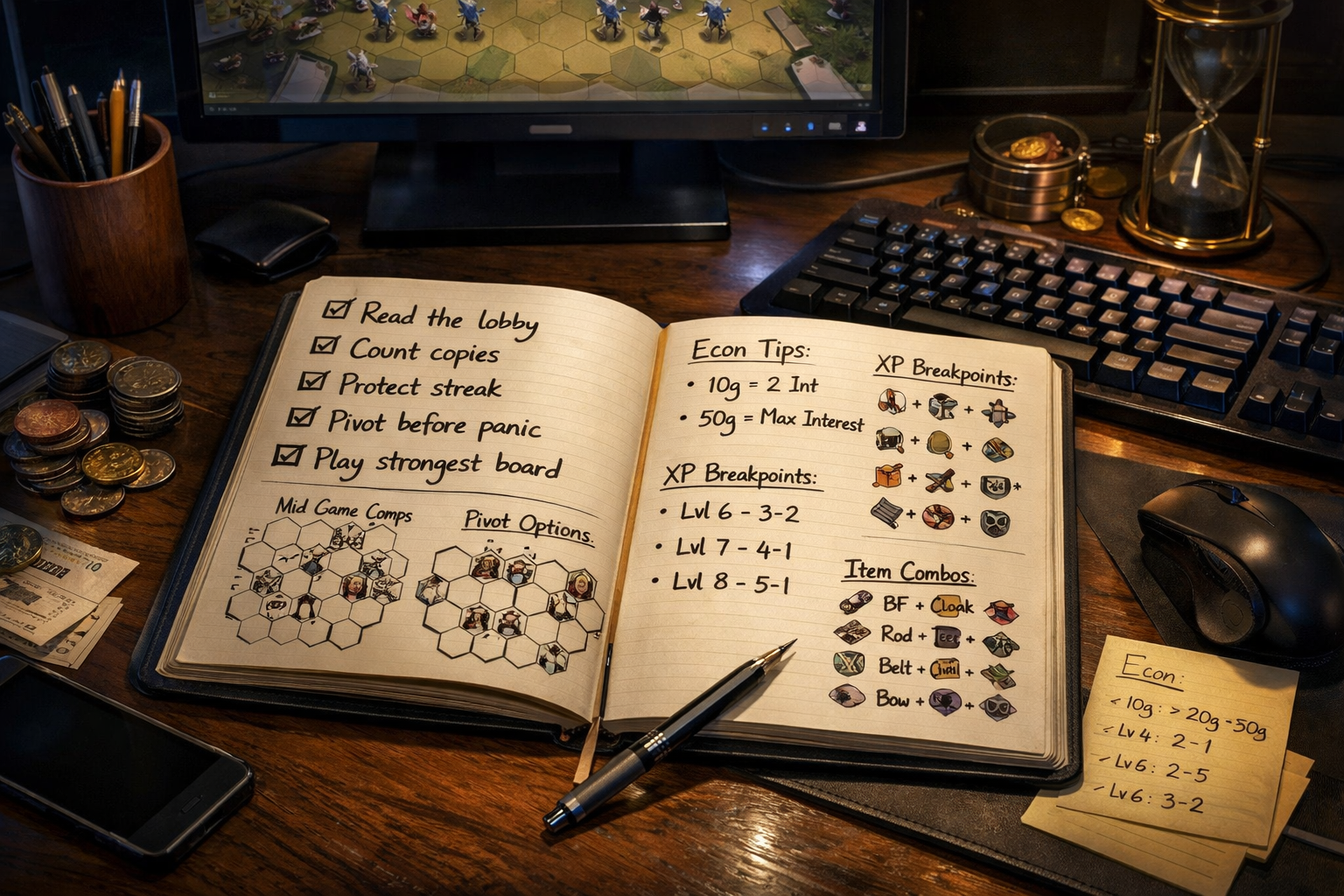
What is this player probably trying to become? Not every board needs a perfect answer, but you usually want a rough one. Are they clearly committed to an AP backline? AD backline? Front-to-back bruiser style? Reroll line? Flexible fast-8 cap board? A board does not need to be complete for its direction to be obvious.
Upgrades and tempo
How upgraded is the board relative to the stage? A natural 2-star frontline with slammed items matters. A lobby full of upgraded boards means greed gets punished harder. A lobby full of weak one-stars means you may have extra time.
Item commitment
Items tell the truth faster than traits do. A player can hold many units, but their items often reveal what they really want. If someone slammed strong AD carry items and already has a usable holder, they are more likely to continue along that direction. If another player has flexible tank items and utility components, they may still be open.
Bench clues
The bench is where panic often starts and where scouting often wins. Bench units reveal reroll intent, transition plans, and hidden contesting. Two players can both look like they are on different temporary boards while secretly holding the same late-game carry on bench. If you do not check benches, you may discover contesting too late.
Copy counts
How many copies of your important units already exist outside your board? This matters more the more dependent your line is on specific upgrades. If several copies are already gone from the pool and multiple players are still alive, hitting becomes more expensive and more uncertain.
Health and economy state
A player at high health with good economy can punish you later even if their board looks incomplete now. A player at low health may be forced to roll immediately, reducing flexibility. Scouting is not just about what exists now. It is also about what each player is likely to do next.
Positioning tendencies
Late in the game, positioning matters more and more. Not every set creates the same threats, but there are always positioning battles: avoiding hooks, dodging burst, protecting carries, baiting aggro, spreading against splash damage, cornering, anti-cornering, and frontlining for better target access. You do not need perfect positioning reads every round, but seeing repeated habits helps.
How to tell whether you are contested
This is one of the most misunderstood parts of scouting. Players often say they are contested too early or too late. Seeing one player with one shared unit does not automatically mean your line is dead. On the other hand, waiting until two players have already hit your exact endgame board is far too late.
To judge contesting correctly, ask these questions:
Are they sharing your final carry, or only your temporary pieces?
Many boards overlap in the early and mid game. Shared frontline units, generic utility units, or common item holders do not always mean a hard contest. What matters most is whether multiple players are chasing the same key upgrades at the same timing window.
Are their items actually compatible with your line?
If another player owns some of your units but their items point elsewhere, they may not remain on your line. Item mismatch often creates false alarms. Scouting well means distinguishing temporary overlap from true long-term contesting.
Do they have stronger ownership of the line than you do?
This is a brutal but useful question. If another player already has better copies, better items, better augments, and a smoother holder path into the same board, they may simply own that line more naturally than you do. In that case, staying stubborn is usually ego, not strategy.
What is their health and gold situation?
A nearly dead player contesting your units is less threatening than a healthy player with rich economy contesting your units. A weak low-health player may die before the contest matters. A healthy player can keep pressuring the pool and outcap you later.
Is your line narrow or broad?
Some TFT lines can tolerate light contesting because many units or item combinations can bridge into a similar endgame shell. Other lines depend heavily on exact upgrades and a small unit pool. The narrower your plan, the less contesting you can tolerate.
A good rule is this: if you notice real contesting early enough, you still have options. If you notice only after you already committed all your gold and all your items, you do not have a scouting problem anymore. You have a damage-control problem.
How to spot open lines before everyone else
The best pivots in TFT often do not feel dramatic. They feel clean because the player noticed an opening before the whole lobby did. This is a major advantage of good scouting. You are not just avoiding bad lines. You are identifying the lines with less friction.
Open lines usually reveal themselves through a combination of signals:
- Very few players are holding the key carry or supporting core.
- The items you already have are naturally playable in that direction.
- The line has a stable item holder path from your current board.
- Your augments, economy, or level timing support the transition.
- You can move into it without sacrificing too much immediate board strength.
Notice what is not on that list: hype. Many players pivot toward the most fashionable line instead of the most available line. That is how “best comp” obsession creates bad results. In ranked TFT, the strongest board for your shop, your items, and your lobby is often more important than the theoretical number one comp on a tier list.
External meta resources can help you understand broad trends, and sites like Liquipedia TFT are useful for general competitive context, but scouting in your actual lobby should always come first. A line can be powerful in theory and still be terrible in your match if half the lobby is fighting for it.
Board strength, tempo, and scouting for survival
Some players think scouting is mostly a late-game cap skill. In reality, it is often a survival skill. You scout to protect health. You scout to decide how greedy you can afford to be. You scout to understand whether you need power now or later.
Here is a timeless principle: tempo is relative. A board that feels decent in one lobby may be dangerously weak in another. If everyone around you is rolling, upgrading, and slamming aggressively, a “greedy setup turn” can cost far more HP than you expected. If the lobby is weak and awkward, you may get away with preserving econ longer.
That means scouting is essential to these practical questions:
- Can I greed interest this round?
- Can I hold these pairs instead of rolling?
- Should I level to preserve streak?
- Do I need to slam a suboptimal but strong item for immediate tempo?
- Am I one loss away from needing a real stabilization turn?
A lot of panic pivots are actually delayed tempo decisions. The player waited too long to acknowledge that their board was behind. Then, once they were low HP, every decision felt urgent and messy. Good scouting prevents this by showing you the pace of the lobby before the emergency happens.
Items, item holders, and why they matter when pivoting
Items are the bridge between scouting and pivoting. If your items are flexible and your holder is useful, you can move between lines with much less pain. If your items are narrow and tied to a weak holder that does not transition well, every pivot feels expensive and stressful.
That is why strong TFT players often think in terms of direction rather than exact destination. Instead of saying, “I am playing this exact carry no matter what,” they think, “My current items support an AD backline direction,” or, “These components and my board naturally support an AP tempo line,” or, “These frontline items let me stabilize while I stay open on damage direction.”
When scouting, ask yourself these item-related questions:
- Can my current item holder carry these items for two or three more stages if needed?
- If I pivot, which units can inherit my items cleanly?
- Am I forcing a line because I already built one narrow item?
- Are there multiple endgame boards that use what I have already slammed?
The more honest you are here, the better your pivots become. Many bad pivots are not really pivots. They are desperate attempts to justify earlier overcommitment. The smoother solution is to preserve flexibility before the crisis, not after.
For players who want to improve their fundamentals instead of only chasing patch-specific tricks, the official Riot ecosystem is still the best long-term anchor. The Teamfight Tactics support portal is also useful for official explanations around systems and account-related topics, while community stat sites help with interpretation.
How to pivot without panic
Pivoting is one of the most emotional moments in TFT because it often happens when your original plan is no longer comfortable. Maybe you got contested. Maybe your items fit better elsewhere. Maybe your shops gave you a cleaner line than the one you imagined. The key is to remember that a pivot is not a failure. It is a correction.
A calm pivot usually follows this sequence:
1. Recognize the signal early
Do not wait until your board is collapsing. The moment you notice that your line is getting crowded, your item path is awkward, or another line is opening, start mentally preparing. You do not have to pivot instantly, but you should already be evaluating outs.
2. Define what must stay and what can move
Most good pivots do not replace everything. They preserve your strongest temporary pieces, your best frontline, your item holder, or your already-upgraded utility units. If you try to rebuild your entire board in one turn, you will often become weaker before you become stronger.
3. Pivot around your strongest anchor
Your anchor might be itemized frontline, a strong upgraded holder, a flexible emblem, a powerful economy position, or an augment that points clearly toward a category of boards. Build from the anchor outward. This makes the pivot structured instead of random.
4. Know whether you are pivoting for stability or for cap
Not every pivot aims at first place immediately. Sometimes you pivot because you need a board that stops the bleeding. Sometimes you pivot because your current board is stable but cannot realistically outscale the healthy players in your lobby. These are different goals, and they require different levels of commitment.
5. Spend only as much gold as the situation demands
Panic rolls are how many players turn a salvageable game into an eighth. If you only need to stabilize, do not roll for a perfect final board. Upgrade what matters most, field the strongest version you can now, and keep future outs alive.
6. Re-scout after the pivot
Once you move, scout again. Did you enter a line that is actually cleaner? Are you still lightly contested? Did your new board buy enough time? Pivoting is not the last decision. It creates the next decision.
Common pivot patterns that work in any set
Specific comps change from set to set, but certain pivot ideas stay useful forever. If you understand these patterns, you can adapt quickly no matter what the current champion pool looks like.
Temporary item holder into true carry
This is the most common pivot pattern. You start with a strong early or mid-game holder, use them to preserve HP, then move those items onto the real endgame carry once the lobby and your shops confirm the path. This is why flexible holders are so valuable.
Shared frontline, different backline
Sometimes the most efficient pivot keeps your entire frontline and changes only the damage package. This is especially useful when your tank items are already strong and your lobby contesting is centered on backline carries rather than frontliners.
Shared backline, different frontline
In other lobbies, the opposite is true. You already have a strong carry setup, but the frontline you imagined is overcontested or under-upgraded. A more modest frontline pivot can stabilize you enough to keep the carry online.
Tempo pivot into generic strongest board
When you are under pressure, the best pivot is often not elegant. It is simply the strongest board you can field right now using your upgrades, synergy breakpoints, and items. This kind of pivot is not about style. It is about surviving long enough to reach a cleaner board later.
Abandoning a reroll when the signs are bad
Reroll lines punish denial. If you are missing too many copies, the lobby is contesting you, and your HP or econ is slipping, a late stubborn reroll can end your game. A disciplined exit into a more standard leveling line is often better than a heroic refusal to pivot.
Cap pivot in late game
Sometimes your mid-game board did its job, but the healthy players remaining have higher ceiling boards. In that case, you may need a late pivot toward more capped utility, legendary units, stronger splash traits, or a superior final item transfer. This pivot is less about emergency and more about maximum placement.
Scouting and your economy: when to roll, hold, or level
If you want to know how to scout in TFT in a way that truly improves rank, you must connect scouting to economy. Gold is not just money. It is future freedom. Every bad read of the lobby can cost you gold indirectly by forcing expensive correction later.
When scouting says you can greed
If the lobby is weak, your board is above average, and your likely future line remains open, you may be able to preserve economy and delay rolling. In these spots, scouting gives you permission to be patient rather than hopeful. That is important. Good greed is informed. Bad greed is denial.
When scouting says you must roll
If you are weaker than you thought, the lobby is accelerating, or you are entering a dangerous stage with too many one-stars, scouting tells you that “saving gold” may actually be spending HP inefficiently. Rolling is correct when the cost of staying weak is larger than the value of your current economy plan.
When scouting says level first
Sometimes the strongest stabilization is not deep rolling but adding one more high-value slot, improving odds, or unlocking an important synergy breakpoint. If your units are decent but your board needs structure and tempo, leveling can be better than hunting for random upgrades at lower odds.
When scouting says keep options open
Bench management matters here. Holding too many dead pairs can trap you. On the other hand, selling every possible out too early can corner you into a contested line. The balance comes from scouting. If you know which directions are open, your bench becomes purposeful rather than cluttered.
One of the cleanest ways to describe good TFT economy is this: spend gold to solve the right problem. Scouting tells you what the actual problem is. Maybe it is lack of frontline. Maybe it is contesting. Maybe it is tempo loss. Maybe it is overcommitted itemization. Without scouting, many players solve the wrong problem with very expensive rolls.
The most common scouting mistakes
Let’s make this practical. If you already scout sometimes but still feel uncomfortable pivoting, chances are one of these mistakes is holding you back.
Scouting only for your own carry
Yes, contesting matters. But if you check only that one detail, you miss everything else. Sometimes your carry is fine, but your frontline is contested. Sometimes your line is open, but the lobby tempo is too high for your greed. Sometimes your line is lightly contested, but your item holder path is better than theirs, which means staying is still correct. Narrow scouting leads to narrow conclusions.
Assuming every overlap is fatal
Overreacting is as bad as underreacting. Not every player with one shared unit is your enemy. Some will transition away. Some have mismatched items. Some are just using a temporary board. Good scouting is about pattern confirmation, not instant fear.
Ignoring benches
Benches often expose hidden plans. A player can look harmless until you notice three copies of the exact unit you need sitting off-board. If you are not checking benches, you are scouting only half the information.
Panic pivoting all at once
A full-board panic pivot is one of the fastest ways to lose rounds. Most strong pivots are layered. Keep what is still good. Replace only what needs replacing. Preserve item value and immediate combat strength whenever possible.
Staying loyal to a line because of sunk cost
This is the biggest one. You already built items. You already bought copies. You already imagined the final board. So you keep going, even when the lobby has clearly changed. TFT punishes emotional attachment. Past investment does not make a weak future stronger.
Not scouting after committing
Some players scout to decide their line, then stop. But lobbies evolve. A line that was open two stages ago may no longer be open. A weak player may highroll into your units. A healthier player may pivot onto your side of the pool. Continue scouting after every major decision.
A simple practice routine to build scouting habits
If scouting still feels overwhelming, use this short routine for a block of games. Do not try to master everything at once. Build repeatable habits.
Step 1: Early-game sweep
During the early stages, do one quick sweep of the lobby and answer only these questions:
- Who looks strongest?
- Who looks weakest?
- What item directions are common?
Step 2: Mid-game contest check
Before your first serious roll or major commitment, answer these:
- Who shares my likely carry?
- Who shares my frontline or support core?
- Do their items suggest real contesting or temporary overlap?
Step 3: Pivot scan
At every important turning point, ask:
- If I cannot stay on this line, what is my cleanest out?
- What line is open enough for my current items?
- Can I preserve my strongest anchor while moving?
Step 4: Late-game threat scan
Once only a few players remain, stop thinking about the whole lobby and focus on specific threats:
- Who outcaps me if I do nothing?
- What positioning change matters most?
- Do I need more utility, more frontline, or a stronger cap board?
After each game, do a short review. Ask yourself one honest question: Did I lose because I lacked luck, or because I ignored information? That question alone will improve your TFT decision-making over time.
FAQ: TFT scouting and pivoting
How often should I scout in TFT?
You do not need to scout every second. The best approach is to scout at consistent checkpoints: early-game overview, before major item slams, before level-up windows, before roll-downs, and after stabilizing. Consistency matters more than spam clicking.
How do I know if I should pivot or just hold my line?
Look at the combination of factors, not one factor alone. If your line is contested by healthy players, your items are only awkwardly supporting it, and an alternative line is open, pivoting is usually correct. If your items, upgrades, and position are naturally stronger than the players sharing your units, staying may still be fine.
Should I always avoid contested comps in TFT?
No. Light contesting is normal. What matters is whether you can still hit on time and whether your version of the board has a stronger claim through items, augments, economy, and tempo. Avoiding every overlap is too passive. Ignoring heavy contesting is too stubborn.
What is the fastest way to get better at scouting?
Reduce the number of things you check at first. Start with board identity, item commitment, bench clues, and contesting. Once those become automatic, add health totals, econ reads, and positioning details more deliberately.
Why do my pivots always feel weak?
Usually because they happen too late or because too much of your value was locked into a narrow plan. Better scouting and more flexible itemization make pivots feel smoother because you move earlier and preserve more strength during the transition.
Is scouting still important if I already know meta comps?
Yes. Knowing the meta is useful, but TFT is still a lobby game. You do not play the tier list. You play the eight-player environment in front of you. Scouting tells you which theoretical lines are actually good in your specific match.
Final thoughts
If there is one idea to remember from this guide, let it be this: scouting is not about perfection, it is about clarity. You do not need perfect information to make better decisions than the average player. You only need enough information to stop lying to yourself about what the lobby is showing you.
When players say they want to become more consistent in Teamfight Tactics, what they often really want is to stop having games that spiral out of control. Better scouting is one of the most reliable ways to do that. It helps you identify contesting before it becomes expensive. It helps you understand tempo before your HP disappears. It helps you choose pivots that preserve strength instead of panicking into chaos. Most importantly, it helps you think in options rather than in fantasies.
A strong TFT player does not treat the game as a rigid script. They do not force the same answer every lobby and blame the shop when it fails. They read signals. They compare their plan to the reality of the match. They pivot when the evidence says pivot. They stay when the evidence says stay. That balance is what makes scouting such a powerful ranked skill.
So the next time you queue up, do not promise yourself that you will scout “more.” Promise yourself that you will scout with purpose. Check the lobby early. Re-check before big commitments. Look at items, benches, health totals, and likely future directions. Ask what is contested, what is open, and what your strongest anchor is. Then make the next decision calmly.
That is how you read the lobby. That is how you pivot without panic. And that is how you turn TFT from a stressful guessing game into a strategy game you can actually control.