



Cooldown Tracking in LoL 2026: Win Fights by Reading Timers
Cooldown Tracking in LoL 2026: How to Win Fights by Tracking Enemy Abilities
Most players in LoL think they lose fights because of mechanics. Sometimes that is true. But in a huge number of ranked games, the real difference is much simpler: one side knows when it is safe to step forward, and the other side does not. Cooldown tracking is the skill that turns that knowledge into wins. It tells you when a lane opponent is harmless for a few seconds, when a jungle gank has no follow-up, when a support cannot peel, when a carry has no Flash, and when a full teamfight should be taken immediately instead of delayed.
If you have ever watched a strong player make a trade look easy, survive an engage that should have killed them, or suddenly force a fight at a dragon that looked too risky a moment earlier, there is a good chance cooldown tracking was behind it. Good players do not only look at health bars. They look at what has already been used, what is still available, what is likely to come back first, and what that means for the next 5, 10, or 30 seconds of the game.
This guide breaks cooldown tracking down into a practical system you can use in every role. The goal is not to memorize every number in the game. That would be unrealistic and not even necessary. The goal is to build a decision-making habit: identify the enemy tool that matters most, notice when it is gone, and immediately ask what becomes possible because of that window. When you do that consistently, your lane trades become cleaner, your skirmishes become more deliberate, your teamfights become less random, and your ranked results become more stable.
Because LoL changes over time, this guide is written to stay useful across seasons and patches. Exact cooldown values, item builds, and champion priorities can shift, but the logic of ability windows does not. A champion that depends on one dash, one shield, one hook, one stun, one escape, or one ultimate will always become more vulnerable after using it. If you can see that window before your opponent does, you gain control over the fight.
For official champion kits and spell descriptions, Riot’s own champion pages are a strong reference point at leagueoflegends.com. If you want a broader community reference for skill details, scaling, and history, many players also use LoL Wiki. For reviewing match patterns, lane matchups, and your own recent games, tools like OP.GG can help you connect theory with real decision-making. And if your goal is faster ranked progress while sharpening fundamentals, Boosteria’s LoL elo boost pricing page is the most relevant internal resource for this topic.
Why Cooldown Tracking Matters
Every fight in LoL is built around access to tools. Health, gold, levels, and positioning all matter, but abilities determine how those advantages are expressed. A champion with engage available can threaten space. A champion without engage becomes far less dangerous. A lane bully with poke ready controls the wave differently than the same champion after spending their main spell on minions. A carry with mobility can play aggressively. The same carry without mobility becomes punishable.
This is why cooldown tracking creates wins in ways that look bigger than they are. Suppose an enemy mid laner uses their primary waveclear or crowd control spell to thin the minion wave. That might look like a small action. In reality, it can remove their ability to contest your next step forward. If you recognize that immediately, you can trade, zone, push, crash, or set up with your jungler. If you do not recognize it, the opportunity disappears, their spell comes back, and the lane resets to neutral.
At higher levels of play, many trades are not reactions. They are pre-planned punishments. One player waits for the spell that defines the matchup. Once it is used, they step in confidently because they already know the opponent’s response options are limited. This makes their mechanics look smoother, but the real edge comes from information.
Cooldown tracking also reduces bad fights. Many players die not because they lacked damage, but because they ignored the enemy’s remaining tools. They walk into a choke while the enemy still has engage. They chase a target whose escape is nearly back up. They overcommit to a dive without tracking defensive ultimates or summoner spells. Good tracking saves you from these errors before they happen.
Another reason the skill is so powerful is that it scales across every role and every level of play. A top laner can use it to choose trade patterns. A jungler can use it to time ganks. A support can use it to create or deny all-ins. An ADC can use it to judge whether front-to-back is safe. A mid laner can use it to force priority before roaming. Cooldown tracking is not a niche trick. It is one of the cleanest universal fundamentals in League.
What You Should Actually Track
The biggest mistake newer players make is trying to track everything at once. That is not how strong cooldown tracking works. You rarely need the full exact state of all ten champions every second. What you need is a hierarchy. Track the ability that most changes the fight.
1. The key spell in the matchup
Every lane and skirmish has one or two abilities that matter more than the rest. It might be a hook, a stun, a dash, a shield, an escape, or the main burst spell. In top lane it could be the cooldown that decides whether a melee champion can enter range safely. In bot lane it may be the support engage tool or the ADC escape. In mid it is often the spell that enables a full combo or prevents a trade.
2. Ultimate cooldowns
Ultimates shape objective fights, tower dives, side lane pressure, and teamfight entries. You do not always need the exact second an ultimate returns, but you do need a strong feel for whether it is likely up or still unavailable. If a major teamfight ultimate was used recently, that can be your signal to accelerate the game before it returns.
3. Summoner spells
Flash, Teleport, Heal, Exhaust, Ghost, Cleanse, and Barrier all create major windows. Flash is the most important universal summoner to track because it changes threat range, survivability, and engage patterns. If an enemy carry has no Flash, your next setup becomes much easier. If your side lane opponent has no Teleport, you can pressure waves and timers differently. Summoner tracking often matters just as much as ability tracking.
4. Item actives and defensive buttons
League regularly includes items or effects that act like extra abilities. A stasis effect, movement burst, spell shield, cleanse effect, or shield active can flip a fight. You should especially track defensive actives on carries and engage enabling actives on initiators.
5. Waveclear and mobility
Players often focus on damage cooldowns and forget utility cooldowns. But sometimes the most important enemy spell is not the one that kills you. It is the one that lets the opponent reset the wave, escape a gank, or safely contest space. If a mobility spell is down, a gank becomes easier. If a waveclear spell is down, a shove or crash becomes harder for the enemy. These windows win games quietly.
6. Defensive layering
Many fights are decided not by whether the enemy can start the fight, but by whether they can survive your answer. Shields, heals, damage reduction, peel, and disengage tools should all be included in your tracking mindset. When those are gone, backline access becomes much more realistic.
The Core Principle: Window Creation
Cooldown tracking is really the art of recognizing windows. A window is a period where the game state changes because one side has fewer available tools than usual. Once you understand that, tracking becomes simpler. You stop asking, “Do I know every cooldown?” and start asking, “What can they not do right now?”
That question is the foundation of winning fights. If the enemy cannot disengage, you can extend. If they cannot engage, you can take space. If they cannot burst, you can hold your defensive tools. If they cannot waveclear, you can crash. If they cannot contest the objective safely, you can force it.
There are three common types of windows:
- Short windows: A few seconds after a basic ability is used. These matter most in lane trading, jungle skirmishes, and support interactions.
- Medium windows: Time created by summoner spells, key mobility tools, or major defensive spells. These can shape a whole minute of map pressure.
- Long windows: Ultimate cooldowns, Teleport differences, or repeated forced fights before a major teamfight tool returns. These influence entire objective sequences.
A lot of ranked players see cooldown tracking as counting. In reality it is more about converting. The enemy used a spell. What do you convert that into? A better trade? Wave control? Vision? A dive? Dragon setup? Pressure on a carry? If you do not convert the window into something concrete, tracking is just observation. Strong players turn observation into action.
This is why the best time to think about cooldowns is before the spell is even used. Enter lane asking yourself which enemy spell changes the lane. Enter a dragon fight asking which two enemy buttons matter most. Enter a side lane knowing whether your opponent needs one specific spell to threaten you. Then when it gets used, you do not hesitate. You already know your plan.
Lane Phase Cooldown Tracking
Trading around the spell that unlocks the matchup
In lane, cooldown tracking should feel deliberate rather than busy. Before minions even meet, ask a simple question: what spell makes the enemy strong in this matchup? Against some champions it will be their gap closer. Against others it will be their crowd control, shield, or main poke tool. Once you identify it, your lane becomes much easier to read.
For example, if an opponent uses their trading spell on the wave, that is often your invitation to walk up. If they use their escape carelessly, your jungler has a much clearer gank. If they burn a defensive spell early in a trade, you may be able to extend instead of disengaging. The key is not to step forward randomly. Step forward because a reason appeared.
Using minion waves to make cooldowns matter more
Cooldown windows are strongest when combined with wave position. If the enemy uses an important spell while the wave is pushing toward you, they can become vulnerable to a long punish because they have to walk farther to safety. If they use the spell near your crash timing, you may be able to secure the shove uncontested. If they use waveclear or poke on a cannon wave, that can change whether they are allowed to contest the next few minions.
Good laners do not only watch abilities. They watch the interaction between abilities and wave state. A missed skillshot in the middle of the lane is one thing. A missed skillshot while overextended on a bad wave is much more important.
Health bars are not enough
One of the easiest ways to improve your laning is to stop evaluating fights by health alone. A player at 70 percent health with their key cooldowns ready may be stronger than a player at 90 percent health with no tools left. If you only look at hit points, you will misread winnable lanes and unwinnable trades.
Instead, read lane strength as a combination of health, resources, cooldowns, wave, and spacing. Once you think that way, you stop being surprised by trades that looked odd from the outside. They were often won before they started because one side had the important button and the other side did not.
Cooldown baiting
A major part of lane control is making the enemy use a spell they do not want to use. This is where spacing, fake last-hit pressure, short stutter steps, and feints become powerful. If you can stand just close enough to tempt out the enemy’s main trading spell, then dodge or absorb it efficiently, you create your own punish window. You did not wait for a mistake. You manufactured one.
This is especially important in lanes where you cannot simply start trades on demand. Against strong ranged poke or heavy engage, baiting the key spell first can be the difference between feeding and taking over the lane.
Support matchups and bot lane layering
Bot lane is where cooldown tracking becomes more complex because there are four champions instead of two. But the principle stays the same: identify the spell that starts everything. Many bot lane fights are not really ADC versus ADC. They are support versus support until one side gets a clean opening. If the enemy support’s engage is down, you can step up much more freely. If your own peel is missing, you may have to give space even when your health bar looks fine.
In bot lane, track in layers. First track engage or peel. Then track mobility. Then track defensive summoners. When a major engage spell misses and the enemy ADC has already used movement, that can be the best all-in moment of the lane. If you miss that window, the lane often returns to neutral before you get another clean chance.
Jungle and Skirmish Tracking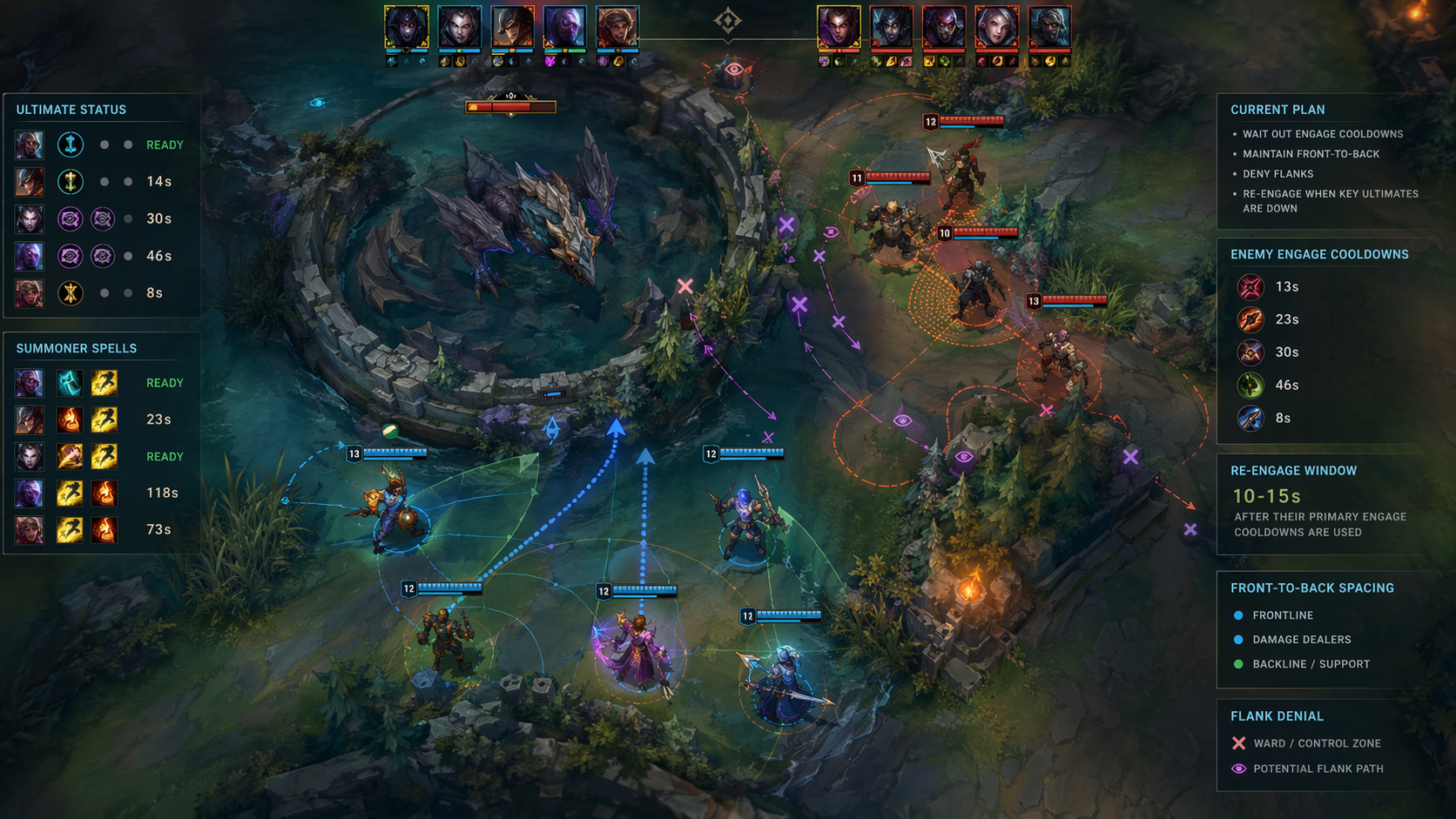
Cooldown tracking becomes even more valuable once more players enter the picture. In jungle skirmishes, exact mechanics matter less than whether the champions arriving have the tools to contribute immediately. A 2v2 can become winning or losing based on one missing crowd control spell or one unavailable dash.
Track setup before damage
In early river fights, the most important cooldown is often the one that allows the skirmish to begin cleanly. This may be a stun, knock-up, slow, or mobility spell that lets someone reach priority targets. If the enemy lacks setup, their raw damage matters less because it is harder for them to apply it. If your side lacks setup, chasing can become dangerous even while ahead.
Ganks are often about escape tools
As a jungler or laner coordinating with a jungler, you should pay close attention to enemy escape cooldowns. A lane with Flash down and mobility already used is not just slightly easier to gank. It can become almost guaranteed if wave position supports it. On the other hand, a lane with all defensive tools available may waste your time even if the matchup looks promising on paper.
This is why strong ganks often happen seconds after a lane interaction, not a full minute later. The enemy used something to trade, shove, or harass. That created the opening. If you arrive too late, the window closes.
River fights and chain cooldowns
In skirmishes, do not only track whether one spell is gone. Track whether the enemy has already used part of a sequence. Many champions are far less threatening after the first layer of their combo is spent. If the opener has already been used, their follow-up may be predictable or weaker. If the reset tool is unavailable, overchasing becomes safer. If the disengage tool is gone, you can keep pressure longer.
Think in chains: engage, burst, peel, disengage. Once you see which link is broken, you know how to fight the remaining sequence.
Objective setup before the objective starts
A big part of dragon and herald control happens before the actual commit. If the enemy support or mid laner uses a key spell to check vision, contest a bush, or clear the wave, that can dramatically weaken their next entrance. Teams that recognize this do not wait passively for a perfect 5v5. They take small advantages during setup and convert them into control.
Teamfight Cooldown Tracking
In full teamfights, cooldown tracking separates disciplined teams from chaotic ones. Most lower-level fights are decided by panic reactions. Higher-quality fights are decided by sequencing. One side knows which enemy ultimates are already gone, which defensive tools remain, and when to re-enter after the first exchange.
Do not track every spell equally
In a 5v5, trying to mentally count everything is unrealistic. Instead, divide the fight into the three or four enemy tools that truly decide whether you can win. Usually those are:
- The primary engage tool
- The biggest area control or teamfight ultimate
- The main peel or disengage tool protecting the carry
- The carry’s mobility or defensive summoner
If you know the status of those tools, your read on the fight becomes dramatically clearer. After that, you can make better decisions about whether to kite back, re-engage, flank, or commit front-to-back.
Fight in phases
Many teamfights are lost because players treat them like a single burst of action. In reality, most fights have phases. There is a setup phase, an engage phase, an answer phase, and a cleanup phase. Cooldown tracking matters most in transitions between phases.
If the enemy uses major engage and fails, that is not automatically your signal to hard chase. You still need to ask what remains. Do they still have peel? Does their carry still have Flash? Do they still have burst on your front line? But if the engage and peel are both gone, the cleanup phase can begin immediately. This is how strong teams suddenly make fights look easy. They recognize that the dangerous part of the enemy kit has already passed.
Front-to-back versus backline access
Cooldown tracking often determines your target selection. If the enemy backline still has all peel and mobility, trying to dive may be low percentage even when emotionally tempting. If those tools are gone, the exact same path becomes correct. Good players do not tunnel on the same target every fight. They let the cooldown state tell them whether they should hit front line safely or turn aggressively onto exposed carries.
Re-engage windows
One of the most underused teamfight skills in solo queue is the delayed re-engage. Many players think a fight is over once both sides throw their first spells. But some of the best windows appear a few seconds later. The enemy used engage. The enemy used a major ultimate. The enemy support used peel too early. Suddenly, your side still has damage and mobility while their key answers are gone. That is your moment to step back in.
When players say a team “ran out of gas,” they are often describing cooldown imbalance. One side still has tools. The other side does not.
Role-by-Role Guide
Top lane
Top lane cooldown tracking is often about trade commitment. Many top matchups revolve around one gap-closer, one defensive spell, or one crowd control tool. The lane can flip the moment one of those is used poorly. If your opponent spends their main threat on the wave or misses the spell that enables their short trade pattern, you can often extend the trade farther than usual. If they still have that spell, you may need to keep interactions short and controlled.
Top lane is also the role where wave position amplifies cooldown mistakes the most. A champion who uses an important spell while overextended near your side of the lane can become vulnerable to a long punish or jungle pressure. Pay special attention to escape tools, sustain windows, and ultimates that define side lane all-ins.
Jungle
For junglers, cooldown tracking is the difference between efficient pathing and coin-flip ganking. Watch lanes for recent spell usage before you commit. Did the enemy just use their escape? Did your laner bait out a key defensive button? Is the enemy laner holding their crowd control because they know you are nearby? Strong junglers think of ganks as timing windows, not simply lane visits.
In skirmishes, your role also involves calling or sensing when the enemy cannot contest. If the opposing mid has no ultimate or the support used key peel to secure vision, that may be enough to start the objective sequence confidently.
Mid lane
Mid lane rewards fast recognition. A lot of your pressure comes from wave priority, roam timing, and punish windows created by the enemy using cooldowns on the wave. When their main waveclear or control spell is down, you can step up, crash, move first, or threaten a chunk trade. Mid players who track cooldowns well often look much more proactive because they understand when they own the lane for a few seconds.
In side lane or river skirmishes, mid laners should also track whether they still have enough tools to move first without dying. Your own cooldown awareness matters as much as enemy tracking.
ADC
For ADC players, cooldown tracking is largely about danger management. You need to know what can actually reach you, what peel you can expect, and when the enemy front line is temporarily harmless. This is not passive play. It is precision play. If the enemy engage and major crowd control are down, your damage window opens. If they are still up, greed for one extra auto can lose the fight.
ADC players should especially track enemy engage range when Flash is available or unavailable. A tank with Flash up and one without Flash are different threats, even if their base kit is unchanged. The same is true for assassin flank potential and support crowd control.
Support
Support is arguably the best role for cooldown tracking because support abilities often start or stop the fight entirely. You should constantly ask whether the enemy can engage, whether your carry can be protected, and whether your own lane has the all-in window. If an enemy hook misses, that is not just relief. It is often your turn. If your own peel is down, that may mean backing off even when your lane partner wants to trade.
Support players who master cooldown timing create a feeling of control for the whole team. They know when to posture, when to bait, when to hold vision, and when to back away before the enemy’s major tools return.
Summoner Spells, Items, and Runes
A lot of players say they track cooldowns, but what they really mean is ability cooldowns. That is only part of the picture. Summoner spells and activatable defensive tools frequently matter more than a normal rotation.
Flash
Flash is the king of cooldown tracking because it changes both offense and defense. Without Flash, carries are easier to catch, initiators are less threatening, and side lane champions have fewer bailout options. When you know an enemy has no Flash, your positioning, target selection, and patience should all improve. You can hold some tools longer because the escape route is limited. You can set deeper vision because pick potential rises. You can commit more confidently to ganks and dives.
Teleport
Teleport tracking matters for wave management, side lane pressure, and objective planning. If a side laner has no Teleport, you can manipulate tempo with more confidence. If your side has Teleport advantage, you can create asymmetrical pressure. This is not as flashy as combat cooldown tracking, but it wins games at a macro level.
Defensive summoners
Heal, Barrier, Exhaust, and Cleanse each change fight math in important ways. If the enemy bot lane has no defensive summoner, a future all-in becomes more likely to succeed. If a carry has Cleanse or a support has Exhaust, your engage or burst timing may need to change. Track these not as numbers, but as permission states. Do they still have the right to survive your first commit?
Item actives and special effects
Item actives create hidden complexity in fights. A stasis effect can completely reset burst sequencing. A movement burst can extend or deny engage range. A spell shield can absorb what should have been your clean pick. A defensive cleanse can nullify the exact spell you were waiting to land. Players who ignore items often believe their execution failed, when in reality their timing failed.
Rune awareness
Some runes do not have a visible “button” feel, but they still create windows. Burst amplification, movement procs, healing spikes, and keystone trade patterns all influence when an opponent is strongest. You do not need to obsess over every proc, but you should understand whether the enemy is looking for a short trade, extended trade, poke cycle, or sustain reset. That is also part of cooldown literacy.
Communication and Shotcalling
Cooldown tracking becomes even stronger when communicated well. In coordinated play this is obvious, but it matters in solo queue too. Your teammates do not need a perfect speech. They need a simple, timely signal.
Keep calls short
Good cooldown calls are brief and actionable. Examples include:
- “No Flash bot.”
- “Hook missed, walk up.”
- “No ult mid, we can contest.”
- “ADC no cleanse, look engage.”
- “They used engage, re-enter.”
The best call is not the most detailed one. It is the one your team can use instantly.
Ping the window, not just the spell
Many players type cooldown information but fail to connect it to action. Better communication combines both. Instead of only saying the enemy has no Flash, indicate what that means: gankable, diveable, vulnerable at dragon, or exposed in side lane. Cooldown data becomes much more useful when tied to the next step.
Use setup moments
Objective setups give you time to communicate. Before dragon, call which enemy spells matter most. Before a siege, remind the team whether engage or flank tools are available. Before Baron, identify whether the enemy’s major teamfight ultimate is up. These reminders reduce the chaos of the actual fight.
How to Build the Habit
The easiest way to learn cooldown tracking is not by trying to monitor the entire map. It is by building a repeatable mental checklist.
Step 1: Pick one or two enemy tools per phase
In lane, focus on the key trading spell and Flash. In mid game skirmishes, focus on engage and main defensive response. In late fights, focus on primary engage, primary peel, and carry mobility. Limit your scope and your consistency will rise.
Step 2: Verbally label the window in your head
When the enemy uses an important spell, say it to yourself mentally: “No hook.” “No dash.” “No ult.” “No Flash.” This sounds simple, but the label helps your brain switch from passive watching to active decision-making.
Step 3: Ask what changes right now
The moment you identify a cooldown, ask: can I trade, shove, move, gank, invade, start, re-engage, or disengage? The question should become automatic. Cooldown tracking without this follow-up often leads nowhere.
Step 4: Review one missed window per game
After each match, find one fight or lane moment where the enemy spent an important cooldown and you did not punish it. This is the fastest way to improve because it trains recognition rather than theory alone.
Step 5: Learn champion identities, not just numbers
You do not need a spreadsheet of exact timers to become good at this skill. You need to know which spell defines each champion’s threat pattern. If a champion relies on one dash to start fights, you track that. If they rely on one shield to survive, you track that. If they rely on one ultimate to control space, you track that. Identities matter more than memorization.
Common Mistakes
Trying to track everything
This causes overload and usually ends with tracking nothing. Start with the most important spell or summoner. Prioritize impact.
Recognizing the cooldown but doing nothing
This is incredibly common. Players notice that an enemy spell is gone, but they do not step up, do not call for help, do not start the objective, and do not adjust spacing. Information only matters if it changes behavior.
Forcing because one cooldown is down while others are still up
Just because a key engage spell was used does not always mean the fight is free. The enemy may still have peel, burst, terrain control, or defensive summoners. Avoid the simplistic version of tracking where one missing tool blinds you to the rest of the fight state.
Ignoring your own cooldown state
Some players become so focused on the enemy that they forget their own side is missing the tools required to punish. A window only matters if you have the means to use it.
Not adjusting for skill order and items
Even in a timeless guide, one thing stays true: cooldown feel changes with levels, haste, and itemization. You should never assume a lane spell always has the same return timing throughout the game. Instead of exact memorization, keep updating your sense of whether the cooldown is likely long, medium, or short at the current stage.
Watching the wrong champion
In teamfights, players often tunnel on the nearest target rather than the most influential spell user. If the real threat is enemy engage or peel, you need awareness of that source even while hitting front line.
Practical Examples
Example 1: Mid lane shove into roam
The enemy mid uses their main waveclear or control spell to secure the ranged minions. You know they cannot contest the next few seconds as strongly. You step forward, finish the shove, move first toward river, and help your jungler gain space. No flashy mechanics were required. You simply recognized that their ability choice gave you temporary lane ownership.
Example 2: Bot lane punish after missed engage
The enemy support throws their engage tool and misses. Your support immediately walks up, your ADC mirrors the step, and the lane becomes your lane for several seconds. If the enemy ADC also used movement to dodge or reposition, the punish window becomes even better. This is how “random” bot lane swings often happen.
Example 3: Side lane all-in after defensive spell
You are holding side lane against a champion who needs one specific defensive tool to survive extended trades. They use it too early to control the wave or blunt a short interaction. Now your next commit can be longer, because their best answer is no longer available. Good side lane players constantly test for these windows rather than brute-forcing neutral states.
Example 4: Dragon re-engage
The enemy uses a major engage tool to start the dragon fight, but your team kites back cleanly and avoids the worst of it. Instead of fully retreating, you check the remaining enemy cooldown state. Their engage is gone, peel has already been used to protect the first entry, and their carry has limited mobility. That is a classic re-engage moment. Teams that understand these phases win many fights that others would surrender mentally.
Example 5: Baron denial through summoner tracking
The enemy carry lacks Flash and your support knows it. Even though both teams are near equal in gold, the enemy cannot hold the same space around Baron because any clean angle becomes much more dangerous. The result may not be an immediate kill. It may simply be enough territorial pressure to secure vision, threaten a turn, and gain control of the objective area.
Review Process for Improvement
If you want cooldown tracking to become a real strength instead of an idea you understand intellectually, you need to review it with intention. The good news is that this kind of review is much simpler than deep macro study.
Look for moments, not full games
You do not need to analyze every second. Pick two or three important fights or lane sequences and ask:
- Which enemy cooldown mattered most here?
- When was it used?
- Did I recognize the window?
- Did I convert it into a trade, shove, engage, or disengage?
- If I lost the fight, was it because I ignored remaining enemy tools?
Review your deaths
Your deaths are often the fastest teachers. If you died in lane, ask whether you stepped forward while the enemy’s key spell was up, or failed to punish when it was down and later got trapped in a worse state. If you died in a teamfight, ask what engage, peel, or summoner you forgot to account for.
Review missed aggression
Not every cooldown error leads to death. Sometimes the problem is that you gave away pressure. Maybe the enemy had no major spell and you still respected them too much. Maybe an objective was free because a big ultimate had just been used elsewhere. Review hesitation as seriously as over-aggression.
Use trusted references wisely
If you are unsure which abilities define a matchup, Riot’s support glossary at Riot Support is a useful starting point for terminology, while official champion profiles and matchup references can help you identify which spells matter most in practice. The goal is not to become obsessed with numbers. It is to recognize patterns faster.
FAQ
Do I need to memorize exact cooldown numbers for every champion?
No. Exact numbers help at a high level, but most players improve dramatically just by tracking the most important spell in each interaction. Focus first on champion identity: what tool makes them threatening, safe, or useful in the current fight?
What is the easiest cooldown to start tracking?
Start with Flash and one key lane or fight ability. Flash changes so many interactions that it naturally teaches you to think in windows. Then add the enemy’s primary engage or escape spell depending on the matchup.
How do I track in chaotic solo queue fights?
Simplify your job. Track only the tools that decide whether you can enter safely. Usually that means engage, peel, and carry mobility. You do not need perfect information. You need useful information.
Should I type timers in chat?
If it helps and you can do it quickly, yes. But in many solo queue games, pings and short messages are enough. The best communication is the kind your team can act on immediately.
Why do I still lose fights even when I track abilities correctly?
Because cooldowns are only one part of the game. Gold, levels, wave state, positioning, vision, and execution still matter. Cooldown tracking does not replace fundamentals. It multiplies them.
How can I practice without overwhelming myself?
Choose a single phase of the game for one week. For example: in lane, always track the enemy’s main trade spell and Flash. Once that becomes natural, expand to skirmishes and teamfights.
Final Thoughts
Cooldown tracking is one of the cleanest ways to win more fights in LoL because it rewards awareness more than raw talent. It helps you trade better in lane, coordinate smarter skirmishes, respect real threats, and punish fake ones. It makes your aggression more purposeful and your caution more informed. Most importantly, it changes your relationship with the game from reactive to proactive.
The strongest habit you can build is this: every time the enemy uses an important ability, immediately ask what they cannot do now. That one question turns scattered information into pressure. Sometimes the answer will be “fight now.” Sometimes it will be “walk up for wave control.” Sometimes it will be “call the jungler.” Sometimes it will simply be “do not panic, their main threat is gone.”
As you climb, the exact champions, items, and metas will change. But windows will always exist. Someone will always waste their key spell. Someone will always burn Flash too early. Someone will always enter a dragon setup without their best tool. The players who notice first will keep winning these moments again and again.
If you want more consistent ranked results, cleaner fights, and fewer “how did we lose that?” moments, start here. Track less, but track better. Identify the spell that matters. Recognize the window. Convert it into action. That is how cooldown tracking turns small details into game-winning advantages.