



CS2 Audio Awareness Guide 2026: Sound Cues That Win Rounds
CS2 Audio Awareness Guide 2026: Sound Cues and Information Advantage
Mechanical skill wins duels, but information wins rounds. In CS2, one of the most reliable sources of information is sound. A single footstep can reveal a timing window. A jump-spot can confirm presence without giving away a body. A reload behind cover can signal weakness. A dropped smoke can suggest a setup. A missed sound can be just as important as a heard one. The players who consistently climb are not only aiming better. They are listening better, interpreting faster, and reacting with more discipline.
This guide is built to be as timeless as possible. Instead of relying on temporary trends or patch-specific gimmicks, it focuses on the core principles of CS2 audio awareness that remain valuable across maps, ranks, and metas. If you learn how sound works as information, how to separate real cues from noise, and how to communicate what you hear in a useful way, you create an advantage before the first bullet lands.
That matters whether you play solo queue, Premier, Faceit-style environments, or organized team games. It also matters whether you are entrying on T side, anchoring on CT side, lurking, AWPing, or calling mid-rounds. Audio awareness is not a “support skill.” It is a universal skill that sharpens positioning, improves utility usage, and turns uncertain situations into favorable reads.
Counter-Strike 2 itself emphasizes reworked audio and environmental readability on the official game pages, which fits perfectly with the idea that hearing the right detail can change your round plan. If you want official game information or update tracking, you can check the official CS2 page and the Counter-Strike 2 Steam page. For high-level match observation and map knowledge, HLTV and Liquipedia’s CS2 map portal are strong references. If you are also exploring faster rank progress, Boosteria’s CS2 boosting prices page is the most relevant pricing link for this topic.
Table of Contents
- Why Audio Awareness Matters in CS2
- What Counts as Useful Sound Information
- Footsteps, Movement, and Positional Reads
- Utility, Weapon, and Equipment Sounds
- Silence as Information
- Map Geometry, Distance, and Timing
- How to Listen Actively Instead of Passively
- T Side Audio Awareness
- CT Side Audio Awareness
- Post-Plant and Retake Audio Play
- Sound Discipline and Information Denial
- How Players Fake, Bait, and Manipulate Sound
- Turning Sound Cues Into Better Team Communication
- Audio Settings, Hardware, and Environment
- Practice Drills to Improve Audio Awareness
- Common Audio Awareness Mistakes
- Evergreen Map Examples and Sound Patterns
- How to Review Your Own Audio Mistakes
- A Simple Improvement Plan
- Final Thoughts
Why Audio Awareness Matters in CS2
In CS2, every round is an information war. You rarely have perfect vision. Smokes cut sightlines. Flashbangs remove certainty. Angles create risk. Rotations take time. That means the side that collects better information usually makes better decisions. Sound is one of the cleanest ways to collect that information because it often arrives before visual confirmation.
A footstep can answer a question that would otherwise require a risky peek. A dropped bomb can confirm pressure in one part of the map. A ladder sound can narrow enemy positioning. A reload can tell you someone may be vulnerable. Even something as small as a scope sound or a utility pin pull can shift whether you swing, fall back, or call for help.
This is why strong audio awareness creates a real information advantage. It helps you:
- rotate earlier without over-rotating
- hold more precise pre-aims
- use utility with better timing
- avoid unnecessary peeks
- catch lurks and late flanks
- punish weak or isolated enemies
- sell fakes or avoid falling for them
- make cleaner clutch decisions
The key is that hearing a cue is only step one. The real value comes from interpretation. Many players hear the same sound, but only better players correctly ask: what does this likely mean, what does it not mean, what are the most dangerous follow-ups, and what can I do before the enemy changes the situation?
That is the difference between “I heard one B” and “I heard one set of steps B, no utility yet, likely probing for control or conditioning the rotation.” One is raw noise. The other is usable round information.
What Counts as Useful Sound Information
Not every sound has the same value. To improve quickly, think of sound cues in categories. This helps you process them faster during real rounds.
1. Confirming sounds
These are cues that strongly confirm presence or action. Examples include clear footsteps close to you, a ladder climb, a jump land, bomb plant audio, a weapon reload, or a defuse sound. They may not tell you everything, but they usually confirm that someone is there and doing something specific.
2. Suggestive sounds
These are cues that point to a likely action but still require context. A grenade pin or smoke bounce near one area may indicate a setup, pressure, or fake. A scoped AWP sound may confirm a sniper nearby, but not exact location if the space has multiple plausible angles. These sounds matter most when paired with timing and map knowledge.
3. Pressure sounds
Some sounds exist to force a reaction. Fast running, staged utility, spam through smoke, and multiple footsteps at once can all create pressure. Good teams do not always make noise because they must. Sometimes they make noise because they want you to rotate, waste utility, or reveal your own position.
4. Weakness sounds
Reloads, weapon pickups, healing-style hesitation equivalents in other games do not exist here, but repositioning sounds, failed jumps, panic utility, or chaotic movement often indicate discomfort. A reload behind a half-wall can invite a swing. A hurried step after silence can suggest someone is re-adjusting because they feel exposed.
5. Absence of sound
No noise can be one of the strongest reads in Counter-Strike. If a team regularly takes space with pressure and suddenly the same lane is silent, that often means one of three things: they are defaulting slower, they have yielded control, or they are masking an explosive timing elsewhere. Silence is not empty. Silence is a clue.
Footsteps, Movement, and Positional Reads
Footsteps are the most obvious sound cue in CS2, but most players still underuse them. Hearing footsteps is easy. Learning from them is harder. The value of footsteps comes from four questions:
- How many sets of steps did you hear?
- Was the movement fast, hesitant, or stop-start?
- Which route makes the most sense from that sound?
- What timing does that create for the next fight?
For example, one fast step pattern near a choke point does not necessarily mean a full commit. It may be a lurker, a contact gatherer, or a player trying to draw utility. But three or more heavy movement cues, especially paired with a grenade, sharply raise the chance of pressure or an execute. Audio is probabilistic. You are building likely stories, not demanding impossible certainty.
Fast running versus walking
Fast movement usually communicates urgency, confidence, or a willingness to trade timing for noise. Walking communicates discipline, late-round uncertainty, or a desire to preserve surprise. If you hear fast steps followed by silence, you should consider whether the enemy has reached a staging point and stopped before the actual attack.
That means you should not mentally erase players just because the sound ended. Sound disappearing often means the dangerous part is about to begin.
Jumping, dropping, and landing
Vertical audio is incredibly valuable in Counter-Strike. Drop sounds often reveal route commitment because vertical movement usually narrows enemy options. A player who drops from one level to another often cannot instantly reverse the decision. This can be used to stack, isolate, or time a re-aggression. The same logic applies to ladder sounds. Ladders are not only position cues; they are commitment cues.
Jump landings also help you interpret intent. A single jump could be a spot, a teammate boost setup, or a reposition. Repeated jump audio may suggest a player checking vision, trying to bait shots, or struggling with timing. Context is everything, but these are high-signal sounds because they are hard to hide.
Crouch and micro-movement
At higher levels, many rounds are decided by tiny movement errors. A small shuffle behind cover, a step after a missed timing, or an over-adjustment while holding an angle can reveal more than a loud rotate across the map. If you are in a clutch or late-round hold, train yourself to value these micro-cues. In close situations, they often matter more than distant utility.
Utility, Weapon, and Equipment Sounds
Footsteps get the attention, but utility and weapon sounds are often even more informative because they are tied to intent. Players may accidentally make movement noise. They rarely throw utility for no reason in meaningful rounds.
Utility sounds
Consider what each grenade type usually signals:
- Smokes: blocking vision, denying an angle, selling presence, staging a hit, delaying a push, or covering a retreat
- Flashbangs: taking space, supporting a peek, defending a rush, or forcing respect even without a swing
- HE grenades: chip damage, clearing corners, punishing known positions, or adding chaos to an execute
- Molotovs/incendiaries: area denial, position clearing, slowing a push, or forcing movement into pre-aimed lines
The sound itself matters, but the timing matters more. A smoke 1:45 into the round may mean default map control. The same smoke in a late 20-second situation can mean pure necessity. A flash thrown with no footsteps behind it is different from a flash immediately followed by three pairs of steps.
This is why advanced listening is about combinations. Utility plus footsteps plus silence afterward tells a story. Utility plus no footsteps plus opposite-side pressure may be a fake. Utility thrown unusually early in repeated rounds may be conditioning. The more patterns you notice over multiple rounds, the more accurate your reads become.
Reload sounds
Reloads are classic punish windows. If you hear a reload and know the enemy cannot be safely covered by a teammate, that can be your cue to swing. But avoid blind hero plays. A smart opponent may fake a vulnerable state to bait your aggression. Ask whether the enemy position, spacing, and earlier utility usage make the reload likely to be real and punishable.
Scope, inspect, weapon switch, and pickup sounds
In tighter positions, these details can matter a lot. A scope sound can confirm an AWP holding nearby and change how you clear. A weapon pickup can reveal a rotate path, a trade site, or a player recovering from a low-buy situation. A weapon switch or knife-out sprint near the end of a round may tell you someone thinks the space is safe. That is often when they are most punishable.
Bomb-related sounds
Bomb audio has obvious value, but many players still miss deeper reads. A dropped bomb does not only confirm location. It changes map freedom. It affects lurker timing. It changes whether a side can split, sell pressure, or reroute quickly. The plant sound is even more important because it creates a precise action window. Defuse sound is the purest example of audio-triggered decision making in the game. You hear it, you either spam, swing, use utility, or decide it is a stick attempt that must be punished.
Silence as Information
One of the biggest differences between average and strong players is how they interpret silence. Average players only react when they hear something. Strong players also react when expected sounds do not happen.
Think about common examples:
- No early steps in an area that usually gets contested
- No utility to challenge standard map control
- No re-clearing sound after you were previously pressured
- No rotate noise when your team has shown presence elsewhere
Each missing sound changes probability. If a lane is quiet, it may be open for control. Or it may be a trap. If defenders normally molotov a choke but do not do it this round, maybe they lack utility, maybe they changed setup, or maybe they want you to feel invited into a stack. Silence should never be treated as certainty. It should be treated as altered odds.
Late rounds are especially shaped by silence. As the clock drops, every second of quiet pressure forces decisions. Silence can make players rotate too early, clear too much, or get anxious and reveal themselves. This is why good lurkers love silence: it lets the opponent imagine danger before danger actually arrives.
Map Geometry, Distance, and Timing
Audio awareness is not just about hearing a sound. It is about placing that sound inside map geometry and round timing. The same footstep means different things depending on where you are, what routes are possible, and how much time is left.
That means better audio reads require three layers of understanding:
1. Distance
How far away is the sound source likely to be? Even if you cannot know exact distance perfectly, you should develop relative instincts: close, medium, far, immediate threat, or background noise. Distance affects whether you can safely hold, must reposition, or can call for a rotate.
2. Route logic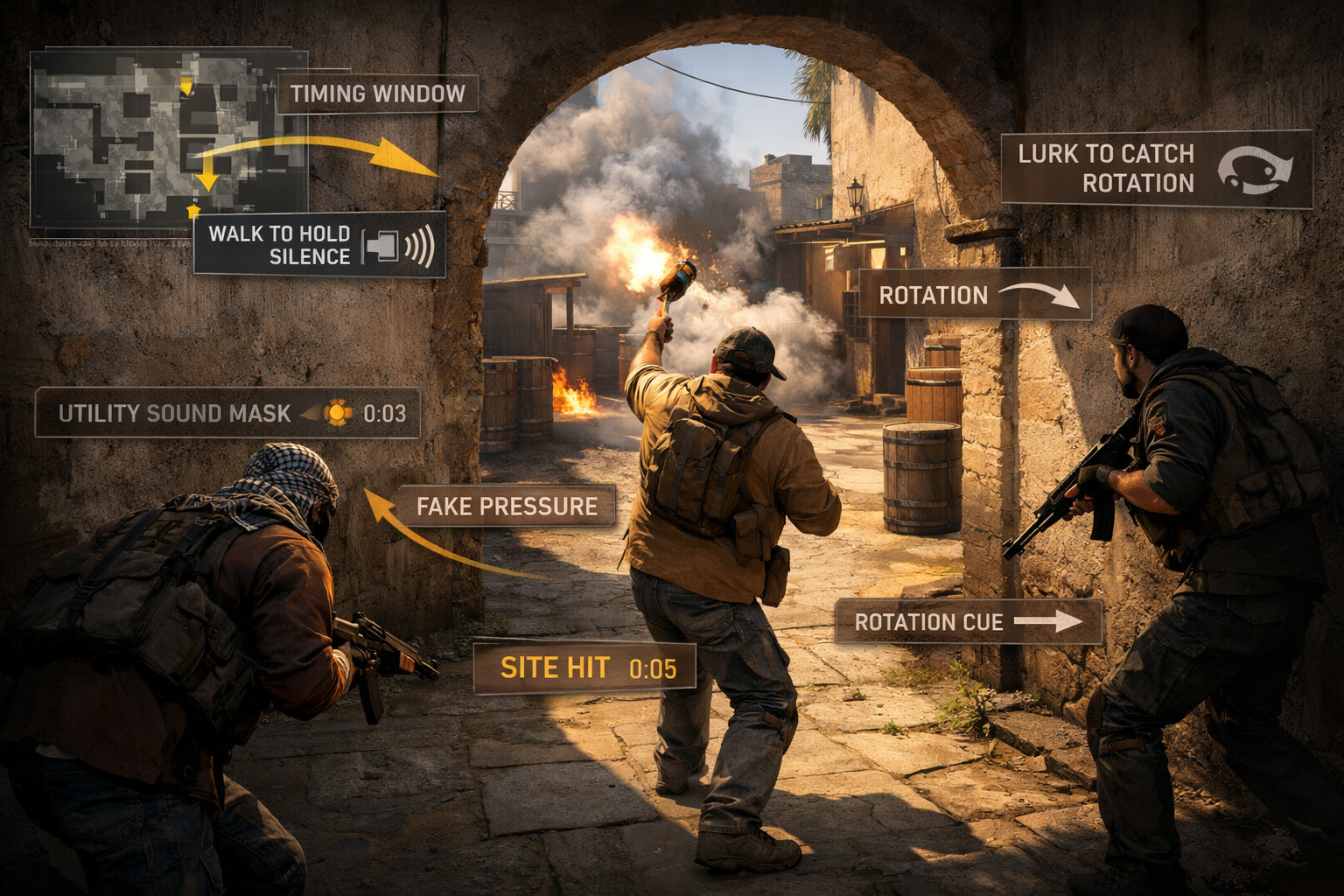
From that sound origin, what are the likely next routes? Strong players do not just hear where the enemy is. They hear where the enemy can be next. That is why audio awareness improves pre-aiming so much. You stop aiming at random and start aiming at the most logical arrival point.
3. Timing windows
Every sound cue creates a clock. If you hear steps in one area, how long until they can appear at another? If a smoke popped, how long until the likely swing? If a player dropped lower, how long until contact? Thinking in timing windows converts raw sound into proactive defense or proactive pressure.
This is one reason watching top-level matches is useful. On HLTV, you can follow elite teams and pay attention not only to crosshair placement and utility, but to how quickly players react to small sound cues. Their speed is not random. It comes from years of mapping sound to route and timing.
How to Listen Actively Instead of Passively
Most players hear passively. They notice loud sounds and miss the rest. Active listening is a deliberate process. You are always asking: what do I expect to hear here, what did I actually hear, and how does that change my decision?
A useful active-listening framework is:
- Expect: based on spawn, economy, previous rounds, and map tendencies, what sounds are likely?
- Capture: what exact sound cues occurred?
- Compare: what is missing or unusual?
- Interpret: what is the most likely enemy plan?
- Act: hold, rotate, use utility, pressure, or communicate
For example, imagine you are anchoring a site. You expected early pressure because the enemy has weak buy conditions and likes fast contact. Instead, you hear nothing for fifteen seconds, then one piece of utility elsewhere. That should immediately change your mental model. Maybe it is a default. Maybe the pressure is delayed. Maybe they are conditioning. Whatever the answer, your job is not to stay mentally frozen in your original expectation.
Active listening also means managing your own audio clutter. If your team comms are chaotic, music is on, or your focus is split, your ears may technically work but your decision quality drops. Great audio awareness is partly a mechanical hearing skill and partly an attention skill.
T Side Audio Awareness
T-side players often think of sound mainly as something to avoid giving away. That is only half true. Good T sides use sound both defensively and offensively. They deny information when needed, but they also gather information and weaponize sound to manipulate defenders.
Using sound to read defenses
As a T, you want to identify how defenders allocate resources. Utility thrown early can reveal likely anchors or support setups. A jump spot, a scoped rifle, a smoke extinguish timing, or a re-peek sound can all expose habits. Across several rounds, these habits become attackable patterns.
If defenders always use the same sound-heavy utility response to early pressure, you can bait it. If a site sounds unusually empty compared to earlier rounds, that can be a sign of rotation or deeper hold positions. If mid control is uncontested and quiet, you may gain map control with less utility and preserve your execute kit.
Contact rounds and controlled silence
Contact rounds are impossible without sound discipline. Controlled silence is not random slow play. It is organized restraint. Players must understand spacing, stop-start timings, and the point at which the first sound is acceptable. One careless footstep can ruin the whole idea.
But contact play is not just about staying quiet. It is about breaking silence at the right moment. The transition from quiet to explosive must be synced. If one player makes noise too early and the others are not ready, the defenders get time to react, reposition, and call support.
Masking movement with utility
One of the best ways to gain an information edge on T side is to move during louder, expected audio events. Flash pops, HE detonations, smoke bounces, and teammate spam can all cover movement cues. The goal is simple: make your important sound occur when the enemy is least able to isolate it.
This is particularly powerful when taking space after utility, not before it. Many players throw utility and then hesitate. Better players throw utility and immediately claim the confusion window it creates.
Lurking with audio logic
A strong lurker does not just sit quietly and hope. A strong lurker listens for rotation cues, site utility, and late-round panic. If the execute begins elsewhere, the lurker’s audio job is to detect who is moving, who is staying, and which route is now weak. The best lurks are often unlocked not by vision, but by sound.
CT Side Audio Awareness
On CT side, audio awareness is tightly linked to survival and rotation discipline. Defenders usually play with less freedom because they must cover multiple threats. That makes sound even more valuable. You often cannot afford a wide info peek, so audio becomes your safer path to confidence.
Anchoring with sound
As an anchor, your first responsibility is not to get a kill. It is to avoid losing the site for free. Sound helps you do that by telling you when to hold, when to use delay utility, when to call for help, and when to fall back into stronger positions.
Many anchors throw utility too early because they react emotionally to the first cue. Better anchors separate probe noise from commit noise. One step and one flash do not always justify your best delaying grenade. Hold your nerve. Listen for the follow-up pattern.
Support players and layered audio reads
If you are playing a support or rotator role, you should treat teammate sound information as incomplete but valuable. Your anchor may hear “multiple.” Your job is to combine that with your own map sounds, the minimap, and remaining utility to decide whether to rotate fully, lean, or hold against a fake.
Great CT rotations are rarely dramatic. They are measured. A one-step lean, a better anti-mid-round angle, or a temporary support smoke can be enough. Full rotations should usually come from accumulated evidence, not panic.
Info peeks after audio confirmation
Info peeks are strongest when audio has already narrowed the possibilities. If you hear movement but not a full commit, a quick peek may confirm numbers or utility presence. But the sound should guide the peek. Do not swing wide hoping the sound gives you a miracle. Use the sound to choose the correct moment and angle.
Post-Plant and Retake Audio Play
Some of the most decisive audio moments in CS2 happen after the bomb is planted. In post-plants, every sound becomes magnified because space is tighter and timing is shorter. The same is true for retakes.
For the post-plant side
If your team planted the bomb, your goal is to convert audio into tradeable fights. Listen for defuse taps, utility pin pulls, steps crossing choke points, and repositions after failed pressure. You do not always need to see the enemy first. Very often, hearing the tap or the approach sound is enough to trigger spam, utility, or a synchronized swing.
Discipline matters here. Many players panic the moment they hear the first tap. Sometimes that is correct. Sometimes the enemy wants exactly that. If you still have time, consider whether the sound is a bait attempt designed to drag you into crossfires.
For the retaking side
When retaking, audio helps you locate post-plant setups and isolate defenders. Listen for repositions after your first smoke lands. Listen for weapon swaps. Listen for the player who gets nervous and adjusts after hearing you approach. Many post-plant wins come from making one hidden player uncomfortable enough to reveal themselves with a tiny movement cue.
Also remember that silence can protect you on retakes. Not every retake must be loud. Sometimes the best way to win is to deny post-plant players the audio they need to line up easy utility and crosshair placement.
Sound Discipline and Information Denial
If hearing sound gives information, then denying sound protects information. Sound discipline is the defensive side of audio awareness. It is the skill of moving, grouping, holding, and taking space without giving the enemy unnecessary clarity.
Sound discipline includes:
- walking at correct timings
- avoiding accidental drops or ladder cues
- not over-adjusting when holding close angles
- syncing group movement so one player does not ruin the round
- stopping noise before reaching the danger zone, not inside it
The deeper truth is that sound discipline is not just about staying quiet. It is about deciding when noise is worth the cost. Sometimes speed is more valuable than silence. Sometimes a loud crunch into position is fine if the fight is already committed. The mistake is making noise without a purpose.
Ask yourself in each round: if I make this sound, what exact information am I donating? My location? My route? My number? My timing? My weapon? If the answer is “a lot,” then the movement probably needs to be cleaner.
How Players Fake, Bait, and Manipulate Sound
The better you get, the more you will face players who understand that your ears are a target. They know you want information, so they feed you selected information. This is where audio mind games begin.
Common sound manipulations
- single-player noise to suggest map pressure
- staged footsteps followed by instant silence
- utility used to sell an execute that never comes
- fake reloads or exaggerated movement to bait a swing
- late lurk steps timed with a main hit elsewhere
To avoid being manipulated, always ask: what does the enemy gain if I believe this sound literally? If the answer is “I rotate too early” or “I peek into a setup,” slow down. Use additional cues before committing to the read.
At the same time, you should learn to create these manipulations yourself. Strong teams control not only where they are, but what the enemy thinks they hear.
Turning Sound Cues Into Better Team Communication
A lot of useful sound information dies in bad comms. Players either say too little or too much. “B maybe” is vague. “They are all B” from one smoke bounce is dangerous. Good comms from audio should be precise, calm, and scaled to certainty.
Useful patterns include:
- Confirmed: “One close ladder.”
- Probable: “Multiple pressure A, not full commit yet.”
- Conditional: “Heard one rotate unless that was a fake.”
- Timing-based: “If they commit off this smoke, contact in three to five seconds.”
This style of communication gives teammates something to act on without pretending you know more than you do. It also improves your own thinking because saying the cue clearly forces you to process it clearly.
Try to avoid emotional comms like “they are everywhere” or “I hear so much.” Replace chaos with structure: number, area, action, confidence level. That is how sound becomes team advantage instead of personal stress.
Audio Settings, Hardware, and Environment
You do not need exotic gear to improve audio awareness, but you do need consistency. Reliable headphones, a stable volume level, and a low-noise environment matter more than chasing tiny hardware edges.
Some practical principles:
- use headphones you know well and keep them consistent
- avoid background music during serious ranked sessions
- keep voice comms clear but not so loud that they bury subtle cues
- do not constantly change your equalizer or sound processing setup
- test settings in repeatable scenarios, not only in live matches
The main goal is to reduce uncertainty. If your sound profile changes every week, your brain cannot build reliable pattern recognition. Better to use a good, stable setup than an endlessly optimized one you never fully learn.
Also remember that some players sabotage their own listening with fatigue. Long sessions, tilted mental state, and overloaded comms all make subtle cues harder to process. Rest and attention are part of audio performance.
Practice Drills to Improve Audio Awareness
Audio awareness improves fastest when trained intentionally. Do not just hope it gets better through volume of games. Use drills.
Drill 1: Cue labeling
In your next matches, verbally label every meaningful cue to yourself: step, jump, reload, utility, scope, plant, tap, rotate. This forces active listening and makes sounds easier to remember under pressure.
Drill 2: Sound-first holds
Play some defensive positions with a rule: do not peek until you hear a cue that justifies it. This teaches patience and helps break the habit of gambling for vision when sound already provides enough.
Drill 3: Demo pause predictions
Watch your own demo or a pro match. Pause after a sound cue and predict what should happen next. Then continue. This trains route logic and timing interpretation, not just hearing.
Drill 4: Silence awareness
For several games, focus specifically on missing sounds. Ask: what did I expect to hear that never happened? This is one of the quickest ways to grow from average game sense to better strategic listening.
Drill 5: Post-plant sound reaction
In clutch reviews, isolate every defuse-tap situation and ask whether your reaction was early, late, or correct. Post-plants are perfect training environments because audio decisions are frequent and clearly testable.
Common Audio Awareness Mistakes
Even good players lose rounds from predictable listening errors. Here are some of the biggest ones:
Overreacting to one cue
One sound should influence you, not control you. Do not rotate your whole round plan off a single weak clue.
Ignoring silence
If expected pressure never comes, that changes the equation. Many players fail because they keep playing the round they imagined, not the round that is happening.
Listening without context
Sound without timing, utility count, and map logic is incomplete. Train yourself to connect these layers.
Talking over the important moment
Teams often lose late rounds because someone gives a long speech when a tiny step or tap was the cue that mattered. Good comm discipline is part of good audio awareness.
Making unnecessary noise yourself
You cannot complain about missing enemy info if you constantly donate your own. Sound discipline and sound awareness grow together.
Evergreen Map Examples and Sound Patterns
Maps change over time, but the principles stay stable. Every CS2 map asks the same questions: where are the choke points, where do rotations compress, which vertical transitions produce loud commitment sounds, and where does silence create the most tension?
On maps with tight corridors and layered utility battles, footsteps and grenade timings often define early control. On maps with larger rotation lanes, delayed steps and route commitment become more valuable. On vertically expressive maps, drop and ladder sounds are gold because they compress the enemy’s future options. On open maps, one isolated sound may matter less than the sequence of multiple cues.
This is why studying map structure on resources like Liquipedia’s CS2 maps portal can still help your audio game. The more clearly you understand routes, timings, and likely setups, the more meaningful each sound becomes.
If you want simple examples to think about:
- tight apartments or hallway spaces reward precise footstep counting
- mid-control areas reward reading utility plus movement together
- vertical connectors reward attention to drops and ladders
- late-round bombsite retakes reward patience around taps and reposition sounds
The map names may vary in relevance over time, but those audio truths do not.
How to Review Your Own Audio Mistakes
If you are serious about improvement, do not only review aim duels. Review information errors. After a match, ask:
- What sound did I hear?
- What did I think it meant?
- What did it actually mean?
- Did I overreact, underreact, or communicate poorly?
- Was the problem hearing, interpretation, patience, or discipline?
This kind of review is powerful because it exposes hidden losses. Maybe your aim looked fine, but you took the duel from the wrong position because you misread a step pattern. Maybe you died on a rotate that was never needed. Maybe you lost a clutch because you talked through the tap cue. Those are audio errors, not crosshair errors.
When you identify a pattern, create one correction. Not ten. One. For example: “In the next session, I will stop fully rotating on first contact unless two more cues confirm it.” Small corrections compound fast.
A Simple Improvement Plan
If you want a practical path forward, use this four-step plan for the next two weeks:
- Week 1 focus: label sound categories in real time — footsteps, utility, reload, silence, rotate.
- Week 1 review: after each match, write down two rounds where sound changed the outcome.
- Week 2 focus: improve communication quality — number, area, action, confidence.
- Week 2 review: study three post-plant or retake rounds and judge your reaction timing.
Do not try to master everything at once. Audio awareness is a layered skill. First hear better. Then interpret better. Then communicate better. Then manipulate better.
If you stack those layers, you will notice something interesting: your aim seems to “improve” even if your raw mechanics barely changed. That happens because better information gives you cleaner fights. And cleaner fights always feel easier to win.
Final Thoughts
CS2 audio awareness is not a flashy skill, but it is one of the highest-value skills in the game. It does not disappear when your aim is off. It does not rely on perfect teammates. It works on eco rounds, gun rounds, defaults, executes, clutches, and retakes. It improves solo queue consistency and team structure at the same time.
If you remember only one thing from this guide, let it be this: do not treat sound as background detail. Treat it as a stream of tactical information. Every cue should answer a question, create a probability, or force a decision. Footsteps reveal route logic. Utility reveals intent. Reloads reveal vulnerability. Silence reveals altered risk. And your own discipline decides how much you reveal in return.
The players who master audio awareness are rarely surprised for long. They may not know everything, but they know enough, early enough, often enough to shape the round. That is the real information advantage. And in Counter-Strike, information advantage is one of the cleanest paths to more consistent wins.
So lower the clutter, sharpen the listening habit, communicate with more precision, and start reviewing rounds for information mistakes instead of only aim mistakes. Once you do, CS2 becomes easier to read, calmer to play, and much more controllable from round to round.