



LoL Objective Stealing & Smite Fighting Guide 2026
Objective Stealing and Smite Fighting Guide in LoL 2026
Objective control is one of the biggest separators between average LoL players and players who consistently climb. Mechanics matter. Champion mastery matters. But when a game swings on Baron, dragon soul, Rift Herald, Elder, or an early neutral fight that reshapes the map, the team that understands how objectives are really won often beats the team with better hands. That is why objective stealing and Smite fighting are such important skills. They are not just “highlight plays.” They are repeatable, learnable macro situations that decide ranked games every day.
Most players think an objective steal is luck. They see a jungler jump in, press Smite at the perfect moment, and assume the whole play was just nerves and coinflip timing. In reality, the best steals are built well before the last hit. The same is true for Smite fights. Good players do not simply trust reflexes. They manipulate vision, wave state, entrance control, burst order, objective health pace, and enemy attention until the final secure becomes easier than it looks.
This guide is built to stay useful over time. Instead of relying on patch-fragile numbers, it focuses on principles that remain valuable even when Riot adjusts map flow, objective durability, rewards, or jungle systems. The exact stats of epic monsters may change from season to season, but the foundations of objective control remain the same: information, access, tempo, coordination, threat layering, and decision quality.
If you want to improve your overall ranked consistency, objective control is one of the highest-leverage areas to study. It teaches you when to start, when to stop, when to turn, when to zone, when to hide burst, when to threaten a steal, and when to trade cross-map instead of forcing a losing contest. That knowledge improves every role, not just jungle.
For players who want more structured improvement around ranked progression and macro decision-making, you can also check Boosteria’s LoL boosting prices. For official game overviews and Riot’s broader objective philosophy, useful references include the LoL How to Play page, Riot’s 2026 gameplay preview, and Riot’s objective tuning notes.
Table of Contents
- 1. What Objective Stealing Really Means
- 2. Why Smite Fights Are Misunderstood
- 3. Understanding the Objective Ecosystem
- 4. The Setup Before Spawn
- 5. Vision Control and Information Warfare
- 6. Lane Priority and Wave Pressure
- 7. How to Start Objectives Correctly
- 8. How to Steal Objectives Reliably
- 9. How to Secure Objectives and Prevent Steals
- 10. Burst Combos and Smite Sync
- 11. Role-by-Role Objective Responsibilities
- 12. Turn or Finish? The Core Objective Question
- 13. Common Objective Mistakes
- 14. Practice Routine for Better Smite Fighting
- 15. Advanced Mindset for Comebacks and Pressure
- 16. FAQ
- 17. Final Thoughts
1. What Objective Stealing Really Means
An objective steal is not just taking Baron or dragon with a last hit. It is any situation where the team that does not control the area still finds a way to claim the objective. That can happen through a literal Smite steal, a spell-plus-Smite burst, a non-jungler execute, a zoning mistake by the enemy, or a turn that pulls the enemy jungler away from the objective window.
In the broadest sense, objective stealing is about breaking control. One team tries to create a safe, predictable secure. The other team tries to introduce chaos, uncertainty, split attention, and timing disruption. The side that wins is not always the side with better mechanics. It is often the side that better controls the decision environment.
That is why steal attempts are powerful even when they fail. A good steal threat can force the enemy team to stop damage, turn prematurely, burn cooldowns awkwardly, reveal key abilities, or pull players away from zoning duties. Sometimes the “steal” is successful because you made the enemy stop trusting their own setup.
If you understand this, your mindset changes immediately. You stop asking, “Can I coinflip this?” and start asking, “How do I make their secure uncomfortable?” That is the real skill.
2. Why Smite Fights Are Misunderstood
Most players imagine a Smite fight as a reaction duel between two junglers staring at objective health. That image is incomplete. A true Smite fight begins earlier, usually with one or more of these questions:
- Who has lane priority around the river?
- Who controls the most reliable entrances to the pit?
- Who can hide burst damage?
- Who has the better objective damage pacing?
- Who is forced to tank the objective and lose health?
- Who can threaten the enemy jungler’s positioning?
- Who must walk through fog to contest?
- Whose key cooldowns are already missing?
By the time the monster reaches low health, the outcome is often already heavily influenced by those earlier factors. A jungler with no vision, no nearby frontline, no Flash, and no access angle is not taking a fair Smite duel. A jungler whose team controls all entrances and can pair Smite with reliable burst is not taking a fair duel either. The “50/50” label is often wrong. Many supposed 50/50s are actually 70/30 or 80/20 situations created by superior setup.
The best junglers hate unnecessary coinflips. They do not brag about stealing when they could have prevented the risk entirely. At higher levels, objective mastery is often less about clutch Smite moments and more about building objective states where the final hit feels boring.
3. Understanding the Objective Ecosystem
To fight well around objectives, you need to understand what each objective asks from the map. In League, not every epic monster creates the same type of contest. Their location, timing, durability, reward type, and map consequences all change how teams should approach them.
Early Objectives
Early objectives usually test preparation more than brute force. Whether the season emphasizes early void objectives, Herald value, or first dragon pressure, the core themes stay the same: lane priority matters more because teams have fewer completed items, death timers are shorter, and tempo swings are often about wave control and recall timing rather than full map collapse.
Early objective fights are also where many players overforce. They see a neutral spawn and assume they must contest. That is not always true. If your lanes are shoved in, your bot lane has no summoners, and your mid cannot move first, walking into river may give the enemy objective and kills. Sometimes the best “objective play” is to recognize that the setup is lost and make a better trade elsewhere.
Mid-Game Objectives
Mid-game objective fights are more complex because rotations are faster and side lanes become more important. Teams have enough damage to burn objectives more quickly, enough burst to threaten combo-secures, and enough crowd control to punish facechecks. This is the stage where most Baron throws happen, most dragon soul setups are decided, and most bad turn-or-finish calls ruin games.
Late Objectives
Late-game Baron, Elder, or soul-point contests magnify every mistake. The reward is so high that teams will accept much higher risk, which means objective pits become pressure cookers. In these moments, discipline beats ego. The team that keeps track of entry angles, cooldowns, and damage windows usually wins. The team that panics often hands the objective over.
One useful evergreen rule is this: the more decisive the objective reward, the more important zoning and layered burst become. Late objectives should almost never be secured with random health pacing and unplanned last hits.
4. The Setup Before Spawn
Objective fights are won before the monster appears. If you only start thinking about Baron or dragon when it spawns, you are already late. Good teams spend the previous minute shaping the map.
Reset Timing
The first part of setup is recalling at the correct time. If you recall too late, you return to the map after the objective has already been started. If you do not recall at all, you may arrive without health, mana, wards, or items. The ideal reset gives you enough time to buy, refill wards, and move into the river before the enemy can establish control.
Many low- and mid-elo teams lose objectives simply because they stagger recalls. One player bases 50 seconds before spawn, another 20 seconds before spawn, another stays for one more wave, and suddenly the team never arrives together. A “bad Smite fight” often started as a “bad recall pattern.”
Map Assignment
Before an objective, every role should know where it belongs. Who catches side wave? Who hovers mid? Who moves first into river? Who protects the flank? Who places the deep ward? Who saves teleport angle or engage flank? Without assignment, teams drift. Drift leads to facechecks, and facechecks lead to free setups for the enemy.
Health and Summoner Readiness
Never treat all contests equally. If your frontline is at half health, your support has no control wards, your mid has no mana, and your jungler has no Flash, the value of contesting drops sharply. Likewise, if the enemy is chunked or missing a key cooldown, your willingness to force can increase.
Strong objective teams treat health, summoners, and cooldowns as part of the objective itself. They understand that Baron is not only the monster in the pit. Baron is also the state of everyone standing around it.
5. Vision Control and Information Warfare
Vision is the language of objectives. It determines who sees the start, who sees the approach, who can hide burst, and who must guess. But good vision control is not just about putting wards down. It is about building a picture of possible movement.
Control the Entrances, Not Just the Pit
Many players over-focus on warding directly inside the objective pit. That matters, but it is not enough. Most steals do not happen because nobody saw the objective health. They happen because the enemy was allowed to approach the pit from an angle that was not controlled. If you only ward Baron itself but do not track jungle ramps, river brushes, blast cone routes, and side access, you are not really safe.
Denying Vision vs. Creating False Safety
When a team clears vision, it creates uncertainty. That uncertainty pressures the other team into checking. But it can also create false confidence for the team on the objective. They may assume the enemy is too far away or has no angle, when in reality the enemy is already setting up a steal path through fog.
The best objective teams combine denial with active information gathering. They do not just remove wards; they also track likely positions. If the enemy jungler disappeared 10 seconds ago and your team has not accounted for blast cone, flank brush, or over-wall movement, then your objective secure is not solved.
Vision as Tempo
Vision buys time. If you see the enemy early, you get a bigger decision window. You can stop damage, turn, reposition, or finish. If you see the enemy late, all those decisions compress into panic. That is why even a single well-placed ward can matter more than a few seconds of extra objective damage.
6. Lane Priority and Wave Pressure
One of the most underrated objective concepts in solo queue is that lane pressure creates objective pressure. Teams talk about Baron like it exists separately from waves. It does not. Waves decide who can move first, who loses farm by roaming, and who must reveal on side lane when the objective is live.
Why Priority Matters
If your mid and side waves are pushed, the enemy must answer or concede space. That makes your objective setup easier because their windows to contest become narrower. If your lanes are crashing into you, then walking into river means choosing between losing waves and risking a bad fight.
This is especially important for steals. If you are behind and want a chance to steal Baron, pushing at least one wave beforehand can force the enemy into a harder choice. Do they rush Baron and risk a delayed reset? Do they send someone to answer? Do they start with incomplete numbers? Every bit of wave pressure makes the objective state messier for the team in control.
Side Lane Pressure Before Baron
Baron control becomes much stronger when one side lane is already in a favorable state. If your team has side pressure, the enemy cannot comfortably commit all five players to the pit for long. Someone must answer the wave or at least threaten the answer. That creates cracks in their formation, and cracks are what steals feed on.
Dragon and Mid Priority
Dragon setups are often decided by mid push and bot movement. If your mid can move first, your support can walk into river more safely. If your support can enter first, your wards survive longer. If your wards survive longer, your jungler gets better objective information. Everything connects.
7. How to Start Objectives Correctly
Not every objective should be started just because it is available. Good teams ask three questions before hitting the monster:
- Can we finish before the enemy fully arrives?
- Can we turn if they contest?
- Can we prevent a clean access path for the enemy jungler?
If the answer to all three is no, the start is usually bad. Starting an objective without a plan is one of the fastest ways to lose both the monster and the fight.
Fast Burn vs. Slow Burn
Some teams should burst objectives quickly. Others should burn slowly while watching for turn angles. Fast burn is good when you have strong secure, clear numbers advantage, or visible enemy positions on the far side of the map. Slow burn is better when the enemy is nearby and you need flexibility. The mistake is doing the worst version of both: starting fast with no secure plan, then hesitating too late when the enemy arrives.
Tank Management
Who tanks the objective matters. If your jungler tanks Baron too long and gets chunked, your Smite fight becomes weaker. If your frontline loses too much health to dragon before the enemy arrives, they may not be able to hold the choke. Smart teams rotate tanking, kite the monster correctly, and keep the jungler healthy enough to survive a contest.
Objective Health Pace
Watch how quickly the monster is losing health. This sounds obvious, but many players do not actively manage pace. If the enemy jungler is approaching and the objective is still too healthy to burst before contact, you may need to stop or turn. If the monster is falling at a controlled pace and your burst tools are ready, you may keep going. Pacing is not random. It is a strategic choice.
8. How to Steal Objectives Reliably
Stealing reliably does not mean succeeding every time. It means building the highest percentage attempt from a losing position. That starts with a question: what is the easiest way to disrupt the secure?
Do Not Enter Too Early
A classic mistake is showing too soon. The moment you reveal your approach, the enemy can stop damage and turn. A good steal attempt often stays hidden as long as possible. If you are the jungler, patience matters. Let the enemy commit deeper. Let the objective reach a more vulnerable threshold. Let their zoning formation stretch.
Use Multiple Threat Angles
The best steal attempts are not solo efforts. One player threatens the pit, another threatens a flank, another pokes from outside, another pressures a choke. The goal is not always to deal damage. The goal is to divide attention. If the enemy must track three threats at once, their secure discipline weakens.
Threaten the Enemy Jungler
Many steals happen because the defending team focuses too hard on the objective and forgets the opposing Smite. Your job as the team contesting is to make the enemy jungler uncomfortable. Knock them away. Burst them. zone them. force them to kite. Even a half-second of hesitation changes everything.
Think in Thresholds
Elite objective players do not just stare at the current health number. They think in secure thresholds. At what health can the enemy pair Smite with an ability? At what health can you pair Smite with your own burst? At what health does the objective become vulnerable to a non-jungler execute or a long-range spell? Once you think in thresholds, your timing becomes much cleaner.
Save Your Mobility Until It Matters
If your champion has a dash, Flash, leap, tunnel, or wall-hop, do not waste it too early unless using it earlier creates a safer angle. Many failed steals happen because the jungler uses mobility to enter vision, gets displaced, and never reaches the secure window. You often want your final movement tool for the last layer of access.
Know When a Steal Attempt Is Better Than a Full Fight
Sometimes your team cannot win a front-to-back teamfight but can still threaten a steal. In that situation, your goal is not to force 5v5 heroics. Your goal is to create just enough disorder for one window. If you get Baron and lose two players, that may still be worth it. If you fail the steal but also give over four kills, the attempt was probably mismanaged.
9. How to Secure Objectives and Prevent Steals
Preventing steals is the other half of objective mastery. If your team gets leads but repeatedly loses Baron or dragon, your problem is not mechanics. It is objective discipline.
Assign Zoning Jobs Clearly
One of the biggest solo queue failures is that everyone hits the objective. That looks efficient, but it is often wrong. Usually, some players should damage the monster while others control the entrances. If five people are in the pit, nobody is truly zoning. The enemy jungler then gets a free path to the secure window.
Do Not Burst Randomly
Random burst is one of the main causes of lost objectives. If three damage spells land unexpectedly at different times, the health bar becomes chaotic and your Smite timing gets worse. Good teams either burn steadily or communicate the burst combo clearly. The last seconds should feel intentional, not messy.
Track Enemy Summoners and Access Tools
If the enemy jungler has Flash, blast cone access, or a wall-hop, your anti-steal setup must reflect that. If they do not, your team can zone more confidently. Objective security is about respecting what the enemy can still do, not what you wish they could not do.
Pulling the Objective
Sometimes repositioning Baron or dragon within the pit changes the steal angle dramatically. Small positional differences can make it harder for the enemy to reach the correct Smite range, harder for them to land a combo spell, or easier for your team to body-block and crowd-control them. Objective positioning is often overlooked, but it matters.
Stop Hitting When Necessary
Many teams lose objectives because they refuse to stop damage for one second. If the enemy jungler is about to enter and your zoning line has failed, continuing to hit can create a pure coinflip. Stopping, turning, or forcing the enemy back out may raise your secure chance immediately. Good teams understand that “not hitting” can be the best objective damage decision.
10. Burst Combos and Smite Sync
One of the cleanest ways to secure objectives is to combine Smite with a high-confidence burst spell. This is far better than relying on Smite alone whenever your composition allows it.
Why Smite Plus Burst Is Strong
Smite by itself is visible and expected. Smite plus champion damage compresses the health window. That gives the enemy less time to react and makes outside steals harder. The best burst-secures come from reliable, instant, or nearly instant damage sources that are easy to count on under pressure.
Sync, Don’t Layer Too Early
The purpose of a combo-secure is not to dump damage near the end and hope it lines up. It is to sync damage into one controlled window. If your key ability lands too early, you may simply bring the objective into the enemy Smite range. Timing discipline matters more than raw damage amount.
Be Aware of Enemy Burst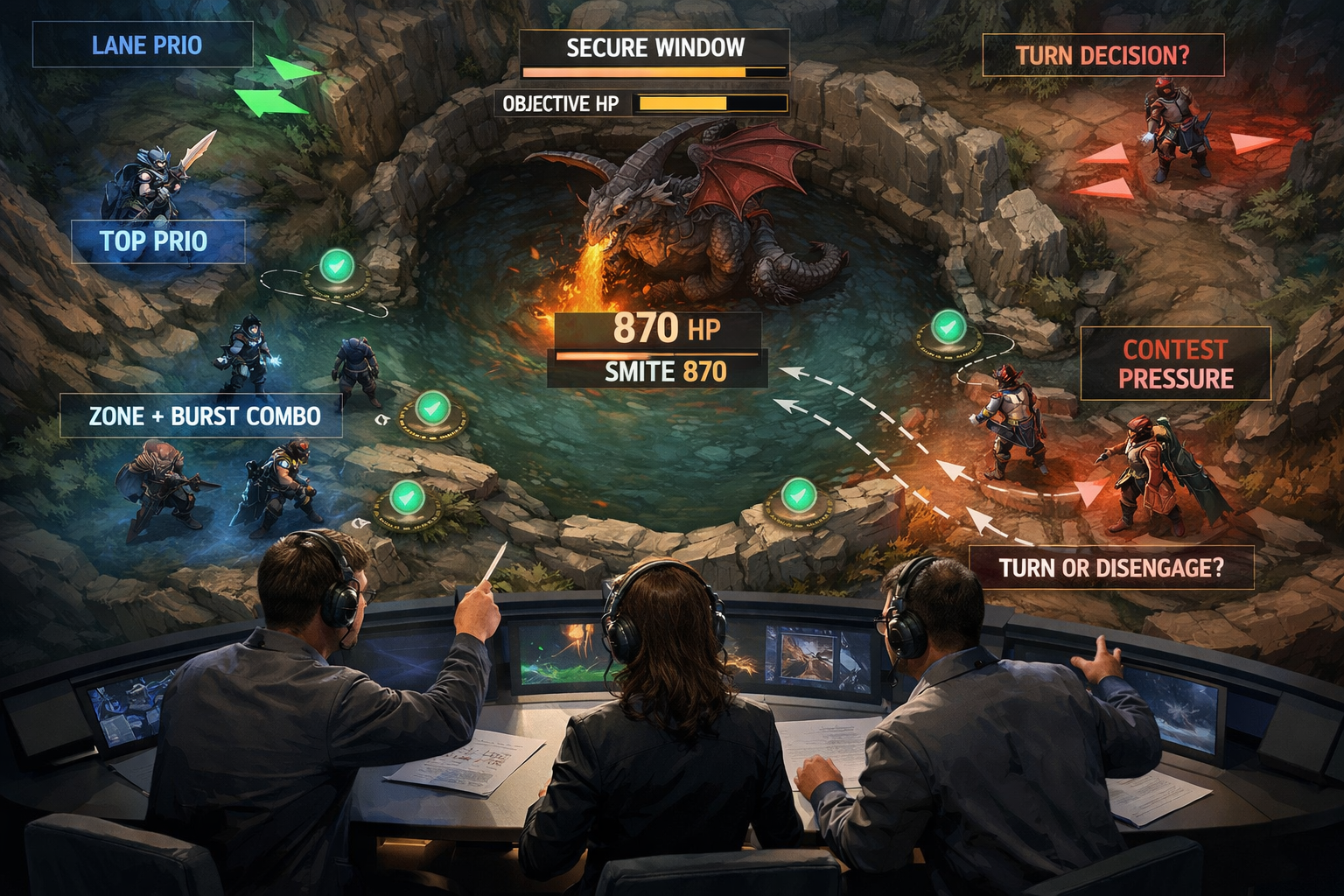
Objective security is not only about your burst. It is also about theirs. If the enemy has an execute, a high-damage spell, or multiple sources that can spike the health bar quickly, you must respect the possibility of an unexpected drop. Teams that ignore enemy burst often blame Smite when the real issue was health unpredictability.
Practice Your Personal Secure Pattern
Every jungler player should know their own cleanest secure sequence on their main champions. You want that sequence to feel automatic under pressure. If you have to “figure it out live” every time, your timing will always be weaker than it could be.
11. Role-by-Role Objective Responsibilities
Jungle
The jungler is the center of objective security, but not the sole owner of objective success. Your job is not just to Smite. Your responsibilities include tracking spawn timers, identifying when lanes can move, keeping your health stable, calling when to burst or stop, and recognizing whether the contest is favorable. A good jungler also understands when not to start.
When contesting, the jungler must think about pathing and threat concealment. When securing, the jungler must think about health thresholds and enemy access. In both cases, staying mentally calm matters as much as finger speed.
Support
Support often decides whether objective setups are comfortable or chaotic. Vision denial, control wards, river entry timing, and peel for the jungler all sit heavily on support play. A support who over-chases before Baron can lose the setup. A support who anchors the choke perfectly can make the objective trivial.
Mid Lane
Mid controls access through push, poke, burst threat, and fast rotation. Mid laners should constantly think about whether they can move first and whether their damage should go into the objective, the choke, or the enemy jungler. Many objectives are won because the mid laner pressured the opponent off the entrance before the monster got low.
Top Lane
Top laners provide frontline structure, flank pressure, side wave leverage, and turn threat. A strong top laner around Baron can make the enemy team feel trapped between contesting the pit and respecting a fight. If you are top lane, do not assume your role is simply “hit whoever is near.” Around objectives, your body position changes the entire geometry of the fight.
ADC
ADC objective damage is often huge, but that does not mean your only job is auto-attacking the monster. Sometimes the correct play is to hold a better angle, keep safer spacing, or save damage for the turn. Dying for one more auto before Baron secure is one of the most common carry mistakes in solo queue.
12. Turn or Finish? The Core Objective Question
This is the most important objective decision in LoL: do you finish the monster, or do you turn and fight?
There is no single universal answer, but there are reliable guidelines.
Finish When:
- The enemy jungler is dead, far away, or clearly zoned.
- Your burst-secure is ready and coordinated.
- The objective is already within a safe secure threshold.
- The enemy team has poor access and no strong contest tool.
- The fight after securing would still be favorable.
Turn When:
- The enemy jungler is close and uncontested.
- Your team’s damage pacing has become messy.
- The enemy carries are grouped in a punishable choke.
- Your composition prefers fighting in the entrance over flipping the objective.
- Your frontline or jungler is too low to trust the secure.
The biggest error is indecision. Teams that half-turn and half-finish often do the worst version of both. If the call is to turn, turn together. If the call is to finish, commit the secure sequence clearly.
13. Common Objective Mistakes
Calling Every Contest a 50/50
This mindset hides the real problem. Most bad objective situations were made earlier by weak setup, poor zoning, bad wave management, or inconsistent burst timing.
Starting with No Lane Priority
If your lanes cannot move, starting a major objective often invites a collapse. You may still do it as a force play, but you must recognize the risk honestly.
Everyone Hitting, Nobody Zoning
This is one of the most common causes of stolen objectives. Damage alone is not control.
Using Key Cooldowns Too Early
Blowing crowd control or mobility before the enemy jungler actually commits can open the door for the steal you were trying to prevent.
Panicking at Low Health
Players often rush their Smite because the monster suddenly becomes emotionally “urgent.” Calm tracking beats panic timing almost every time.
Forgetting Cross-Map Trades
Not every objective should be contested. If the enemy has first move, stronger setup, and better fight tools, trading side waves, towers, camps, or vision reset may be the smarter line.
14. Practice Routine for Better Smite Fighting
Objective control improves fastest when you train it deliberately instead of hoping ranked games teach it passively.
Review Your Replays
After each lost Baron or dragon, ask:
- When did we last have time to reset properly?
- Did we have lane priority?
- Who was zoning the enemy jungler?
- Was our objective health pacing controlled?
- Did we know enemy access tools?
- Should we have turned instead of finishing?
If you answer those questions honestly, many “mechanical” problems reveal themselves as macro problems.
Practice Secure Sequences
In practice environments or even mentally between games, rehearse your main champions’ secure patterns. Know your preferred spell order. Know which abilities you should hold. Know whether your burst is front-loaded or delayed. Familiarity reduces panic.
Study Entry Angles
Pay attention to the common routes enemy junglers use to contest Baron and dragon. The more familiar you are with those routes, the faster you will recognize when they are available and when they are covered.
Communicate Earlier
Even in solo queue, simple pings used early are powerful. Ping the objective timer. Ping your reset. Ping the enemy Flash. Ping whether to turn or finish. Last-second communication is much weaker than 20-second communication.
15. Advanced Mindset for Comebacks and Pressure
Objective steals are often comeback tools. That means your emotional approach matters. When behind, many teams become desperate and show too early, force too hard, or run into dark river without a plan. Smart comeback teams stay patient. They accept that their chance may be only one moment, and they keep the map stable until that moment appears.
On the other side, winning teams often become arrogant. They assume the objective belongs to them because they are ahead. That mindset causes the exact mistakes steals punish: lazy zoning, bad spacing, random burst, and poor respect for fog.
If you want elite objective discipline, think like this:
- No objective is free until it is secured.
- No steal is impossible if access still exists.
- No Smite fight is isolated from the map state around it.
- No lead is safe if your team loses structure at the pit.
This mindset keeps you sharp whether you are ahead or behind.
Pressure Without Starting
One advanced concept is using objective threat without fully committing to the objective. Sometimes Baron pressure is stronger than Baron itself. If your team can force facechecks, pull enemies out of side lanes, and create bad recalls, you may gain more by threatening Baron than by flipping it immediately.
The same applies to dragon soul points. Walking into river, controlling vision, and forcing the enemy to respond can create picks or summoner advantages before the objective is even started. The best teams understand that objectives are not only rewards. They are also tools for creating favorable fights.
Understanding Enemy Psychology
Teams under pressure often behave predictably. Some panic-rush the objective. Some always turn too early. Some tunnel on the enemy jungler and forget carries. Some refuse to stop damage no matter what. If you can read that pattern, your steal attempts and anti-steal setups become much stronger.
For example, if an enemy team always hard-focuses the objective once it falls low, you can time a delayed entry to exploit their tunnel vision. If they always stop hitting too early, you can pressure the choke to make them lose time and sometimes lose the objective entirely.
Tempo After the Objective
One often ignored question is what happens after the objective. Good players do not only ask, “Can we get Baron?” They ask, “What happens if we get Baron and lose three people?” or “If we steal dragon but lose the fight, is that still worth it?” These follow-up judgments matter because objective value is contextual.
Sometimes a desperate Baron steal that buys time for scaling is game-saving. Sometimes a soul steal is huge even if two teammates die. Sometimes a low-value early objective is not worth contesting if it ruins your lanes and recall rhythm. Objective mastery means valuing the whole sequence, not just the last hit.
16. FAQ
Should I always try to contest Baron if I have Smite?
No. Sometimes the access is too bad, your team is too far, or the enemy setup is too clean. A low-percentage contest that also gets your team wiped can lose the game instantly. Contest when you can create real pressure, not just because the objective exists.
How do I stop calling everything a 50/50?
Review the setup earlier in the sequence. Ask who had vision, who had lane priority, who had burst sync, and who had zoning control. Once you start seeing those layers, most “50/50s” will stop feeling random.
Is stealing mostly a jungler skill?
No. Jungle is central, but steals are heavily influenced by support vision, mid pressure, top flank presence, ADC objective pacing, and team coordination. Likewise, preventing steals is a full-team responsibility.
What is more important: hitting the objective or zoning?
That depends on the situation, but in many games zoning is more valuable than one extra damage source on the monster. If the enemy jungler cannot enter, your secure becomes much easier.
What should I focus on first if I keep losing Smite fights?
Start with setup, not timing. Improve resets, vision control, entrance coverage, and burst coordination. Pure Smite mechanics matter, but macro cleanup usually gives the biggest improvement first.
17. Final Thoughts
Objective stealing and Smite fighting are some of the most dramatic moments in LoL, but they are not magic. They are the result of structure. The team that wins those moments most consistently is usually the team that understands the hidden work around them: wave control, vision, entry denial, tank management, burst sync, map pressure, and disciplined decision-making.
If you are a jungler, stop thinking of Smite as a last-second mini-game. Think of it as the final piece of a longer macro puzzle. If you are a laner, stop assuming objective control is somebody else’s job. Your push timing, warding, body positioning, and damage discipline all shape whether an objective is secure or stealable.
The goal is not to become a montage player who prays for miracle steals. The goal is to become the kind of player who understands why the moment exists in the first place. Once you learn that, you will not only steal more objectives. You will also give away far fewer of your own.
Study the setup. Respect the entrances. Track the health pace. Control the burst window. And whenever possible, make the final Smite boring. That is what real objective mastery looks like.