



Valorant Agent Role Mastery Guide 2026: Play Every Role Better
Valorant Agent Role Mastery Guide 2026: Duelist, Controller, Initiator and Sentinel
Role mastery is one of the biggest separators between players who simply queue games and players who climb with purpose. In Valorant, raw aim matters, but clean decision-making around roles matters just as much. A mechanically gifted player who does not understand when to create space, when to hold utility, when to deny a lane, or when to anchor patiently will often lose rounds that were very winnable. On the other hand, a player with solid fundamentals and sharp role discipline can create far more value than their scoreboard suggests.
This guide is built to be as timeless as possible. Instead of relying on short-lived balance trends or one-patch gimmicks, it focuses on role principles that remain valuable across patches, agent releases, and map rotations. Whether you are a solo queue grinder trying to rank up, a duo looking for better synergy, or a five-stack trying to tighten structure, this guide will help you understand what each role should actually do and how the four core role families fit together.
For official agent pages and role assignments, you can always check Riot’s Valorant Agents page. For map layouts and current map references, Riot’s official maps page is also useful. If your goal is not just knowledge but faster rank progress, you can also explore Valorant boosting prices as an additional option alongside practice and coaching.
Table of Contents
- Why Role Mastery Matters
- How the Four Roles Fit Together
- Duelist Mastery
- Controller Mastery
- Initiator Mastery
- Sentinel Mastery
- How Roles Interact During a Round
- Role Mastery in Solo Queue
- How to Build Your Agent Pool
- How to Review Your Own Gameplay by Role
- Best Practice Drills for Each Role
- Most Common Ranked Mistakes by Role
- FAQ
- Conclusion
Why Role Mastery Matters
A lot of players think role mastery means memorizing an agent’s lineups, combo tricks, or highlight-reel mechanics. Those things can help, but they are not the foundation. Role mastery starts with understanding responsibility. Your role tells you what kind of value your team expects from you in neutral situations, during site hits, while defending, during retakes, and in clutch moments.
A Duelist is not just “the fragger.” A Controller is not just “the smoker.” An Initiator is not just “the recon player.” A Sentinel is not just “the trap character.” Those are shallow labels. In real matches, a Duelist converts pressure into space, a Controller changes the shape of fights, an Initiator gathers or forces information, and a Sentinel stabilizes territory while protecting the team’s weak points. Once you understand roles at that deeper level, you stop making random plays and start making useful plays.
Role mastery also improves communication. Teams fall apart when players use the same words but mean different things. If your Duelist says “I’m going in,” your Initiator should already understand whether that means flashing close, droning first, clearing a common angle, or setting up a trade. If your Controller says “wait for my smoke,” your Duelist should know that the timing window matters more than dry peeking early. Good teams look coordinated because they share role expectations. Even in solo queue, knowing those expectations helps you read what your teammates need without long explanations.
The final reason role mastery matters is consistency. Mechanics fluctuate from day to day. Confidence fluctuates from match to match. But clear role fundamentals travel well. A player who knows how to deny flanks, trade entries, time utility, hold space, and play post-plant correctly will still be useful on bad aim days. That is why role discipline is one of the safest ways to improve long term.
How the Four Roles Fit Together
Before going role by role, it helps to understand the big picture. The four role families are designed to solve different tactical problems in a round.
- Duelist: Converts pressure into immediate space and first-contact threat.
- Controller: Blocks vision, splits sightlines, and changes the geometry of the fight.
- Initiator: Gains information, clears dangerous zones, and helps teammates enter or retake.
- Sentinel: Secures flanks, anchors sites, punishes overextension, and buys time.
Think of a clean site hit. The Controller removes critical sightlines. The Initiator reveals or displaces defenders. The Duelist takes the first step in and demands attention. The Sentinel either secures the map behind the hit or transitions into post-plant control. When a round looks smooth, each role solves a different problem at the right time.
Problems appear when roles blur at the wrong moment. If the Duelist waits forever for someone else to create contact, the push stalls. If the Controller smokes too early, defenders wait them out. If the Initiator dumps all utility without follow-up, nothing is gained. If the Sentinel abandons flank control at the wrong time, the round collapses from behind. In ranked, many lost rounds are not about being out-aimed. They are about role timing being misused.
Another important truth: no role is “easy” in serious play. Some roles are more forgiving in low ranks, but all four become demanding as lobbies get smarter. Duelists must judge risk and entry timing. Controllers must think ahead and survive long enough to matter. Initiators must coordinate utility with real purpose. Sentinels must constantly read the pace of the round. Choose the role that suits your strengths, but respect all of them.
Duelist Mastery
The True Job of a Duelist
The Duelist’s job is to create pressure that forces defenders to react. Sometimes that means getting the first kill. Sometimes it means dashing in, drawing crosshairs, and enabling trades. Sometimes it means threatening a lane so hard that defenders must reposition. The core idea is this: Duelists are built to take first contact with better odds than other roles. Their kits are designed to help them survive aggression, force movement, or isolate fights.
Too many Duelist players misunderstand this and play for highlight clips instead of winning space. A Duelist who farms exit kills but never enters is not doing the job. A Duelist who lurks every round while the team stares at a smoke wall is often dodging responsibility. Fragging matters, but role fulfillment comes first. When you play Duelist well, your team gets room to breathe.
Attack-Side Duelist Fundamentals
On attack, a Duelist should think in terms of pressure windows. You are strongest when the enemy is divided, blind, stunned, revealed, smoked off, or worried about multiple angles at once. You are weakest when you dry swing first into prepared crossfires without support.
Your pre-entry checklist should be simple:
- Do I know which angle is most dangerous?
- Has my Initiator cleared or pressured that area?
- Are the important sightlines smoked?
- Can my teammates trade me if I go in?
- Am I entering for space, for a duel, or to force rotation?
Notice that “Can I top frag?” is not on the list. The point is not ego. The point is functional impact. Your first entry should either secure a kill, draw multiple defenders into bad crosshair placement, or force defenders off a critical position. If none of those things happen, your entry was probably mistimed or unsupported.
Duelists also need to understand the difference between fast pressure and reckless pressure. Fast pressure happens when your team is ready to capitalize. Reckless pressure happens when you explode into a site before smokes land or before utility clears the close corners. The difference is often less than two seconds, which is why good Duelists constantly sync with their team.
Defense-Side Duelist Fundamentals
On defense, Duelists are often used for early pressure, contesting key lanes, or making attackers uncomfortable before the execute starts. That does not mean you must push every round. Good defensive Duelist play is selective. You challenge when the map, economy, spawn timing, or utility pattern gives you a high-value opportunity.
There are four strong defensive Duelist patterns:
- Early contest: Challenge a contested lane before attackers settle into a default.
- Anti-rush stall into reposition: Fight briefly, then escape to force attackers into a slowed execute.
- Mid-round flank timing: Reclaim space once the enemy commits utility elsewhere.
- Retake spearhead: Be the first body creating momentum in the retake.
The biggest mistake on defense is confusing “playmaker” with “coin flip.” If you swing alone into five players and die with no information traded back, you did not create value. A good Duelist pressure play either gets a pick, confirms presence, burns enemy utility, or delays the hit enough for your teammates to rotate.
How Great Duelists Think
The best Duelists are not just mechanically explosive. They are excellent readers of space. They know when a defender is likely isolated. They sense when a smoke creates a one-second off-angle timing. They understand that creating panic is often as valuable as getting a kill.
They also know when not to be first. If your Initiator has already tagged multiple defenders and your teammate has a stronger angle to punish, forcing yourself into the first peek can actually ruin the round. Duelist does not mean brainless speed. It means intelligent pressure.
Common Duelist Mistakes
- Entering before utility lands.
- Taking first contact with no trade support.
- Turning every round into a hero play.
- Lurking too often and leaving the team without a spearhead.
- Refusing to slow down when defenders are clearly stacked.
- Over-chasing kills instead of securing post-plant positions.
How to Improve as a Duelist
Review your own games and ask one question after every death: Did my death create useful space? If the answer is yes, your death may have been worth it. If the answer is no, your aggression was likely mistimed. This single question can transform how you approach entry play.
Also practice one calm habit: after taking site space, stop sprinting for a moment and identify the next dangerous angle. Many Duelists die after successful entries because they feel forced to keep moving. Sometimes the best continuation is to hold, wait for teammates, and deny the retake route.
Controller Mastery
The True Job of a Controller
Controllers shape the battlefield. Their job is not just to place smokes on default spots. Their real purpose is to decide which fights happen now, which fights happen later, and which angles do not get to participate at all. This is why good Controllers often feel invisible on the scoreboard but essential in the round.
A strong Controller understands three concepts: vision denial, timing denial, and movement shaping. Vision denial is obvious: block sightlines. Timing denial means forcing the enemy to wait or fight at a different moment than they wanted. Movement shaping means guiding where opponents are allowed to stand, swing, rotate, or retreat.
Controllers also benefit enormously from game sense. Because they often survive deeper into rounds, they influence executes, defaults, post-plants, and retakes. A dead Controller is not always a failure, but a Controller who dies before the round’s most important utility window is often a huge loss.
Attack-Side Controller Fundamentals
Attack-side smoke timing is one of the most misunderstood concepts in ranked. Players often ask for smokes too early. A smoke that blooms before your team is ready can actually help the defenders because it gives them time to reposition, call rotates, or wait out your execute.
As a Controller, ask yourself:
- What sightline must disappear for our entry to work?
- What second angle might still kill our entry even after the smoke lands?
- Do I need all my utility for entry, or should I keep some for post-plant?
- Am I smoking to enable contact, to fake pressure, or to divide the site?
Good Controllers do not always smoke both obvious lines. Sometimes one smoke plus pressure is enough. Sometimes one smoke is a fake and the real hit is elsewhere. Sometimes a late smoke after contact is better than a standard early smoke. The right play depends on what your team wants to achieve.
The best Controllers also plan one step ahead. They do not only think, “How do we get in?” They think, “Once we are in, where will defenders retake from, and can I still block or punish that?” Post-plant utility discipline wins a huge number of rounds.
Defense-Side Controller Fundamentals
On defense, Controllers are guardians of tempo. You can stall a rush, deny a split, isolate a choke, help a teammate escape, or cut off a retake entrance. The strongest defensive Controllers do not panic-smoke. They place utility with a clear idea of what problem it is solving.
Here are strong defensive Controller habits:
- Use smoke timing to burn enemy patience, not just to cover fear.
- Support the first contact player without fully giving up site information.
- Save some utility for the actual commitment instead of using everything on early noise.
- Think about how your smokes affect your own teammates’ vision too.
Many Controller players sabotage their team by smoking in a way that helps attackers isolate duels. A smoke that seems safe can become a shield for the enemy entry if your teammates cannot contest the choke anymore. Learn the difference between stalling the hit and gifting cover to the hit.
Controller Mindset in Mid-Rounds
The mid-round is where Controllers separate themselves. Your team has shown pressure, maybe traded one kill, maybe used part of the utility pack, and now the round becomes fluid. At this point, a Controller should think like a chess player: what space is still contested, what angles matter now, and what utility will decide the next 15 seconds?
A great Controller can stabilize chaotic rounds by making the map simpler. A well-placed smoke or decay zone can prevent the enemy from swinging together. A temporary wall can help your team cross, fake, or reset. A refillable smoke on defense can completely change a retake. Stay alive, communicate your cooldowns, and remember that late-round utility is often more valuable than early autopilot utility.
Common Controller Mistakes
- Smoking too early.
- Using all utility for entry and leaving nothing for post-plant.
- Dying first with no trade or impact.
- Auto-smoking default spots without reading the round.
- Helping attackers or defenders by creating one-way isolation against your own team.
- Forgetting that your utility can fake presence, delay rotates, or sell map pressure.
How to Improve as a Controller
After each match, review every smoke or wall and ask: What problem did this utility solve? If the answer is “none” or “I just always do it,” then it was likely low value. Your goal is to become intentional, not automatic.
Also study how different map shapes change Controller value. Riot’s official map overviews are useful reminders that some maps emphasize verticality, some reward mid control, some have unusual rotation tools, and some force direct chokepoint fights. Controllers thrive when they understand those structural differences.
Initiator Mastery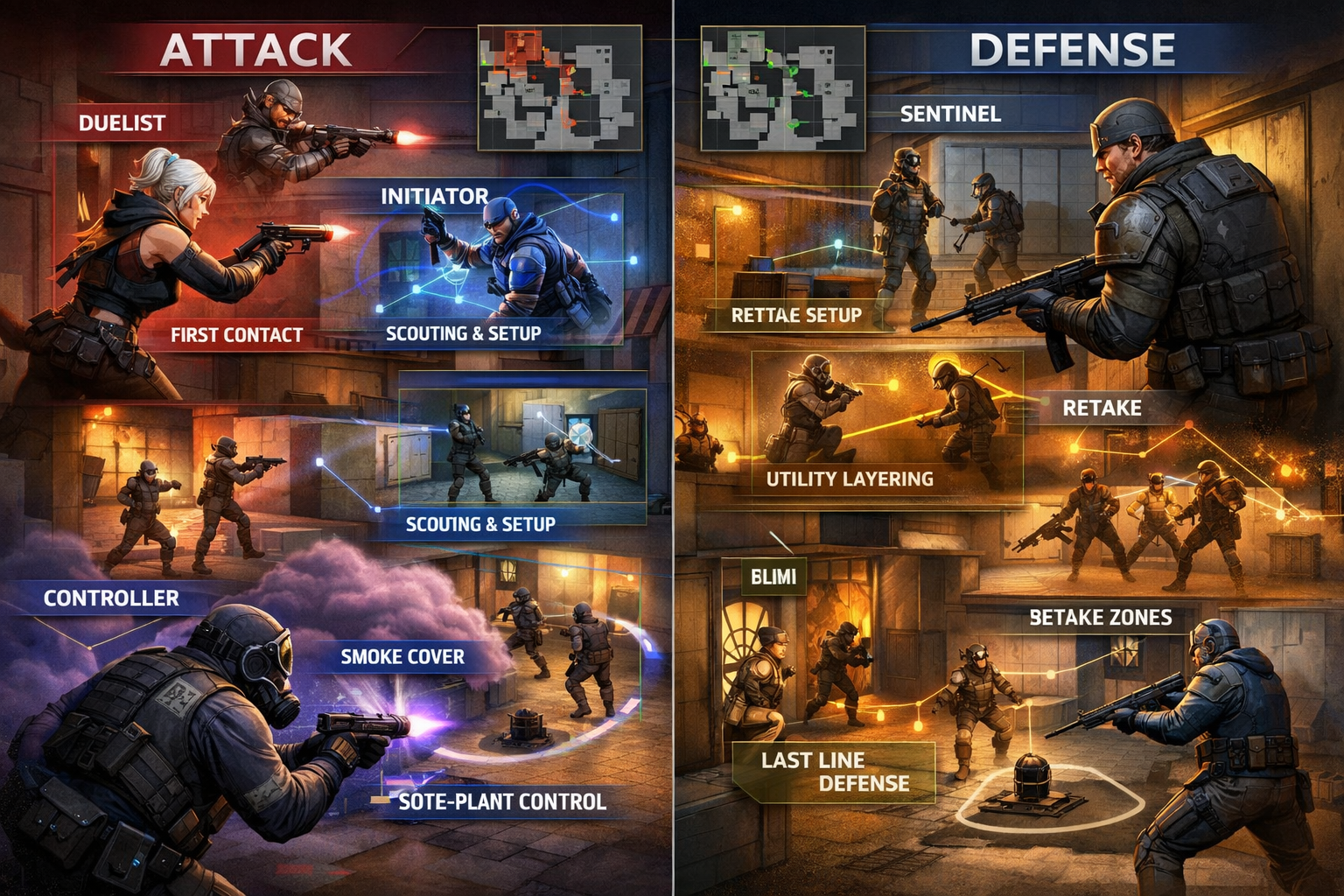
The True Job of an Initiator
Initiators are the bridge between information and action. They help the team challenge dangerous space by revealing defenders, forcing movement, flashing for contact, or displacing enemies from strong positions. Their value does not come from pressing utility buttons. It comes from creating openings the team can actually use.
This is why Initiators often feel amazing in coordinated play and frustrating in messy ranked games. If your team does not follow your utility, it can look wasted. But that does not mean the role is weak. It means the role demands sharper timing and stronger communication. In fact, recent official balance direction has reinforced the idea that Initiators should remain powerful while rewarding deliberate, coordinated use rather than mindless spam.
Attack-Side Initiator Fundamentals
On attack, the Initiator’s first question should be: What do we need before we commit? The answer might be info on a close corner, pressure on a power angle, a flash to break crosshair placement, or utility to flush an Operator out of a long line.
Good Initiator utility is not random. It should do one of the following:
- Confirm where defenders are.
- Force defenders to move from a strong position.
- Make defenders turn or hesitate before the entry.
- Enable a teammate to peek with an advantage.
- Protect a vulnerable transition, such as crossing into site or scaling into mid.
Initiator players often overvalue raw information. Yes, revealing one player can matter, but only if the team adjusts correctly. Information without action expires fast. If you scan two defenders on site and your team still waits five seconds before entering, that utility window is mostly gone. Good Initiators call not only what they found but what the team should do next.
One of the best habits for an Initiator is to pair every utility use with a follow-up plan. “I’m flashing close left, swing with me.” “Drone first, then Duelist goes.” “I’ll clear back site, save smoke for CT.” This turns utility from decoration into structure.
Defense-Side Initiator Fundamentals
On defense, Initiators are often responsible for controlled information gathering and counter-pressure. You may scan for early numbers, use a flash to protect a teammate’s contest, disrupt a rush, or set up the retake. The biggest challenge is utility discipline. If you spend everything too early just to feel active, you may leave your team helpless when the real hit comes.
Strong defensive Initiators do three things well:
- Probe without overcommitting. Gather info, but do not give the attackers free punish timings.
- Support the first contact defender. Your utility can save a site anchor from being overwhelmed.
- Retake with purpose. Your flashes, reveals, or concusses are often the cleanest way to break entrenched post-plant positions.
Initiators are especially valuable in retakes because defenders already know roughly where the enemy must be. That makes utility more focused and less speculative. If you are playing Initiator, avoid burning all your resources on low-value early noise unless your team specifically wants to fight for a lane.
The Best Initiators Think in Chains
The strongest Initiator players think in chains rather than one-off abilities. A reveal forces movement. The forced movement creates a flash timing. The flash timing creates an entry or a trade. The entry creates site control. The site control creates safer plant positioning. That chain mentality is what makes the role powerful.
Weak Initiators press one ability, announce a tag, and hope the round solves itself. Strong Initiators see the whole sequence.
Common Initiator Mistakes
- Using utility with no teammate ready to capitalize.
- Gathering information too early and letting it expire.
- Blinding teammates with poor flash communication.
- Dumping all utility in the first 20 seconds.
- Prioritizing fancy lineups over practical, repeatable timings.
- Playing too far away from the action to trade or follow up.
How to Improve as an Initiator
Start reviewing the conversion rate of your utility. When you reveal, stun, blind, or force someone off an angle, does your team actually gain ground? If not, was the utility too early, too shallow, too obvious, or unsupported? The best metric for Initiators is not just assists. It is whether your utility reliably leads to map control or cleaner fights.
Also simplify your pool of setups. You do not need fifty lineups for every site. You need a few trustworthy clears, a few retake patterns, and a few default-breaking tools you can execute quickly under pressure.
Sentinel Mastery
The True Job of a Sentinel
Sentinels protect structure. They are the role that allows a team to spend attention elsewhere without falling apart. A Sentinel locks down flanks, anchors sites, punishes greed, delays rushes, and makes the enemy uncertain about where they can move safely. In disciplined play, this is priceless.
Players sometimes reduce Sentinels to passive trap characters, but that is incomplete. A great Sentinel is not passive. A great Sentinel is patient, informed, and disruptive. They make attackers waste time, utility, and comfort. They help the rest of the team rotate with confidence because someone is handling the dangerous details.
Attack-Side Sentinel Fundamentals
On attack, the Sentinel’s job is often misunderstood. Because Sentinels are strongest at holding ground, many players think they do little when attacking. In reality, good Sentinels are crucial on attack. They secure flanks, hold lurk routes, protect late-round map control, and often become post-plant specialists.
Attack-side Sentinel value often comes from these jobs:
- Watching for flank pressure so the team can focus forward.
- Locking down an area the team already won.
- Creating safe post-plant crossfires or trap pressure.
- Conditioning defenders to respect utility and move more carefully.
- Supporting defaults by allowing the team to spread wider without collapsing.
This means a Sentinel should think about round security. While the Duelist creates chaos and the Controller shapes sightlines, the Sentinel keeps the round from becoming sloppy. Once site is taken, your job may become even more important than during the initial hit.
Defense-Side Sentinel Fundamentals
Defense is where the role’s classic value shines. Sentinels anchor. Anchoring does not mean hiding on site forever. It means making the attackers pay for committing into your area and buying enough time for the team to rotate or retake under control.
A good Sentinel anchor understands three layers:
- Detection: Know when the hit is real.
- Delay: Use utility and positioning to slow the flood.
- Survival or damage trade: Either stay alive long enough for help or make your final fight expensive.
The best Sentinels are hard to rush cleanly because they do not panic. They know which utility must be used instantly and which should be saved for the deeper commitment. They reposition after contact. They force attackers to clear one more layer than expected. And most importantly, they communicate clearly: numbers, pace, utility used, spike seen or not seen, and whether the team should rotate fast or hold.
Sentinel Mid-Round Intelligence
Sentinels are often excellent mid-round readers because they pay attention to the map’s weak points. If utility on your side of the map was faked, you may spot it faster. If the flank route is suddenly quiet in a suspicious way, you may catch a trap. If a team has shown one pattern for six rounds, you are often the first to see the rotation timing behind it.
That is why Sentinel players should not think of themselves as “just site anchors.” You are often the team’s structural reader. You help determine whether the enemy has truly committed, whether your teammates can leave a lane, and whether the post-plant is vulnerable to a retake path. Play with your brain as much as your utility.
Common Sentinel Mistakes
- Playing too passively and giving up too much free space.
- Using all stall utility on the first bit of noise.
- Forgetting to adapt trap placement after it gets read repeatedly.
- Over-lurking on attack and leaving post-plant too weak.
- Refusing to rotate because of rigid “anchor” thinking.
- Taking ego fights instead of letting utility create favorable fights.
How to Improve as a Sentinel
Review whether your utility meaningfully changed enemy behavior. Did they slow down, clear differently, waste extra utility, or avoid your side entirely? That is real Sentinel impact. Not all value shows up in kills. Fear, hesitation, and forced reroutes are victories too.
Also adapt more often. If your setup works three rounds in a row, assume the enemy is now looking for it. Great Sentinels keep a layer of unpredictability without becoming random.
How Roles Interact During a Round
True mastery happens when you stop viewing roles as separate jobs and start seeing them as connected phases of a round.
In the Default
During the default, Initiators and Sentinels often define the round’s stability. Initiators probe for information and test reactions. Sentinels secure weak points and let the team spread safely. Controllers may hold utility while preserving threat. Duelists pressure lanes to keep defenders honest.
A bad default has everyone trying to make something happen alone. A good default makes defenders feel uncertain while your team stays safe.
In the Execute
During the hit, the order usually matters more than the individual utility itself:
- Controller removes key sightlines.
- Initiator clears or displaces dangerous positions.
- Duelist takes first space and forces immediate reactions.
- Second wave players trade, plant, and stabilize.
- Sentinel secures flank or reinforces post-plant structure.
If this order breaks, rounds become ugly. A common ranked problem is the Duelist waiting too long, which causes smokes to fade and utility to expire. Another is the Duelist going too early, which causes a lonely death with no support. Good teams sync these layers naturally.
In the Post-Plant
Once the spike is down, roles shift. Duelists often hold aggressive forward positions or punish fast retakers. Controllers deny lines and delay retake timings. Initiators keep reveal or flash utility for the retake wave. Sentinels protect vulnerable entrances or secure key post-plant zones. The round is no longer about taking space. It is about converting space into time.
In the Retake
Retakes are where role discipline becomes obvious. Controllers help isolate site pockets. Initiators break entrenched positions. Duelists create the first burst of momentum. Sentinels cover flanks and stabilize defuse security. Teams that understand their jobs retake with layers. Teams that do not often trickle in and die one by one.
Role Mastery in Solo Queue
Solo queue changes the texture of role play because communication is inconsistent. That does not mean roles stop mattering. It means you must simplify your impact.
Duelist in Solo Queue
Take more self-sufficient fights, but do not abandon team timing. Use short calls: “Flash and go,” “Trade me,” “I’m dashing in now.” Solo queue Duelists should reduce hesitation. Many ranked rounds are lost because no one wants to be first.
Controller in Solo Queue
Be extra clear with timing. “Wait smoke.” “Smoking now.” “Play after plant.” Controllers in solo queue often need to lead the rhythm because teammates may otherwise rush before utility is ready or waste the post-plant by overfighting.
Initiator in Solo Queue
Use direct utility that teammates can understand instantly. You may not always get perfect follow-up, so favor setups with obvious value. A simple, well-timed flash with a clear swing call is better than a fancy lineup no one expects.
Sentinel in Solo Queue
Your consistency becomes even more valuable. Secure the backline, communicate flank timings, and be disciplined in post-plant. In chaotic games, the team that forgets structure usually loses. Sentinels are often the antidote to chaos.
How to Build Your Agent Pool
Do not try to master every agent at once. Build your pool in layers.
- One primary agent in your best role.
- One backup agent in the same role with a slightly different style.
- One off-role comfort pick for awkward comps or queue realities.
For example, a Duelist player may want one mobility-focused pick and one more self-contained dueling pick. A Controller player may want one classic smoke-focused option and one more flexible or aggressive controller. A Sentinel player may want one information-heavy anchor and one more stall-oriented anchor. An Initiator player may want one recon-oriented choice and one flash-oriented choice.
This approach makes you flexible without spreading your practice too thin. Riot’s official agent roster is the best place to keep track of role assignments and newer additions when shaping your pool.
How to Review Your Own Gameplay by Role
VOD review becomes far more useful when you ask role-specific questions.
Duelist Review Questions
- Did I enter on time or too early?
- Did my first death create useful space?
- Was I tradable?
- Did I overheat after entry success?
- Did I disappear from rounds by lurking too much?
Controller Review Questions
- Did my utility solve a real problem?
- Were my smokes timed with the hit?
- Did I save enough for post-plant or retake?
- Did I die before my most important utility window?
- Did my placements help or hurt teammates?
Initiator Review Questions
- Did my utility lead to space or just information?
- Were teammates in position to use my setup?
- Did I communicate the follow-up clearly?
- Did I hold enough utility for the retake or second phase?
- Did I blind or block teammates by accident?
Sentinel Review Questions
- Did I secure the weak point effectively?
- Did my setup delay the hit or get bypassed easily?
- Did I adapt after the enemy learned my pattern?
- On attack, did I help protect the round after site was taken?
- Did I rotate at the correct moment or too late?
If you watch pro matches, try using the official VCT site as a starting point for observing how role timing and map control look in structured play. Do not copy pro play blindly, but do study how clearly each role contributes to a round.
Best Practice Drills for Each Role
Duelist Drills
- Practice entry pathing in custom games so you stop getting stuck on corners or utility routes.
- Work on crosshair placement during movement, not just static aim routines.
- Scrim or queue with the goal of being tradable every entry.
- Train stop-and-clear habits after taking first space.
Controller Drills
- Practice map-specific smoke speed so you can place utility quickly under pressure.
- Run custom-game rehearsals for common execute timings and post-plant placements.
- Review rounds where smokes faded before contact and fix your timing.
- Train yourself to survive deeper into rounds rather than taking unnecessary first duels.
Initiator Drills
- Learn a small set of repeatable flashes, clears, and reveals for each map.
- Practice calling utility with exact follow-up cues.
- Run custom timing drills with a friend to sync flash-and-swing windows.
- Review whether your utility created movement, not just noise.
Sentinel Drills
- Build two or three different setups per site so you can rotate patterns.
- Practice quick post-plant setup transitions after your team takes space.
- Study common flank timings and how your utility covers them.
- Review rounds where attackers ignored your setup and ask how you could have adapted.
Most Common Ranked Mistakes by Role
Duelist
The most common Duelist mistake is confusing aggression with value. You do not need to force a clip every round. You need to create openings that your team can use.
Controller
The most common Controller mistake is autopilot utility. Smoking the same places at the same timing regardless of context makes your impact predictable and often weak.
Initiator
The most common Initiator mistake is ability dumping. Utility is strongest when it arrives with purpose and follow-up, not when it is thrown just to feel useful.
Sentinel
The most common Sentinel mistake is rigidity. If your setup, position, or rotation timing never changes, smart opponents will solve you quickly.
FAQ
What is the best role to climb with in Valorant?
There is no universal best role. Duelist can feel powerful in lower coordination environments because you directly influence first fights, but Controllers, Initiators, and Sentinels often become more reliable as you improve. The best climbing role is usually the one that matches both your mechanics and your decision-making style.
Do I need to main only one role?
No, but you should not spread yourself too thin. Most players improve fastest by specializing first, then adding controlled flexibility. One primary role plus one fallback role is usually enough for ranked.
Which role is hardest?
That depends on the level of play. Duelist pressure is mentally demanding because failures are visible. Controller is cognitively demanding because utility timing affects the whole round. Initiator requires precise coordination. Sentinel demands discipline and adaptation. All four become hard when played properly.
Can I rank up without perfect aim?
Yes. Strong crosshair placement and decent mechanics are still necessary, but role mastery can dramatically raise your consistency. Good utility timing, better positioning, smarter trading, and cleaner post-plants win many rounds that pure aim does not.
How do I know if I picked the wrong role?
If you constantly feel that your natural instincts fight your job, it may be a sign. For example, if you love reading the map and controlling tempo, Controller or Sentinel may suit you better than hyper-forced entry play. If you enjoy starting fights and making the first move, Duelist may fit better. If you enjoy enabling and coordinating engagements, Initiator may feel best.
Conclusion
Valorant role mastery is not about labels. It is about understanding how rounds are actually won. Duelists create pressure and space. Controllers shape sightlines and tempo. Initiators turn uncertainty into openings. Sentinels protect structure and punish impatience. When those jobs are done at the right time, teams look smooth, coordinated, and difficult to read. When those jobs are ignored, even good aim often is not enough.
If you want long-term improvement, stop judging your rounds only by kills. Start judging them by role value. Did you create the opening? Did you deny the angle? Did you secure the weak point? Did your utility lead to action? Did your death create space or waste it? Those are the questions that turn average players into dependable ones.
Master your role first. Then learn how it connects to the other three. That is where real consistency begins, and that is how you build gameplay that stays strong even when patches, agents, and map pools change.