



CS2 Communication Guide: Calls, Trades, and Mid-Round Plans
CS2 — How to Communicate in CS2: Simple Calls, Trades, and Mid-Round Plans
In CS2, your aim wins duels—but your communication wins rounds. The fastest teams don’t necessarily have the best one-taps; they have the cleanest information flow: quick calls, reliable trades, and simple mid-round plans that everyone understands. The good news is you don’t need “pro-level comms” to get big results. You need a small set of repeatable habits that work in every map, every rank, and every patch.
This guide gives you a timeless communication system you can apply immediately: a simple call formula, a map-agnostic call library, trade rules that turn 50/50 fights into round wins, and mid-round plan templates you can run with strangers in solo queue or with a regular stack. If you implement just a few of these, you’ll notice your rounds feel calmer, your team stops drifting, and you start converting advantages more often.
1) The 5 Principles of Useful CS2 Communication
Most teams don’t “lack comms.” They lack useful comms. A round can be full of talking and still be low information: jokes, panic, arguing, or random suggestions. Useful communication has five simple qualities that stay true across every map and meta.
Principle 1: Calls must change behavior
The purpose of a call is not to describe what you saw—it’s to help your teammates make a better decision right now. “He’s mid” is sometimes enough, but “Two mid, one hurt, they can split B, hold your smoke” is behavior-changing. When you speak, you should be able to answer: “What should my teammate do differently because I said this?”
Principle 2: Faster is better than perfect
A slightly imprecise call delivered instantly is often better than a perfect call delivered late. CS2 rounds are decided in seconds: a timing window closes, a gap in coverage appears, a trade is missed. If you hesitate while you search for the “correct” word, you may lose the moment your team needed.
Principle 3: The most important info is numbers + location + direction
If you only remember one rule, remember this: numbers, location, and direction usually win the round. “Two pushing B main,” “One behind us, coming late,” “Three spotted A side, mid is likely open.” Numbers tell your team whether to rotate, stack, or hold. Direction tells them how fast danger is arriving.
Principle 4: Say the next action out loud
Many rounds collapse because the team shares information but never converts it into a plan. The tiny upgrade is to add “Next action” to your calls: “I’m smoking, we can cross,” “Hold, I’ll flash,” “Don’t peek, play time,” “Reset, we have advantage.” If you’re not sure what the next action is, ask one clear question: “Do we rotate or hold?”
Principle 5: One voice at a time during contact
In the most important seconds—first contact, post-plant clutch moments, retakes—overlapping voices kill clarity. Your team should have an implicit rule: when bullets start, only the people with direct information speak, and everyone else keeps comms short or stays quiet. This alone dramatically improves trading and clutch conversion.
2) Voice, Settings, and Habits That Make Calls Clear
Communication isn’t only about what you say; it’s about whether your team can hear it and process it quickly. A few small setup choices create “clean comms” without effort.
Push-to-talk vs open mic
- Push-to-talk is usually best for clarity and reducing noise. It prevents breathing, keyboard spam, and background audio.
- Open mic can be fine if your environment is quiet and your mic is well-tuned, but it increases accidental clutter during fights.
If you use push-to-talk, bind it to a key you can press while moving and shooting without losing control. The point is to avoid “I couldn’t call because my finger was busy.”
Volume balance that supports decision-making
Many players keep game audio so loud that teammates are “background noise.” Others do the opposite and lose footsteps. Aim for a balance where you can clearly hear:
- Close-range footsteps and key utility cues (without pain)
- Teammate callouts without straining
- Your own voice at a comfortable level (so you don’t shout)
Use the minimap and pings as a “second channel”
Voice is fast, but the minimap is constant. When possible, combine the two: “Two here” + ping, or “Bomb here” + ping. Your voice gives meaning; the map gives precision. The goal is to reduce long explanations.
Adopt a calm tone on purpose
Your tone is part of the information. Panic tells your team “we are losing,” even if you’re up a player. Calm tells your team “we have a plan.” You don’t need to be emotionless—just avoid raising intensity when it’s not needed. Calm comms also reduce arguments, which keeps focus on the next round.
3) The Simple Call Formula (Copy/Paste Templates)
Here’s the communication framework that works in every rank and every map. You’ll use the same structure for enemy spots, utility, rotations, and plans. When everyone follows a predictable format, teammates process calls faster because they know what’s coming next.
The core call formula
Location → Number → Damage/Weapon → Direction/Timing → Next action
Examples:
- “A main, two, one low, coming fast — I’m falling, trade me.”
- “Mid, one AWPer, holding — don’t wide swing, smoke first.”
- “B, three spotted, bomb seen — rotate now, leave one lurk.”
- “Behind us, one late — hold for 5 seconds, then go.”
Template 1: Enemy spotted
“[Place], [how many], [HP if known], [moving/holding], [my action].”
Examples:
- “Ramp, one, tagged, holding — I’m not peeking.”
- “Connector, two, one low — I’m flashing and swinging.”
- “Heaven, one — I’m smoking it and crossing.”
Template 2: Utility call
“[Utility] [where] [for what], [timing].”
Examples:
- “Flashing over mid for peek, 3…2…1.”
- “Smoking CT to cross, now.”
- “Mollying close corner to clear, then we swing.”
Template 3: Trade request
“I’m going [first action]. Trade me from [your position].”
Examples:
- “I’m entrying main. Trade me from the right wall.”
- “I’m swinging close. Trade me instantly.”
- “I’m defusing half. Cover my swing after tap.”
Template 4: Rotation / stack
“[Number] seen [area]. [Area] likely weak/open. Rotate [who] / hold [who].”
Examples:
- “Three A side, mid quiet. Rotate one to B, keep two A.”
- “Bomb spotted B, heavy. Full rotate, save utility for retake.”
Template 5: Mid-round plan
“We have [goal]. We do [plan]. If [trigger], then [audible].”
Examples:
- “We want a safe plant. Default 20 seconds, then hit A. If we get a pick mid, we split.”
- “We have man advantage. Slow down, group two-by-two. If they push, punish and reset.”
- “We’re low money. Contact play; if we get first kill, commit. If not, save and keep rifles.”
The “10-word rule” for chaotic moments
When fights start and comms get messy, use a stricter rule: keep calls under ~10 words. This forces clarity: “Two out main,” “Bomb down mid,” “One behind smoke,” “Play time,” “Tap and swing.” You can expand after the danger moment passes.
4) A Map-Agnostic Call Library You Can Use Anywhere
Many players get stuck because they think communication requires perfect map callouts. It doesn’t. You can communicate effectively with generic, descriptive language that works on any map. The goal is to be understood instantly, not to sound like a commentator.
Universal location words 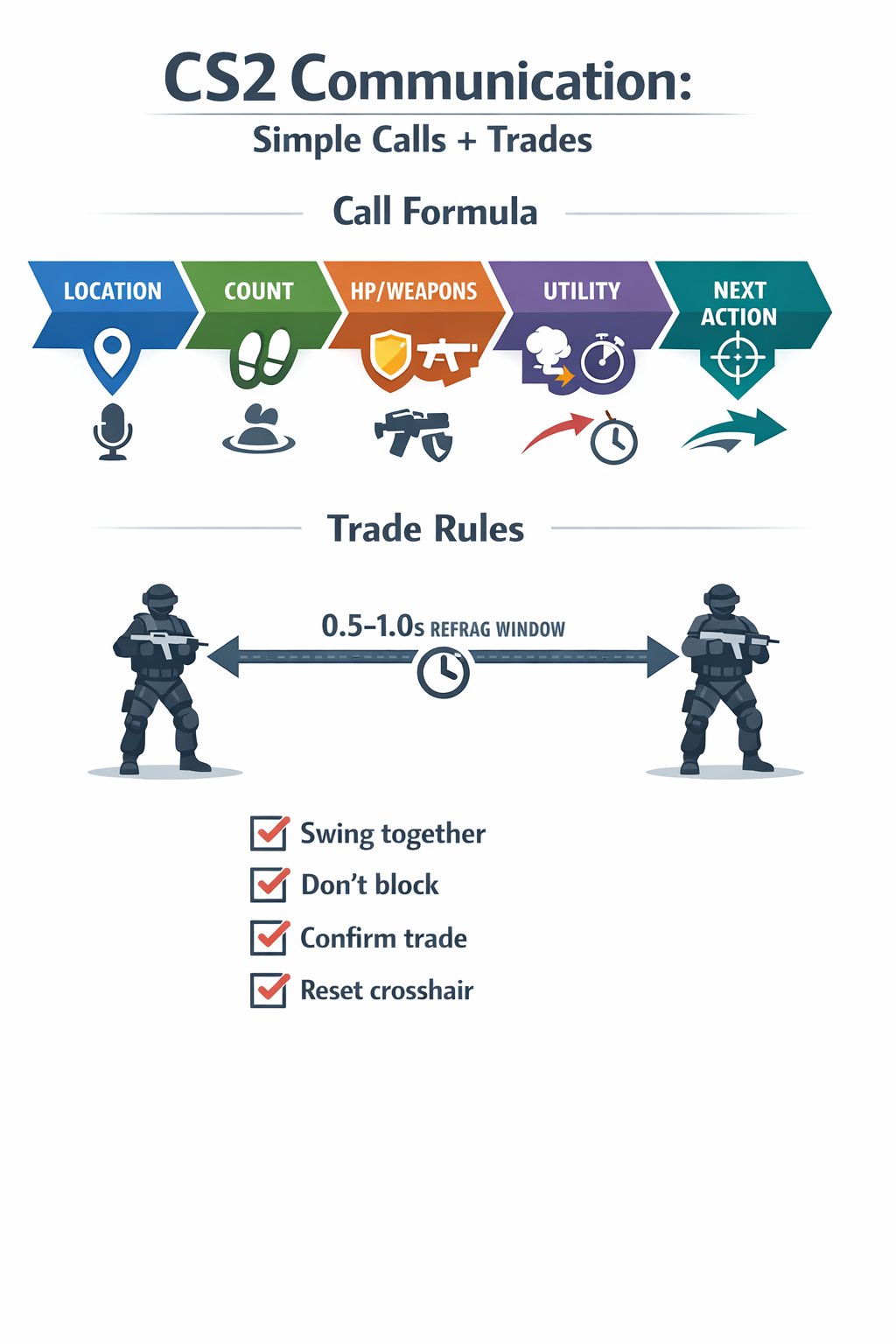
- “A / B / Mid” — the simplest anchors for your team’s mental map.
- “Main” — the primary lane into a site (“A main”, “B main”).
- “Connector” — a link route between two areas.
- “Heaven / Hell” — high platform vs underneath/low cover.
- “Ramp / Stairs” — vertical movement paths.
- “Close / Far” — distance relative to your angle.
- “Left / Right / Top / Bottom” — relative to the landmark your team is using.
- “Behind / In front / Crossing” — direction and motion, often more important than exact names.
Enemy count language that reduces confusion
- “One” (confirmed single target)
- “Two” (two bodies seen, or two sets of footsteps clearly)
- “Multiple” (more than two, but you can’t confirm exact)
- “Heavy” (three-plus presence and/or bomb spotted)
- “Could be more” (you saw one, but timing suggests additional)
Damage / status words that matter
- “Tagged” (hit but unknown exact HP)
- “Low” (very low, often one bullet from death—use carefully if you’re sure)
- “Half” (roughly mid HP; use if you’re uncertain but want to signal “we softened them”)
- “Lit [number]” (if you know the damage from your HUD or clear info)
- “No armor / armored” (only if clearly observed; otherwise skip)
Direction and timing words that win rounds
- “Pushing” (closing distance toward you)
- “Swinging now” (immediate peek)
- “Holding” (stationary angle, likely waiting)
- “Crossing” (moving across a gap; a timing window)
- “Late” (arriving after a delay; often flank or rotation)
- “Fast” / “Slow” (pace; helps teammates decide to rotate or hold)
Utility vocabulary (short and actionable)
- “Smoke [area]” (blocks vision; specify purpose: cross, isolate, deny)
- “Flash [over/through]” (warn teammates so they can turn or swing)
- “Molly close” (clear a corner, deny push, force movement)
- “HE [spot]” (chip damage, finish low targets, punish grouped enemies)
- “One-way / gap” (only if your team understands; otherwise say what you want: “play behind smoke edge”)
Objective calls: bomb and round state
- “Bomb spotted [area]” (most powerful info for rotations)
- “Bomb down [area]” (locks the enemy’s options; prioritize holding it)
- “Planting” (timing cue—CTs must act)
- “Play time” (defenders should delay; attackers should avoid unnecessary fights)
- “Stick / half / fake” (defuse plan language)
Short phrases that create structure
- “Reset” — stop forcing; regroup and re-clear angles.
- “Group” — move together for trades.
- “Hold” — freeze; don’t peek.
- “Contact” — quiet entry; no early utility, rely on timing and trading.
- “Exec” — coordinated utility + entry on a timing.
- “Split” — hit from two lanes at once to break crossfires.
- “Fake” — show pressure one side, finish the other.
If your team uses these consistently, you’ll feel “organized” even without a dedicated in-game leader. Organization is mostly shared vocabulary.
5) Trades: The Easiest Way to Win More Rounds
Trading is the fastest, most reliable improvement you can make in CS2. When you trade well, you don’t need perfect aim. You turn risky entries into guaranteed value, you punish aggressive defenders, and you convert advantages more often. Most matchmaking rounds are decided by missed trades, not missed headshots.
What “trade” actually means
A trade is not “I died and my teammate killed him later.” A real trade is a refrag within a tight window where the enemy cannot escape or reset. In practice, you want the kill within about 0.5–1.0 seconds of your teammate dying, or at least before the enemy can reposition or reload safely.
The trade triangle: spacing, timing, and angles
- Spacing: close enough to refrag instantly, far enough not to get sprayed down together.
- Timing: swing off your teammate’s contact, not after it.
- Angles: don’t hold the exact same line; cover each other’s blind spots.
The simplest trade rule for any rank
“If you can’t trade, you shouldn’t be peeking together.”
This rule fixes a common mistake: players “pair up” but still take isolated fights because they’re too far apart, watching the wrong angle, or blocked by utility. If you can’t trade instantly, either adjust your positions or don’t take the fight yet.
Trade protocol for attacking (T-side)
- Choose an entry pair: Player 1 entries, Player 2 is the immediate refrag.
- Agree on the first angle: “I clear close, you clear deep,” or “I swing left, you swing right.”
- Call the trigger: “Swing on my contact,” “I’m jumping out,” “Flashing then go.”
- After the trade, stop: don’t chain-peek alone. “Reset” and clear the next angles together.
Trade protocol for defending (CT-side)
CT trading is often harder because defenders are spread out, but it’s still possible with a few habits:
- Play in pairs when you can: one anchor, one support/rotate position that can swing quickly.
- Don’t die alone in a choke: if you’re isolated, delay with utility and wait for help.
- Use “I’m falling” calls: backing up is a trade-friendly move because it funnels the enemy into your teammate’s angle.
How to call for trades (the exact words)
- “I’m peeking. Trade me.” (simple and universal)
- “Swing with me, don’t bait.” (use sparingly; keep tone neutral)
- “Hold my cross, I’ll clear close.” (assigns roles)
- “If I die, kill him instantly.” (makes the timing expectation explicit)
Trading through utility (the common failure)
Many teams lose trades because they throw utility and then forget how it changes spacing. Examples:
- A smoke blocks the refrag line, so the second player can’t see the duel.
- A flash blinds both attackers because it wasn’t called.
- A molly forces the entry to wide swing alone, breaking the pair.
Fix this with one habit: when utility goes out, say the consequence. “Smoke up, we swing through it together,” or “Flash is for me only, don’t peek yet.” Utility without communication often makes trading worse, not better.
Post-plant trades: win rounds with crossfires
After planting, many teams throw the round by hunting kills. Your goal is to create trades and time pressure. Post-plant is a trading puzzle:
- Pair up: two players cover the same entry route from different angles.
- One player watches the defuse: not necessarily the bomb itself, but the line that touches it.
- Call your plan: “Play time,” “Don’t peek,” “Swing on tap,” “I’m hiding, you bait.”
Retake trades: how to avoid “one-by-one” deaths
Retakes fail when players enter at different times. Your retake needs a countdown: “Wait… group… 3, 2, 1, flash, swing.” Even if your utility is weak, synchronized timing gives you trades.
6) Mid-Round Plans: How to Call Without Overcalling
Mid-round calling doesn’t mean giving a speech. It means turning your current information into a simple plan that matches the round state (numbers, money, utility, bomb, time). The best mid-round plans are short, flexible, and easy for strangers to follow.
The 3 questions that create any mid-round plan
- What do we know? (enemy positions, utility used, bomb location, timing)
- What do we want? (plant, pick, save, deny plant, isolate, force rotations)
- What is the next 10 seconds? (group, hold, take space, throw utility, rotate)
Round-state triggers (what you should call immediately)
- Man advantage: “We’re up one. Slow down, group, trade.”
- Man disadvantage: “We’re down one. Look for a pick or stack.”
- Bomb spotted: “Bomb seen. Rotate now / hold now.”
- Time low: “30 seconds. Commit plan.”
- Utility advantage: “We have flashes/smokes. Exec together.”
The easiest mid-round plan type: “Default → Trigger → Finish”
This structure works in solo queue because it doesn’t require perfect coordination.
- Default: take safe space, hold pushes, gather info.
- Trigger: a pick, utility used, a weakness spotted, or time threshold.
- Finish: a grouped hit, a split, or a rotation to the weak side.
Example call: “Default for 20. If we get a pick, we group and hit. If not, we take mid then split.” That’s enough. Your team now shares a clock and a decision rule.
Mid-round plan templates you can run anywhere
Plan A: “Slow default into late hit” (safe and consistent)
Use when you don’t trust your team’s entrying, or when defenders are aggressive.
- Call: “Default. Hold pushes. Don’t die. Group at 45 seconds and hit together.”
- Key comm: “If someone pushes, punish and reset.”
- Why it works: you reduce randomness and force defenders to reveal info or waste utility.
Plan B: “Contact explode” (for low utility or surprise)
Use when your utility is weak, or you want to punish a defender who relies on early info.
- Call: “Contact. No steps if possible. When first contact happens, everyone swings.”
- Key comm: “Trade instantly. Don’t stop in the choke.”
- Why it works: timing beats setups; defenders can’t reposition if the fight is immediate.
Plan C: “Fake pressure → rotate” (simple deception)
Use when defenders over-rotate or when you want to pull utility.
- Call: “Show pressure A: smoke/flash, make noise, then rotate B as a group.”
- Key comm: “Don’t die on the fake. The fake is to pull rotations.”
- Why it works: you exploit the most common matchmaking habit: rotating too early.
Plan D: “Split” (break crossfires)
Use when a direct choke hit is getting farmed, or when you have two lanes of control.
- Call: “We split. Two come from main, two from mid/connector. Wait for my flash, then swing together.”
- Key comm: “Hold until both groups are ready. Then 3, 2, 1.”
- Why it works: defenders can’t focus one doorway; trades become easier.
Plan E: “Play the advantage” (the most important plan)
This is the plan that wins the most rounds in all ranks, and it’s often ignored.
- Call (up a player): “We’re up one. Stop peeking. Group two-by-two. Trade only.”
- Call (post-plant up a player): “Play time. Don’t peek. Swing on tap.”
- Why it works: it removes the enemy’s best comeback tool—isolated duels.
How to make “audibles” without confusing teammates
An audible is a mid-round change: rotate, cancel, speed up, slow down. Audibles fail when the caller changes the plan but doesn’t give the team a clear regroup point.
Use this audible format: “Cancel → Regroup [place] → New plan → Timing.”
Examples:
- “Cancel. Regroup mid. Then hit B in 10 seconds.”
- “Cancel. Fall back. Hold pushes for 5, then exec A.”
- “Cancel. Save rifles. Meet at spawn and exit together.”
Mid-round for defenders: hold, rotate, or retake?
CT mid-round plans are simpler if you treat them like a decision tree:
- If bomb is spotted: rotate early, keep one flank watcher.
- If multiple are spotted but bomb not seen: rotate one, keep info, don’t full gamble.
- If the site is lost: call “save” or “group retake” clearly—no half-commits.
The worst outcome is a split decision: two players retake, three players save, nobody trades, and you lose rifles anyway. The fix is one decisive call: “Full retake” or “Full save.” Even a suboptimal decision executed together often beats a perfect decision executed half-way.
7) Who Talks When: Roles, Priorities, and Speaking Order
You don’t need a formal IGL to have structured comms. You need speaking priorities: who talks first, what matters most, and what to avoid saying during fights.
Speaking priority ladder (most important first)
- Contact info: enemy location/count/direction during fights.
- Objective info: bomb spotted, bomb down, plant/defuse status.
- Trade/utility timing: “Flash 3-2-1,” “Swing with me,” “Smoke blocks our line.”
- Round plan calls: group/rotate/reset/save/retake.
- Everything else: discussion, economy talk, feedback (best saved for freeze time).
Role-based comm responsibilities
- Entry: calls first contact and asks for trades/flash timing.
- Second in (trader): calls what they’re holding and confirms trade intention (“I’m with you”).
- Lurk: calls timings and rotation pressure (“I can cut rotate,” “I hear steps leaving”).
- AWPer / long-range holder: calls held angles and whether they’re re-peeking or falling.
- Anchor: calls pressure level early (one vs heavy), then either delays or falls for retake.
Freeze-time habit: decide one simple goal
If your team can’t coordinate mid-round, start earlier. In freeze time, decide one of these: “Default then hit,” “Fast hit,” “Contact,” “Fake,” “Play for picks,” or “Save/force.” You don’t need perfect detail. You need shared expectations.
8) Solo Queue Comms: Quick Trust, Minimal Words, Maximum Impact
In solo queue, long speeches often backfire. People don’t know you, don’t trust you yet, and may interpret direction as criticism. Your goal is to create cooperation with minimal friction.
Start with information, not commands
People accept information more readily than orders. Instead of “You must rotate,” try: “Three spotted A side, B might be weak.” Instead of “Stop peeking,” try: “We’re up one, we can play time.” You’re guiding the team toward the same action with less ego conflict.
Use “I” language to reduce defensiveness
- “I can flash you in.”
- “I think we should group.”
- “I heard steps, could be flank.”
It sounds small, but it changes how teammates react. You’re offering, not policing.
Make one plan, then stop talking
The best solo-queue caller says a short plan and then goes back to playing: “Default 20, then group B.” After that, only give contact calls and utility timing. Over-talking makes teammates tune out.
Two “universal plans” that work with strangers
- “Default + late group hit” — safe, reduces early deaths, creates trades.
- “Play advantage” — when up a player, slow down and trade.
9) Handling Tilt, Toxicity, and “Comms Meltdowns”
The most “timeless” CS2 communication skill is emotional control. Not because you should be a therapist—because tilt creates bad information and worse decisions. A tilted team lies to itself: “They’re everywhere,” “We can’t do anything,” “Our teammate is useless.” None of that helps you win the next round.
Use “reset phrases” that calm the team
- “Reset. Next round.”
- “We’re fine—play trades.”
- “We have time.”
- “One plan: group and exec.”
Don’t argue during the round
If someone makes a mistake, arguing mid-round lowers everyone’s performance and usually loses the round. Save feedback for freeze time, and keep it specific and future-focused: “Next time let’s trade that together,” not “Why did you do that?”
Mute strategically, not emotionally
If a teammate’s comms are actively harming decision-making (insults, spam, constant blame), muting can be a tactical choice. Keep your own calls clean so the rest of the team still benefits. You can win rounds even with limited communication if your calls remain actionable and calm.
10) Practice Drills: Train Comms Like a Skill
Communication improves fastest when you practice it deliberately—just like crosshair placement. The goal is to make your call formula automatic so you can speak clearly under pressure.
Drill 1: “3-second call”
Any time you see an enemy, force yourself to deliver the call in under 3 seconds: location → count → direction. Add damage only if it’s instant to say. This trains speed.
Drill 2: “Utility countdown”
In casual games or warmup, practice counting down flashes and coordinated swings: “Flashing 3…2…1.” This reduces team-blinds and increases trade timing.
Drill 3: “Trade pair rule”
Queue with one friend, or even with randoms by suggestion: “Let’s go together and trade.” Your goal is to never peek alone. After each death, ask: “Was I tradable?” If not, adjust spacing.
Drill 4: “Silent seconds”
Practice not narrating. For 10 seconds at a time, say nothing unless you have: (1) contact info, (2) bomb info, or (3) a utility timing. This builds discipline and makes your calls more valuable.
11) Common Communication Mistakes (and Fixes)
Mistake: calling too late
Fix: call as soon as you confirm location and direction. You can refine after.
Mistake: unclear “he’s here” language
Fix: attach calls to a landmark: “close right of smoke,” “behind box,” “crossing to left.”
Mistake: exaggerating enemy numbers
Fix: use “multiple” or “could be more” when uncertain. Overcalling rotations loses rounds.
Mistake: arguing instead of planning
Fix: replace blame with one actionable sentence: “Group and trade,” “Reset,” “Save,” “Retake together.”
Mistake: utility without timing
Fix: always add timing: “flashing now,” “smoke up,” “molly clears close then swing.”
Mistake: post-plant hunting
Fix: say “play time” and define swing rules: “swing on tap,” “don’t peek until contact.”
12) Quick Cheat Sheets: Calls, Trades, Mid-Round Scripts
Cheat Sheet A: The 5 best calls to master
- “Bomb spotted [area].”
- “Bomb down [area].”
- “[Place], two, pushing.”
- “I’m flashing 3-2-1.”
- “We’re up one—play trades.”
Cheat Sheet B: Trade checklist
- Are we close enough to refrag instantly?
- Are we avoiding the same angle (so we don’t die together)?
- Did we agree on the trigger (“on contact”, “after flash”)?
- After a kill, did we reset before re-peeking?
- In post-plant/retake, did we enter together?
Cheat Sheet C: Mid-round scripts (short and usable)
- Default: “Default 20. Hold pushes. Group and hit.”
- Man advantage: “Up one. Slow. Group. Trade only.”
- Time low: “30 seconds. Commit now.”
- Cancel/audible: “Cancel. Regroup mid. New hit in 10.”
- Retake: “Wait. Group. Flash 3-2-1, then swing.”
- Post-plant: “Play time. Don’t peek. Swing on tap.”
- Save: “Full save. Keep rifles. Exit together.”
13) Helpful Resources
If you want official and community hubs for CS2 updates, esports context, and general support, these are reliable starting points:
- CS2 on Steam (official)
- Steam Support (audio/voice troubleshooting)
- HLTV (esports matches, teams, and trends)
- Liquipedia Counter-Strike (tournaments and basics)
14) FAQ
What’s the single most important thing to call in CS2?
Enemy numbers and location, especially when you see bomb or multiple attackers. Those calls affect rotations and stacking decisions immediately.
Do I need perfect map callouts to communicate well?
No. Use universal landmarks (main, mid, connector, heaven, close/far) plus direction (pushing, holding, crossing). Clarity beats correctness.
How do I stop teammates from talking over each other?
Keep your own calls short during contact, and use one calm phrase like “one at a time” or “comms for contact.” Avoid sounding angry; tone matters.
How do I improve trading in solo queue?
Pick one teammate and pair up by suggestion: “Let’s go together and trade.” Then actually follow the trade rules: spacing, same timing, and no solo re-peeks after a kill.
When should we retake versus save?
The key is decisiveness. If your team is split, saving is often better than a half-retake. If you have enough players together with some utility and time, a coordinated retake can work—especially with a countdown.
How do I call utility without confusing teammates?
Name the utility, the location, and the timing: “Flashing over mid in 3…2…1,” “Smoking CT now.” That prevents team-blinds and creates synchronized swings.
Why do my teammates ignore plans?
Plans fail when they’re too long or too late. Keep plans short (“Default 20 then hit”), set a timing rule, and then stop talking unless you have new information.
What do I say when we’re up a player?
“We’re up one. Slow down. Group and trade.” This is the highest win-rate call in matchmaking because it removes the enemy’s comeback path.
15) Wrap-Up: The Simple System to Keep
Great CS2 communication isn’t fancy. It’s fast, clear, and tied to action. If you want a simple system:
- Use the call formula: Location → Number → Direction → Next action.
- Prioritize trades: if you can’t trade, don’t peek.
- Run simple mid-round plans: Default → Trigger → Finish.
- When up a player: slow down and trade.
- Keep tone calm and words short during contact.
If you want faster improvement with structured teamwork habits—communication, trading, mid-round calling, and round management— consider CS2 coaching/boosting options here: https://boosteria.org/cs2-boosting/prices
Implement just two changes this week: (1) always call numbers + direction, and (2) always play in tradable pairs. You’ll be surprised how quickly your rounds feel controlled instead of chaotic.