



VALORANT Economy Guide: Buy, Force, Bonus & Full Save
VALORANT Economy Guide: Buy, Force, Bonus, and Full Save (Simple Rules)
In ranked, aim and utility matter—but the fastest “silent MMR gain” comes from economy discipline. If your team gets more rifle rounds with full utility than the enemy, you win more games even on average mechanics. This guide gives you timeless, simple rules for deciding when to full buy, force buy, play a bonus round, or full save. It’s built to stay useful even as weapon prices and patches change, because it focuses on principles you can apply on any map, any agent, and any rank.
If you ever feel unsure because prices shift over time, use the same framework and just verify exact costs in your in-game buy menu. The goal is not perfect math every round—your goal is to make consistent, team-synced decisions.
Why Economy Wins Ranked
Most ranked games are decided by a handful of swing rounds. These are the rounds where one team has rifles, armor, and utility, while the other team is stuck on a messy mix of pistols, low-armor buys, or a couple of “hero” rifles with no support. Economy is what creates those swing rounds.
Think of credits like time: you’re trading “future power” for “current power.” A force buy is borrowing power from the next round. A full save is investing power into the next round. A bonus is protecting your investment while trying to steal momentum. If your team makes these trades together, you get more rounds where you’re favored. If your team makes these trades separately, you create rounds where you’re unfavored on purpose.
This is why two teams with equal aim can feel completely different: one team hits every “strong round” with five players equipped, while the other team enters critical rounds with broken buys, no utility, and mismatched weapons.
Core Terms: Full Buy, Force, Bonus, Full Save
Full Buy (a.k.a. “Rifle Round”)
A full buy means your team can reliably fight for the round: strong primary weapons, appropriate armor, and enough utility to execute or defend correctly. It does not mean everyone must have the same gun. It means the team’s total loadout supports a real game plan.
Force Buy
A force buy means you are buying into a round even though you cannot comfortably full buy. You accept that your next round may be weaker because you want a chance to win now. A force can be correct when the round is high value (momentum, scoreline pressure, or breaking enemy economy).
Bonus Round
A bonus round happens after you won a round with cheaper weapons (often after pistol or anti-eco), and you keep most of those weapons to preserve your money advantage. You enter the round slightly underpowered, but you’re playing for a “free shot” at an extra round while protecting your next full buy.
Full Save (Eco)
A full save means you deliberately spend as little as possible so you can buy strong next round. Done correctly, a full save isn’t “giving up”—it’s setting up a more favorable fight next round. The best teams don’t avoid losing rounds; they avoid losing two rounds in a row to bad spending.
The Simple Economy Rulebook (Ranked-Proof)
If you only learn one thing, learn this: economy is team-based. Your personal buy is less important than the team’s buy. Use these rules to make quick decisions without arguments.
Rule 1: Buy Together or Save Together
The #1 ranked economy mistake is split buying: two players full buy, two players half buy, one player saves. This creates a round where your team can’t execute properly and can’t trade properly. If your team is not aligned, your “good gun” becomes an expensive donation.
Rule 2: Plan for the Next “Real Round”
Every round, ask: When is our next round where 4–5 players have strong weapons + armor + utility? That’s your next “real round.” Your buys should protect that moment, not sabotage it.
Rule 3: Don’t Break the Team for an Operator or a Hero Rifle
If buying a premium weapon forces you (or others) to have no armor or no utility, it often reduces your team’s win chance. In ranked, consistency beats highlight buys. If your team’s buy becomes uneven, you lose coordinated pressure and trading.
Rule 4: If You Win Pistol, Don’t Gift the Enemy a Rifle Round
After winning pistol, the enemy is usually limited. Your goal is to convert that advantage cleanly. The common trap is overbuying into a messy round and then losing the next “real round” because your money becomes awkward. Convert the win with a structured plan: safe weapons, appropriate armor, and utility to clear close angles.
Rule 5: If You Lose Pistol, Decide as a Team: Force Once or Save Once
After losing pistol, you typically have two viable paths: (A) force to try to steal the next round and flip momentum, or (B) save to hit the following round with a cleaner buy. Both can work. The mistake is doing neither—half buying without a plan.
Rule 6: Bonus Rounds Are About Preserving Next Round Power
When you bonus, your mindset is: “We want a chance to win this round, but we refuse to ruin our next buy.” That means: keep weapons, avoid panic rebuys, and prioritize trades and damage over ego duels.
Rule 7: If You’re Forcing, Force With a Purpose
A good force buy is not random spending. It’s a plan: pick a fight style (stack, fast hit, close-range ambush, coordinated utility), then buy to support that plan. A bad force is five different ideas and five different loadouts.
Rule 8: Treat “Utility + Armor” as Part of Your Gun
In VALORANT, a rifle with no utility and weak armor can be worse than a cheaper weapon with strong utility. Utility is how you take space, deny space, and secure trades. If your agent’s kit is critical to the team plan, your economy should protect it.
Rule 9: One Drop Can Fix a Whole Team’s Economy
Learn to drop smartly. If one player has extra credits, they can “smooth out” the buy so the team hits the round together. Teams lose rounds because they refuse to press the drop button.
Rule 10: Stop Buying Late
A hidden throw is buying too slowly and missing the round start. In ranked, late setups lose rounds. Decide quickly using your “next real round” plan, then move.
How Credit Flow Works (Timeless Concepts)
You don’t need advanced math to manage economy, but you do need to understand where credits come from. Even if exact numbers change across seasons, the structure is consistent:
- Round outcome: win gives a payout; loss gives a payout.
- Loss streak scaling: consecutive losses generally increase your loss payout (a comeback mechanic).
- Spike plant bonus (attack): planting often provides additional team credits even if you lose.
- Kill rewards: kills grant credits, with rewards varying by weapon type.
- Carry-over: credits not spent roll into the next round, enabling “investment” buys.
The strategic takeaway is simple: economy is a two-round game. Most decisions are about whether you want to be stronger this round or next round. If you lose a round and then also ruin your next buy, you effectively lose two rounds with one mistake.
For official game info and updates, it’s always smart to periodically skim Riot’s official channels: playvalorant.com and support-valorant.riotgames.com. You don’t need patch-by-patch memorization—just stay aware of major system changes.
Full Buy: When to Buy Big and Why
A full buy is your best chance to win “standard” rounds because it unlocks the complete game: execute utility, retakes, layered defense, and confident trading. The purpose of every eco decision is to create more full-buy rounds than your opponent.
What “Full Buy” Really Means
A true full buy is not just rifles. It’s a team loadout that supports your intended round plan. The exact definition changes by rank and composition, but it usually includes:
- Strong primary weapons on most players (not necessarily identical)
- Appropriate armor choices for your role and plan
- Enough utility to take space, hold space, or retake
- At least one plan for first contact (info, anti-rush, or exec)
Full Buy Timing: The “Two-Round Stability” Check
Before you full buy, do a quick stability check:
- This round: Can we field a strong fight plan with most players properly equipped?
- Next round: If we lose, will our next buy still be playable, or will we be fully broken?
You don’t need to be “safe” every time. Sometimes you should full buy even if you’ll be broke on a loss. But you should do it consciously, not accidentally.
When a “Light Full Buy” Is Better Than a Broken Full Buy
In ranked, many rounds are lost because players try to buy “perfect weapons” and sacrifice everything else. If your choice is: (A) expensive gun + weak armor + almost no utility, or (B) slightly cheaper gun + strong armor + key utility, option B often wins more rounds because it enables trading and survivability.
Force Buy: When It’s Correct (and When It’s Throwing)
Force buying is not “always bad” and not “always good.” It’s a tool for specific situations. The question is: Is this round valuable enough to borrow power from the future?
Good Reasons to Force
- High-value round: winning would swing momentum or break the enemy’s economy.
- Enemy is vulnerable: they have an awkward buy, limited utility, or few rifles.
- Map/side pressure: you’re close to losing the half, and you need a stop now.
- Ult/kit spike: your team has impactful ultimates that make a weaker buy viable.
Bad Reasons to Force
- Impulse: “We lost, I’m angry, I’m buying.”
- Solo hero mentality: one player forces while the rest save.
- No plan: you buy random weapons without a clear fight style.
- Destroying the next round: a force that makes your next buy also weak is often a double loss.
How to Force Buy Correctly (Loadout Priorities)
When forcing, prioritize what increases your chance of getting the first two kills and converting the round:
- Armor consistency: survive one extra bullet, win one extra duel.
- Close-range or trade-friendly weapons: force rounds often revolve around tight fights and crossfires.
- Must-have utility: smokes to cross, flashes to enter, slows/stuns to punish pushes.
- Team plan: stack a site, fast hit with utility, or trap for a pick then collapse.
A great force buy is usually a coordinated fight, not five independent duels. If you force, call the plan in spawn: “We’re forcing—stack B, play close, trade fast.”
Bonus Round: The Most Misplayed Round Type
Bonus rounds win halves. They also lose halves—if you misunderstand their purpose. A bonus is not “we’re broke.” A bonus is: we’re ahead, and we’re protecting the next full buy.
When Bonus Rounds Usually Happen
- After winning pistol and then winning the follow-up anti-eco
- After winning a round with a cheaper buy (SMGs/shotguns) and carrying weapons forward
- After a successful force that leaves you with weaker weapons but better team credits
The Bonus Mindset: “Damage, Trades, and Keep Guns”
In a bonus, you’re often facing enemy rifles while you have cheaper weapons. You can still win—but you shouldn’t play like it’s an even round. Your priority order should be:
- Get value from your weapons: close angles, crossfires, stacked holds.
- Trade quickly: don’t isolate 1v1s against rifles.
- Preserve weapons when the round collapses: saving a carried gun can be worth more than a low-percentage clutch attempt.
Bonus Round Buying Rule: “Don’t Panic Rebuy”
The classic throw is: you’re on a bonus, you take a duel, you die, then you rebuy expensive gear mid-round or next round, and suddenly your next “real round” becomes a broken buy. If your team agreed it’s a bonus, treat it like a bonus.
How to Steal Bonus Rounds
Bonus wins often come from one of these patterns:
- Fast hits with layered utility: overwhelm a single anchor before rotates arrive.
- Trap for a rifle: punish an aggressive push, then upgrade weapons and slow the round.
- Stack and gamble (defense): commit to a read, trade close, then save upgraded rifles for next round.
Full Save: How to Lose a Round and Still Win the Half
Saving is emotionally hard in ranked because players feel like they must “do something.” But full saves create your strongest future rounds. The purpose of a full save is: set up a clean, synchronized buy next round.
When Full Saves Are Usually Correct
- Your team cannot field a meaningful force buy together
- You need one round to rebuild to rifles + utility
- You want to avoid the “double loss” (lose now and still be broke next)
- The enemy has momentum and strong economy—forcing into it is low percentage
What to Do on a Full Save (So It’s Not Wasted)
A full save round still has goals. Choose one as a team:
- Stack and trade: 4–5 players stack one site or zone, play close, aim to steal weapons.
- Play for damage: take short-range fights that cost the enemy armor/utility.
- Play for plant (attack): sometimes planting is more valuable than kills if you can do it safely.
- Play for upgrades: set simple traps to pick up a rifle and exit.
Full Save Buying Rule: Keep It Simple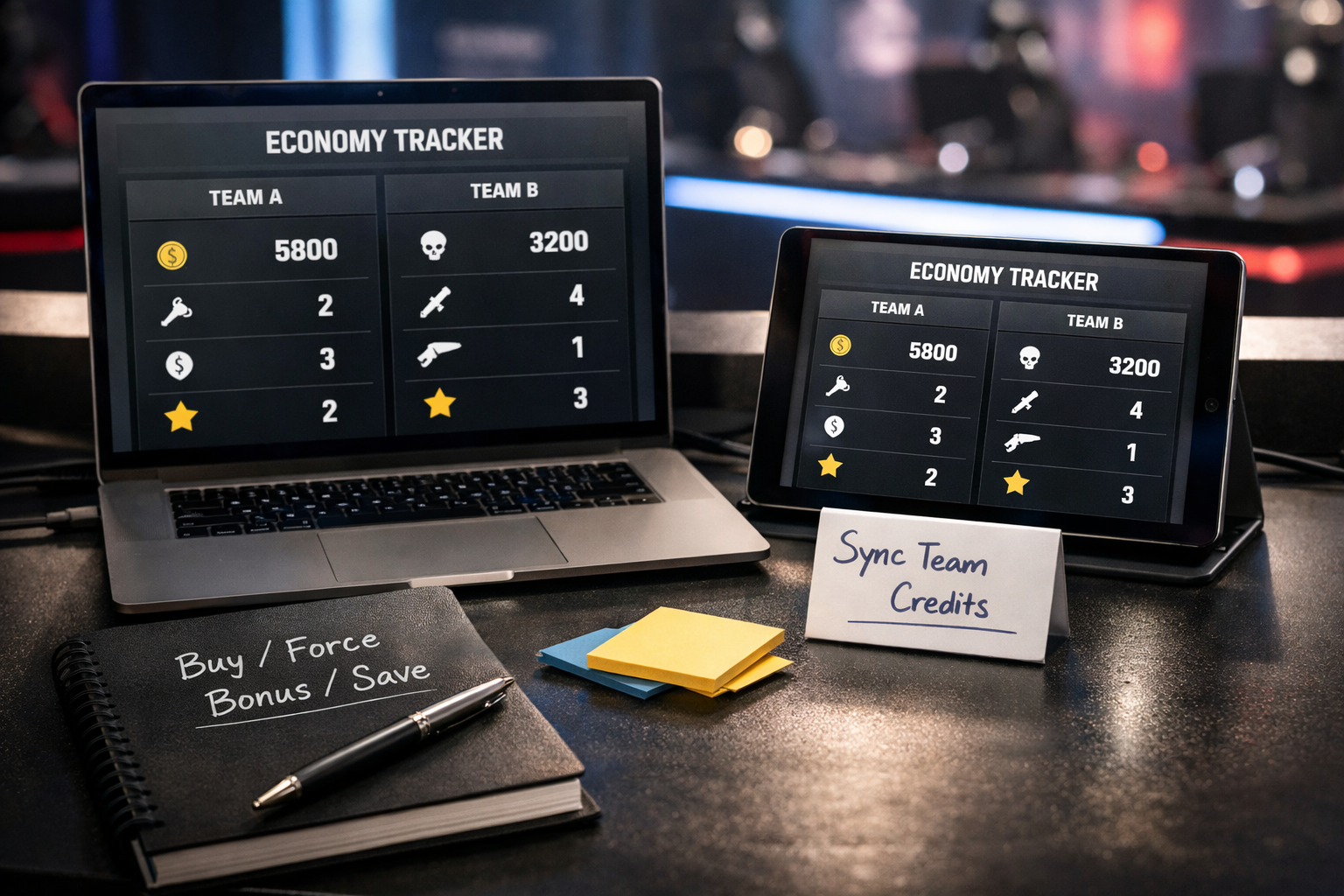
Don’t turn a full save into a confused half buy. If you’re saving, spend minimal credits. Buy only what supports your team’s chosen plan (for example: one key utility piece, or a light weapon if your team is stacking close). The goal is still next round power.
Team Economy Sync: Drops, Roles, and “Don’t Break the Team”
The most important skill is not knowing the perfect buy—it’s keeping five players aligned. Here’s how to do it quickly in solo queue.
The 3-Sentence Buy Call (Works in Any Rank)
- Call the round type: “Full buy / force / bonus / save.”
- Call the goal: “We’re playing for trades / stack / fast hit / plant.”
- Call the next real round: “Next round is rifle + full util.”
This eliminates arguments and prevents split buys.
Drops: The Economy Superpower
Drops are how you convert uneven personal credits into an even team buy. In practice:
- If one teammate is short for a playable weapon, someone who is rich should drop.
- If your team is forcing, coordinate drops so at least 3–4 players have coherent weapons.
- If one role needs a specific weapon (for example, a dedicated long-angle holder), prioritize that role only if it doesn’t break the rest of the team.
Role Economy: Not Everyone Must Spend the Same
Economy isn’t equality—it’s functionality. A support player with critical utility might prioritize ability purchases and a consistent gun. An entry might prioritize armor and trade-friendly weapons. A player holding long angles might invest differently. The team goal stays the same: show up to the key rounds with five players that can execute the plan.
Stop “Solo Saving” in Rifle Rounds
Another classic ranked error is saving alone when the team is full buying. It feels safe, but it usually weakens the round so much that you lose anyway, and then your “saved money” doesn’t matter because you’re now out of sync. If the team full buys, join the plan.
Attack vs Defense: Economy Differences That Matter
Attack: Plant Value and Post-Plant Strength
On attack, your economy is heavily influenced by whether you can plant. In rounds where you’re underbought (force or save), a plant can be a major win condition. It’s not “playing for stats”—it’s playing for the next round buy.
On full buys, think about your post-plant strength: if your plan requires utility to hold the spike, make sure your spending supports that. A perfect rifle with no post-plant utility often turns into a chaotic retake loss.
Defense: Holding Value and Save Discipline
Defense has more opportunities to preserve weapons because you can fall back and save when a site collapses. This is why defense economy often feels “richer” when played correctly. The discipline is knowing when the retake is too low percentage and when saving is correct.
Saving isn’t cowardice if it protects your next rifle round. The mistake is saving when the retake is clearly winnable—or retaking when it’s clearly unwinnable. Communicate quickly: “We save” or “We go now.”
Common Ranked Economy Mistakes (and Fixes)
Mistake 1: The “Hero Rifle” With No Utility
Fix: If your buy removes your ability to trade or execute, you’re not stronger—you’re isolated. Choose a slightly cheaper weapon and keep the utility that makes your round playable.
Mistake 2: Half Buying Without a Plan
Fix: Every non-full buy must have a purpose: steal weapons, stack, plant, or hit a timing. If you can’t name the purpose, you’re probably supposed to save.
Mistake 3: Breaking the Bonus
Fix: If the team calls “bonus,” stop upgrading one-by-one. Play together, trade, and preserve the next full buy.
Mistake 4: Ignoring Drops
Fix: Ask for drops early, not late. If someone is rich, they should offer. Even one drop can turn a broken round into a coherent round.
Mistake 5: Buying Too Late and Losing Round Setup
Fix: Decide in the first few seconds of buy phase. A slightly imperfect buy with good positioning is better than a perfect buy with zero setup.
Practical Round Templates You Can Copy
These templates help you avoid the most common scoreline traps. You don’t need perfect memory—just recognize the situation and apply the pattern.
Template A: Win Pistol → Convert → Bonus → Full Buy
- After pistol win: buy to safely clear close angles and trade as a group.
- Conversion round: don’t overcomplicate—play disciplined, avoid gifting weapons.
- Bonus round: keep carried guns, aim for trades and upgrades.
- Next round: hit full buy with five players and strong utility.
Template B: Lose Pistol → Team Decision (Force Once OR Save Once)
- If forcing: commit to a plan (stack/fast hit), aim to steal momentum.
- If saving: keep it minimal, prioritize next round rifles and utility.
The key is doing it together. Mixed decisions lose both rounds.
Template C: Stabilize After a Loss (Stop the Bleed)
- Call the next “real round.”
- If needed, full save once to sync buys.
- On the real round, spend for a coherent plan (utility + trades).
- If you win, protect the next round with smart buys and drops.
Template D: Breaking Enemy Economy After a Win
When you win a rifle round, the next round is often about preventing the enemy from rebuilding cleanly. Two ways this happens:
- Don’t overchase: preserve your weapons so the enemy can’t equalize through your throws.
- Expect a force: play anti-close angles and trade discipline—don’t gift isolated duels.
Between-Rounds Checklist (10 Seconds)
- What round type are we? Full / force / bonus / save.
- What’s our win condition? Trades / stack / fast exec / plant / upgrade.
- When is our next real round? Next round or in two rounds?
- Do we need drops? Fix uneven buys now.
- Do we have the utility for our plan? Smokes/entry/retake tools.
FAQ
Should we always force after losing pistol?
Not always. Forcing can be strong if your team is coordinated and has a clear plan. Saving can be better if your team tends to split up or if your agents need a cleaner utility buy to function. The worst option is the in-between: random half buys with no plan.
What’s the biggest economy skill for climbing?
Syncing your team’s buy timing. If you can consistently reach key rounds with 4–5 players properly equipped, you will win more “normal” rounds and stop losing to chaotic swing rounds.
When is saving a rifle correct?
Saving is correct when the retake is clearly low percentage (time, utility, numbers disadvantage) and preserving your weapon meaningfully improves next round. It’s incorrect when your team can coordinate a fast retake with utility and trades. The key is making a quick team call—don’t let one person silently save while others die.
How do I stop teammates from split buying?
Use simple language and speed: “Full buy together” or “Full save together—next round rifle.” Then immediately offer a drop or ask for one. Ranked players respond better to short, confident calls than long explanations.
Do I need to memorize exact prices?
No. Prices can change across seasons. Memorize the decision framework and check the buy menu for details. The big wins come from round type selection (buy/force/bonus/save) and team synchronization, not perfect arithmetic.
Want Faster Improvement With Pro Guidance?
If you want help building a personal economy plan (agent-based buys, rifle timing, drop habits, and anti-force protocols), you can check Boosteria’s VALORANT options here: https://boosteria.org/valorant-boosting/prices. Even a short coaching-style review of your last 5 games can reveal where your credits are leaking—and how to fix it.
For ongoing official updates and competitive resources, you can also reference: Play VALORANT (Official), VALORANT Support (Riot), and VALORANT Esports.