



Dota 2 Vision & Map Control: Wards, Sentries, Smokes
Dota 2 — Vision & Map Control: Wards, Sentries, Smokes (Timeless Basics)
In Dota 2, gold and experience win fights—but information wins games. Vision tells you where a fight will happen, when to avoid a bad one, and which objective is actually safe to take. Map control isn’t just “placing wards.” It’s a repeating loop: create information → use it to take space → turn space into objectives → reset vision → repeat.
This guide focuses on timeless fundamentals that stay useful across patches and metas: how to ward with purpose, deward efficiently, coordinate smokes, and build a mental framework for controlling the map—whether you’re position 5 buying most of the vision, a roaming 4 creating pressure, or a core learning to play around fog.
If you want a quick way to level up faster (without guessing what you did wrong every match), you can also check Boosteria’s Dota 2 services here: Dota 2 boosting prices. (We’ll still keep the guide purely educational—this link is just there if you want it.)
1) What “Vision” Really Means in Dota 2
Most players think of vision as “seeing heroes.” That’s only half the value. Real vision is about predicting the next 20–60 seconds of the match. A good ward doesn’t just show a hero—it confirms a plan:
- Safety: Can my core farm here without dying?
- Threat: Can we set up a kill if someone shows?
- Timing: Are they grouping for an objective or split?
- Information denial: Can we force them to move blind?
Vision also includes tools beyond Observer Wards: creep waves, hero positioning, summoned units, illusions, scan usage, smoke breaking, and even enemy support patterns. If your team plays the map well, you often “see” the enemy without literally seeing them.
Vision is a trade: information vs. resources
Every ward costs gold and inventory time. Every deward costs time and risk. The goal isn’t maximum wards—it’s maximum value per ward cycle. A “perfect” high ground ward that gets instantly dewarded can be worse than a simple ward that survives and protects a farming route for three minutes.
Timeless concept: “Where can they be?”
Dota’s fog-of-war creates a permanent question: Where can the enemy be right now? Strong map control shrinks their options. When you control an area, enemies must either: (1) show on a wave, (2) spend resources to invade (smoke, sentries, numbers), or (3) give up that part of the map.
If you want to double-check basic mechanics, patch notes, and official updates, the most reliable sources are Valve’s official Dota 2 site and the in-client updates: dota2.com.
2) A Simple Map Control Framework
Map control becomes easier when you stop thinking in random ward spots and start thinking in zones. Here’s a timeless framework you can use in any match:
- Your safe zone: areas you can farm without dying (usually near towers and teammates).
- The neutral zone: contested space where both teams can appear.
- The enemy zone: areas you enter only with a reason (pressure, smoke, objective).
Vision should support one of these goals: defend safe zone, expand into neutral, or attack enemy zone.
The “Three Questions” rule
Before placing any Observer Ward, answer these three questions:
- What does this ward protect or enable? (farm route, tower, Roshan, smoke entry)
- Who benefits right now? (which core is farming, which lane is pushing)
- What is the next objective? (tower, Roshan, invasion, defense)
If you can’t answer those, you’re probably placing a “habit ward” (predictable and low value).
Wards are strongest when paired with pressure
A ward in a dead area does nothing. A ward in a pressured area becomes deadly. The timeless synergy is: push a wave → enemy responds → your ward sees the response → you punish or take something else.
This is why top teams look “psychic.” They aren’t guessing—they’re forcing predictable reactions, then using vision to confirm it.
3) Observer Ward Basics: Purpose Before Placement
Observer Wards should rarely be placed “because it’s time.” Place them because your team is about to: (1) farm an area, (2) pressure a tower, (3) take Roshan, or (4) smoke / invade.
Three categories of Observer Wards
1) Defensive wards (protect farm)
Defensive wards watch entrances to your safe zone: ramps, jungle pathways, and rotation routes from mid. They are most valuable when your carry is farming nearby and your team isn’t ready to fight. Defensive wards should be hard to deward and should not require you to walk into enemy territory.
2) Aggressive wards (enable kills)
Aggressive wards are for hunting: behind towers, in enemy jungle routes, near triangle access points, and near likely TP response paths. Their job is to help your team connect: spot a target, coordinate stuns, and secure the area long enough to convert into an objective.
3) Objective wards (win the next play)
Objective wards are temporary but powerful. You place them to take a specific action: breach high ground, take Roshan, hold a choke, defend a tower, or protect a siege. These wards might die quickly—and that’s fine—because the goal is the objective, not long duration.
What makes a ward “good”?
- It answers a question: “Can they gank this lane?” “Are they grouping Roshan?”
- It’s timed: placed before the danger, not after the death.
- It’s connected to your team’s position: vision is worthless if no one can respond.
- It’s part of a cycle: ward → play around it → refresh when the map shifts.
Timeless placement principles (instead of “spot lists”)
Patch changes may adjust trees and cliffs, but these principles don’t change:
- Watch entries, not interiors: seeing the enemy enter a zone is more useful than seeing them already inside it.
- See sideways: wards that catch rotations across the map often beat wards that stare at a single camp.
- Prefer asymmetry: place wards where you can approach safely but the enemy must risk to deward.
- Split your vision: one ward sees an approach, another sees a fallback route; don’t stack all value into one cliff.
- Make it awkward: slightly off-meta positions survive longer and still do the job.
For learning patterns and watching high-level games, Liquipedia and replay tools are useful references: Liquipedia Dota 2.
4) Warding by Game Phase: Lane → Midgame → Late
Warding changes because the purpose changes. In lane, you ward to stabilize trades and prevent ganks. In midgame, you ward to control farming routes and set up smokes. In late game, you ward to secure buyback fights and objective setups (especially Roshan and high ground).
Laning stage: information for survival and rune control
In the first minutes, wards should help you answer: Who is rotating? Where is the enemy support? Are runes safe to contest?
- Lane protection wards: watch common gank routes into your core’s lane.
- Mid support wards: help mid survive and control runes.
- Pull / camp info: see whether the enemy is contesting pulls or stacking.
Timeless tip: Don’t over-ward lane cliffs “just because.” If your lane is winning, use vision to protect pressure (see rotations to punish). If your lane is losing, use vision to protect retreat (avoid feeding).
Early-midgame: protect the first farming triangle and tower zones
When supports start moving and cores hit early items, the map opens. Your most important question becomes: Which core is farming where, and what is the next move?
You typically want vision that:
- Protects your carry’s “default farm loop” (lane wave → nearby camps → retreat path).
- Shows enemy supports moving (the real gank enablers).
- Supports your first tower push or tower defense.
Midgame: expand vision with pressure and smokes
Midgame warding is about space creation. If your team is stronger, you want aggressive vision that turns their jungle into danger. If your team is weaker, you want defensive vision that prevents pickoffs and delays the enemy’s map expansion.
The timeless rule is: Ward where you want to play, not where the enemy is currently playing. If you always ward after the enemy takes your area, your vision is permanently behind the game.
Late game: vision is about buybacks and objective commitment
Late game fights are decided by positioning, initiation, and buybacks. Vision should now answer:
- Where will the fight start? (chokes, ramps, objective entrances)
- Can we safely reset? (retreat routes and TP points)
- Can we punish buyback movement? (catch re-entry paths)
In late game, it’s often correct to place “short life” wards that secure a single play: smoke into Roshan, force a tower, or defend high ground.
5) Sentries & True Sight: Deward, Block, Protect
Sentry Wards are not only for dewarding. They are a map control tool: you use them to deny enemy information, block camps, protect your own aggressive vision, and secure objective areas.
Three core uses of sentries
1) Dewarding (remove information)
Dewarding is strongest when it’s systematic, not emotional. A random sentry after you die often misses the real problem. Good dewarding follows logic: “If they ganked from here, their ward likely sees this approach or this wave.”
2) Blocking camps (deny economy)
Blocking is a quiet win condition: it reduces enemy farming efficiency and delays key items. It also changes support behavior—if they must spend time unblocking, they have less time to smoke and gank.
Timeless best practice: only block when you can defend the block or get repeat value. A block that’s removed instantly is fine if it forced a response at the perfect moment (like delaying a stack before a timing).
3) Protecting your own wards (vision layering)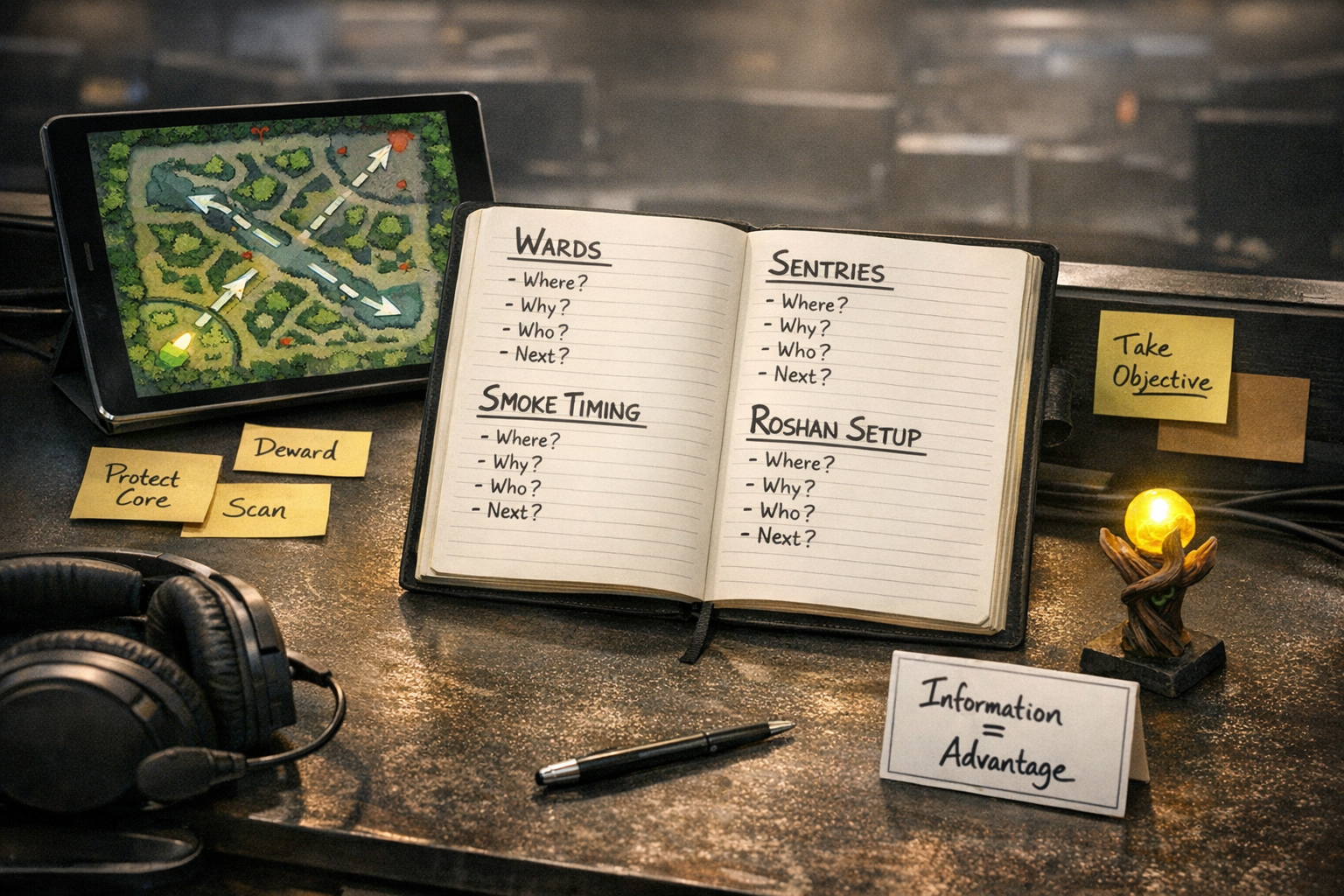
The classic mistake: place an aggressive observer, leave, and lose it immediately. The timeless fix: layer protection. If you want an aggressive ward to live, consider:
- Placing a sentry nearby to catch the enemy’s counter-sentry.
- Choosing a ward position that forces the enemy to show on a wave to approach it.
- Placing the ward during a moment of pressure so the enemy can’t safely deward.
True sight is a tempo play
Don’t treat sentries as “support chores.” Every successful deward is a tempo win: you remove their information, force them to play slower, and gain freedom to take the next objective.
Public stats and replay analysis tools can help you review vision impact in your own games: OpenDota and Dotabuff. Use them to see where deaths happen and whether your team had vision when it mattered.
6) A Practical Dewarding System (No Guessing)
Dewarding is easiest when you stop thinking “Where do people ward?” and start thinking: What information did the enemy need, and how did they get it?
Step 1: Identify the “information event”
Ask: what did the enemy do that proves they had vision?
- They wrapped behind your carry perfectly.
- They dodged your smoke at the exact moment you entered their jungle.
- They always initiate from the same angle with confidence.
- They instantly punished a support walking to ward.
These are “information events.” They narrow the ward possibilities.
Step 2: Connect the event to a vision requirement
Example: they wrapped behind your carry in your triangle. For that wrap to work, they likely saw either: (a) your carry farming a camp loop, or (b) your supports leaving the area, or (c) the wave state that made the carry predictable.
That means their ward is probably on an entry route, near a common farming path, or near a wave-viewing point. Now your sentry placement becomes targeted, not random.
Step 3: “Triangulate” with two small checks
When you suspect an area:
- Check pathing: Where did the enemy come from and where did they retreat?
- Check timing: Did they move before you showed on the wave or after?
If they moved before you showed, they had a deeper ward (entry/rotation). If they moved after you showed, they may only be reacting to the wave.
Step 4: Deward safely (this is where most supports die)
Dewarding is risky because it’s predictable: you walk into fog and stop to place a sentry. Timeless safety rules:
- Deward with a wave: when creeps are near, enemies are more likely to show or be busy.
- Deward with a buddy: one extra hero nearby changes everything.
- Deward after showing elsewhere: force them to respond, then deward while they’re visible.
- Deward and instantly leave: don’t linger and “admire the vision.” Reset your position.
Step 5: Replace vision as a “trade”
The best deward is often: remove their ward → place your ward in a different angle. This flips information advantage. If you only deward without replacing, you miss the chance to immediately punish while they’re blind.
7) Smokes: How to Make Them Work Every Patch
Smoke plays are timeless because they solve the same problem in every meta: How do we start a fight on our terms without being seen? Smokes are not “random gank buttons.” They are a strategic tool to:
- Convert vision advantage into a kill.
- Break the enemy’s map control and reclaim space.
- Force an objective (tower or Roshan) by removing a defender.
- Find the key hero before they finish an item or hit a timing.
The timeless smoke formula
Most successful smokes follow this structure:
- Prep: push a wave, place/refresh a ward, or confirm enemy positions.
- Group: smoke only when you have enough heroes to kill the target quickly.
- Path: choose a route through fog that avoids obvious ward lines.
- First contact: kill fast or disengage fast—hesitation ruins smokes.
- Conversion: turn the kill into an objective or deep vision, not just a reset.
Smoke timing: when it’s best
- After an enemy shows far: if their key hero is on the other side, you can punish the remaining map.
- After you shove lanes: lanes create “information pressure” and force reactions.
- Before a major objective window: Roshan attempts, tower sieges, or big item timings.
- Right after you deward: enemies feel safe when they have vision; removing it makes them vulnerable.
Smoke pathing: avoid the “straight line into death”
The most common reason smokes fail is predictable movement. Many teams smoke from base and run directly to the enemy triangle or mid—exactly where wards are usually watching. Timeless pathing improvements:
- Enter from side angles: wrap behind towers, approach through less traveled ramps.
- Use wave cover: if a lane is pushing, enemies watch that lane; approach from the opposite side.
- Break your own pattern: if you smoked top twice, smoke mid-to-bot via a different route next.
What to do when smoke breaks
Smoke breaking is information. It tells you someone is nearby. The mistake is panic. The timeless rule: If smoke breaks early, either commit instantly to the nearest kill, or disengage instantly. Half-commits create staggered deaths.
Smoke + vision synergy: “Ward to enter, ward to exit”
If you want smokes to win games, link them to vision:
- Entry ward: helps you choose the correct first target or confirms a rotation route.
- Exit ward: placed after the kill to control the area and stop counter-smokes.
Even if you don’t kill anyone, a good smoke can still win if it gives you: deep vision + space for your cores + control of an objective.
8) Vision Around Objectives: Towers, Outposts, Roshan
Objectives are where vision becomes decisive. Teams don’t lose because “they had fewer wards.” They lose because they took an objective while blind—or defended one without information.
Towers: see TP reactions and flank routes
When pushing a tower, the most important vision is rarely “on the tower.” It’s on:
- Approach ramps and flanks that allow the enemy to initiate.
- Nearby TP access points and common defender paths.
- Backline angles where supports hide to cast spells.
Timeless push rule: Ward where the enemy must come from to fight you, not where you are already standing.
Defending towers: “two layers” of information
A stable defense often needs two layers:
- Outer layer: sees them coming (rotation ward, entry ward).
- Inner layer: sees the fight area (choke, ramp, backline).
The outer layer tells you whether to defend or trade. The inner layer tells you how to take the fight if you commit.
Outposts and map anchors
“Anchors” are points that stabilize your map: tower remnants, outposts, or strong warded triangles. Vision around anchors helps you:
- Keep a core farming safely near the anchor.
- Prevent smokes into your backline.
- Create a safe launchpad for your own smoke.
Roshan: the timeless vision battleground
Roshan fights are decided before they happen. If you control the area around the pit (approaches, ramps, nearby chokes), you control the fight.
A timeless Roshan vision plan includes:
- Approach vision: see enemies moving toward the pit from multiple routes.
- True sight: sentries to remove enemy wards and protect your own setup.
- Fight vision: wards that show high grounds and flanks around the pit.
- Post-Roshan vision: a ward to secure your exit or enable a siege with Aegis.
Timeless Roshan mistake: teams start Roshan with no plan for the fight. Always ask: If they arrive, do we finish, turn, or disengage? Your wards should support that answer.
9) Playing Around Fog: Core & Support Responsibilities
Vision isn’t only a support job. Supports may buy wards, but cores often decide whether vision has value—by where they farm, when they show, and how they react to missing heroes.
Position 5: the “map safety manager”
Your timeless priorities:
- Protect the win condition: identify who must not die (often your carry or your scaling mid).
- Keep defensive vision updated: entrances to your safe farm zones.
- Maintain sentry discipline: deward the areas that cause deaths, not random hills.
- Communicate the map story: “we’re blind here,” “they have vision top,” “smoke likely.”
Position 4: the “information attacker”
Your timeless priorities:
- Create pressure: force enemy responses so wards become meaningful.
- Help place aggressive vision safely: smoke, wrap, or move with a core.
- Enable picks: your roaming should connect vision to stuns and damage.
- Disrupt enemy sentries: punish predictable deward attempts.
Cores: how to “use” vision correctly
Many cores waste vision by ignoring it. If your team wards an area and you farm elsewhere, that ward is dead value. If you farm the warded area but still die, you may be: (1) pushing too far past the vision line, (2) farming with no escape route, (3) showing on the wrong wave at the wrong time.
Timeless core rules:
- Farm behind your vision line: don’t cross into darkness without a reason.
- Read missing heroes: if key enemy heroes are missing, assume smoke or wrap until proven otherwise.
- Don’t “fix” vision by dying: if your supports are trying to ward, play safe for 20 seconds so they can do it.
- Buy your own survival tools when needed: sometimes a sentry, smoke, or detection is the best 50 gold you’ll spend.
Communication: simple callouts that improve vision play
Use short, action-focused phrases:
- “We are blind top.” (means: don’t farm there / need a ward)
- “Sentry triangle then smoke.” (means: remove vision before committing)
- “They dewarded here.” (means: enemy supports are nearby; punish or shift)
- “Wave pushed, we can ward now.” (means: timing window is open)
10) Common Vision Mistakes (and Quick Fixes)
Mistake 1: Warding the same cliffs every game
Predictable wards die fast. Quick fix: keep the purpose but change the angle. If you want to watch an entry, place the ward slightly off the obvious cliff so it still sees movement but survives longer.
Mistake 2: Placing aggressive wards without pressure
If no lane is pushed and your heroes aren’t threatening anything, aggressive wards are easy to deward. Quick fix: push a wave first or smoke to place the ward, then immediately make a play around it.
Mistake 3: Dewarding alone and feeding
Many supports die because they deward “on schedule” instead of “on timing.” Quick fix: deward with a wave, with a teammate, or after forcing the enemy to show elsewhere.
Mistake 4: Smokes used with no conversion
A smoke that gets a kill but wins nothing else often isn’t enough. Quick fix: before smoking, decide your conversion: tower, Roshan, invade, or deep vision.
Mistake 5: Vision doesn’t match the win condition
If your carry needs 5 minutes, your wards should protect farming and prevent pickoffs. If your lineup wants to fight now, your wards should enable initiation and punish rotations. Quick fix: identify your team’s next 5-minute goal and ward for that.
11) Habits & Drills to Improve Vision Fast
Habit: Treat every ward like a mini-plan
When you place a ward, immediately ask: What do we do if we see someone? If the answer is “nothing,” the ward is low value.
Habit: Track enemy support movement
Enemy supports reveal vision patterns by where they walk and when they disappear. If a support leaves lane, goes missing, and your offlane suddenly gets wrapped, that’s a story. Train yourself to notice these patterns: they help you predict wards and smokes.
Drill: Post-game “death review” (5 minutes)
After a match, review your deaths and your carry’s deaths:
- Were you in vision or fog?
- Did you have an observer covering the approach?
- Did the enemy initiate from a flank that you never warded?
- Was your lane pushed (giving you time to ward) or shoved into you (forcing you to stay)?
Do this consistently and you’ll stop repeating the same vision mistakes.
Drill: “Ward cycle” awareness
Practice thinking in cycles: When your ward is placed, note mentally when it will likely be contested (after they lose a fight, after they smoke, after they take a tower). Then be ready to refresh vision before you get punished.
Drill: Smoke discipline practice
In your next 10 games, make a rule: “We only smoke after pushing a wave or after a deward.” This single constraint forces better smokes and reduces random failures.
12) Quick Checklists: Ward, Deward, Smoke
Observer Ward checklist
- What does this ward protect or enable?
- Which core is playing near it right now?
- Does it see an entry route or only a camp?
- Can we respond if we see someone?
- Is it placed with pressure (wave pushed / enemies showing)?
Sentry / Deward checklist
- What “information event” suggests they have a ward?
- Which approach path did they use?
- Can I deward safely (wave / teammate / enemies showing)?
- After deward, can I replace vision from a new angle?
- Did we gain space or an objective from the deward?
Smoke checklist
- What is the goal: kill, Roshan, tower, invasion, or reset vision?
- Did we push at least one lane first?
- Do we have enough heroes to kill quickly?
- Is our path avoiding obvious ward lines?
- After first contact, do we convert immediately?
13) FAQ
How many wards should we have up at once?
The correct number is “enough to support your current plan.” Defensive play usually needs stable vision around farming zones. Aggressive play needs vision on enemy routes and objective areas. Instead of counting wards, measure outcomes: Are your cores dying in “unexpected” places? Are your smokes working? Are you taking objectives safely?
Should I always ward high grounds?
High ground wards are powerful—but predictable. If your ward dies instantly, consider a lower, less obvious angle that still watches the entry route. The best ward is the one that survives long enough to produce a real map advantage.
When should we buy detection beyond sentries?
If invis heroes or invis items are deciding fights, detection becomes a team responsibility. Don’t rely on one support to solve everything. Timeless rule: if you keep dying to invis, you’re already paying the cost—just in deaths instead of gold.
How do we play when we’re behind and have no map control?
Start with defensive vision, protect your strongest farming lane, and avoid feeding. Look for a smoke that removes a key hero or wins one strong fight near an objective. Behind teams usually recover by: (1) catching a greedy core, (2) winning a fight around a tower/high ground, (3) converting into Roshan or a map reset.
What’s the easiest way to improve vision as a core?
Respect the vision line: farm where your team has information, and avoid stepping into darkness without a plan. Also: help your supports by playing safer for short windows when they need to ward. One minute of discipline can save a whole ward cycle.
14) Final Takeaways
Vision and map control are not about memorizing ward spots. They’re about purpose, timing, pressure, and conversion. If you keep these fundamentals, your warding stays relevant across patches:
- Ward with a goal: protect farm, enable kills, secure objectives.
- Deward systematically: use “information events” and safe timings.
- Smoke with structure: prep → group → path → contact → convert.
- Win the map in cycles: gain space, use it, refresh vision, repeat.
If you want a faster path to climbing (and want help applying these concepts to your role, hero pool, and bracket), you can explore: Boosteria Dota 2 boosting prices.
For continued self-improvement, reviewing your games with public tools can also help: OpenDota and Dotabuff.