



CS2 Economy 101: Full Buys, Forces, Half Buys & Saves
CS2 — Economy 101: Full Buys, Half Buys, Forces, and When to Save
In Counter-Strike 2, aim and utility win fights—but economy wins matches. Most “random” stomps are actually predictable outcomes of better buy timing: one team stacks strong rounds together, while the other keeps taking underpowered fights at the worst moments.
This guide teaches you a timeless economy framework you can apply across patches and map pools: how to recognize full buys, half buys, force buys, bonus rounds, and hard saves—plus how to make those calls as a team without overcomplicating it.
If you want faster improvement with structured coaching and consistent teammates, check Boosteria’s CS2 services: CS2 Boosting Prices. (Even if you never buy anything, treat this article as your team’s “economy playbook.”)
The Real Goal of Economy
Many players think economy is simply “buy when you can.” That mindset creates two problems: solo buys (one player is strong, four are weak) and timing losses (you spend money right before the enemy spikes).
A better definition: Economy is the art of stacking your strongest rounds together while forcing your opponent to fight during their weakest rounds. This is why coordinated teams feel oppressive even when they’re not individually better—they create “power windows” where their weapons, armor, and utility are consistently superior for several rounds in a row.
When you manage money well, you achieve three things:
- Consistency: fewer “trash rounds” where you have zero chance.
- Pressure: more rounds where you can execute properly with grenades and trade setups.
- Momentum control: you choose when to gamble (force) and when to stabilize (save into full).
You do not need exact dollar thresholds memorized to play good economy. You need principles, simple team rules, and the discipline to follow your call even when it feels boring.
Buy Language: Full / Half / Force / Save / Bonus
Economy breaks down when teammates use different definitions. Fix this by using shared language. Here’s a practical “ranked-ready” set of definitions:
Full Buy
A round where your team can field a complete fighting setup: rifles (or AWP), armor, and enough utility to play your plan. A “full buy” is not just about a rifle— it’s about being able to win the round on purpose (execute, retake, deny, isolate).
Half Buy
A round where you intentionally spend some money (often on pistols, light armor, or a few grenades) while still preserving enough to full buy next. The goal is to: increase win chance without destroying the next round’s power.
Force Buy
A round where you spend nearly everything even though you can’t build a “proper” full buy. You force when the strategic value of winning now is worth the risk of being broke later.
Save (Hard Eco)
A round where you minimize spending to maximize next round. You still try to get value (damage, upgrades, exits), but you’re not pretending it’s a normal gun round.
Bonus Round
A round after a win—often after pistol—where you choose to keep cheaper weapons to build a stronger economy while still having a good chance to win. “Bonus” means: you’re happy if you win, and not devastated if you lose, because the next round is your real power spike.
The 6 Baseline Rules That Prevent Throw Buys
If your team follows these six rules, you’ll instantly reduce the most common ranked economy griefing: random buys, double ecos, and constant “one guy broke” rounds.
- Buy together, lose together.
A “mixed” round (two rifles, three pistols) is usually the worst of both worlds: your rifles can’t be supported, and your pistols can’t trade effectively. - Plan for next round before you spend this round.
Ask: “If we lose, what does our next buy look like?” Good economy is forward-looking. - Full buy requires utility.
If you have rifles but no smoke/molly/flash for your role, it’s not a full buy—your round will collapse under pressure. - Never chase a ‘hero gun’ at the cost of the team.
If one player buys an AWP and leaves teammates with nothing, you’ve created a fragile round that fails with one death. - When in doubt, stabilize.
Most ranks lose more games by forcing too often than by saving too often. Stabilizing builds streaks of strong rounds. - Save with a purpose.
A save round isn’t “do nothing.” It’s “take a low-risk play to damage, steal, or force rotations” without gifting free kills.
If you only remember one sentence from this article, make it this: “Strong rounds come in blocks.” Your job is to create blocks of strong rounds for your team—and blocks of weak rounds for the enemy.
Full Buy: When to Commit and What “Full” Means
What a “real” full buy looks like
A full buy is the round where your team expects to win through structure: trading, utility timing, and clear win conditions. In practical terms, a full buy usually includes:
- Primary weapons: rifles for most players; AWP when your plan supports it.
- Armor: enough to survive chip damage and fight multiple duels.
- Utility: at least a smoke + flash baseline for the players making first contact, plus mollies/HEs where relevant.
- Role clarity: who is entry, who is trade, who holds flank, who supports with flashes, who anchors.
When you should full buy
You should full buy when your team can field a coherent round without sabotaging the next one. Common “green light” situations:
- After a save when everyone can now afford rifles + armor + some utility.
- After losing a close round where your economy is still healthy enough to keep pressure.
- When the enemy is likely on a weaker buy and you can punish with disciplined trading.
- When you have momentum and want to lock the half by chaining two strong gun rounds.
Full buy doesn’t mean “buy the most expensive gun”
Many players “full buy” by upgrading their weapon and downgrading their utility. That’s backwards. In CS2, utility multiplies the value of rifles: smokes create safe space, flashes create favorable fights, mollies clear angles, and HE stacks punish grouped setups.
If your role is “support,” your best full buy might be: rifle + armor + full utility instead of rifle + expensive extras with no grenades. Your utility enables entries and retakes—two phases where rounds are often decided.
How to protect your economy during full buys
Full buys are where teams accidentally throw economy by making two common mistakes: late-round hero plays and unnecessary rebuys.
- Late-round hero plays: If the round is already lost, stop feeding kills. Preserve guns when you can. Saving one rifle can be the difference between a full buy and a broken half buy next.
- Unnecessary rebuys: If you win with three rifles and two SMGs, consider upgrading only the weakest parts. Don’t throw away money that could buffer your next loss.
Half Buy: The Bridge Round That Sets Up a Stronger One
Half buys are misunderstood. People treat them as “buy whatever you feel like.” A real half buy is a planned round with a specific objective: increase your chance to steal the round while guaranteeing a better next buy.
Why half buys win games
Half buys keep your economy healthy. They reduce the “double-eco” pattern where a team saves, then buys badly, then has to save again. The best teams use half buys to stay competitive even when they’re behind.
Half buy goals
- Pick a win condition: a stack, a trap, a fast hit, or a coordinated retake attempt.
- Create upgrade potential: fight in areas where you can retrieve rifles safely.
- Protect next round: don’t spend so much that you destroy the next full buy.
Common half buy setups (conceptual)
These are principles, not rigid shopping lists:
- Armor + pistol focus: survive long enough to trade and steal a rifle.
- Light utility for a single play: one smoke to cross, one flash to burst, one molly to clear a close angle.
- One “power” piece if it fits the plan: a single better gun can anchor a stack or lead a set play, but only if it doesn’t break the team’s next round.
How to decide if it’s half buy or save
Ask two questions:
- Will spending here improve our round plan? (Not just “I want a better gun.”)
- Will we still have a strong buy next round if we lose?
If the answer to (2) is “no,” it’s probably not a half buy—it’s a disguised force buy.
Force Buy: When It’s Worth Breaking the Rules
Force buys are not “bad.” Random force buys are bad. A smart force is a deliberate risk taken for a strategic reason: map control, half control, breaking the enemy’s economy, or leveraging a timing window.
When force buys make sense
- To break the opponent’s economy at a critical moment: If the enemy is barely afloat and a loss would ruin their next buy, forcing can swing the entire half.
- When you’re down in the half and need volatility: If saving guarantees you lose another round anyway (because of score/time pressure), forcing can create comeback chances.
- After pistol loss when a conversion win would crush the opponent: Some teams force early to avoid falling into a multi-round deficit.
- When you have a strong read: If you know the enemy pattern and can stack the correct site or trap their default, a force can be high value.
When force buys usually fail
- When your team is not coordinated: untraded fights and scattered buys waste money.
- When you can’t define a win condition: “let’s just go A” without utility/trading is coinflip.
- When it creates two weak rounds in a row: a failed force plus a broken next round is a common losing spiral.
How to force correctly
A good force buy has:
- A single plan the whole team understands (“fast B off two flashes,” “stack A and play retake,” “mid crunch”).
- Trading rules (“no solo peeks,” “second man always ready”).
- Utility concentration (even limited grenades can be strong if they’re timed together).
- Exit discipline if the round becomes unwinnable (save what you can).
The biggest force-buy upgrade you can make is not a weapon—it’s communication: force together or don’t force at all.
Save Round: How to Lose on Purpose Without Wasting Value
Save rounds feel terrible, so players sabotage them by “half-forcing” with random purchases. But a disciplined save round is a weapon: it lets you build a strong buy that can win multiple rounds in a row.
The three objectives of a save round
- Preserve money for a real buy next.
- Extract value through damage, kills, or upgrades.
- Deny enemy economy by forcing them to survive and keep weapons, or by making them rebuy utility.
How to get value on a save
- Play together: groups can trade and steal a rifle. Solo saves usually just feed.
- Choose close-range fights: tighter angles reduce the enemy’s rifle advantage.
- Target isolated players: punish lurkers, late rotates, or greedy hunters.
- Plan an exit route: if you get a rifle, prioritize surviving with it.
When to “hard save” vs “active save”
Not all saves are identical:
- Hard save: you avoid fights, preserve what you have, and aim for the strongest next round possible.
- Active save: you still keep spending low, but you commit to a coordinated trap or stack to steal weapons.
The difference is your risk tolerance. If your next round is a guaranteed strong buy anyway, you can take an active save to try to steal momentum. If your economy is fragile, hard save protects the future.
Bonus Rounds After a Win: How to Farm and Upgrade
Bonus rounds are where good teams become rich and bad teams become “almost rich.” After winning with cheaper weapons, you often have a choice: upgrade immediately or carry over and build a bigger bank.
The bonus round mindset
A bonus round is an investment. You accept slightly lower firepower now to:
- Build buffer money so one loss doesn’t break your next buy.
- Keep enemy economy under pressure if they finally full buy and still lose.
- Upgrade naturally by stealing rifles as the round progresses.
How to play bonus rounds effectively
- Don’t gift rifles early: avoid solo peeks with SMGs or light rifles.
- Lean into utility and teamplay: flashes and smokes help close the weapon gap.
- Hunt smart, not greedy: chasing kills can throw your economy if you die after time or lose weapons.
- Know your upgrade plan: who keeps what, who swaps, who saves for AWP later.
Bonus rounds are a big reason pro teams look “unstoppable”: they turn early wins into a money engine. You can copy that in ranked by simply not overbuying after every win.
Pistols & Conversion Rounds (Round 1–3 Patterns)
Early rounds create snowball effects. You don’t need perfect meta purchases to benefit— you need correct round goals and smart conversions.
Round 1: Pistol is about structure, not hero aim
- T side: use numbers and flashes to isolate defenders; trade immediately.
- CT side: play crossfires and force the attackers to clear multiple angles.
- Both sides: don’t split into isolated 1v1s unless it’s part of a plan.
Round 2: Conversion is about denying upgrades
After winning pistol, your job is to win the next round with minimal casualties. The enemy is often on a low buy or force. Your priorities:
- Stay alive: avoid risky solo duels that hand over weapons.
- Clear corners properly: low buys love close angles and stacks.
- Use utility to reduce chaos: a smoke/flash can prevent the one rifle steal that flips the round.
Round 3: The first “real” test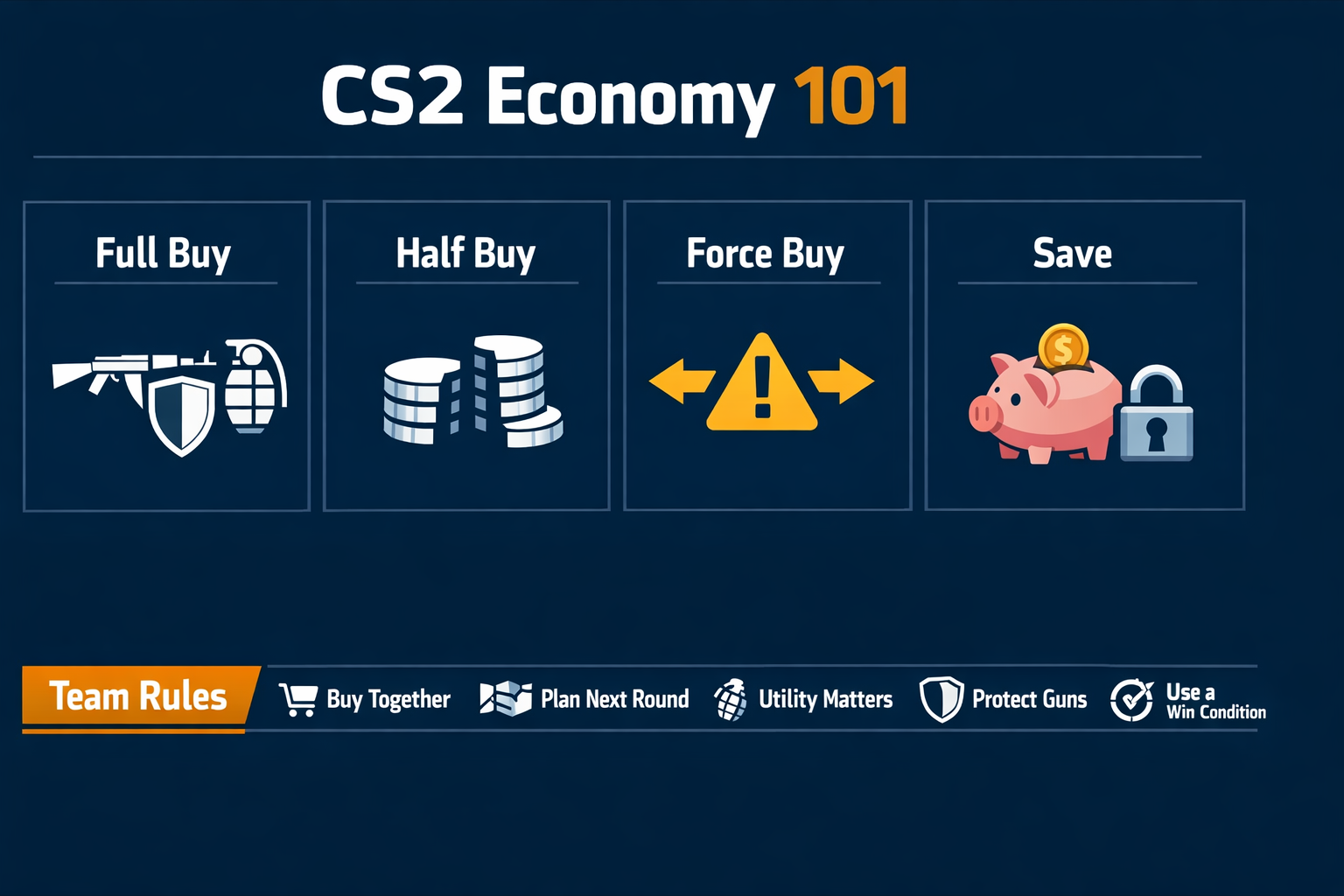
Round 3 often decides whether your early advantage becomes a lead or disappears. If you converted cleanly, you can choose: play a bonus (keep cheaper weapons and farm) or upgrade (secure maximum firepower).
Use a simple rule: If your current weapons still give you a good chance to win and you can keep money high, consider a bonus. If the enemy will likely full buy and your weapons are too weak to play your map plan, upgrade.
CT vs T Economy: Same Concepts, Different Priorities
The economy logic is the same on both sides: stack strong rounds, coordinate buys, avoid mixed trash rounds. But CT and T rounds ask different questions.
CT side: utility and position are your “second weapon”
CTs often need utility to control space (smokes for choke points, mollies for rush denial, flashes for retakes). If CTs buy rifles with no grenades, they frequently lose map control and get executed on.
CT economy also benefits from survivability. If you can save two rifles from a lost site, your next round might be a partial buy that still fights like a full buy.
T side: executions and trading scale with coordination
Ts can convert weaker weapons into wins more often if they have: flashes, timing, and clean trades. A force buy on T side can be very strong when it’s built around a fast hit or a crunch with a clear first-contact plan.
Side-specific mindset shift
- As CT: think “deny space, delay, retake with utility.”
- As T: think “create unfair fights, isolate anchors, trade instantly.”
Economy decisions should support that identity. If your buy cannot support your side’s win conditions, it’s not a good buy—no matter what gun is in your hands.
Team Coordination: Calling Buys in 10 Seconds
Ranked teams fail economy because nobody wants to lead. You can fix this with a simple protocol that takes 10 seconds at the start of each buy time.
The 10-second buy call protocol
- One person asks: “Can we full next if we lose?”
- Everyone quickly answers: “Yes / No / Close.”
- Caller chooses one: “Full / Half / Force / Save.”
- Caller adds a plan: “Stack B,” “fast A,” “play retake,” “default into late exec.”
How to handle the “one guy is broke” problem
This happens constantly. Solve it with one of these team-friendly options:
- Downshift together: convert the round into a half buy so everyone is aligned.
- Drop smart: if the team can still buy full and it won’t break the next round, drop to keep roles functional.
- Stabilize next: if dropping destroys the next round, don’t drop—save into a cleaner full buy.
The key is to decide as a team. Random charity drops often create a “we won but we’re broke” situation two rounds later.
Utility Priority: When Grenades Beat a Bigger Gun
One of the most timeless truths in Counter-Strike is that utility creates advantages before bullets are fired. If you’re learning economy, you must learn to value grenades correctly.
Utility as a multiplier
A rifle without a flash often takes a fair duel. A rifle with a flash often takes an unfair duel. Economy is not only “how strong is my gun,” but “how many unfair fights can my team create this round.”
Simple utility rules
- Entries need flashes more than they need perfect guns.
- Anchors need delay tools (smoke/molly) more than extra upgrades.
- Retakes require smokes (to cross or isolate) and flashes (to swing and trade).
- Half buys should focus utility on one plan, not spread one grenade across five players randomly.
If your team wants a quick checklist for learning nade fundamentals, Liquipedia’s CS coverage is a useful reference hub: Liquipedia Counter-Strike. For broader CS news and match context, HLTV is widely used: HLTV. For official updates and announcements, bookmark Valve’s Counter-Strike site: counter-strike.net.
Common Economy Mistakes (and Fixes)
Mistake #1: “I can afford a rifle, so it’s a buy round.”
A rifle alone is not a buy. If the team can’t support that rifle with trading and utility, you’re effectively taking low-percentage fights and donating weapons.
Fix: Buy as a team. If the team isn’t buying, don’t “solo buy” unless it’s part of a called force plan.
Mistake #2: Mixed buys every other round
The pattern looks like this: two players buy, three save; you lose; then the three buy and the two are broke. You end up with no real full buy for multiple rounds.
Fix: Use clear categories (full/half/force/save). If one player can’t buy, downshift together or save.
Mistake #3: Forcing without a plan
A force without a plan is just gambling. You’re relying on random duels against better weapons.
Fix: Every force needs a win condition: a stack, a trap, a crunch, or a fast hit with timed flashes.
Mistake #4: Overbuying after a win
Players feel invincible after winning and immediately spend to max out. Then one loss breaks everyone’s bank, and the lead disappears.
Fix: Use bonus rounds and selective upgrades. Keep buffer money whenever possible.
Mistake #5: Throwing away guns in unwinnable rounds
Running into a 1v4 with 20 seconds left is emotional, not strategic. Your “save” is sometimes your next round’s weapon.
Fix: Recognize unwinnable states and preserve value. Make saving a normal team behavior, not a shameful one.
Practical Scenarios: What to Buy and Why
You’ll learn economy faster through situations than through rules. Here are common ranked scenarios and the decision logic behind them. (No exact money math required.)
Scenario 1: You lost a close gun round (bomb planted, 2v2 lost)
Decision: Usually full buy if most players can still afford rifles, armor, and some utility. The key is whether losing again creates a double eco.
Why: Close losses often mean your structure is working. One adjustment can flip the next round. If your money can sustain another buy, keep pressure and deny enemy momentum.
Scenario 2: You lost hard (no plant, 5 alive on enemy)
Decision: Often save or half buy, depending on how far you are from a real buy.
Why: A hard loss suggests your plan failed early. Forcing into the same mismatch often creates a two-round collapse. Stabilize, then return with a complete setup.
Scenario 3: Your team won pistol and converted, now enemy likely full buys
Decision: Consider a bonus round if your current weapons can still fight with utility and teamwork. If your weapons are too weak for your map plan, selectively upgrade.
Why: Bonus rounds build bank. If you win the bonus, you often break the enemy’s first real gun round, which can decide the half.
Scenario 4: You’re down late in the half and need rounds fast
Decision: Lean toward forces or aggressive half buys with clear win conditions.
Why: Saving can be “correct” but still lose you the match if it guarantees you run out of rounds. At some point, volatility is your friend.
Scenario 5: CT side, you saved two rifles last round
Decision: Build around the saved rifles. The rifle savers become anchors; teammates buy utility and lighter upgrades.
Why: Saved rifles act like free money. Protect them with utility and crossfires to stabilize your defense.
Scenario 6: Someone insists on buying an AWP but the team can’t support it
Decision: Treat this as a team choice, not a solo choice. If the AWP forces others onto weak buys, say no. If you can drop without breaking future rounds, and the map/role supports it, say yes.
Why: An unsupported AWP often turns into a donated AWP. The best AWP rounds are built with utility and teammates who can trade around the AWP player.
Practice Drills: Train Economy Like a Skill
Economy is decision-making under time pressure. If you want it to become automatic, train it deliberately.
Drill 1: The “Next Round” habit
During buy time, say out loud: “If we lose, we will ____ next.” (Full / Half / Save / Force). Do this for ten matches and you’ll stop throw-buying.
Drill 2: One-call leadership
In solo queue, volunteer to call buys for 5 games. Keep it simple: “Save,” “Half,” “Force,” or “Full,” plus a single plan (“stack B,” “fast A,” “default”). Your win rate will improve just from reducing chaos.
Drill 3: Bonus discipline
After a conversion win, practice not upgrading everything immediately. Track how often your team stays economically stable after one loss. The goal is to avoid the emotional “spend because we’re winning” trap.
Drill 4: Save round value
On save rounds, aim for one of these outcomes: steal one rifle, deal meaningful damage, or force multiple enemies to rebuy. If you get none, review why (bad grouping, wrong fights, no plan).
Glossary
- Full Buy: Team has complete fighting setups (guns + armor + utility) and a real plan.
- Half Buy: Controlled spending to increase chance now while guaranteeing a better next buy.
- Force Buy: High-risk spend to win now for strategic reasons (momentum, economy break, score pressure).
- Save / Hard Eco: Minimal spending to maximize next round strength.
- Bonus Round: Keeping cheaper weapons after a win to grow economy while still contesting the round.
- Mixed Buy: Uncoordinated purchases leading to uneven team power—usually bad.
- Buffer Money: Extra bank so a loss doesn’t break your next buy.
- Win Condition: The specific way you plan to win a round (stack, crunch, fast hit, retake trap, etc.).
FAQ
Is it better to force more in ranked since teams are uncoordinated?
Usually, no. Uncoordinated teams get worse value from forces because they don’t trade properly or follow a plan. You should force when you can define a simple win condition the team will actually execute. Otherwise, stabilize into real full buys and win with structure.
How do I stop teammates from ruining buys?
Use short, confident calls: “Save this,” “Half next,” “Full together next.” Then add one plan: “Stack B,” “Play retake A,” “Fast mid.” People follow clarity more than they follow perfect logic.
Do I need to memorize exact economy numbers?
Not to climb. Exact thresholds can change over time, but principles don’t. Focus on: buying together, planning next round, prioritizing utility, and protecting buffer money. If you want deeper detail, keep an eye on official patch notes and announcements: counter-strike.net.
What’s the fastest way to improve CS2 economy decisions?
Review your losses and tag them as one of these categories: (1) bad buy timing, (2) mixed buys, (3) force with no plan, (4) overbuy after a win, (5) failed saves (fed guns). Fixing just one category often adds several rounds per match. If you want guided improvement, Boosteria’s CS2 options are here: CS2 Boosting Prices.