



Marvel Rivals Team Composition Guide: Synergy & Drafting 2026
Marvel Rivals Team Composition Guide 2026: Synergy Builds and Drafting Strategies for Beginners
If you’re new to Marvel Rivals, team composition can feel chaotic: heroes fly in, walls break, Team-Up abilities collide, and suddenly your “random” lineup either steamrolls or collapses. The good news: you don’t need perfect aim or encyclopedic hero knowledge to build winning teams. You need a simple framework: pick a clear win condition, cover essential jobs, and choose heroes whose kits naturally help each other.
This guide is written to stay useful over time. Instead of chasing short-lived “meta lists,” you’ll learn timeless composition principles, beginner-friendly synergy templates, and drafting habits that help you win more often—no matter which heroes are popular this season. We’ll keep examples practical, and we’ll show you how to adapt when the lobby doesn’t cooperate.
Official references for game basics: the Marvel Rivals official site and the Steam page. For the developer announcement background, see NetEase’s Marvel Rivals announcement.
1) What “Team Composition” Means in Marvel Rivals
Team composition is how your six heroes work together to win fights and objectives. In Marvel Rivals, that means more than “we have a tank and a healer.” You’re dealing with: fast 6v6 pacing, Team-Up abilities that combine powers, and dynamic, destructible environments that change sightlines and cover mid-fight. A good composition gives your team a simple advantage: your heroes can reliably do the same “winning thing” repeatedly.
Think of a composition as a plan that answers: “How do we start fights?”, “How do we survive their start?”, and “How do we finish the fight?” If your lineup can answer those three questions, you’ll feel the game slow down—even when the battlefield is exploding.
Also important: Marvel Rivals is known for flexible team building. Many lobbies allow role stacking and creative lineups. Freedom is fun, but it punishes teams that forget fundamentals. So the goal is not to force strict rules— it’s to keep your comp functional while still letting people play heroes they enjoy.
2) Roles 101: Vanguard, Duelist, Strategist (and the Real Jobs)
Marvel Rivals broadly groups heroes into three roles: Vanguard, Duelist, and Strategist. Beginners often misunderstand these roles as “tank / DPS / healer.” That’s not wrong, but it’s incomplete. Winning compositions cover jobs—repeatable tasks that decide fights.
Vanguard: Space, Safety, and Fight Control
Vanguards create safe space for your team to operate. Sometimes they do it with durability, sometimes with disruption, sometimes by blocking angles, and sometimes by forcing the enemy to look at them. A good Vanguard player isn’t just “taking damage”—they are deciding where the fight happens.
- Main-Front Vanguard: anchors the team, contests objectives, absorbs pressure, and protects teammates.
- Dive Vanguard: starts fights by jumping the enemy backline, forcing cooldowns and chaos.
- Control Vanguard: uses slows, stuns, walls, pulls, or zoning to shape the battlefield.
Duelist: Pressure, Picks, and Cleanup
Duelists convert the space your Vanguards create into advantages: damage, eliminations, and objective progress. Beginners often tunnel on “top damage.” Instead, learn to look for timed pressure: hit when the enemy is distracted, displaced, or low on defensive cooldowns.
- Poke Duelist: chips from range, forces healing, and weakens enemies before the engage.
- Burst Duelist: deletes one target quickly when a stun/pull/slow lands.
- Flank/Dive Duelist: attacks the backline, finishes supports, and forces panic.
- Anti-Dive Duelist: protects your Strategists and punishes enemies who jump in.
Strategist: Sustain, Utility, and “Fight Insurance”
Strategists keep your team functional when everything goes wrong. Yes, they heal and support—but they also provide the tools that decide fights: speed, shields, cleanses, buffs, vision/awareness, and crowd-control setups. A beginner-friendly Strategist mindset: keep your team’s best hero alive long enough to win.
- Primary Sustain: strong healing or shielding to keep Vanguards alive on objectives.
- Utility Support: buffs, debuffs, mobility, and fight control to help your team execute.
- Peel Support: protects the backline from dive heroes and resets fights.
The 5 “Jobs” Every Winning Comp Should Cover
Regardless of who you pick, strong comps usually cover these five jobs:
- Engage: a reliable way to start fights (dive, pull, stun, or pressure advantage).
- Survive Engage: a way to not instantly lose when the enemy starts first (shields, peel, counters).
- Confirm Kills: burst, chase tools, or CC chains that turn damage into eliminations.
- Objective Presence: heroes that can stand on or near objectives without melting.
- Adaptability: at least one flexible hero or player willing to swap when needed.
Your team does not need perfect role balance at all times. But if you’re missing two or more of the jobs above, you’ll feel it: fights become coin flips, and you depend on opponents making mistakes.
3) The Composition Blueprint: 6 Questions That Build a Team
Here’s the simplest “build system” for Marvel Rivals team comps. Ask these six questions in order. If you can answer them, you can assemble a functional comp from almost any hero pool.
Q1) What’s our win condition?
A win condition is the main way your team expects to win fights. Beginners should pick one of these simple win conditions:
- Dive & Delete: jump one target together and remove them instantly.
- Brawl & Outlast: stay grouped, sustain through damage, win long fights on objectives.
- Poke & Collapse: weaken enemies from range, then engage when they’re low or scattered.
- Control & Trap: lock an area with zoning and CC, punish anyone who enters.
If your team doesn’t know the win condition, everyone plays a different game. That’s the real reason “random comps” feel bad.
Q2) How do we start fights (engage pattern)?
Every comp needs a start button. For beginners, prioritize simple, repeatable engages: a Vanguard who can go first safely, a control tool that forces movement, or a pick tool that creates a 6v5.
Q3) How do we keep our Strategists alive?
New teams lose because their support dies first, then the fight is over. You need at least one of: peel (punish divers), escape tools (mobility/teleport), or positioning space (a Vanguard holding angles so the backline isn’t exposed).
Q4) Who is our “fight finisher”?
Damage is common. finishing is rare. Your finisher is the hero (or duo) that turns advantage into a wipe: burst a stunned target, chase a fleeing enemy, or use an ultimate to close the round.
Q5) Can we touch the objective without exploding?
Even poke comps eventually have to step onto the point or contest the payload/zone. Make sure you have at least one hero who can survive that moment: a sturdy Vanguard, a defensive utility Strategist, or a Duelist who can contest briefly and escape.
Q6) What is our “Plan B” swap?
A timeless composition habit: decide one swap you’ll make if the plan fails. Example: “If we can’t kill their backline, swap one Duelist to anti-dive peel,” or “If we can’t break their bunker, swap to a dive initiator.” One planned swap prevents tilt and keeps the team learning.
4) Beginner Team Templates (Easy 6v6 Comps That Work)
These templates are not strict rules. They are training wheels that keep your lineup functional. Pick a template that matches your team’s comfort level and the lobby’s hero choices.
| Template | Who It’s For | Strengths | Common Failure |
|---|---|---|---|
| 2 Vanguard / 2 Duelist / 2 Strategist | Most beginners | Stable, forgives mistakes, strong objective control | Too slow if you don’t coordinate engages |
| 1 Vanguard / 3 Duelist / 2 Strategist | Teams with confident aim | High pressure, strong picks, quick snowball | Main Vanguard gets overwhelmed |
| 2 Vanguard / 3 Duelist / 1 Strategist | Aggressive brawl teams | Hard to push off point, strong frontline | Runs out of sustain in long fights |
| 1 Vanguard / 2 Duelist / 3 Strategist | Learning teams / low coordination | Very safe, great at stabilizing | Lacks finishing power |
Template A: “Balanced Core” (2/2/2)
If you don’t know what to pick, start here. Balanced comps help you learn the game because fights last long enough for you to understand what happened. You’ll also have enough tools to fix mistakes: one Vanguard can engage, one can peel, Duelists can pressure and confirm, Strategists can stabilize and enable.
How to play: Take space slowly, win one clean fight, then convert that advantage into objective progress. Don’t chase too far—reset together.
Template B: “Pick & Snowball” (1/3/2)
This is the beginner-friendly “damage-heavy” comp. It works when your Duelists understand timing: you poke, you force cooldowns, then you collapse on one target with a quick burst window. Your one Vanguard must be disciplined: survive, hold space, and only commit when the team is ready.
How to play: Get one elimination first. If you engage 6v6 into a stable enemy brawl, you often lose.
Template C: “Frontline Bulldozer” (2/3/1)
This comp wins when it never stops moving forward. Double Vanguard makes it hard for the enemy to hold a clean angle. It is also forgiving for beginners on objectives—someone can always contest. The risk is obvious: with only one Strategist, your fights must end quickly or you get outlasted.
How to play: Force close fights, deny enemy comfort, and win by taking space and trading efficiently.
Template D: “Safety First” (1/2/3)
This is a great learning template when you’re struggling. Triple Strategist doesn’t mean “AFK heal.” It means your team is hard to kill and can run structured pushes: shields, speed, resets, and sustained objective time. To win with this template, you must be patient and focus-fire: you don’t have infinite damage, so picks must be deliberate.
How to play: Play slow, survive their engage, then counter-push when their cooldowns are down.
5) Synergy Builds: 7 Proven Team Archetypes
A synergy build is a composition where heroes boost each other’s strengths and cover each other’s weaknesses. Below are seven evergreen archetypes you’ll see across competitive play in most hero shooters. Each one includes: what it needs, what it avoids, and the simplest “fight script” to execute.
Build 1: Dive & Collapse (Beginner-Friendly Version)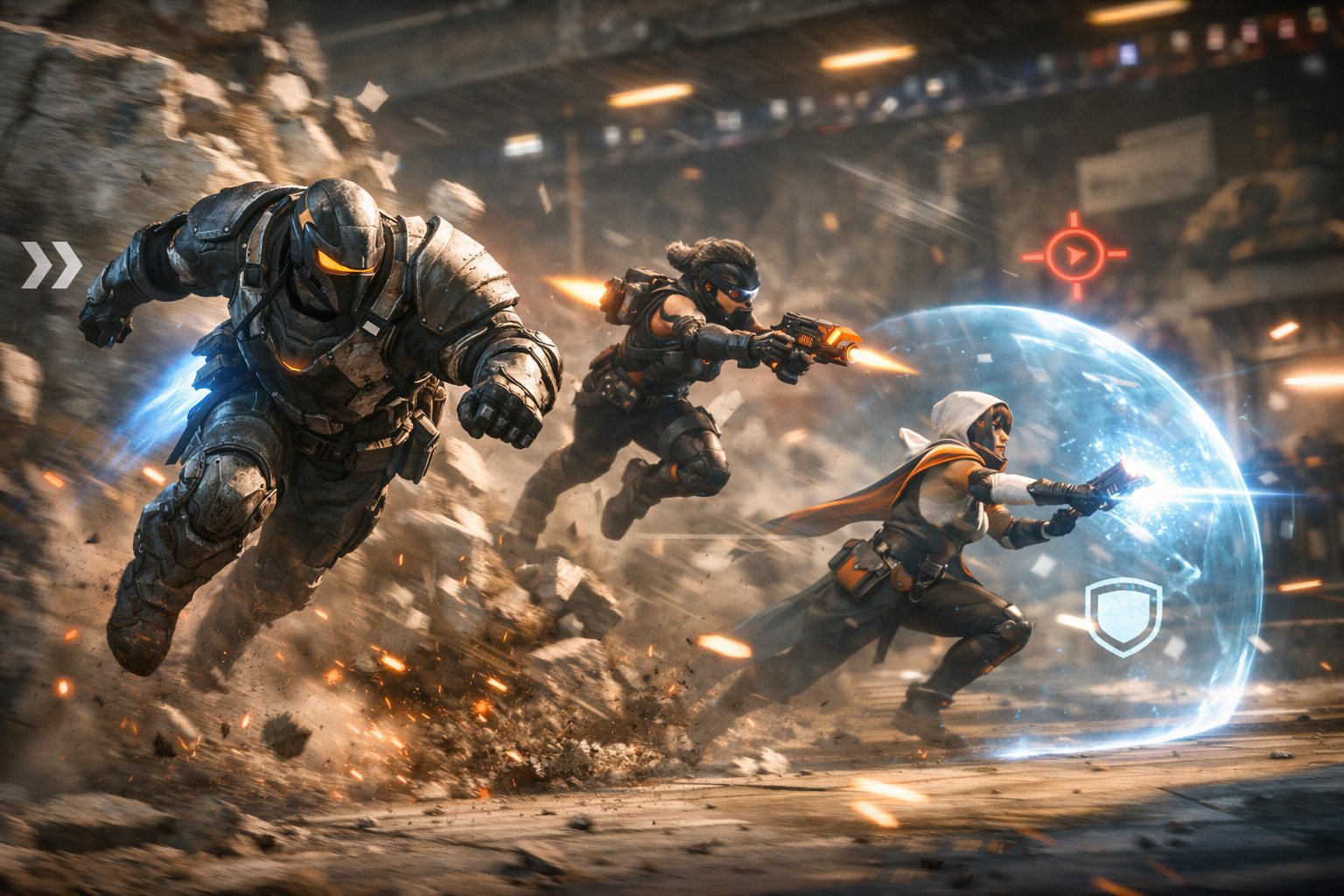
Goal: Jump one target together, force panic, and win the fight before the enemy can stabilize. Dive comps feel “easy” when coordinated and “impossible” when not—so beginners should run a simplified version: one clear initiator, one follow-up diver, and strong backline safety.
- Needs: a dive Vanguard or engager, a mobile Duelist, and at least one Strategist who can keep divers alive.
- Best into: fragile backlines, slow poke teams, comps with limited peel.
- Struggles into: heavy crowd control, layered peel, or teams that punish overcommitment.
Fight script: (1) poke/scan for cooldowns → (2) engage on isolated target → (3) burst window → (4) reset to objective.
Beginner mistake: diving different targets. Pick one: “left Strategist,” “high ground Duelist,” etc.
Fix: call one target and require two confirmations before committing: “Ready?” “Go.” That alone wins games in low ranks.
Build 2: Brawl & Sustain (The “Never Leave the Point” Comp)
Goal: Win long fights by staying grouped, rotating defensive cooldowns, and grinding the objective. This build is excellent for beginners because it teaches discipline: spacing, focus-fire, and cooldown trading.
- Needs: at least one sturdy Vanguard, at least one strong sustain Strategist, and consistent mid-range damage.
- Best into: dive comps that can’t finish quickly, disorganized enemies, teams that chase too far.
- Struggles into: heavy poke that drains resources, or control comps that split your team.
Fight script: (1) take objective early → (2) hold angles close together → (3) counter-engage when enemy commits → (4) stabilize and re-cap space.
Beginner mistake: chasing kills off point. You win by being unmovable, not by being flashy.
Fix: assign one Duelist as “chase only when called.” Everyone else stays within support range.
Build 3: Poke & Collapse (The “Make Them Low First” Comp)
Goal: Win by controlling sightlines and forcing the enemy to push while weak. Poke comps thrive when the environment provides long angles and when your team understands patience. In Marvel Rivals, destructible cover changes this constantly—so your team must reposition rather than “hold one spot forever.”
- Needs: consistent ranged pressure, a Vanguard who can protect angles or deny dives, and a collapse tool (stun/pull/mobility).
- Best into: slow brawl teams, short-range lineups, enemies with predictable routes.
- Struggles into: coordinated dive, strong flank routes, or teams that rush before poke matters.
Fight script: (1) take high ground/angles → (2) chip two targets → (3) collapse on the first low target → (4) snowball position.
Beginner mistake: poking forever and never converting. Poke without collapse is just “stat padding.”
Fix: set a rule: when you force two defensive cooldowns, you must push or rotate.
Build 4: Control & Zoning (The “You Don’t Get to Stand Here” Comp)
Goal: Win by making space unplayable: walls, traps, slows, stuns, and area denial. Control comps are powerful in objective modes because they create “no-go” zones that win time. They’re also excellent for beginners who lack mechanical confidence: good positioning and ability timing matters more than aim.
- Needs: at least two zoning tools, one durable objective holder, and a finisher who converts crowd control into eliminations.
- Best into: rush teams with predictable paths, comps relying on one carry angle.
- Struggles into: teams with multiple flank routes or heroes who bypass zones (mobility/teleports).
Fight script: (1) set zones before they arrive → (2) punish first entry → (3) kite backward while keeping zones active → (4) re-take space together.
Beginner mistake: using zoning randomly. Zones should block a path, protect a revive, or isolate a target—never “just because.”
Fix: link zoning to a call: “Zone left door,” “Wall the point,” “Slow their push.”
Build 5: Pick & Punish (The “One Mistake = Loss” Comp)
Goal: Create a numbers advantage early by catching someone out of position. Pick comps rely on crowd control, burst damage, and fast confirmation. Beginners can run a gentle version: one reliable CC setup and one burst follow-up, with a team that understands when to back off.
- Needs: a consistent pick tool (stun/pull/root), burst follow-up, and safe positioning to avoid counter-dive.
- Best into: enemies who peek too much, comps without strong sustain, teams that rotate late.
- Struggles into: heavy sustain or teams that play tight and disciplined.
Fight script: (1) hold an angle → (2) land pick tool → (3) burst instantly → (4) back to objective before they trade you.
Beginner mistake: chasing the pick too far and getting traded.
Fix: your rule is “kill + reset,” not “kill + hunt.” You win by repeating the pick, not by gambling.
Build 6: Anti-Dive Fortress (The “Protect the Backline” Comp)
Goal: Make diving you a bad decision. This build wins when the enemy insists on diving anyway. Anti-dive comps are especially useful for solo queue because they protect inexperienced Strategists and punish aggressive opponents.
- Needs: peel tools (stuns, slows, knockbacks), a Vanguard who holds near the backline, and Duelists who punish divers.
- Best into: dive-heavy teams, flank-heavy lobbies.
- Struggles into: slow poke that never dives, or strong zone control that keeps you pinned.
Fight script: (1) let them commit → (2) peel and isolate the diver → (3) burst the diver → (4) counter-push while they’re down.
Beginner mistake: spreading out. Anti-dive works when you’re close enough to protect each other.
Fix: set a “support circle”: everyone stays within two seconds of helping your Strategist.
Build 7: Split Pressure (Advanced, but Learnable)
Goal: Force the enemy to look in two directions at once: a main group takes space while one hero pressures a flank or backline. This is hard for beginners, but you can learn it by making the split job extremely simple: one flanker’s job is not “get five kills”—it’s “force two people to turn around.”
- Needs: a safe main group (Vanguard + support), one mobile split hero, and communication (“I’m pressuring right.”).
- Best into: slow bunker teams, enemies who panic and over-rotate.
- Struggles into: teams that ignore the split and delete your main group, or teams with strong 2v1 punish.
Fight script: (1) split hero takes flank position → (2) main group pressures objective → (3) when enemy turns, split hero hits backline → (4) collapse together.
Beginner mistake: split hero dies first every fight.
Fix: the split hero should start fights late, not early. Let the enemy commit to the main group first.
6) Drafting & Picks: How to Build a Comp in 30 Seconds
In many matches, “drafting” is just the hero selection screen. You don’t need a tournament-level plan. You need a fast checklist that produces a coherent lineup even when teammates pick whatever they want. Use this approach in every lobby.
The 30-Second Draft Checklist (Beginner-Proof)
- Lock one Vanguard early (or ask for one). If nobody picks Vanguard, your team often loses objective control.
- Secure one Strategist early. Two is ideal; one is the minimum if you plan short fights.
- Choose your win condition: dive, brawl, poke, control. Say it in one sentence.
- Fill the missing job: engage, peel, or finishing damage—whichever you lack.
- Pick one flex slot: a hero you can swap later based on what the enemy is doing.
How to Read the Lobby Without Overthinking
You can infer what your team is building just by watching early picks: two mobile Duelists often implies dive; double Vanguard implies brawl; two ranged Duelists implies poke. Your job is not to “force” the comp—it’s to complete it so it becomes functional.
A simple rule: if your team has a clear strength, amplify it. If your team has a dangerous weakness, patch it. Example: if your team is all dive, add a Strategist who can keep divers alive and a Duelist who can finish quickly. If your team is all poke, add an anti-dive option and a Vanguard who can hold space when the enemy rushes.
Drafting With Team-Up Abilities in Mind
Team-Up abilities are one of Marvel Rivals’ defining features: you can combine powers to unlock unique plays. You do not need to memorize every Team-Up. You only need one habit: draft for shared timing.
- Shared timing: pick heroes whose “go” moments align (mobility engages + burst follow-up + support enable).
- Avoid timing conflicts: one hero wants slow poke while another wants instant dive; both end up unsupported.
- One combo is enough: if you have one reliable two-hero combo you can repeat, your comp becomes consistent.
What If Your Mode Has Hero Bans?
Some competitive environments include hero bans at higher tiers and/or specific rule sets. Instead of learning “the best bans,” beginners should learn a better skill: drafting redundancy. That means you don’t rely on exactly one hero to do an essential job.
Practical redundancy examples:
- If your comp needs engage, have two engage options (a Vanguard engager + a Duelist follow-up).
- If your comp needs peel, have at least one peel tool plus a backline-safe positioning plan.
- If your comp needs sustain, have either two Strategists or one Strategist plus defensive utilities.
Three Drafting Mistakes Beginners Make (and Fixes)
- Mistake: picking heroes you like with no synergy.
Fix: pick the hero you like that also fills a missing job (peel, engage, sustain, finisher). - Mistake: copying a “pro comp” without the coordination to run it.
Fix: simplify the plan: one engage call, one target focus rule, one reset rule. - Mistake: changing heroes every loss without learning why.
Fix: keep one hero constant for 10 games and measure improvement in one skill (positioning, cooldown timing, target focus).
7) In-Game Adaptation: Fixing a Comp Without Tilting
The fastest way to climb as a beginner is not mastering 30 heroes—it’s learning how to patch weaknesses mid-match. Most “bad comps” are fixable with one smart swap and two smarter positioning decisions.
Diagnose the Problem in One Sentence
After every lost fight, force yourself to pick one main reason:
- We died first (survival problem). Add peel, play closer, or swap one Duelist to anti-dive.
- We couldn’t kill anything (finisher problem). Add burst, add CC setup, or focus one target together.
- We lost the point (objective problem). Add a sturdier contest hero or stop chasing off objective.
- We got chipped out (poke problem). Add mobility engage or shields/sustain to cross angles safely.
- We got rushed (rush problem). Add zoning, tighter grouping, and punish overcommitment.
The “One Swap” Rule
Teams throw games by swapping too much. Try this instead: make one swap for a specific reason, then play two fights before changing again. This trains your brain to connect cause → effect.
Positioning Fixes That Feel Like a Buff
Many comps become “good” if you position correctly:
- Support triangle: Strategists stand where two teammates can protect them without leaving objective.
- Frontline leash: Vanguards do not go beyond the range where Strategists can help them safely.
- Angle discipline: poke heroes hold angles that have an escape route; don’t hold “dead-end” sightlines.
- Chase cap: if you chase past one corner without vision, you return—or you die and lose the round.
Cooldown Economy: The Hidden Composition Skill
Beginner teams waste defensive cooldowns early, then lose when the real fight starts. Treat defensive abilities like money: you want to spend them only when it prevents death or creates advantage. A timeless rule: if the enemy uses two big cooldowns, you can win the next 8–12 seconds if you still have yours.
8) Solo Queue Playbook: When Teammates Won’t Coordinate
Solo queue is not about building the “perfect comp.” It’s about building a comp that still functions when teammates play independently. The secret is picking heroes (and roles) that create value even with low communication.
Solo Queue Composition Priorities
- Stability first: one Vanguard + at least one Strategist improves everyone’s performance.
- Self-sufficiency: pick heroes with escapes, self-peel, or flexible positioning tools.
- Simple value: consistent damage, consistent heals, consistent crowd control—avoid “requires combo” heroes if nobody is talking.
- One carry window: pick one hero whose ultimate can swing fights even with limited coordination.
If Your Team Has No Vanguard
This is the most common beginner loss condition. Without a Vanguard, you often lose: objective time, safe space, and front-to-back structure. If you can play Vanguard, do it. If you can’t, pick heroes that can contest safely and don’t feed. Then play slower: you must win with picks and positioning, not by standing on point forever.
If Your Team Has No Strategist
No Strategist usually means your fights must be short and decisive. You need either: a burst/pick comp that wins instantly, or a “kite and reset” style that avoids sustained brawls. The biggest fix is simple: someone picks Strategist. If that’s you, you often gain free wins.
Solo Queue Communication That Actually Works
Don’t write essays. Use short, repeatable phrases:
- Win condition: “We dive their backline together.” / “We hold point and outlast.”
- Target: “Focus their Strategist.” / “Burst the diver.”
- Reset: “Back, regroup.”
- Timing: “Go on my engage.”
Even if only one teammate listens, your win rate rises because your fights become less random.
9) Practice Plan: How Beginners Improve Fast
Marvel Rivals has a lot going on—so beginners improve faster when they isolate skills. Here’s a practical 10-game loop that works for almost everyone.
The 10-Game Improvement Loop
- Pick one role for 10 games (Vanguard, Duelist, or Strategist). Consistency beats variety when learning.
- Pick 2 heroes max in that role. Learn matchups and positioning instead of constantly re-learning kits.
- Track one metric: deaths per 10 minutes, first death rate, or “fights where I used ult too late.”
- After each game, answer: “Did we lose because we couldn’t start fights, couldn’t survive, or couldn’t finish?”
- Make one adjustment next game: positioning, cooldown timing, or one swap rule.
Role-Specific Micro Goals
- Vanguard goal: die fewer times while still contesting. Learn when to disengage.
- Duelist goal: confirm one clean elimination per fight (not just damage).
- Strategist goal: avoid being first death. Keep one key teammate alive during the enemy’s main engage.
If you can hit these micro goals, your team comps “feel better” automatically because your role is doing its job. Composition is not only about picks—it’s about execution.
If you want help climbing or want to learn faster with experienced players, Boosteria offers Marvel Rivals services here: Marvel Rivals Boosting Prices. (Always choose services responsibly; improvement still comes from learning fundamentals.)
10) FAQ
What’s the easiest team comp for beginners in Marvel Rivals?
Start with a balanced structure (2 Vanguard / 2 Duelist / 2 Strategist) or a safer variation (1 Vanguard / 2 Duelist / 3 Strategist). These comps forgive mistakes and help you learn positioning, cooldown timing, and objective discipline.
Do we need “role lock” to have a good composition?
No. You can win with flexible lineups, but you must cover essential jobs: engage, survive engage, confirm kills, and objective presence. If your team stacks one role, make sure the missing jobs are covered by utility, mobility, or disciplined play.
What’s more important: synergy or counter-picking?
For beginners, synergy is more important. A coherent plan executed well beats a “counter comp” executed poorly. Once you’re comfortable, add counter-picking as a bonus skill: patch your weakness against what the enemy is doing.
How do we stop getting destroyed by dive heroes?
Tighten your spacing and add peel. Keep Strategists in safe positions, hold defensive cooldowns for the dive moment, and punish the diver together. If needed, swap one Duelist to anti-dive and keep at least one Vanguard closer to backline.
How do we stop getting chipped out by poke?
Don’t stand in predictable angles. Rotate quickly, use cover, and engage before you lose too much health. Add shields/sustain or mobility, and focus on collapsing together once you force their defensive tools.