



CS2 Utility Basics: Smokes, Flashes & HE to Take Space
CS2 — Utility Basics (Patch-Proof): Smokes/Flashes/HE for Taking Space
Utility is the fastest way to make “hard” fights easy in CS2. It buys you time, blocks information, forces defenders out of safe angles, and lets your team take map control with fewer coin-flip duels. The problem: most players learn utility as a list of fragile lineups that break after map updates, jump-throw changes, or minor geometry tweaks.
This guide is different. It focuses on patch-proof utility fundamentals—principles and protocols that survive meta shifts. You’ll learn how to build smokes, flashes, and HE grenades into repeatable patterns for taking space on any map, at any rank. Wherever specific examples appear, they’re there to teach the concept, not to lock you into a single lineup.
If you want structured practice and faster rank progress, you can also check Boosteria’s CS2 services here: https://boosteria.org/cs2-boosting/prices
1) What “Taking Space” Really Means
“Taking space” is not the same as “getting a kill.” In CS2, space is control of safe movement and information. When your team takes space, you reduce the defender’s options: they must either give ground, fight at a disadvantage, or burn utility to survive.
Think of the map as a set of zones connected by chokes. Every choke is a problem because it compresses your team into predictable positions, and defenders can aim at it for free. Utility is how you expand from a choke into a zone without donating bodies.
Space has three layers
- Vision space: angles you can see and hold safely. Smokes trade vision in your favor.
- Movement space: pathways you can cross without being punished. Flashes and smokes open paths.
- Action space: positions you can occupy long enough to run the round (split, hit, or rotate). HE and flashes convert control into entry.
What utility should accomplish when taking space
- Remove unknowns: clear corners with flash timing or force movement with HE.
- Break crossfires: smoke one side, flash the other, isolate a single defender.
- Block rotations: smokes can delay info, forcing late rotations or hesitations.
- Claim “anchor positions”: once you take a key zone (mid control, a connector, a deep lane), it changes the whole round tree.
Your goal isn’t to throw “the perfect smoke.” Your goal is to create a repeatable advantage: fewer angles to clear, cleaner trades, safer movement, and predictable next steps.
2) Utility Economy: Why Grenades Win Rounds
Utility is a resource. A team that spends it well can win rounds while losing aim duels, because utility shapes the fights before bullets are fired. Most players lose rounds because they spend grenades with no plan—or worse, hold grenades until it’s too late.
The four utility questions (ask them every round)
- What space do we need first? (early map control vs direct hit)
- What are the defender’s strongest positions? (AWP lane, crossfire, multi-peek)
- What utility breaks those positions? (smoke to block, flash to force turn, HE to force retreat)
- What utility do we save for after contact? (re-smoke, re-flash, post-plant, anti-retake)
Two rules that keep you “patch-proof”
- Rule A: Utility must have a job. If you can’t say what a grenade is supposed to achieve, don’t throw it.
- Rule B: Utility must connect to a movement or a decision. A smoke that lands but nobody crosses is a donation. A flash that pops but nobody swings is wasted.
How many grenades should a take-space plan use?
For most “take space” actions (like taking a key zone early, or cracking a defended choke), assume: 1 smoke + 1 flash is the minimum. Add 1 HE if there’s a known close position or a common anchor spot. Add a second flash if defenders can multi-peek or if you’re entering a stacked area.
For deeper utility theory and pro match references, credible CS coverage sites like HLTV (hltv.org) and Liquipedia (liquipedia.net) can help you study patterns and timing ideas without chasing fragile lineups.
3) Smokes: Deny Vision, Re-shape the Map
Smokes are the most strategic grenade because they change what both teams can know. They don’t “win” fights directly—they remove information and force decisions. Used well, a smoke isolates a duel or blocks a rotation read. Used poorly, it gives defenders cover, allows them to lurk in it, or signals your plan too early.
Patch-proof smoke concepts
Concept 1: Smoke the defender’s “best angle,” not the entire site
Many players try to smoke “everything” and end up with gaps or overlapping smoke clouds that help CTs. Instead, identify the one angle that makes entry impossible (often an AWP lane or headshot angle) and smoke that. Then take the next duel.
Concept 2: Smokes are most valuable when they enable a cross
The strongest use-case is a smoke that lets your team move from “stuck” to “present”: crossing an exposed lane, reaching a safer off-angle, or entering a zone without giving a free kill. If nobody crosses or occupies space while the smoke is active, you likely wasted it.
Concept 3: Smokes create “walls” that isolate fights
Think of a smoke not as a circle, but as a wall segment. A wall lets you fight one side at a time. Your entry plan should explicitly answer: “Which side are we fighting first?”
Concept 4: “Re-smoke” is a real strategy
In many rounds, the first smoke gets you into a zone—but the second smoke keeps you alive while you stabilize (plant, regroup, clear). Good teams plan for a re-smoke or a “smoke refresh” when they expect CTs to re-peek or re-take control.
How to choose a smoke type
- Cross smoke: blocks a lane so you can move. Priority when you need to physically take space.
- Isolation smoke: cuts off a support angle so you can fight the anchor alone.
- Fake smoke: triggers rotation tendencies or forces defensive utility.
- Delay smoke: slows defender pushes or stops re-peeks while you plant/reset.
Anti-CT tricks (timeless)
- Smoke + late pop flash: CTs often “get curious” and edge the smoke. Punish with a delayed pop flash as your entry swings.
- Smoke and hold: if you expect a push-through, don’t rush. Hold the edge with a crossfire and make them pay.
- Smoke gap discipline: a small gap is often worse than no smoke. If your lineup is inconsistent, switch to a closer, safer throw.
For official CS2 updates, mechanics notes, and game information, the most reliable source is Valve/Steam: CS2 on Steam. But remember: this guide aims to keep your improvement independent from small patch shifts.
4) Flashes: Create Unfair Fights
Flashes are the highest “skill-per-second” grenade in CS2 because they convert coordination into kills. A good flash doesn’t just blind someone—it forces defenders to choose between two losing options: turn and give up the angle or eat the flash and die.
The three flash jobs
- Entry flash: lets your first swinger clear a dangerous angle.
- Support flash: enables your teammate’s swing (you throw while they fight).
- Re-take/stop flash: prevents CT aggression or breaks a re-peek.
Patch-proof flash principles
Principle 1: Flash timing beats flash placement
Many players obsess over “perfect” pop flashes, but timing is what wins. The flash should detonate at the moment your teammate is ready to swing, not while they’re still running, not after they’ve already taken contact.
A simple protocol: call “flashing in 2…1…” and swing on “1,” not after the bang. This makes your entries consistent even if your throw isn’t perfect.
Principle 2: Use “cover flashes” to force crosshair movement
A cover flash doesn’t need to fully blind. It just needs to threaten blindness so defenders must flick their crosshair, reposition, or hesitate. This is huge against strong aimers: you’re not trying to “cheese” them—you’re forcing their crosshair off the kill line.
Principle 3: “Pop” is a spectrum
You don’t always need a perfect pop. Sometimes a slightly visible flash is fine if it forces a turn. The real goal is disrupting the defender’s ability to shoot the entry.
Principle 4: Don’t “self-flash” the team
The fastest way to lose a round is a teammate flash that blinds your own entries. Build a habit: call the flash, throw it, then immediately tuck or turn so you don’t blind yourself or your second man.
Flash types you should know (timeless)
- Pop flash: detonates with minimal travel time. Great for close chokes.
- High arc flash: detonates above common eye lines; good for wide zones and forcing turns.
- Bank flash: bounced off a wall for speed and unpredictability.
- Late flash: thrown after contact to punish re-peeks and trades.
A simple flash checklist
- Who is swinging off it?
- Which angle are we neutralizing?
- Is our swing synced with the detonation?
- Do we have a second flash if CTs multi-peek?
5) HE Grenades: Force Movement, Break Setups
HE grenades are often misunderstood. They’re not just for “damage.” They’re for forcing movement. If a defender is holding a close angle, anchoring behind cover, or playing a known off-spot, an HE can push them into a worse fight or force them to give ground—creating free space without a duel.
Patch-proof HE uses
- Clear a common close position: make a defender move so your entry doesn’t face a perfect crosshair.
- Break utility combos: if you expect a CT to stall (smoke + molly style patterns), HE can disrupt and punish the stall timing.
- Finish damage stacks: combine with teammates (two HEs) to punish predictable holds.
- Anti-boost/anti-stack: HEs punish multiple players sharing a tight area.
When an HE is better than a flash
If the defender is likely to not turn (e.g., anchored close, ready to eat a flash and spray), HE can be superior. It forces them to move or take damage before the duel begins. The best pattern is: HE first (force movement) → flash second (punish the reposition) → swing.
HE discipline: don’t throw it “because you have it”
A random HE into a deep angle rarely matters. HE is strongest when you have information: sound cues, teammate contact, a common anchor spot, or a known stall position. If you can’t justify it, save it for post-plant, or for stopping a re-take push.
6) Timing Windows: The Hidden Skill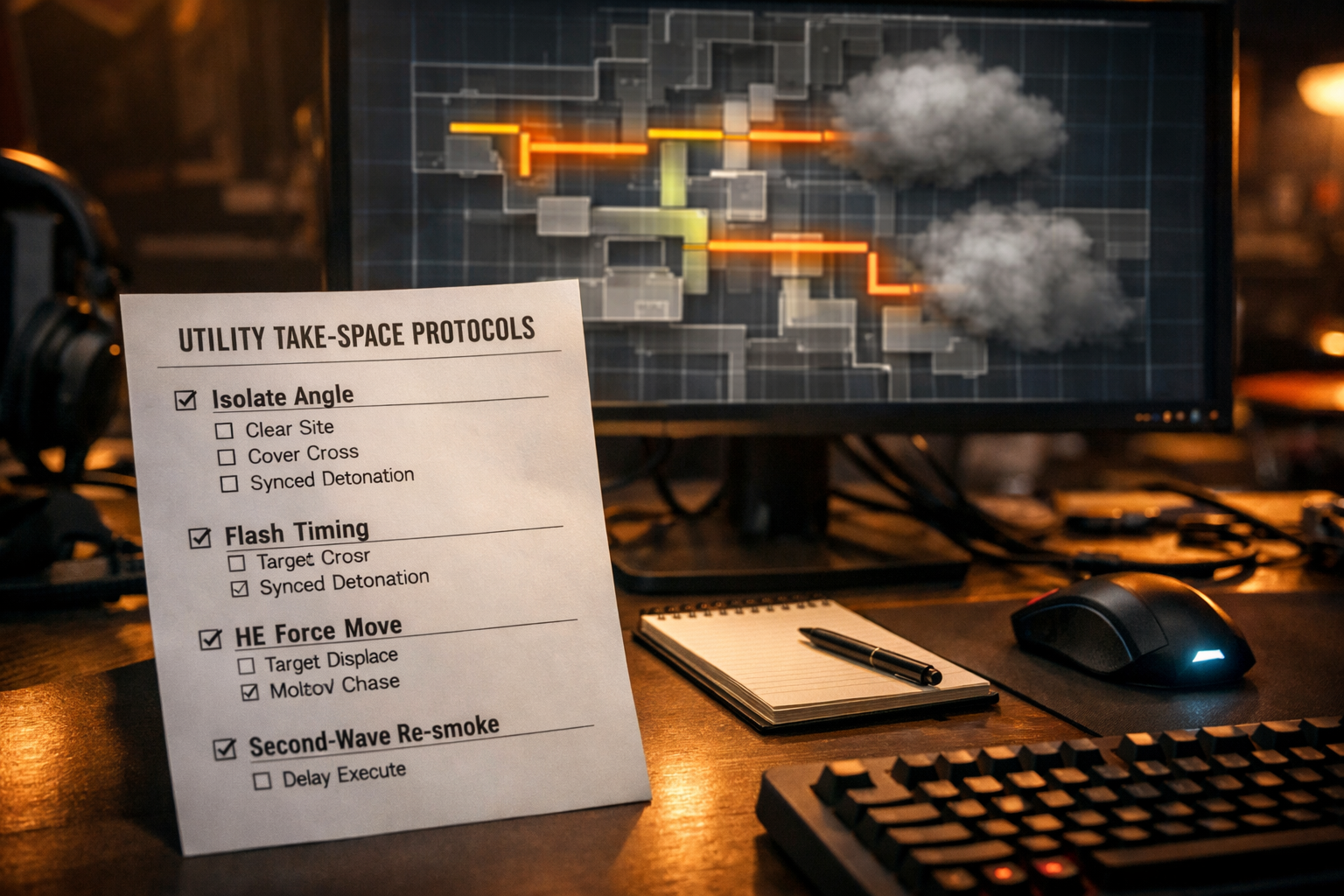
Two teams can throw the same smokes and flashes and get opposite results. The difference is almost always timing. Timing decides whether defenders are set, whether rotations arrive, and whether your entry gets a clean duel or a crossfire.
The three timing windows for taking space
- Early window (0:00–0:25-ish): defenders are still settling. Good time to take a key zone with quick utility and body presence.
- Mid-round window: defenders re-balance based on info. Great time for a second take—re-smoke, re-flash, and walk into the gap you created.
- Late window (execute): defenders have less utility, but rotations are closer. Your utility must be cleaner and your trade spacing tighter.
Utility timing rules you can apply on any map
- Throw-to-action: every grenade should be followed by immediate movement, a swing, or a decision.
- Contact triggers: if a teammate spots or shoots, that’s a trigger to throw the planned support flash or HE.
- Second-wave utility: save one flash or smoke for the moment CTs “re-peek” after your first contact.
- Don’t stack utility on silence: if nobody is ready to act, don’t dump two flashes and a smoke into the void.
A good way to learn timing is to watch top-level demos and focus on when they throw utility, not only where. You can study event match VODs and player patterns through major tournament coverage and databases like HLTV (hltv.org).
7) Patch-Proof Protocols for Taking Space
A “protocol” is a repeatable mini-play: a small sequence that your team can run with minimal communication. Protocols are how you become consistent. They’re patch-proof because they rely on principles: isolate, flash, trade, occupy, and hold.
Protocol A: Smoke-Isolate → Flash-Entry → Trade
This is the default “take space” protocol for most chokes.
- Smoke the defender’s strongest support angle (the angle that creates a crossfire).
- Entry flash the anchor angle (the most dangerous close/primary hold).
- First swings with intent: clear one angle only (because the smoke removed the other).
- Second trades immediately. Third holds a flank/anti-push line.
- Occupy the space you gained. Don’t drift back into the choke.
Key idea: the smoke isn’t “for the hit.” It’s to turn a two-angle problem into a one-angle problem.
Protocol B: HE-Force → Late Flash → Swing
Use this when you suspect a close anchor or a stubborn defender who won’t respect a flash.
- Throw HE into the close anchor zone (force movement or damage).
- Wait a beat—anticipate the reposition.
- Throw late flash where the defender likely re-aims.
- Swing as it pops and take the duel while they’re unsettled.
Protocol C: “Cross and Claim” (Cross Smoke + Body Presence)
When you need to move through an exposed lane, use a cross smoke to create a safe pathway, then immediately place bodies into the new zone.
- Smoke the long lane.
- Two players cross together (trade-ready), not one-by-one.
- One player stops to hold a counter-push line; the other clears the next corner.
- Use a support flash if defenders can peek the end of the smoke.
Patch-proof concept: this works on any map because it’s about lane denial and trade spacing, not a particular lineup.
Protocol D: “Fake-to-Take” (Information Manipulation)
Smokes and flashes can be used to shape rotations. This is patch-proof because defenders are human: they react to sound, smoke walls, and perceived danger.
- Show credible utility on one side (a smoke + a flash is usually enough).
- Don’t overcommit bodies—leave 1–2 players near the fake.
- Shift the pack to take the other side using a quick isolate smoke + entry flash.
- Be ready to punish a fast rotate with a late flash.
Protocol E: “Re-take the take” (Second-wave map control)
Many rounds are won by taking space twice: first you pressure a zone and draw utility, then you wait, then you take it again when CTs relax.
- First take: light utility, test and collect info.
- Reset: stop, hold pushes, listen for rotates.
- Second take: re-smoke, late flash, and occupy deeper space.
If you want a structured path to rank improvement beyond utility (mechanics, roles, trading, round planning), Boosteria’s CS2 options are here: https://boosteria.org/cs2-boosting/prices
8) Mid-Round Utility: Re-take Space, Re-clear Angles
Mid-round is where utility becomes “chess.” Early utility is about claiming territory. Mid-round utility is about keeping it, reclaiming it, or converting it into an execute.
Mid-round problems utility solves
- CT re-peeks: defenders often re-peek after your first contact. A late flash punishes this.
- Stalled hits: if you’re stuck, re-smoke a key angle and take a different route.
- Lurker isolation: smoke lines and flashes can protect your lurker from multi-peeks while they take a timing duel.
- Rotation uncertainty: a smoke can hide a rotation or delay a defender’s information.
Two mid-round habits that win games
- Always keep one “stop” grenade. Typically a flash or smoke that prevents a CT push when your team is rotating or regrouping.
- Use utility to re-clear, not to guess. If you suspect a close corner, flash and clear it. If you suspect an anchor behind cover, HE it.
Re-clearing protocols (timeless)
- Flash then swing: don’t clear a re-peek angle dry if you can avoid it.
- Two-man clear: one swings wide, one swings tight—trade spacing is your safety net.
- Smoke to isolate: if re-clearing exposes you to multiple angles, smoke off the extra angle first.
9) CT Utility: How Defenders Stall (and How to Beat It)
To become a great utility player, you must understand what defenders want. CT utility aims to: delay, force you into a choke, and buy time for rotations. If you understand stall logic, you can break it with patience and second-wave utility.
Common CT utility patterns
- Early denial: a quick smoke or flash to stop your first step into a zone.
- Re-peek timing: defenders throw utility, then re-peek right after it fades.
- Close anchor hold: a player sits close with support ready—built to punish dry entries.
- Info push: a defender pushes through smoke or around quiet timings to collect info.
How to beat stalls with patch-proof solutions
- Don’t sprint into the stall. Pause, hold, and punish the re-peek.
- Use second-wave utility. A re-smoke and a late flash often beat the “fade and peek” habit.
- Trade the close anchor. If you suspect close, HE + flash and enter with two players ready to trade.
- Control the push-through. Hold smoke edges with crossfire instead of staring alone.
CS fundamentals and mechanics often remain stable across updates, and large skill gains come from better decision-making and team play—not from chasing the latest gimmick.
10) Common Utility Mistakes (and Fixes)
Mistake 1: Throwing utility with no follow-up
If you smoke a lane but nobody crosses, you gained nothing and you revealed intent. Fix it by connecting every grenade to a movement: cross, swing, clear, or rotate.
Mistake 2: Over-smoking (smoking your own entry)
Some players create a “smoke maze” that blocks their own sight lines and lets CTs hide. Fix it by smoking only the angles you must remove, and keeping at least one “clear” route for entry and trading.
Mistake 3: Flashing too early
A flash that pops while your team is still running simply warns defenders. Fix it with countdown timing and a “swing on 1” protocol.
Mistake 4: Using HE as random chip damage
Random HE into deep lanes rarely changes a round. Fix it by using HE for forced movement in close anchors or known stall positions.
Mistake 5: No second-wave plan
Many hits fail after the first contact because teams have no re-smoke or late flash. Fix it by saving one grenade specifically for the re-peek window or the plant stabilization moment.
Mistake 6: Poor spacing (utility doesn’t save bad trades)
Utility creates advantages, but you still need trade spacing. Fix it with a simple rule: the second player should be close enough to trade within one second, but not so close that both die to spray or a single grenade.
11) A Practice Plan That Actually Improves Utility
You don’t become “good at utility” by memorizing fifty lineups. You become good by building repeatable protocols, learning timing, and improving communication. Here’s a patch-proof practice plan that works even if maps change.
Step 1: Build a small “utility toolkit” (not a library)
Choose one map you play often. Pick: 2 cross smokes, 2 isolation smokes, 2 entry flashes, and 2 HEs that clear common close anchors. That’s it. Eight throws are enough to win many games if your timing and follow-up are strong.
Step 2: Drill throw-to-action timing
- Smoke → cross immediately (no hesitation).
- Flash → swing on call (countdown).
- HE → anticipate movement → late flash → swing.
Step 3: Practice “second-wave utility”
In a private server or practice environment, simulate the sequence: take space → pause → re-smoke → late flash → re-clear. The goal is to build the instinct that rounds don’t end after first contact.
Step 4: Review one round per match
After each session, pick one round where your utility felt useless. Ask:
- Did the grenade have a job?
- Did we act on it immediately?
- Did we isolate angles or create confusion for ourselves?
- Did we save second-wave utility?
Step 5: Add one improvement per week
Don’t add ten new lineups. Add one new concept (like “late flash after smoke” or “HE first to force movement”) and focus on it for a week. This is how you stay consistent across patches and map rotations.
If you want outside structure (demo review, protocols, role guidance, and map plans), Boosteria’s CS2 options are here: https://boosteria.org/cs2-boosting/prices
12) FAQ
Is utility more important than aim?
At higher ranks, aim differences shrink, and utility differences grow. Aim wins duels; utility decides whether the duel is fair. The best players use utility to make their aim “count” more often.
How do I stop wasting flashes?
Attach every flash to a named action: “flash for entry,” “flash for re-peek,” or “flash to cross.” Use a countdown and swing on time. If no one is ready to swing, don’t throw the flash yet.
What if my team doesn’t communicate?
Use simple, low-bandwidth calls: “flashing 2-1,” “smoke then cross,” “HE close then swing.” Even silent teams benefit from predictable patterns. Also, choose utility that helps you take safe fights (self-support) without griefing teammates.
Do I need advanced lineups to climb?
No. You need a small, reliable toolkit and strong timing. Patch-proof improvement comes from better decisions, better spacing, and consistent follow-up after utility.
Where can I learn more about CS2 basics and updates?
For official game information, start with CS2 on Steam: store.steampowered.com. For competitive context and match study, HLTV: hltv.org, and Liquipedia: liquipedia.net.