



Rocket League Rank System: MMR, Divisions & Climb
Rocket League Rank System Explained: MMR, Divisions, and Tilt-Proof Climbing
Rocket League is simple to describe and hard to master: hit a ball with a car and score goals. But the ranked ladder adds a second game underneath the game—an invisible system that evaluates performance over time and tries to match you with equally skilled opponents. When you understand that system, you stop chasing short-term wins and start building a repeatable climbing process.
This guide breaks down Rocket League’s rank system in a timeless way: what MMR is (and what it isn’t), how divisions work, why streaks happen, what causes “random” lobbies, and how to climb without getting crushed by tilt. You’ll get practical habits you can apply immediately—plus a long-term improvement plan that keeps working regardless of meta, patch cycles, or seasonal resets.
If you want a faster path with structured support, coaching, or safe rank assistance, you can also check Boosteria’s Rocket League options here: Rocket League Boosting Prices . This article stays focused on understanding the system and improving reliably, so you can make informed decisions about your climb.
Table of Contents
- 1) Rocket League ranks at a glance
- 2) What MMR is (and why it matters)
- 3) Divisions explained: what you see vs what the system tracks
- 4) Placements, seasonal resets, and why you feel “stuck” early
- 5) How MMR changes: wins, losses, streaks, and uncertainty
- 6) Matchmaking realities: parties, smurfs, and “unfair” games
- 7) Why you plateau: skill ceilings, habits, and hidden weaknesses
- 8) Tilt-proof climbing: mental rules that protect your MMR
- 9) What wins games at each rank (timeless principles)
- 10) Mechanics vs positioning: how to train smart
- 11) Game sense that climbs: reads, rotations, and risk control
- 12) Solo queue vs party queue: communication and role clarity
- 13) A tilt-proof weekly training plan you can actually follow
- 14) Replay review like a coach: what to look for and how to fix it
- 15) Common ranked myths that keep players stuck
- 16) FAQ: MMR, ranks, and climbing
- 17) Quick checklist: your next 7 days
1) Rocket League ranks at a glance
Rocket League’s competitive ladder uses a familiar rank structure: you progress through tiers (ranks) and smaller steps inside them (divisions). While the exact names and visuals can evolve over time, the ladder concept stays consistent: the system matches you against players near your current skill rating, and your rating moves up or down based on match results.
The core idea is that your visible rank is a friendly summary of your underlying rating. That underlying rating is often referred to as MMR (matchmaking rating). Your MMR is what the system actually uses to create lobbies. Your rank is what you see. If your goal is to climb reliably, you want to think in terms of process (how you play and improve) and not just the badge on your profile.
Rocket League also has different playlists (like 2v2, 3v3, and extra modes). Each playlist typically has its own rating. That means you can be stronger in one mode and weaker in another. This matters because it changes how you interpret a “bad streak”: sometimes you’re not slumping—you’re just playing a mode where your habits don’t transfer as well.
For official competitive information and updates, the most reliable source is the developer/publisher ecosystem. You can start with official Rocket League channels via Epic Games: RocketLeague.com and general support/updates through Epic Games Support. For esports-level gameplay references (useful when you’re studying decision-making and speed), a trusted hub is Liquipedia Rocket League.
Ranks are not your identity
Your rank is not a personality trait. It’s a snapshot of recent performance in a specific playlist under a specific environment (teammates, opponents, server conditions, focus level). Players tilt hardest when they treat rank as a judgment of worth. Players climb fastest when they treat rank as a measurement tool.
2) What MMR is (and why it matters)
MMR (matchmaking rating) is a numerical value the game uses to estimate your skill and build fair matches. You rarely see it directly in the base UI, but it’s always there. It’s the “truth” the matchmaking system uses, while your visible rank is the “story” the UI tells you.
Think of MMR like a thermostat. Your current skill is the room temperature. Match results (wins and losses) are signals the thermostat uses to adjust. If you win a lot against similarly rated players, your rating rises. If you lose a lot, it drops. Over time, you stabilize near the rating where you win around half your games.
Why MMR matters more than divisions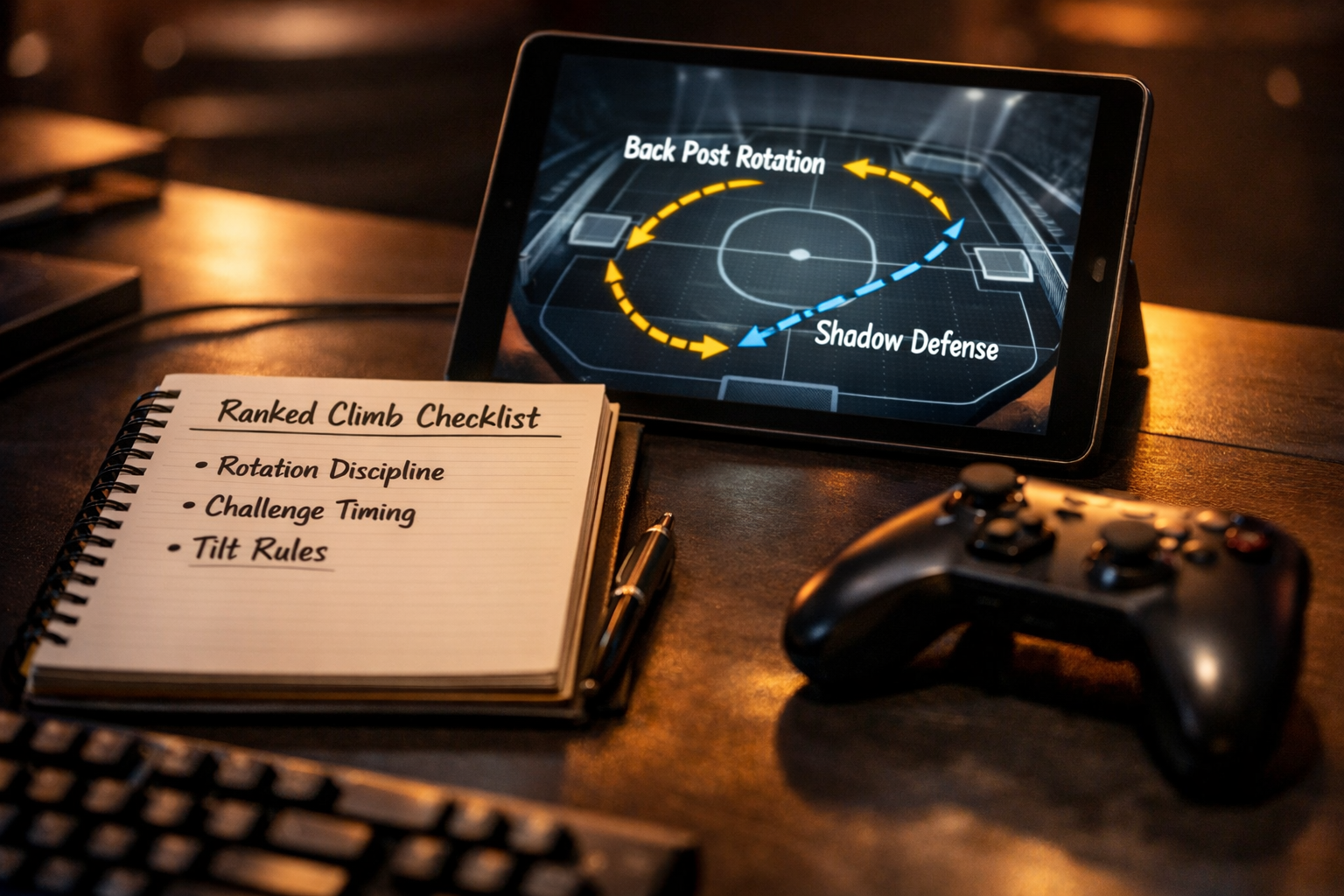
Divisions are a simplified ladder step. MMR is continuous and precise. Two players can be in the same visible division but separated by enough MMR that they experience different lobby difficulty. This is why you can feel like: “I’m in the same rank, but these games are harder than yesterday.” The reality is often that your MMR has moved, even slightly, and you’re facing opponents at the higher edge of the same division range.
MMR is not a perfect measurement of your potential
MMR is good at predicting your current ability to win matches in the current environment. It does not perfectly capture your potential after practice, your skill on a good day, or your ability in a coordinated team with comms. It measures outcomes, not intentions.
The most important truth about MMR
Your MMR responds to results, but your results respond to habits. If you change habits, MMR follows. If you only chase MMR, habits stay the same and you plateau.
3) Divisions explained: what you see vs what the system tracks
Divisions exist to make progress feel clear: you win, you move up. You lose, you move down. But divisions are not the exact system. They’re a UI layer over MMR ranges.
Why you sometimes “don’t div up” after a win
If you win and your visible division doesn’t change, it usually means your MMR moved but not enough to cross the next division threshold. You still gained rating—your progress just stayed inside the same division band.
Why you sometimes “div down” after one loss
If you were near the bottom edge of a division and lost, you might cross the threshold quickly. This feels unfair emotionally, but it’s normal. The fix is not to rage queue; the fix is to track your process and remain consistent.
Division “buffering” and psychological traps
Many players play tighter (worse) when they believe they’re one game from ranking up or down. They become afraid to challenge, afraid to shoot, and afraid to rotate. That fear is often more damaging than any mechanical weakness. If you want tilt-proof climbing, you need rules that protect you from “promotion panic.”
The timeless mindset: treat divisions as milestones, not objectives. Your objective is to play your best decision-making loop every game: safe pressure, smart rotations, high-percentage touches, and rapid recovery.
4) Placements, seasonal resets, and why you feel “stuck” early
Most seasons begin with placement matches or a recalibration period. Players notice two things immediately: (1) games feel chaotic, and (2) rank movement feels inconsistent. This is not only because you “forgot how to play.” It’s because the ecosystem is temporarily mixed: players return after breaks, some are rusty, others are grinding, and parties are more common.
Placements are about uncertainty
The system has more uncertainty about your rating early in a season (or early in a new playlist). When uncertainty is higher, rating adjustments can feel bigger. Over time, as you play more matches, the system becomes more confident about where you belong, and your rating movement stabilizes.
Why early-season lobbies feel “random”
Imagine two players at the same visible rank: one improved a lot last season but barely played, the other played constantly but didn’t improve. Their ranks may look similar, but their real skill and current form can differ. Early-season mixing amplifies this. The best response is to focus on consistency and avoid emotional overreactions to short streaks.
Timeless tip: delay your grind if you tilt easily
If you know you’re sensitive to chaotic games, consider using early season for training and replay review, then grinding ranked once you feel stable. There’s no rule that says you must queue immediately. Climbing is a marathon, not a weekend sprint.
5) How MMR changes: wins, losses, streaks, and uncertainty
Rocket League’s rating movement is designed to move you toward a point where you win around half your games. The exact amount you gain or lose per match can vary based on factors like rating confidence, playlist history, and the ratings of players in the lobby.
What generally increases MMR gains
- Higher uncertainty (new season, new playlist, fewer games played)
- Beating stronger opponents (higher-rated than you)
- Consistent wins in a short window when the system is still calibrating
What generally reduces MMR swings
- More matches played in that playlist (more confidence)
- Stable performance over time
- Playing near your true rating (where you win ~50%)
Why streaks happen
Streaks are not proof that matchmaking is broken. They’re usually a mix of: (1) your focus level, (2) your decision quality under pressure, (3) teammate compatibility, (4) party dynamics, and (5) small rating movement that shifts your opponent pool.
The most dangerous part of a loss streak is not MMR loss—it’s habit decay. Tilt makes you chase the ball, cut rotations, dive as last man, and throw away boost management. If you fix the mental component, many streaks stop before they start.
Outcome vs inputs: the climbing equation
You cannot control match outcomes directly. You can control inputs: first touches, boost lanes, challenge timing, recovery speed, shot selection, and your emotional state. If you want MMR stability, you must stabilize your inputs.
6) Matchmaking realities: parties, smurfs, and “unfair” games
Ranked is not a laboratory. It’s an ecosystem with players of different motivations: some warm up, some sweat, some carry friends, some learn mechanics, some play after work. Understanding the realities helps you avoid the biggest psychological trap: assuming every loss is “not your fault.”
Parties change lobby dynamics
When you face coordinated opponents, you may feel like they’re “faster” or “smarter.” Often they’re simply more synchronized: they rotate cleanly, avoid double commits, and communicate quickly. You can beat parties without comms, but you must play a more disciplined style: safe challenges, strong back-post coverage, and high-percentage clears.
Smurfs: how to respond without losing your mind
Smurfs exist in most competitive games. The key is to stop making them your primary storyline. Even if you encounter them, your best response is strategic:
- Respect their control: don’t dive as last man and gift 1v1s.
- Force low-percentage plays: shadow defend, cover backboard, challenge late.
- Win the other battles: boost starving, demo lanes, and quick counter-attacks.
Most importantly: treat it as high-quality practice. If a stronger player punishes your habits, that feedback is valuable. Take notes and apply them. The goal is not to “win every game.” The goal is to become a player who wins more games over the next 100 matches.
Unfair games are still data
Every match reveals something: your worst panic rotation, your tendency to flip into challenges, your habit of wasting boost, your weak backboard reads, your reluctance to shoot. If you convert frustration into analysis, you turn “unfair” games into progress.
7) Why you plateau: skill ceilings, habits, and hidden weaknesses
Most players plateau not because they lack talent, but because they repeat the same mistakes at a slightly faster speed. Rocket League punishes repeated errors ruthlessly. The higher you go, the smaller the mistakes that cost goals.
Plateau type #1: mechanical ceiling
This is when you cannot execute basic touches consistently: first touch control, reliable clears, simple aerial contact, and recoveries. The fix is targeted repetition—not random free play. You must train the exact patterns that appear in your games.
Plateau type #2: decision ceiling
You might have decent mechanics, but you choose the wrong moments to challenge, the wrong lanes to rotate, or the wrong shots to take. This is the “I’m always there but still losing” plateau. The fix is replay review and a simplified decision framework.
Plateau type #3: mental ceiling
You play well until one mistake happens. Then you speed up, overcommit, and spiral. Your mechanics didn’t disappear; your emotional control did. This is the most common plateau for players who grind a lot. The fix is tilt-proof rules and session management.
Plateau type #4: role confusion
In 2v2 and 3v3, many losses come from unclear roles: both players trying to be “the hero,” both rotating front post, both chasing boost at the same time, or both committing to the same ball. The fix is simple: commit to rotation discipline and value defense as much as offense.
8) Tilt-proof climbing: mental rules that protect your MMR
Tilt is not just “being mad.” Tilt is any emotional state that reduces decision quality: frustration, anxiety, desperation, ego, or fear. Rocket League is a fast game, and small decision errors create big swing moments. That’s why tilt-proofing matters more than any single mechanic.
The tilt spiral (and how it starts)
- You concede a goal (maybe not your fault).
- You speed up and force plays to “make it back.”
- You overcommit and concede again.
- You blame teammates, stop rotating, and play solo.
- You lose MMR and confidence, then queue again to “recover it.”
The key insight: the moment you feel urgency is the moment you must slow down.
Tilt-proof rule set (copy/paste into your brain)
- Two-loss rule: if you lose two in a row, take a 10–15 minute break or switch to training.
- No queue after rage: if your hands are tense or you’re blaming others, stop.
- One focus point per session: choose a single improvement goal (e.g., back-post rotations).
- Play for decisions, not highlights: prioritize low-risk, high-value plays.
- Reset after goals: breathe, check boost, and re-enter the rotation calmly.
Promotion anxiety and demotion panic
Many players sabotage themselves near rank boundaries. They play “not to lose,” which creates passive rotations and late challenges. A better approach is to play the same style you used to get there—except slightly cleaner and with more respect for risk as last man.
Session design: the easiest climb hack nobody uses
Don’t measure yourself by one session. Measure yourself by a week. If you play 5–7 short sessions with high focus instead of 2 marathon sessions with tilt, your MMR stabilizes and your skill improves faster.
9) What wins games at each rank (timeless principles)
Rocket League evolves, but ladder fundamentals do not. Most ranks are separated by three things: consistency, speed of recovery, and risk control. Below is a timeless lens you can apply at any level.
Lower ranks: win by making fewer big mistakes
At early ladder levels, matches swing because of open nets, double commits, and weak clears. The best climbing style is calm and safe:
- Rotate back post instead of cutting front post.
- Take simple shots on target instead of fancy touches.
- Clear to space, not straight back to the opponent.
- Don’t challenge as last man unless it’s guaranteed.
Mid ranks: win by controlling transitions
In the middle ladder, players can hit the ball but struggle with when to hit it. Games are decided by transition moments: a poor touch turns defense into offense instantly. To climb here:
- Value your first touch: aim for control or safe placement.
- Stop gifting possession with blind clears.
- Shadow defend instead of diving.
- Manage boost so you can defend and counter.
Higher ranks: win by pressure without overcommitting
At higher ladder levels, players punish space quickly. You must create pressure while staying structured:
- Challenge to force weak touches, not to “win every ball.”
- Rotate fast, recover fast, and keep lanes clean.
- Use demos and bumps intelligently (timed with rotations).
- Take high-percentage shots and force awkward saves.
Notice what’s missing: “hit flip resets.” Mechanics can help, but fundamentals carry you farther than highlight plays until very high levels. If your goal is consistent climbing, your priority is repeatable decisions and low-error defense.
10) Mechanics vs positioning: how to train smart
The biggest training mistake is spending hours on mechanics that rarely appear in your ranked games. The second biggest mistake is ignoring mechanics and hoping “game sense” will carry you forever. The best approach is a balanced system: train mechanics that directly improve your decision-making.
Mechanics that pay off at every rank
- Recoveries: landing wheels-down, wave-dashes, small boost adjustments
- First touches: controlling the ball into space instead of booming it away
- Shots on target: low shots, high shots, and shooting quickly without perfect setups
- Backboard defense basics: reading bounces and clearing safely
- 50/50s: approaching with a plan so you don’t lose catastrophically
Positioning that multiplies your mechanics
Even perfect mechanics fail if you’re out of position. Positioning is about being in the right place before the play happens. This is why high-ranked players look “fast”—they’re already there.
Training principle: fix the bottleneck
Ask: what loses you the most goals? If it’s whiffs and weak touches, do controlled repetition. If it’s overcommits, do replay review and decision rules. If it’s tilt, do session management. Fix the largest leak first.
Time-efficient training structure
For most players, the best structure is:
- 5–10 minutes warm-up (free play with purpose)
- 10–20 minutes targeted drills (your weakest skill)
- 3–6 ranked games (focus on one improvement goal)
- 1 replay review (one loss, review key moments)
This is tilt-proof because it limits ego queueing and builds skill with feedback.
11) Game sense that climbs: reads, rotations, and risk control
Game sense is the ability to choose the right action quickly. In Rocket League, the “right action” is usually the one that keeps your team safe while creating pressure. The goal is not to win every touch—it’s to win the match.
Rotations: the timeless model
Rotations are not rigid circles. They are fluid role swaps based on who can pressure safely and who must cover. A clean rotation usually follows these ideas:
- First man: apply pressure or force a bad touch, then leave.
- Second man: ready to capitalize if pressure creates a mistake.
- Third man (3v3) / last man (2v2): protect against the counter and avoid risky dives.
Back-post rotation: why coaches repeat it
Rotating back post gives you a wider view, better angle to clear, and prevents you from cutting into your teammate’s line. It’s a simple discipline that instantly reduces double commits and panic saves.
Challenge timing: early, late, or fake?
Most players only know one speed: immediate challenge. Better players vary timing:
- Early challenge when the opponent’s touch is heavy or their control is weak.
- Late challenge when you need to buy time for teammates to recover.
- Fake challenge to force a rushed touch without fully committing.
The best climbing habit: ask “what happens if I lose this challenge?” If the answer is “open net,” don’t dive.
Boost management: the hidden rank separator
Climbing becomes easier when you stop making boost your main objective. Many players abandon defense to grab 100 boost, then concede. A stronger approach is:
- Learn small pad routes so you can stay in the play.
- Keep enough boost to recover and defend (even 20–40 is often enough).
- Steal opponent boost when it’s safe, not when it breaks rotation.
Possession: stop giving the ball away for free
The fastest way to climb is to stop “booming” the ball directly back to opponents. Possession doesn’t always mean dribbling—sometimes it means touching the ball into safe space, forcing a poor opponent touch, or creating time for your teammate to rotate.
12) Solo queue vs party queue: communication and role clarity
Solo queue demands adaptability. Party queue rewards coordination. You can climb in both, but your strategy changes.
Solo queue survival principles
- Play readable: predictable rotations help random teammates trust you.
- Cover more: assume your teammate may overcommit; protect counters.
- Use quick chat wisely: simple, calm messages beat spam.
- Don’t “teach” mid-game: focus on your play and keep morale stable.
Party queue improvement principles
- Define roles: who pressures first, who anchors defense, who takes mid boost?
- Call risk: “I’m last,” “I’m low boost,” “I’m faking,” “I’m rotating out.”
- Review together: one replay per session to identify recurring team mistakes.
Communication that actually wins
Most comms should be about information, not emotions. Useful comms include: boost status, rotation status, intention (challenge/fake), and who’s back. Avoid blame. Blame collapses teamwork and creates tilt.
13) A tilt-proof weekly training plan you can actually follow
You do not need to grind eight hours a day. You need a plan that fits real life and improves the exact skills that decide ranked matches. Here is a weekly structure designed to be timeless and practical.
Daily structure (45–75 minutes)
- Warm-up (8 minutes): free play with purpose (recoveries + controlled touches + quick shots).
- Target drill (12–20 minutes): pick one weakness for the week.
- Ranked block (25–40 minutes): 3–6 games max, one focus point only.
- Cooldown (3 minutes): breathe, stretch hands, write one lesson learned.
Weekly focus cycle
Each week, choose one theme:
- Week A: defense & back-post discipline
- Week B: first touch control & possession
- Week C: shooting consistency & finishing
- Week D: challenge timing & 50/50s
Rotate these themes. You’ll build a broad base without random training.
Ranked focus examples
- Defense day: “I will not dive as last man. I will rotate back post every time.”
- Possession day: “I will take one extra touch before clearing whenever safe.”
- Shooting day: “I will shoot quickly on target instead of forcing a dribble.”
- Timing day: “I will fake challenge at least 3 times to force bad touches.”
How this plan prevents tilt
Tilt often comes from endless queueing and chasing rank. This plan caps games, builds skill daily, and gives you “wins” even when your MMR doesn’t move. Your identity becomes the process, not the result.
14) Replay review like a coach: what to look for and how to fix it
Replay review is the fastest way to climb if you do it correctly. Most players watch replays to confirm teammates were bad. Coaches watch replays to locate patterns.
How to review in 10 minutes
- Pick one recent loss.
- Watch only your perspective first.
- Pause on every goal conceded and answer: “What was the first mistake?”
- Write the mistake type (rotation, challenge timing, boost, mechanical miss).
- Choose one fix for next session.
The “first mistake” rule
Goals often have 3–5 mistakes. If you always blame the last one, you miss the pattern. The first mistake is usually a poor rotation, an unnecessary dive, or a wasted touch that gives possession away.
Common replay patterns that block climbing
- Double commits: you and teammate go for the same ball because rotation is unclear.
- Last man dives: you challenge without a guarantee and concede an open net.
- Front-post rotations: you cut inside and block teammate’s clear/save angle.
- Boost obsession: you leave the play for 100 boost and lose the goal line.
- Panic clears: you boom the ball straight to opponents instead of to safe space.
Turn patterns into drills
Replay review is useless if you don’t change training. If you keep missing backboard clears, practice reading wall bounces. If you keep losing 50/50s, practice approach angles and patience. If you keep diving as last man, write a rule: “I only challenge if I can beat them cleanly or force a corner touch.”
15) Common ranked myths that keep players stuck
Myth #1: “I can’t climb because my teammates are bad.”
Teammates vary. Opponents vary too. Over 100 games, the only constant is you. If you consistently play above your rank, you will climb. The best way to “beat teammate randomness” is to play a stable style: defend well, rotate cleanly, and punish mistakes with quick shots.
Myth #2: “I need advanced mechanics to rank up.”
Advanced mechanics can help, but fundamentals win most ladder games: recoveries, shooting, back-post defense, and decision discipline. Many players reach high ranks with “boring” Rocket League: safe pressure and consistent touches.
Myth #3: “If I just play more, I’ll climb.”
More games without learning is just repetition of mistakes. You climb faster with shorter sessions, clear goals, replay review, and targeted drills.
Myth #4: “Streaks mean I’m improving or getting worse.”
Streaks often reflect mood, fatigue, and matchmaking variance. Measure improvement by decision quality and replay patterns, not by one day of results.
Myth #5: “Tilt is normal; I just have to push through.”
Tilt is normal—but pushing through it is optional. Most MMR loss happens during emotional queueing. Your best climb skill is knowing when to stop.
16) FAQ: MMR, ranks, and climbing
Does Rocket League use MMR for matchmaking?
Yes. While the UI shows ranks and divisions, the system relies on a numerical rating concept (commonly called MMR) to build matches that are as balanced as possible.
Why do I face stronger opponents in the same rank?
Ranks cover MMR ranges. You can be near the bottom or top of a range and still show the same badge. Parties, recent calibration, and playlist differences can also make lobbies feel tougher.
Why does my rank feel different in 2v2 vs 3v3?
Each playlist often has its own rating and skill demands. 2v2 punishes mistakes harder and rewards controlled possessions. 3v3 rewards spacing, rotations, and smart pressure. Being better at one mode is common.
How do I climb faster without burning out?
Use shorter ranked blocks, one focus point per session, replay review after losses, and a two-loss break rule. Consistency beats marathon grinding.
What’s the best single habit for climbing?
If you choose one habit: stop diving as last man. Shadow defend, delay, and rotate. This alone saves huge amounts of MMR across a season.
Where can I learn from higher-level gameplay?
Watching esports can help you understand spacing, boost paths, and decision speed. A reliable reference hub is Liquipedia Rocket League. Combine watching with replay review so you translate ideas into your own play.
17) Quick checklist: your next 7 days
If you want a simple plan, follow this for one week:
- Day 1: Write your tilt rules (two-loss break, no rage queue). Follow them.
- Day 2: Focus on back-post rotations only. Keep it clean.
- Day 3: Focus on first touches: touch into space, avoid giving possession away.
- Day 4: Focus on shooting quickly on target (no extra dribbles).
- Day 5: Focus on challenge timing (fake challenge, shadow defend).
- Day 6: Review one replay and identify your top 2 recurring mistakes.
- Day 7: Play a short ranked block and apply your #1 fix only.
Do this for four weeks (rotating focus themes), and you’ll build a stable climbing foundation that outlasts any season changes.
Optional: structured help for faster progress
Some players prefer a faster, guided path—especially if they’re stuck in a plateau or short on time. If you want structured support, rank assistance, or a clear plan built around your goals, you can explore: Boosteria Rocket League Boosting Prices . Whether you grind solo or use support, the best results come from pairing it with tilt-proof habits and replay-driven improvement.