



CS2 Utility Guide 2026: Smokes, Flashes & HE Usage
CS2 Utility Guide 2026: When and Where to Use Smokes, Flashes and HE
Utility is one of the biggest separators between chaotic Counter-Strike and winning Counter-Strike. Many players spend hundreds of hours improving crosshair placement, recoil control, peeking technique, and movement, but still throw away rounds because they mistime a flash, waste a smoke, or toss an HE with no plan behind it. In CS2, that punishment is even more visible. Space is fought over faster, reactive trading is sharper, and the teams that understand how to control vision and tempo usually make the round feel easier before the duel even happens.
This guide is built to stay useful for as long as possible. Instead of relying on a fragile list of one-map-only lineups that can lose value after updates, the focus here is on timeless principles: why smokes work, when flashes create real value, where HE grenades matter most, and how to combine all three so your utility actually supports the objective of the round. That means you can apply these ideas whether you are playing Premier, FACEIT, pugs with friends, or structured team games.
You will also notice that this guide keeps returning to one core idea: utility is not just about throwing grenades at the start of the round because “that is what good players do.” The best utility answers a question. Are you denying vision? Forcing movement? Creating entry timing? Punishing a choke? Delaying a hit? Breaking a crossfire? Preventing a defuse? Clearing a close corner? Masking a reposition? Confirming damage? When you know the answer, your grenades become purposeful. When you do not, they become expensive noise.
CS2’s modern utility system also rewards understanding interactions rather than memorizing habits. Valve’s official CS2 feature overview highlights that smokes now react to bullets and HE explosions, and staying aware of those interactions changes how you attack through cover, punish spam positions, and contest key lines of sight. For players who want to follow the wider competitive meta, it is also useful to track pro matches and strategic trends on resources like HLTV, review general grenade references on Liquipedia, and keep an eye on the official CS2 update notes. If you are also looking to speed up ranked progress while sharpening fundamentals, Boosteria’s CS2 boosting prices page is the most relevant service link for this game.
Table of Contents
- Why Utility Matters More Than Most Players Think
- Core Utility Principles That Work on Every Map
- How to Use Smokes in CS2
- How to Use Flashes in CS2
- How to Use HE Grenades in CS2
- How to Layer Smokes, Flashes, and HE Together
- T-Side Utility: Defaults, Hits, Fakes, and Post-Plants
- CT-Side Utility: Holds, Delays, Rotations, and Retakes
- Common Utility Mistakes That Lose Rounds
- How to Practice Utility Without Wasting Time
- Final Thoughts
Why Utility Matters More Than Most Players Think
A lot of mid-level CS2 players think of utility as support material around “real Counter-Strike,” meaning gunfights. In reality, utility decides which gunfights happen, when they happen, and how fair they are. A smoke removes one angle and forces the fight into another lane. A flash steals reaction time and turns a 50-50 duel into a heavily favored peek. An HE grenade softens a position, punishes a rush, or forces a low-health player off a line that would otherwise be strong enough to stop your entire hit.
That is why smart teams often look stronger than they mechanically are. They reduce uncertainty. Instead of entering a site exposed to six different positions, they smoke two, flash one, pre-aim one, and isolate the last two into manageable fights. Instead of holding passively on defense, they use a smoke to slow a wave, a flash to take first contact on their terms, and an HE to punish grouped movement through a choke. The round becomes more organized, and organization creates kill opportunities.
Utility is also your best answer to information gaps. If you do not know exactly where the defenders are, you can still remove likely vision lines, check tight corners with flashes, and damage common stack spots with HE grenades. If you are on defense and do not know whether the attack is real, you can use a smoke to stall for information, a flash to confirm presence, or an HE to catch players who are bunched before they fan out onto the site.
Another reason utility matters so much is economy. Every grenade has an opportunity cost, but every wasted fight also has an economic cost. Winning a round cleanly because your utility made the duel easy is often worth more than scraping out a sloppy round with three players surviving on low health and no extra money. Good grenade usage protects rifles, preserves armor, delays expensive retakes, and helps weaker buys punch above their price.
In other words, utility is not only a combat tool. It is a round-shaping tool, a tempo tool, an economy tool, and an information tool. The players who understand that stop thinking, “Where should I throw my smoke?” and start thinking, “What does this grenade allow my team to do next?”
Core Utility Principles That Work on Every Map
Before breaking down each grenade type, it helps to understand the universal rules behind good utility.
1. Throw with purpose, not from habit
Random early utility is one of the most common leaks in CS2. A smoke tossed at the start of the round without follow-up often gives the enemy exactly what they want: time. A flash thrown with no teammate ready to peek only announces your presence. An HE tossed into an empty choke wastes money and gives false confidence. Always ask what the grenade is meant to achieve in the next few seconds.
2. Utility should create advantage, not just activity
Some players feel productive every time they throw something. That is not the same as gaining value. Real value means one of four things happened: you took space, denied space, gained information, or improved a fight. If none of those occurred, the grenade probably did not do enough.
3. Timing matters as much as placement
A perfect smoke thrown too early can expire right before the hit. A good flash thrown one second late can blind your entry instead of the defender. An HE that lands after the enemy already crossed the choke gives you sound but no impact. Strong utility is synchronized with movement, not just accurate in flight.
4. Use utility to isolate, not to overwhelm yourself
Many failed executes happen because teams throw too much at once and lose the sequence. Smokes bloom, flashes pop, one player runs in early, another waits, and the spacing collapses. Your goal is not to create visual chaos for its own sake. Your goal is to simplify the site into smaller problems. Block the key angle, flash the common defender, clear the dangerous close spot, then trade together.
5. Utility becomes better when paired with a role
It is easier to use grenades well when responsibilities are clear. The first entry needs flashes and lanes that let him commit. The second player needs utility that helps trade. The lurker often wants a smoke or flash that punishes rotations. The anchor wants delay grenades and self-sufficient flashes. The rotator wants retake utility. Even in solo queue, briefly thinking in roles helps you avoid duplicated grenades and empty hands in the late round.
6. Save some utility for the most important phase
Not every round is decided in the opening 20 seconds. In fact, many low- and mid-level matches are lost because players spend everything early and then have nothing for the site hit, retake, or post-plant. A smoke for the bomb, a flash for the retake swing, or an HE for a common plant denial spot can decide more rounds than a routine early toss.
7. Utility should respect your team’s spacing
If the grenade forces your teammates to stop, turn, or guess when to move, it probably needs a better call. Great utility fits the pace of the team. It should feel like a door opening, not like traffic.
How to Use Smokes in CS2
Smokes are the most powerful vision-control tool in the game. They can deny AWPs, cut off crossfires, isolate anchors, mask movement, enable plants, discourage re-peeks, support escapes, and force defenders to play uncomfortable close positions. In CS2, they also have extra interaction value because they can be influenced by bullets and HE explosions, which means a smoke is no longer always a fixed block of safety. That makes placement and awareness even more important.
What a smoke should usually do
A smoke should remove an angle that is too expensive to fight directly. That might be a long cross, a heaven position, a connector line, a deep back-site angle, or a rotation path that gives the defense too much information. The purpose is not simply “make a smoke here.” The purpose is “make this fight easier by removing this line of sight.”
When to use smokes
- At the start of the round when you need to deny an immediate peek, protect an opening move, or stop an aggressive defensive line.
- During a default when you want to take a key zone such as top mid, short control, ramp presence, or lobby space without exposing yourself to too many angles.
- On an execute to block anchor vision and isolate the site defenders.
- In the late round to help a plant, fake a plant, cover a reposition, or force a defender to guess.
- On defense to stall a rush, delay a commitment, or buy rotation time.
- On retakes to cut the post-plant into separate duels or force attackers out of comfortable positions.
Where to use smokes
Think in categories rather than map names. The best smoke positions are usually one of the following:
- Cross smokes: used to block a dangerous path you must run through.
- Anchor-denial smokes: used to remove a back-site, platform, heaven, or elevated angle that controls the execute.
- Rotation-cut smokes: used to slow support players or make their re-entry awkward.
- Information-denial smokes: used to stop defenders from seeing whether the hit is real, how many players crossed, or where the bomb is going.
- Plant smokes: used to create a pocket for the planter or force defenders into a guessing game.
- Escape smokes: used after a kill or failed contact to safely fall away.
Good smoke usage on T side
On attack, the most valuable smokes are usually the ones that remove strong defender lines before your team enters the real fight. A classic example is smoking an elevated defender who can see the entry choke and the plant zone. Another is cutting off the rotation lane so the site defenders cannot instantly layer a crossfire with the support player arriving from mid or spawn.
The biggest T-side smoke mistake is throwing all vision denial into the same place. If you smoke three deep angles but leave the strongest close position alive, your entry still dies instantly. Smokes work best when they support the order of clearing. Remove the long and dangerous lines first, then clear the close and swingable space with crosshair placement and flashes.
Another strong T-side use is selling presence without overcommitting. A smoke in a standard defensive line can force a respect rotation or at least pin a defender in place while your team pressures somewhere else. This is especially good when your team understands how long the smoke needs to matter. You do not always need to hit through it; sometimes you only need it to freeze the defense long enough for a timing window on the opposite side of the map.
Good smoke usage on CT side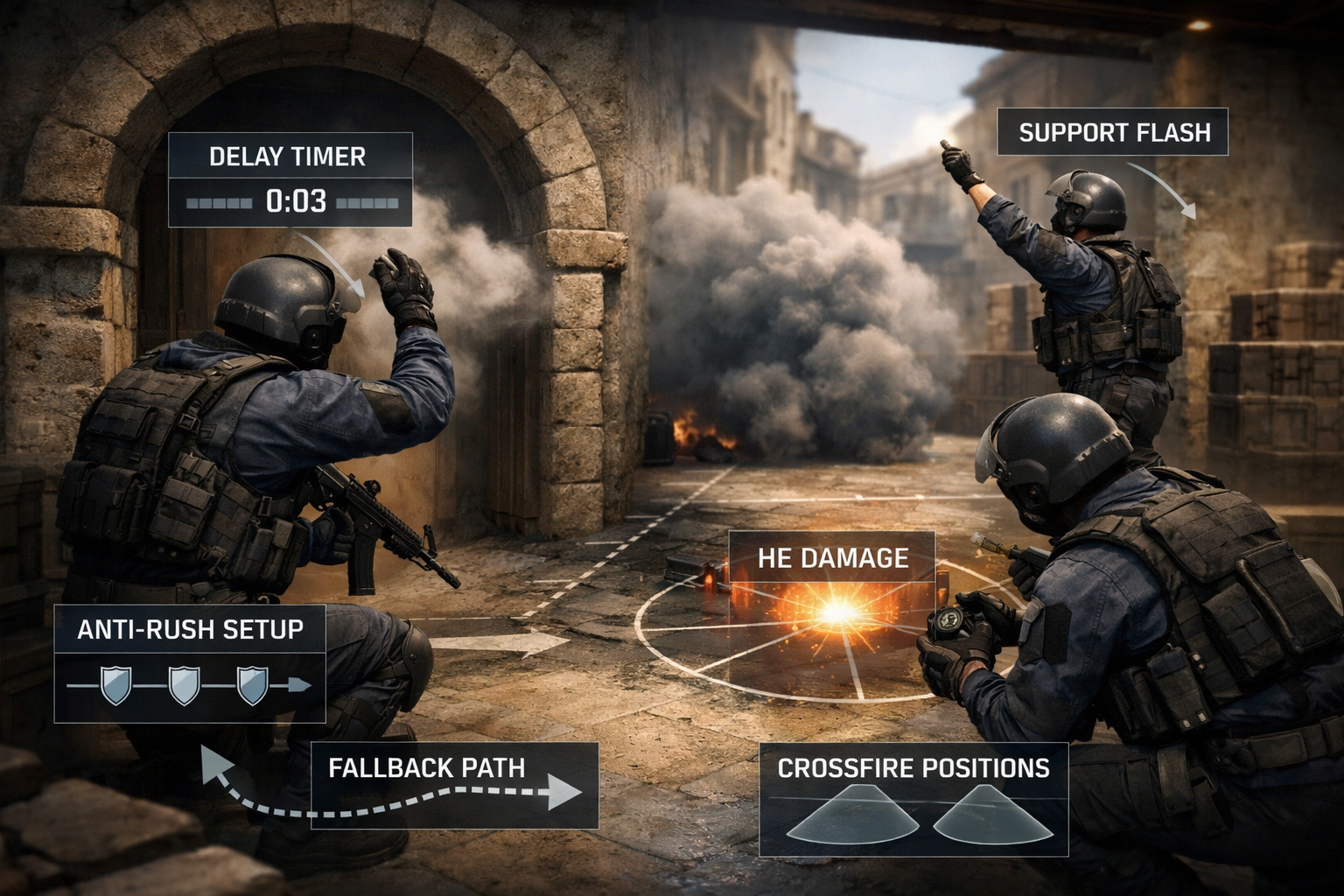
On defense, smokes are often about time. A single well-timed smoke can force the T side to either wait, waste counter-utility, or hit through reduced visibility. That gives your teammates extra seconds to rotate, set up a crossfire, or gather more information elsewhere.
The best defensive smokes are rarely panic smokes thrown directly on top of your own feet. Those can be useful in emergencies, but they also cede space and invite close-range exits. Better CT smokes usually land at a choke, just beyond a choke, or at a lane where the attackers want clear entry vision. That way the T side must choose whether to push blind, burn time, or reveal more utility.
Defensive smokes are also excellent for re-fighting. Throw the smoke, reposition slightly, and let the attackers think they solved the angle. When the smoke fades or pressure shifts, your new line can catch them as they clear the old one.
How to think about smoke timing
Early-round smokes should either stop a fast plan or support your own fast plan. Mid-round smokes should help control map space or preserve a key area. Late-round smokes are often the most valuable because they affect the bombsite directly. That is why disciplined players do not spend every smoke in the first 40 seconds unless they are specifically running a fast script.
A useful rule: if your smoke blooms but your team is not ready to use the new space, the timing is probably wrong. Smokes should open a window, and windows lose value when nobody climbs through them.
When not to smoke
Do not smoke an area that your teammate is actively watching unless there is a clear reason. Do not smoke a choke so shallow that the enemy gets a free one-way edge or easy close contact. Do not give up your own information by smoking too early every round in the exact same place. And do not assume smoke equals safety. In CS2, spam, HE pressure, and fade timing punish lazy assumptions.
How to Use Flashes in CS2
Flashes are the most timing-sensitive grenade in the game. A good flash creates one of the most unfair advantages available in Counter-Strike. A bad flash blinds your team, announces your peek, or pops so far away from the action that nobody is affected. Because of that, flashes reward coordination more than almost any other piece of utility.
What a flash should usually do
A flash should either win space or protect a teammate during a critical action. That critical action could be peeking a held angle, entering a site, escaping after contact, retaking an area, or denying a push through a smoke. The idea is simple: the defender should need to react to the flash and your body at nearly the same time.
Types of flashes that matter most
- Pop flashes: fast detonations designed to blind a defender with minimal warning.
- Support flashes: thrown for a teammate’s peek or entry.
- Self flashes: used by a solo player to take initiative without support.
- Re-take flashes: designed to help a defender or attacker swing back into contested space.
- Anti-rush flashes: used by defenders to stop a fast grouped push.
- Anti-contact flashes: held until the opponent commits close and then popped to punish timing.
When to use flashes
- Before a peek when the enemy is likely posted and ready.
- During an execute to break the first defender’s timing and allow the entry to cross dangerous space.
- After contact to stop a trade chain or re-take initiative.
- On defense when attackers are grouped in a predictable choke.
- In late-round clutches to create a tiny gap in information and reaction time.
Where flashes are strongest
Flashes are strongest where the defender is forced to look in one direction. Think about narrow chokes, one-way entries, common angle holds, and elevated off-angles that naturally draw attention. A defender who is fully focused on a doorway, ramp, or lane is much easier to flash than someone already hiding deep and turned away.
That is why support flashes near entry points are so powerful. The defender wants to hold the choke because it is the main threat. You punish that focus with a flash that detonates just above or beyond the line of sight and then immediately take the duel.
How to throw better flashes on T side
Attackers should think about flashes in layers. The first flash often gets the entry onto the site or through the choke. The second flash usually covers the swing from the support defender or breaks the fallback position. The third flash, if available, helps stabilize the post-plant by punishing the first retake peek.
One of the most common T-side errors is flashing too early and then hesitating. That gives the defender time to tuck, turn, recover, and still kill the entry. Your flash must be paired with movement. The entry swings off the flash. The second player trades off the entry. If you cannot move on the flash, save it until you can.
Another major error is over-flashing an execute. One clean support flash is usually stronger than three uncoordinated ones. Too many flashes make your own team uncomfortable. They also reduce trust. When players are unsure whether the next flash is friendly or hostile, they start half-looking away, and that hesitation kills momentum.
How to throw better flashes on CT side
Defenders often get the most value from patient flashes rather than instant ones. When the attackers start a choke burst, the first instinct is to throw immediately. Sometimes that works, but a delayed anti-rush flash can be even better because the Ts have already committed forward, narrowed their movement options, and begun aiming at the site. That is when they are least flexible.
CT flashes are also strongest when they are supportive rather than heroic. The anchor does not always need to take every fight alone. A rotator or nearby support player can throw the better flash while the anchor focuses on staying alive, spotting numbers, and buying time. Even in ranked, a simple “flash now” call creates huge value.
Self-flashing correctly
A self-flash should let you re-peek without forcing your crosshair off the likely angle for too long. That means keeping it simple. Fancy self-flashes are fun, but the best ones are consistent and fast. Throw, turn minimally if needed, swing instantly, and know exactly which angle you are taking first. Self-flashes lose power when they become indecisive.
Flashing through smokes
One of the best uses of flashes in CS2 is around smoke edges. A player staring at the edge of a smoke is often fully committed to the possibility of a swing. A well-timed pop over or through that smoke makes the peek dramatically stronger. This is especially effective in post-plants, anti-rush setups, and re-takes where both sides are waiting for someone else to make the first move.
When not to flash
Do not flash just because the team is silent and you feel something should happen. Do not throw a support flash if your teammate is not ready to swing. Do not re-use the same obvious flash every round against players who have already adapted. And never forget that a flash is a contract with your team: if you call it, they need to know whether to turn, swing, or hold.
How to Use HE Grenades in CS2
HE grenades are often the most misunderstood part of the utility set. Many players think of them as a bonus item: nice when it lands, forgettable when it does not. In strong Counter-Strike, HE grenades are much more than chip damage. They punish grouped movement, clear weak positions, secure kill thresholds, break fast rushes, deny plants, and make follow-up rifle fights far easier.
What an HE should usually do
An HE should either punish a predictable position or improve the next duel. It does not need to kill to be valuable. Taking an opponent from healthy to fragile can change the entire round. A rifler who would comfortably hold one more swing may now be one bullet from dying. An AWPer forced off a line after damage may not be willing to re-peek. A rush that loses 60 to 100 total team health before the first entry duel is suddenly much less dangerous.
When to use HEs
- Against early-round rushes when attackers group through a tight choke.
- On common default positions where players sit repeatedly for information or map control.
- After contact when an opponent falls back behind common cover.
- To clear close corners before a committed swing.
- On plant or defuse denial when the timing is right and the spot is predictable.
- On anti-eco rounds where grouped pistols or shotgun traps are likely.
Where to use HEs
HE grenades are best in areas where players naturally bunch, pause, or hide. That includes choke entrances, sandbags-style corners, close boxes, under-balcony-style spaces, default plant cover, and common fallback spots after first contact. The grenade becomes much better when the enemy has limited movement choices.
A good way to think about HE placement is to ask: “If I were under pressure here, where would I instinctively stop?” That instinctive stopping point is often a great HE target.
Strong HE usage on CT side
Defenders frequently get the most reliable HE value because attackers must move through predictable gates. A stacked anti-rush HE setup can destroy pistol rounds and light buys. Even a single HE after a contact call can force the T side to slow down or enter with damaged players. The key is restraint. Do not HE the choke automatically every round unless the opponents truly deserve it. Use pattern recognition.
CT HEs are also strong when paired with a smoke. The smoke slows the hit, compresses the attackers behind it, and gives the HE a tighter damage zone. That combination often does more than either grenade alone.
Strong HE usage on T side
On attack, HEs are best for dislodging known close defenders, punishing common off-angles, and softening the site before the final swing. They are especially useful against stubborn anchors who keep playing the same box, pillar, bench, or close wall position. Even if the HE does not kill, it can force a reposition that makes your entry easier.
T-side HEs are also powerful in post-plants. If you know where the retake defender is coming from or where he is likely tapping the bomb from, an HE can buy precious seconds or secure an easy follow-up.
How HEs work best with information
Blind HEs are fine in very predictable situations, but informed HEs are where the real value lives. If your teammate hears multiple footsteps, spots one crossing into cover, tags a player low, or confirms a common hide spot, your HE becomes purposeful. Treat information as the amplifier. The more precise the call, the stronger the HE.
When not to use HEs
Do not save every HE for a fantasy kill that never comes, but do not throw it randomly either. Avoid tossing HEs into broad open space where opponents can sidestep freely. Avoid using them so early that they cannot support the part of the round that actually matters. And avoid stacking too many HEs with no rifle pressure behind them. Damage is great, but damage with immediate pressure is much better.
How to Layer Smokes, Flashes, and HE Together
Utility becomes truly dangerous when grenades stop acting as isolated tools and start working as a sequence.
The simplest and most effective sequence is smoke, flash, swing. The smoke removes the strongest long angle. The flash blinds the defender trying to compensate from the next position. The swing takes the duel while that defender is under maximum stress. This is the backbone of countless site takes and re-takes.
Another excellent sequence is smoke, HE, re-peek. The smoke compresses or slows the enemy. The HE punishes anyone waiting close or stuck behind the edge. The re-peek happens while the opponents are damaged, disorganized, or still recovering from the explosion. Defenders use this well on anti-rush setups, but attackers can use it to break a stubborn hold too.
A third sequence is flash, contact, HE on fallback. The flash forces the defender away or blinds him for the opening duel. Once he escapes behind common cover, the HE lands on the retreat path or hold point. This is particularly strong against anchors who survive the first pressure and try to stabilize from the same safety spot every round.
In post-plant situations, good layering often looks like this: smoke one re-take lane, flash the first contact point, then HE the bomb or the closest cover as the defenders commit. On defense, good layering looks like smoke to delay, flash to punish the push through it, then HE the choke or plant zone when the attackers are committed.
The big lesson is that utility should tell a story. Every grenade should make the next action stronger. If your nades do not connect to each other, your opponents recover too easily between them.
T-Side Utility: Defaults, Hits, Fakes, and Post-Plants
Using utility in defaults
During a default, your job is to gather information, test reactions, and earn pieces of the map without donating opening deaths. Smokes here should deny the most punishing lines. Flashes should support short bursts of initiative. HEs should punish common contest spots. The goal is not to fully commit; it is to force the CTs to reveal where they are comfortable and where they are weak.
A strong default keeps at least some utility for the conversion into a hit. That means resisting the urge to spend every grenade just to look active. Good defaults create pressure while preserving the ability to explode later.
Using utility on hits and executes
When your team commits, the grenades must match the path of the entry. Remove the hardest long angle with a smoke. Use a flash to break the first fight. Use an HE or second flash to punish the fallback spot. Make sure someone is ready to smoke or flash for the plant if needed. The cleanest executes are not necessarily the ones with the most grenades; they are the ones where each grenade supports a specific second of the entry.
Using utility in fakes
Fakes work best when the utility communicates believable intent. One smoke and one flash can be enough if they match a real timing and a real threat. But the fake must have an objective: pin a rotator, create uncertainty, or drag utility out of the defenders. A fake that uses too much without gaining any reaction is often worse than no fake at all.
Using utility in post-plants
This is where discipline wins games. Save a smoke for the bomb if possible. Save a flash for the first re-take swing. Save an HE for the tap, the common defuse spot, or the force-out from cover. Too many attackers celebrate the plant by hunting immediately and then lose the easiest part of the round. Your utility after the plant is often worth more than the utility used to get in.
CT-Side Utility: Holds, Delays, Rotations, and Retakes
Using utility on holds
Anchors should think in waves. First wave: early info or anti-rush utility. Second wave: the delay grenade when real pressure begins. Third wave: the survival grenade that buys time for support. That survival grenade is often the difference between dying alone and letting your rotators arrive in a playable situation.
Using utility during rotations
Rotating defenders should not always sprint in with rifles out and no plan. A single flash for the site anchor, or a smoke that cuts the planter from his support, can turn a nearly lost site into a recoverable situation. When rotating, ask what kind of fight the anchor is currently trapped in and what grenade best changes it.
Using utility on retakes
Retakes are almost impossible when everyone peeks one by one into set crosshairs. Smokes are excellent for segmenting post-plant positions. Flashes are essential for coordinated entry into the site. HEs are strong for default corners, behind-box-style spots, and bomb denial when the attackers try to play the timer. The biggest retake error is urgency without structure. A three-second setup with coordinated utility is often far stronger than a desperate instant swing.
Using utility against eco and force buys
Against weaker buys, do not get lazy. Utility is often even more important because pistols and shotguns thrive in close chaos. Smokes should deny explosive close range. Flashes should clear stacked angles. HEs are excellent for punishing grouped traps. The correct anti-eco is controlled and respectful, not arrogant.
Common Utility Mistakes That Lose Rounds
- Throwing too early: your utility fades before the real fight begins.
- Throwing too late: your teammate dies before the grenade matters.
- Overlapping the same job: two smokes on one angle, three flashes for one peek, or double HE with no pressure elsewhere.
- Using utility without movement: especially flashes that do not create a swing.
- Smoking for the enemy: giving attackers cover to cross or defenders a pocket to hide in.
- Wasting late-round value: empty hands when the plant, retake, or clutch begins.
- Ignoring communication: the best grenade still fails when teammates do not know it is coming.
- Autopilot utility: repeating the same round-start pattern until the opponent reads it easily.
One subtle but important mistake is confusing “standard” with “correct.” Standard utility exists for a reason, but the right grenade depends on what the opponents are showing. If they never contest early space, maybe your opening flash can be saved. If the anchor always repositions after first contact, maybe the HE belongs on the fallback rather than the corner. Adaptation is the difference between utility as routine and utility as strategy.
How to Practice Utility Without Wasting Time
The fastest way to improve utility is not to memorize fifty lineups in one sitting. It is to build repeatable understanding.
1. Learn the purpose before the throw
For every smoke, flash, or HE you practice, name the reason it exists. “Blocks AWP line.” “Lets entry cross.” “Punishes anti-rush stack.” “Denies default plant.” When you remember the purpose, you recall the grenade much more reliably in real matches.
2. Practice in small sets
Take one map or one zone and learn three to five truly useful grenades: one control smoke, one execute smoke, one support flash, one anti-rush flash, one HE spot. That is enough to create immediate match value. Depth beats volume.
3. Review your demos or VODs
Every time a round feels impossible, ask whether utility could have made it simpler. Did you die holding an angle that should have been smoked? Did your entry go in dry? Did you have an HE for the close corner and forget to use it? Did you spend all utility before the plant? This kind of review improves decision-making much faster than mindless repetition.
4. Watch how better players sequence their grenades
Do not only copy where pros throw utility. Study when they throw it, what triggers it, and how their teammates move around it. That is where the real lesson is. Watching high-level CS on HLTV-linked events, streams, or analyst breakdowns can teach timing discipline that raw lineup videos never will.
5. Build communication habits
Even in solo queue, small calls matter: “flashing over,” “smoking cross,” “HE close,” “hold, smoke fading,” “wait for pop,” “save one for post-plant.” Good utility becomes dramatically better when one sentence prepares your team for it.
6. Treat utility like mechanics
Just as aim improves through repetition, grenade consistency improves through focused reps. Practice the throw, but also practice the follow-up movement. Smoke and swing. Flash and peek. HE and clear. The grenade is not the full action; it is the start of the action.
Final Thoughts
Smokes, flashes, and HE grenades are not extras in CS2. They are the framework that makes your fights cleaner, your plans sharper, and your round wins more consistent. Smokes remove unfair vision. Flashes steal timing. HEs punish greed, grouping, and predictability. When combined well, they turn a site from a wall into a sequence.
If you only remember one thing from this guide, remember this: utility should always create the next advantage. Throw your smoke to make the angle manageable. Throw your flash to win the peek. Throw your HE to punish the fallback or the stack. Save what matters for the phase that decides the round. The players who do that reliably stop playing “hope Counter-Strike” and start playing winning Counter-Strike.
Master the purpose, not just the lineup. Once that clicks, your utility will start deciding rounds before the scoreboard ever shows who got the final kill.