



How to Split Push in LoL: Pressure and Backdoor Guide
How to Split Push in LoL 2026: When to Split, Pressure and Backdoor Strategies
Split pushing is one of the most misunderstood win conditions in LoL. Many players think it simply means “go side lane and hit towers.” That is not enough. Real split pushing is a complete macro system. It is about wave timing, information, threat range, objective trading, recall discipline, and knowing exactly how much pressure you can create before the enemy team can punish you.
If you have ever been called a “useless side laner” while your team loses mid, or if you have grouped for every fight and felt your champion become half as effective, this guide is for you. A good split push does not remove you from the game. It forces the game to move on your terms. It creates map stress. It makes defenders reveal themselves. It opens Baron, Dragon, towers, jungle camps, vision lines, and eventually the Nexus.
This guide is written to stay useful for a long time. Instead of being locked to one short-lived patch trend, it focuses on durable LoL fundamentals: lane assignment, pressure windows, cross-map logic, wave management, vision setup, backdoor rules, and decision-making under uncertainty. Riot’s own official How to Play overview is still the simplest reminder of the game’s structural goal: break through turrets and inhibitors to reach the Nexus. Modern gameplay changes also continue to reward strong side pressure through objective systems and map control, as Riot has discussed in its 2026 gameplay preview and official system updates around turrets and backdoor rules in earlier gameplay patch notes.
If your goal is not only to understand split push theory but also to climb more efficiently in ranked, you can also check Boosteria’s LoL elo boost pricing page for additional support options. That said, mastering the ideas below will already raise your win rate, especially in solo queue where side-lane pressure is often defended badly.
1. What Split Push Really Means
Split pushing is the act of creating side-lane pressure away from the main group so the enemy team is forced into a bad choice. They can send one or more players to stop you, which weakens their control over the rest of the map, or they can ignore you and lose gold, structures, jungle access, and sometimes the game itself.
The key phrase is bad choice. If the enemy can answer you comfortably with one champion while their other four players take control elsewhere, your split push is not threatening enough. If your team cannot survive or threaten anything while you are side, your split push is incomplete. Good split pushing combines three things at the same time:
- Lane pressure: minions are crashing and structures are under threat.
- Champion threat: the player in side lane can duel, escape, or take towers quickly.
- Map consequence: if the enemy answers the side lane, something important becomes available elsewhere.
This is why split push is not just a top-lane concept. Top laners, mid laners, and even some marksman picks can do it depending on the draft and state of the game. What matters most is not the lane you started in. It is whether your champion, summoner spells, item build, and current lead allow you to force uncomfortable rotations.
2. Why Split Pushing Works in Solo Queue
Split pushing is especially strong in solo queue because coordinated answers are rare. Many teams react too slowly. Others overreact and send three players to catch one wave. Some panic and start Baron without enough damage. Some force mid for no reason while side waves are collapsing into their towers. Split push punishes indecision, poor communication, weak vision, and bad recall timing.
It also punishes emotional play. When an enemy sees a tower being hit in a side lane, they often feel forced to stop it immediately, even if the smarter play is to trade objective pressure or hold formation. This emotional pull creates picks, isolated fights, and broken formations.
Another reason it works is that not every teamfight composition actually wants to teamfight on even terms. A duelist, high-level side laner, or tower shredder usually gets less value in a front-to-back 5v5 than in a stretched map. If you group permanently on a champion that should be side-laning, you reduce your own draft’s strengths.
Finally, split pushing improves consistency. Teamfighting often depends on mechanics, engage timing, positioning, cooldown tracking, and whether somebody gets caught before the fight begins. Side pressure gives you another way to win without needing one perfect 5v5. In ranked, any strategy that gives you more paths to victory is valuable.
3. When You Should Split Push
You should split push when at least one of the following is true:
- Your champion beats or threatens the likely defender in a long lane.
- Your team is weaker in straight 5v5 fights but stronger in side-lane pressure.
- You have teleport, a global tool, or enough mobility to pressure side safely.
- A major objective is coming up soon and your side pressure can pull defenders away first.
- You already took an outer tower and can extend pressure into the enemy side of the map.
- The enemy waveclear is weak or their side-lane answer is dead, behind, or showing elsewhere.
- Your team can hold mid and avoid hard engage while you pressure side.
A great split push window usually begins before the big objective appears on screen. Many players wait until Baron or Dragon is live, then run to side lane too late. Strong macro players start the side wave first, build a slow push, clear vision entrances, and create a timing problem that reaches full value as the objective becomes contestable.
As a simple rule, split push is strongest when you can threaten two things at once: the side lane itself and the rotation route the enemy must use to answer it. If you can crash a big wave, step into fog, and force defenders to guess whether you are hitting tower, taking jungle camps, threatening flank, or recalling for tempo, you are controlling the map.
4. When You Should Not Split Push
Split pushing is not always correct. There are many games where grouping is better. Here are the biggest red flags:
- Your team gets hard engaged on instantly when you are not there.
- You lose the side-lane duel badly or cannot threaten tower damage.
- The enemy has superior pick tools and you have no deep vision.
- An objective fight is unavoidable in the next few seconds and your wave is still too far away.
- Your teleport or mobility tools are down and your team needs immediate presence.
- The enemy can start and finish Baron or Elder before your pressure matters.
- Your side-lane champion is the only reliable engage or only source of frontline.
Many bad losses come from stubborn split pushing. Some players decide before the game that they are “the split pusher” and ignore context. That is not macro. That is autopilot. If your team has no way to stop a hard force mid, if the enemy outruns your pressure, or if your death immediately gives Baron, you need to adapt.
A useful mindset is this: split push to create leverage, not to prove a point. If the leverage is gone, stop. Reset the map, catch the next side wave, or group for the fight that actually decides the game.
5. Which Champions Split Push Best
The best split push champions usually have several of these qualities: strong dueling, mobility, sustain, tower damage, waveclear, escape tools, or the ability to win outnumbered for a few seconds. They may also have global pressure, teleport synergy, or items that let them demolish structures quickly.
But do not reduce split pushing to a fixed champion list. A champion is a good split pusher only when the game state supports it. A fed skirmisher can become a terrifying side-lane threat. A scaling marksman with three items and safe positioning tools may pressure towers better than a bruiser who is behind. A mage with teleport and fast waveclear can create side tempo even if they are not a classic duelist.
Think in profiles:
- Duelist profile: wins 1v1 and threatens 1v2 if ahead.
- Tower shredder profile: converts every uncontested wave into structure damage.
- Escape profile: hard to punish in fog and long lanes.
- Global profile: can pressure side and still influence a fight.
- Wave denial profile: instantly clears and resets tempo over and over.
The strongest split push pick in your game is the champion whose profile punishes the enemy draft’s weakest answer. Do they lack hard engage onto your side lane? Do they lack waveclear? Do they only have one real defender? That matters more than a generic tier list.
6. Lane Assignment Fundamentals
Good split pushing starts with correct lane assignment. In most games, after early lane phase ends, you want one champion in each side lane and the remaining players controlling the center of the map. Mid lane matters because it is the shortest lane and touches both major objectives and both jungle entrances. The champion in side lane is stretching the map while the mid group prevents the enemy from collapsing too freely.
The most common rule is simple:
- If Baron is the main objective, pressure the lane opposite the enemy’s expected collapse route and make the enemy choose between answering side or contesting river setup.
- If Dragon is the main objective, pressure the opposite side lane early enough that the crash creates a delayed decision at objective time.
Why opposite side? Because the farther the defender has to travel, the harder it is for them to answer your pressure and still arrive on time to the next fight. Long rotations are where split push value is born.
That said, lane assignment is never purely theoretical. Sometimes the right lane is simply the one where you have deeper vision, stronger jungle access, or an exposed inhibitor tower. Sometimes you send a less mobile champion to the shorter side and a more slippery champion to the deeper side. Macro is about using the map you have, not the perfect map from a textbook.
7. Wave Management for Split Push
If split pushing is the strategy, wave management is the engine. Most players sabotage their own split push by hard shoving every wave mindlessly. The best split pushers understand all three states: fast push, slow push, and neutral hold.
Fast Push
Fast pushing is used when you need immediate pressure. You clear the wave quickly to make your minions reach tower as fast as possible. This is useful when an objective is about to spawn, when you need to crash before recalling, or when you know the enemy defender is already far away.
Slow Push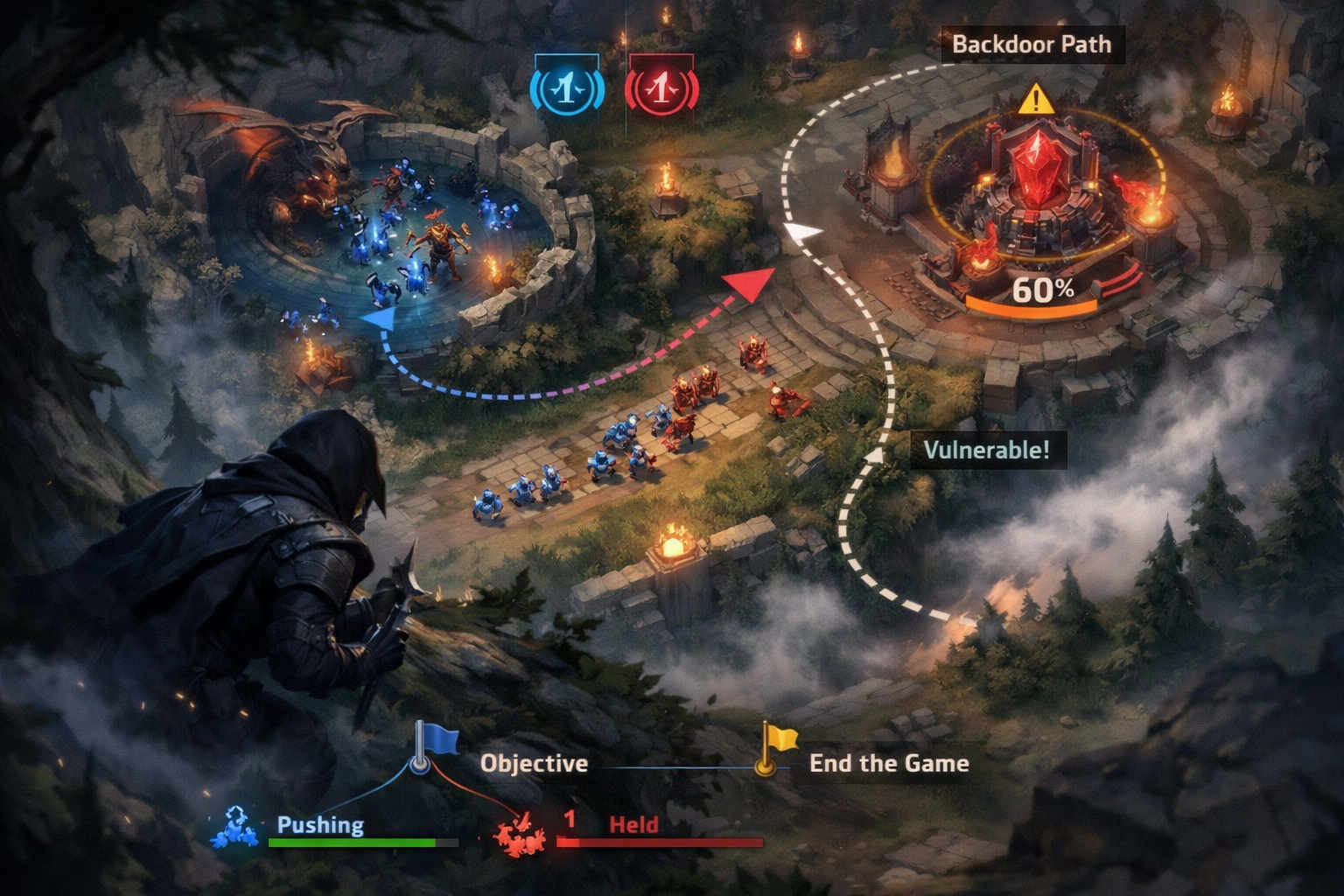
Slow pushing is stronger for deep macro. You leave part of the enemy wave alive so your wave stacks over time. A large stacked wave creates much more pressure than one normal wave because it takes longer to clear and deals more damage if ignored. Slow pushes are ideal when an objective is 45 to 90 seconds away. You build the wave now so it becomes a problem later.
Freeze or Temporary Hold
This is less common in true split push phases, but there are times when holding the wave is better than instantly shoving. If you are ahead and want to force the enemy defender to walk farther out, a controlled hold can expose them. If you are behind and waiting for vision or jungle cover, holding can buy time.
The biggest wave rule for split pushing is this: do not show in side lane without a plan for the next two waves. One wave is not macro. Two or three connected waves are macro. Ask yourself:
- Am I trying to crash now?
- Am I trying to build a stack for later?
- Am I baiting a defender to reveal?
- Am I buying time for my team to get vision?
- Am I setting up a reset before the objective?
If you cannot answer those questions, you are probably just farming, not split pushing.
8. Vision and Information Control
A split push without vision is a donation. You do not need perfect information, but you do need useful information. At minimum, you want to know which defenders are visible, which flank entrances are dark, and whether the enemy can collapse on you before your team gains something elsewhere.
Good side-lane vision is not only about wards in the lane brush. You want vision one layer deeper, on the paths people actually use to collapse. Depending on side and objective state, that can mean jungle crossroads, entrances near river, or escape routes behind the enemy tower line. Riot’s recent gameplay direction has also emphasized giving pushing solo laners better access to meaningful ward value and side-map information, which only makes disciplined side-lane setup more rewarding when used properly.
When you split push, think in three circles of information:
- Immediate safety circle: the brushes and entrances that can kill you in the next 3 to 5 seconds.
- Rotation circle: the jungle route defenders use to move from objective or mid lane to your side lane.
- Punish circle: the path your team controls if the enemy sends too many players after you.
It is also important to use fog actively. After pushing a wave, you do not always need to remain visible. Sometimes the strongest move is to disappear. When you step out of vision, the enemy team must guess: are you recalling, flanking, taking jungle camps, waiting in a brush, or continuing deeper? This uncertainty often creates more pressure than another two auto attacks on the tower.
9. Split Push Around Baron, Dragon and Major Objectives
Side-lane pressure only matters if it interacts with objectives. The biggest mistake in macro discussions is treating split push and objective control as separate ideas. They are the same game. Split push is often the method you use to win objective setup without needing to start the fight first.
For Baron, the classic pattern is to pressure the far side lane before the objective becomes the central focus. If the wave is building correctly, someone must answer it. If nobody answers, the tower or inhibitor takes damage. If somebody answers late, your team gains mid priority and better river control. If too many answer, Baron vision or even Baron itself becomes vulnerable.
For Dragon, the logic is similar, but timing matters even more because Dragon fights are often more compressed and explosive. You usually want the opposite side wave to be pushing toward the enemy so they feel a loss if they commit all five players to river. A side wave arriving at tower during Dragon setup creates a painful choice: defend economy and structure, or commit to the fight and accept map loss.
Do not think only in “fight or no fight” terms. Think in trade value. Can your split push convert into:
- an outer tower for Dragon?
- an inhibitor tower for Baron setup?
- deep vision and camps for temporary objective surrender?
- multiple defenders leaving fog, exposing a pick?
Great split pushers are not obsessed with taking every objective. They are obsessed with forcing the enemy to pay for every objective they take.
10. How to Create Real Pressure Instead of Fake Pressure
Real pressure is pressure the enemy must answer. Fake pressure is visible but harmless. A side lane creates real pressure when at least one of these is true:
- You can kill the defender.
- You can take the tower quickly if ignored.
- You can threaten an inhibitor timing.
- You can disappear into fog and force respect.
- Your team can immediately gain something if two defenders show on you.
Fake pressure looks active but achieves nothing. You shove one wave, stand far back, hit no tower, place no vision, take no camps, and recall without creating any rotation stress. The enemy sees you, ignores you, and still controls the map. That is not split pushing. That is announcing your location.
To create real pressure, combine the wave with your champion’s threat. If you are strong, stand in a position where the defender cannot comfortably walk up. If you are weaker, use the wave and fog to delay without committing. If you have teleport or a global tool, hold that threat over the map. If your team has control over mid, push the side one step deeper. If mid is collapsing, pull back and reset.
Pressure also means resource denial. Taking a side tower is obvious, but stealing camps, removing wards, forcing bad recalls, and making defenders miss waves all count. Over time, these micro advantages become major leads.
11. Mid Game Split Push Playbook
The mid game is where most solo queue games are decided, because this is where lane phase structure breaks down and macro skill begins to matter. A reliable split push playbook in mid game looks like this:
- Catch the side wave early instead of late.
- Decide whether to fast push or slow push based on the next objective timer.
- Track which enemies are visible before extending past river.
- Use your first pressure window to place or confirm vision, not only to hit tower.
- Communicate with pings that your team should hold mid and avoid hard engage unless the enemy sends multiple defenders.
- After the crash, either pressure structure, move into fog, steal camps, or reset. Do not remain visible without purpose.
A classic mid game error is staying in side lane for too long after the wave crashes. The tower may look tempting, but once the enemy has enough time to respond, your best move is often to disappear. Make them guess. If they send one player and you can kill them, great. If they send two and you survive, your team should gain center control. If no one comes, then you return to the tower with the next wave.
Mid game split push is less about “ending through side” and more about accumulating tempo. You are trying to pull the enemy formation apart, create awkward recalls, and build the kind of map where Baron or inhibitor becomes much easier later.
12. Late Game Split Push Playbook
Late game split pushing is more dangerous and more powerful. Death timers are long. One wrong side-lane death can cost the game. But one successful pull can win the game without a full 5v5.
In late game, the side wave matters even more because structures fall faster and recall punishment is harsher. You should pay special attention to:
- Teleport status: yours and the enemy’s.
- Death timers: how much the map changes if one player dies.
- Backdoor protection: whether you can truly end or only threaten.
- Inhibitor state: which lane creates the strongest super minion pressure.
- Objective sync: whether your side push aligns with Baron, Elder, or exposed base structures.
Late game split push usually works best when your team understands one simple rule: do not force too early, do not get caught, and keep the enemy visible. The side laner is not only buying tower damage. They are buying map distortion. Every second the enemy hesitates or sends the wrong defender is a second closer to checkmate.
If an inhibitor is already down in one lane, pressure in another lane becomes more valuable because defenders are repeatedly pulled by the super wave. Double-wave pressure is one of the most oppressive states in LoL. When one lane is self-pushing and another is actively pressured, the defending team often loses the ability to keep all five players hidden. That alone creates pick windows and base race opportunities.
13. Backdoor Strategies and Base Race Logic
Backdooring is one of the most exciting and most misplayed win conditions in LoL. A real backdoor is not random desperation. It is a planned attack on the enemy base while the defender’s attention is pulled elsewhere. It usually works because of wave state, vision denial, teleport timing, mobility, or objective distraction.
The first rule is understanding that not every open path is a true backdoor window. You need to ask:
- Can I reach the base undetected or too late to stop?
- Do I have enough damage to kill the structure before defenders arrive?
- Is backdoor protection active?
- Will my team keep the enemy occupied long enough?
- If the play fails, do we lose Baron, Elder, or the game?
Many players throw by attempting a low-probability backdoor when a normal side push would already win slowly. Do not confuse highlight plays with high-percentage macro. The best backdoors happen when the enemy has already been stretched by previous side pressure. They are not isolated hero moments. They are the final layer of pressure after several minutes of map manipulation.
Base race logic is similar. If both teams are threatening the end, the question is not “who started first?” It is “who reaches meaningful structures faster?” and “who loses more time to waves, defenders, or protection rules?” Sometimes recalling two players is enough to win the race. Sometimes continuing the push is correct because your team ends faster. Strong players decide this by structure count, wave distance, champion damage, and travel time, not by panic.
Practical Backdoor Checklist
- Push the side waves first so defenders are already pulled thin.
- Hide your intention by disappearing before the enemy fully tracks you.
- Make sure your team is visibly threatening something else: Baron, Elder, mid inhibitor, or a 4v4 standoff.
- Know whether you need minions or whether the plan is only a delayed flank into normal siege.
- Commit only if your damage and timing are real.
One overlooked point: some “backdoors” are really just stealth sieges. You slip into the base, wait for the wave or your team’s pressure, and then hit the tower once the defenders are locked elsewhere. These are often stronger and safer than pure no-minion endings.
14. How to Coordinate with Your Team
You do not need a full voice call to coordinate split push. In solo queue, clear pings and consistent behavior are enough. Your team mostly needs to understand what not to do while you are side-laning.
The ideal communication is simple:
- Ping your lane assignment early.
- Ping the objective timer.
- Ping your teleport or lack of teleport.
- Ping retreat if your team starts posturing too far forward before your wave is ready.
- Ping on the way or assist if multiple enemies show on your side and your team can take something.
Many split pushes fail because the side laner and the mid group are operating on different clocks. You are building a slow push for 50 seconds from now, while your team is looking for a random engage 10 seconds from now. Macro works when both clocks match.
If you are the one grouping mid while your side laner pressures, your job is not to force instantly. Your job is to hold formation, keep waves controlled, threaten punish, and make it expensive for the enemy to collapse together. A patient mid group makes a side laner stronger than any extra item component.
15. Common Split Push Mistakes
Here are the most common errors that ruin otherwise good side pressure:
1. Shoving Without Objective Timing
You push the side lane, but nothing is happening anywhere else. The enemy clears, and your pressure resets for free.
2. Fighting Before the Wave Matters
Your team engages before the side wave reaches tower. That means the enemy does not have to choose yet. They simply take the fight.
3. Staying Visible Too Long
After crashing the wave, you keep showing on the map. This removes uncertainty and makes the collapse easy.
4. Ignoring Defender Matchups
You keep trying to split even though the enemy answer now beats you or clears instantly. Adapt the plan.
5. Greeding for One More Tower Hit
One extra auto attack is not worth dying for. Towers are tempting because they are visible value. Deaths are hidden cost until the game explodes.
6. No Reset Discipline
Split pushing while low health, low mana, or on a bad item timer is asking to get trapped. Pressure requires tempo, and tempo often begins with a good recall.
7. Confusing Farm with Pressure
Catching side waves is useful, but not every side wave is a split push. Pressure means the enemy has to react.
8. Wrong Side of the Map
You are bot lane with no teleport when Baron is the only thing that matters. That is not pressure. That is absence.
16. Role-Specific Tips
Top Lane
Top laners are often the natural split pushers because they commonly have dueling tools, sustain, and teleport access. But top players often tunnel too hard on the 1v1. Remember that your side lane only matters if it changes the map for your team. Do not judge success only by whether you killed the defender. Judge it by whether you created a bad choice.
Mid Lane
Mid laners can be elite side-lane controllers if they have fast waveclear, mobility, or teleport. Your biggest advantage is tempo. Push fast, disappear fast, and force defenders to reveal. Many mid lane split push wins come from fog pressure and rotation timing more than brute-force tower hits.
Jungle
Junglers rarely become the main split pusher, but they decide whether split push succeeds. Cover the side lane when the wave is being set. Shadow the first deep push. Use your position to punish over-rotations. If your side laner is drawing pressure and you are farming your own empty camp on the opposite side for no reason, you are missing the macro opportunity.
ADC
Marksmen can split push in the right game state, especially when ahead, when structures are already open, or when the enemy lacks good flank tools. However, side-lane ADC play is less forgiving. You need superior vision discipline and better judgment about when to retreat. Often, the correct ADC split push is a short, controlled side catch into immediate regroup.
Support
Supports shape the map that makes split push possible. Your wards, sweeps, and mid-lane presence determine whether the side laner can extend. Strong supports understand when to leave lane priority alone and move first to set vision around the side-lane route. A well-timed control ward can be worth more than several hundred gold of raw stats.
17. How to Defend Against a Split Push
Learning to split push also teaches you how to beat it. The defender’s goal is not always to kill the side laner. Often the smarter answer is to shorten the map, clear the wave early, hold formation, and deny the split pusher meaningful vision or duel access.
Good anti-split push defense includes:
- Sending the correct defender, not the nearest defender.
- Clearing the wave before it fully stacks.
- Keeping mid lane stable so the side pusher gains less from cross-map pressure.
- Using fog and objective threat to force the side pusher into bad timing.
- Punishing overextension only when the collapse is guaranteed, not as a panicked chase.
The biggest defensive mistake is overcommitting. If three players disappear to kill one side pusher and fail, the rest of the map often collapses. Be disciplined. Sometimes your job is not to catch them. It is to make their split push low value.
18. How to Practice Split Push Macro
Most players try to improve split pushing by playing more games without changing what they look for. A better approach is targeted practice. In your next matches, focus on one skill at a time.
Practice Drill 1: Two-Wave Planning
Every time you go side lane, say to yourself what you want from the next two waves. Fast crash, slow build, or reset. This alone will raise your macro level quickly.
Practice Drill 2: Objective Countdown
Every time Baron or Dragon is under two minutes away, ask which side wave should be building and who should answer it. This trains objective-linked pressure.
Practice Drill 3: Visibility Tracking
Before extending in side lane, count visible enemies. If only two are showing, assume danger. If four are showing and the fifth cannot threaten you, press harder.
Practice Drill 4: Post-Crash Discipline
After every crash, decide immediately: tower, fog, camp, or recall. Stop drifting in visible no-man’s-land.
Practice Drill 5: Review Deaths
When you die in side lane, do not ask only “was I outplayed?” Ask “what information did I ignore?” Most split push deaths are not mechanical. They are informational.
If you want to climb, pair these drills with regular ranked play and a quick review habit. Riot’s official ranked information is useful if you want a simple overview of the ladder itself, but actual climbing often comes from improving one repeatable macro pattern at a time. Split push decision-making is one of the highest-value patterns to master.
19. FAQ
What is the best lane to split push in LoL?
The best lane is the one that creates the worst rotation for the enemy team. In many cases that means pressuring the side lane opposite the next major objective so defenders have to choose between answering you and arriving on time elsewhere.
Should I always split push if I am ahead?
No. Being ahead helps, but you still need the right map state, vision, matchup, and team setup. Some games are won faster by grouping with your lead. Others are won by stretching the map. The correct choice depends on how the enemy can respond.
How do I know if my split push is working?
If defenders are revealing themselves, your team is gaining mid or river control, towers are losing health, camps are being traded, or the enemy is forced into awkward recalls, your split push is working. It does not need to end in a solo tower kill every time.
When should I stop split pushing and group?
Group when your team cannot safely hold without you, when a decisive objective fight is starting before your wave matters, when the enemy defender now neutralizes you, or when your death would immediately lose the game.
Is backdooring a reliable strategy?
Only when it is built on real setup. The best backdoors come from prior side pressure, vision denial, and timing. Random desperate attempts are usually low percentage and throw away tempo.
Do I need teleport to split push?
No, but it makes split push more flexible. Without teleport, you need better lane timing and more respect for objective windows. With teleport, you can pressure deeper and still threaten team presence, but only if your timing is disciplined.
20. Final Thoughts
Learning how to split push in LoL is really about learning how to control time and space. A side wave is not just minions. It is a timer. A tower is not just gold. It is a threat point. Fog is not just darkness. It is uncertainty you can weaponize. The enemy team does not lose to split push because the strategy is flashy. They lose because they are forced to answer too many problems at once.
If you remember only a few ideas from this guide, make them these:
- Split push with objective timing, not randomly.
- Plan the next two waves, not just the current one.
- Create real pressure that must be answered.
- Use fog after the crash instead of standing visible.
- Stop splitting the moment the leverage disappears.
- Treat backdoors as prepared endings, not coin flips.
Players who master these habits become much harder to beat in ranked. They stop coin-flipping every game on the next random 5v5. They learn how to manufacture advantages from side lanes, recalls, information, and timing. That is what strong macro looks like. And once you truly understand split push, the map starts to feel bigger for you and smaller for your opponents.