



VALORANT Sound Awareness Guide 2026: Footsteps & Audio Cues
VALORANT Sound Awareness Guide 2026: Reading Footsteps and Audio Cues
Mechanical aim wins duels, but sound awareness wins rounds before the crosshair even moves. In VALORANT, the player who reads the audio layer correctly often gets the first useful piece of information, rotates first, pre-aims better, avoids a bad fight, or turns a risky guess into a calculated play. That is why strong players do not treat sound as background decoration. They treat it as a live stream of enemy intention.
This guide is built to be as timeless as possible. Instead of focusing on one patch, one map pool, or one temporary meta, it breaks down the underlying system behind VALORANT sound awareness: what footsteps really tell you, how to separate meaningful cues from fake pressure, how to use spike sounds and utility sounds, how to build audio discipline on attack and defense, and how to train this skill on purpose instead of hoping it improves automatically.
If you want to climb more consistently, audio reading has to become part of your game sense. You should not only hear sound. You should be able to translate it into location, timing, spacing, momentum, confidence level, and likely next action. Once you learn to do that, rounds slow down in a good way. You stop feeling surprised by normal enemy decisions because you start catching them earlier.
Riot has also published useful official material on how VALORANT handles sound, including their explanation of footstep radius, the original HRTF audio update, later support for third-party spatial audio solutions, the design of weapon and surface sounds, and sound troubleshooting guidance. Those official resources are worth bookmarking if you want a stronger technical foundation behind your in-game habits.
Table of Contents
- Why Sound Awareness Matters
- How VALORANT Audio Communicates Information
- Reading Footsteps Correctly
- Other Audio Cues That Decide Rounds
- Turning Sound Into Better Decisions
- Sound Discipline and Noise Control
- Best Settings and Equipment Habits
- Training Routine for Audio Awareness
- Common Sound Awareness Mistakes
- Role-by-Role Sound Priority
- FAQ
- Final Thoughts
Why Sound Awareness Matters
VALORANT is a tactical shooter with limited information by design. You cannot see through walls. You often cannot cover every lane at once. Rotations are risky. Utility is powerful but finite. In that environment, sound fills the gap between what you see and what you need to know. It becomes your early warning system, your lie detector, and your timing guide.
When players say “I had no info,” that is sometimes true. But very often the round did contain information. It was just sound-based instead of visual. Maybe the enemy made a brief contact noise while rotating. Maybe a single reload revealed that a lurker was not ready to fight instantly. Maybe the rhythm of footsteps told you it was not a full rush but only one player trying to create pressure. Maybe a jump or drop sound narrowed the enemy to one of two vertical positions. Small clues matter because tactical rounds are built from small edges.
Great sound awareness improves all of the following:
- Positioning: You choose stronger off-angles and safer escape routes because you understand where pressure is coming from.
- Crosshair placement: Better audio reads let you aim at the right doorway, at the right height, at the right moment.
- Rotations: You rotate earlier when a cue is trustworthy, and you hold your ground when it is not.
- Utility efficiency: You stop wasting abilities on ghosts and start using them when enemy momentum is real.
- Clutch success: In 1vX situations, sound often becomes more valuable than raw aim because it lets you isolate fights.
- Team communication: Good sound readers give cleaner, shorter comms with actual value.
The strongest part of sound awareness is that it travels with you across maps, roles, and metas. A player who truly understands audio timing becomes dangerous everywhere. Even when balance changes happen, the core skill remains. That makes it one of the best long-term investments for climbing.
How VALORANT Audio Communicates Information
To improve at reading sound, you need to stop thinking of audio as a single category. Not all cues mean the same thing. Each sound gives a different kind of information. Some tell you exact location. Some suggest direction without certainty. Some reveal commitment. Some reveal hesitation. Some are intentionally planted to manipulate your expectations.
A useful framework is to sort VALORANT audio into five practical categories:
1. Location Cues
These are the sounds that most directly reveal where someone is or was. Footsteps are the obvious example, but so are ladder sounds, drop sounds, rope sounds, many map interactables, and some utility activations. A location cue may not tell you everything, but it narrows the possibilities. If you hear a loud step on one side of the map, your mental minimap should immediately shrink the possible enemy positions.
2. Timing Cues
Some sounds are less about location and more about timing. A reload, ability equip, defuse tap, spike plant attempt, orb interaction, or weapon swap can tell you when someone is vulnerable, occupied, or committed. Timing cues often create your best windows to swing because they reduce the enemy’s readiness.
3. Commitment Cues
Not every sound is meaningful. But some sounds strongly suggest real investment into a play. A coordinated flood of footsteps combined with utility layering is very different from one player stomping for fake pressure. Learning to separate commitment from noise is a major step toward high-level game sense.
4. Deception Cues
Skilled players know that sound affects decision-making, so they use it to manipulate you. They may make noise to draw rotates, cut noise to hide numbers, fake a plant tap to pull a peek, or create one sound source while another player lurks elsewhere. Audio awareness is not just about hearing truth. It is about recognizing when a sound is designed to create a false conclusion.
5. Environmental Cues
VALORANT maps contain surfaces, chokepoints, open areas, enclosed spaces, and vertical layers that shape how sound feels. Certain surfaces are easier to distinguish. Some spaces create cleaner directional reads than others. Some routes amplify how risky loud movement becomes. Understanding the environment helps you judge how reliable a cue really is.
Once you think in categories, sound stops being random. You begin asking better questions in real time:
- Was that just a location cue, or did it also signal commitment?
- Does that sound confirm multiple players, or only one?
- Is the enemy making noise because they must, or because they want me to react?
- Does this audio justify a rotate, or only a slight reposition?
- What follow-up sound should I expect next if my read is correct?
That last question is especially important. Great sound awareness is predictive, not reactive. You hear one cue and immediately anticipate the next one. If the next cue arrives on time, your read strengthens. If it does not, you adjust before it is too late.
Reading Footsteps Correctly
Footsteps are the center of sound awareness in VALORANT because they appear so often and carry so much information. But many players still use them poorly. They hear sound, panic, and either over-rotate or over-peek. The goal is not to react faster to every footstep. The goal is to interpret footsteps more accurately.
What Footsteps Can Tell You
A footstep can reveal all of the following:
- Approximate route
- Movement speed
- Direction of travel
- Possible number of players
- Confidence level of the enemy
- Whether the enemy is clearing properly or autopiloting
- Whether pressure is building or fading
That is a lot of value from one type of cue, but only if you listen beyond “someone is there.”
Run Noise vs Walk Discipline
The first distinction is simple but crucial: loud movement versus controlled movement. Loud footsteps usually mean one of three things. The enemy is rushing, repositioning with urgency, or intentionally broadcasting pressure. Quiet movement means the enemy values surprise, expects a close fight, or wants to deny your timing read.
This means silence itself is information. If a team made loud contact early and then the lane goes quiet, do not assume they left. Often they are now close, walking into a timing window. Many defenders lose opening duels because they heard early noise, relaxed, and forgot that silence can be the most dangerous phase of an execute.
Single Footsteps vs Layered Footsteps
One of the hardest skills to develop is estimating numbers from footsteps. You will not always get perfect counts, but you can improve a lot by listening for layering. Ask yourself:
- Do the steps overlap naturally like multiple players moving together?
- Is the sound staggered in a way that suggests spacing rather than a crowd?
- Does the pressure feel wide and heavy or thin and isolated?
- Do utility cues support the idea of multiple players behind the sound?
A single player making loud contact often produces sharp, readable timing with clear gaps. A group tends to create denser pressure. The more you combine footsteps with utility and tempo, the better your number estimates become. Never trust footsteps alone for an exact count, but do use them to judge whether you are hearing one body, a pair, or real group pressure.
Cadence Tells a Story
Footsteps also have rhythm. Rhythm matters because it hints at confidence and intent.
Fast, direct, uninterrupted footsteps often mean a player believes the space is free or wants to seize timing quickly. Hesitant steps with pauses can mean someone is checking angles carefully, reacting to teammate comms, or trying to bait utility. A burst of steps followed by immediate stillness often suggests the enemy reached a desired position and is now holding for your reaction.
Good players do not only hear where footsteps are. They hear the emotional shape of the movement. Is it assertive? Careful? Panicked? Coordinated? Baiting? Once you listen for cadence, many rounds become easier to read.
Surface Recognition
Riot has talked about using surface-based sounds to provide directional clues, and that matters in practice. Different surfaces create different footstep textures. If you can tell the difference between a hard floor, metal ramp, shallow water, wooden platform, or rope interaction, you get sharper route confirmation and better vertical reads.
You do not need perfect studio ears to use this. Start small. Pick the most recognizable surfaces on the maps you play most and actively learn them. In custom games, move across common surfaces and listen deliberately. Do not rush this step. Surface recognition turns vague sound into map-specific certainty.
For example, if you hear movement on a unique surface and then the sound vanishes, you can often infer where the enemy paused, dropped off, or transitioned next. That is often enough to hold a better crosshair line or warn a teammate before the swing happens.
Verticality Changes Everything
One reason players misread footsteps is that they assume a flat map when VALORANT often gives you stacked possibilities. On maps with elevation changes, stairs, ropes, drops, balconies, or split levels, the same general sound direction may represent different actual danger points.
To fix this, train yourself to ask two questions whenever you hear steps:
- Could this sound be above or below me?
- What movement option would the enemy need to take to become a threat from there?
That second question helps because vertical positions usually require a follow-up action: a jump, drop, rope use, or corner clear. If you predict the required follow-up, you can hold the true threat window instead of getting baited by the first noisy cue.
Footsteps Do Not Equal Immediate Danger
This is one of the most important concepts in the entire guide. Hearing footsteps does not always mean the enemy is about to swing you. Riot’s own explanation of footstep radius is a reminder that footsteps are designed to be heard before the enemy is instantly on top of you. Many players throw away advantage because they hear steps and take a panicked fight too early.
Sometimes the correct play is to stay still, keep the better angle, and let the enemy walk into the disadvantage. Sometimes the correct play is to use the footstep cue to throw delaying utility and reposition. Sometimes it is to call for help without exposing yourself. The audio cue gives you time. Your job is to spend that time well.
Use Footsteps to Set Crosshair, Not Just Position
Many players react to sound with body movement only. Stronger players react with crosshair movement first. If you hear someone approaching from one lane, your first adjustment should often be your aim line, not your feet. Tiny pre-aim corrections turn audio into cleaner first bullets.
A useful habit is this: whenever you hear steps, picture the exact head-level path the enemy is most likely to take. Put your crosshair there before you decide whether to stay, swing, fall back, or utility. That one discipline alone can make your audio awareness feel instantly more useful.
Other Audio Cues That Decide Rounds
Footsteps matter most, but they are far from the only sounds that shape rounds. In many clutch situations, the decisive cue is not a step at all. It is a reload, ability activation, plant sound, defuse tap, or environmental interaction that gives away timing and vulnerability.
Reload Sounds
Reload audio is one of the cleanest timing cues in VALORANT. A reload usually suggests one of four things:
- The enemy spent ammo and may have just finished a fight
- The enemy expects short safety
- The enemy wants to be fully ready before re-peeking
- The enemy does not realize how close you are
If you hear a reload through a wall during a clutch or tight retake, that is often your invitation to take space or swing. Even if you do not fully commit, you now know the enemy’s attention is occupied. That can be enough to reposition into a stronger angle.
Weapon Swaps, Scope Audio, and Equip Sounds
Not every weapon-related cue is loud enough to decide a round by itself, but in close situations these sounds can be huge. Any cue that suggests the enemy is changing readiness states can create a timing edge. If the opponent just swapped, scoped, equipped a utility piece, or otherwise shifted focus, that is a hint they are not at peak gun-readiness at that exact instant.
These cues matter most when combined with footstep silence. If a lane is quiet and then you hear a small readiness-related sound, you may be dealing with a player holding still near a corner rather than a player leaving.
Jump, Drop, Rope, and Interaction Sounds
Movement interactions are powerful because they often reduce enemy options. A drop sound can tell you someone committed to a lower level. A rope or ladder interaction can reveal vertical repositioning. A door, teleporter, orb, or other map interaction can briefly remove ambiguity from the round.
These are high-value cues because they usually narrow the route tree. The enemy may still have choices, but fewer than before. Whenever you hear a distinct interaction sound, immediately ask: what paths are still possible now, and which ones are no longer possible?
Spike Audio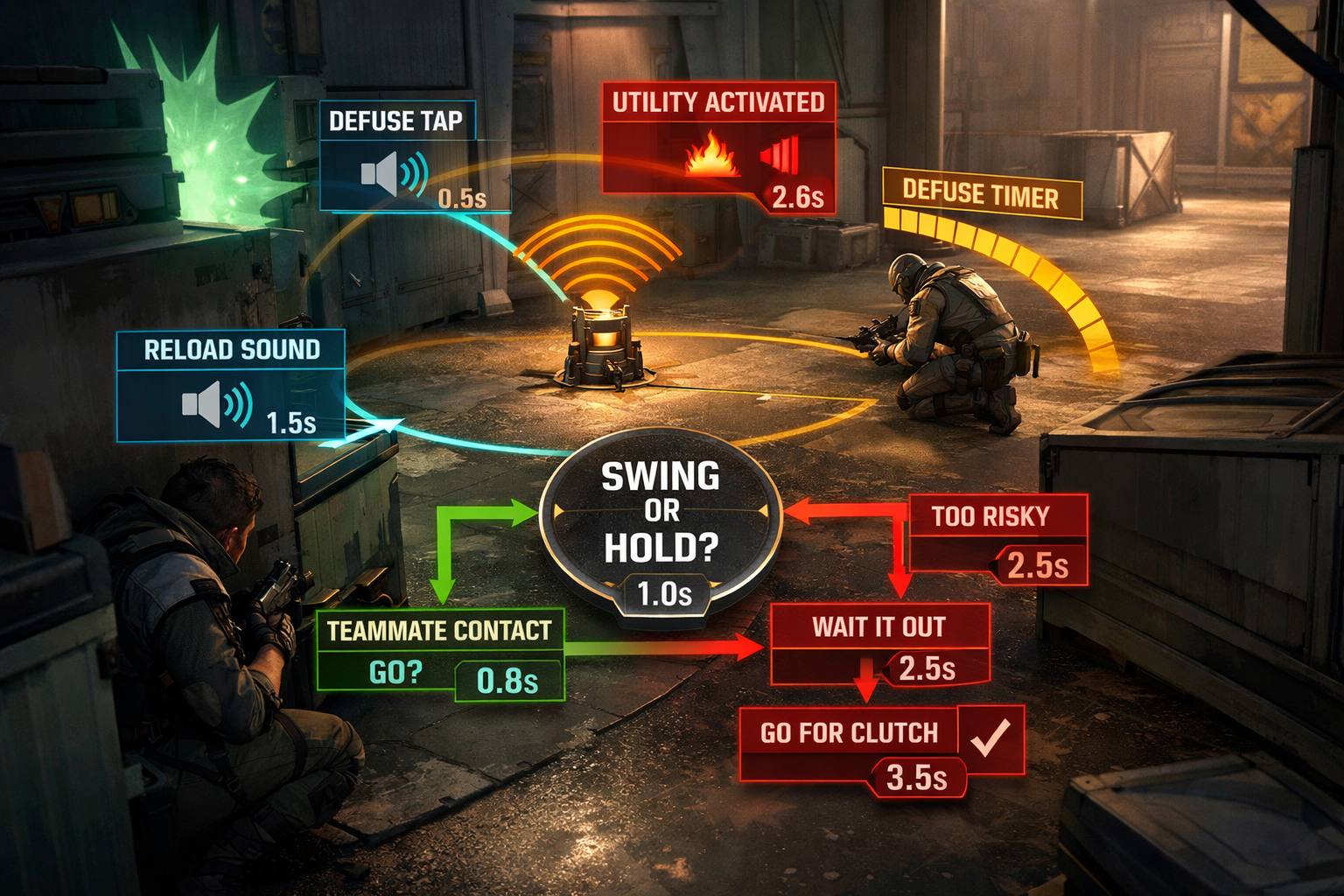
Spike-related sounds are among the most important cues in the game because they directly affect the win condition. You should become extremely comfortable with all of them:
- Spike pickup
- Plant start
- Plant completion
- Defuse tap
- Defuse stick pressure
In post-plant, players often get tunnel vision and focus only on the defuse tap. That is a mistake. The real audio skill is understanding what the tap means in context. Was it a solo tap to force a swing? Was it covered by teammate positioning? Was it paired with utility that lets them stick longer? Was the tap immediate, delayed, or repeated? Each version suggests a different defender plan.
On defense, plant audio is equally valuable. A plant start sound can justify utility, a coordinated swing, or a fast retake setup depending on your numbers and position. Many rounds are lost because players hear a plant and react emotionally instead of structurally. Do not swing just because you heard the sound. First ask whether the planter is isolated, whether teammates can trade, and whether your timing is actually good.
Utility Audio
Utility audio is where advanced sound awareness really separates players. Abilities tell you much more than “something happened.” They can reveal role presence, site pressure, path intention, tempo, and whether a team is trying to force defenders out or simply gather information.
Try reading utility with three layers:
- Source: What kind of ability is this? Info, stall, entry, denial, escape, post-plant, or fake pressure?
- Sequence: What came before it, and what should logically come after it?
- Confidence: Does this sound like a probing ability from one player, or the start of a coordinated hit?
For example, a single info-gathering cue without supportive movement may only demand caution. But layered utility with immediate loud movement usually signals commitment. A stall sound on defense can also imply a nearby defender who expects contact soon. Sound helps you read both teams, not just the enemy.
Teammate Audio as Information
Your teammates’ sounds matter too. Not because they reveal enemy location, but because they influence what the enemy can hear and how the round unfolds. If your teammate stomps nearby, that noise may mask or distort smaller enemy cues. If your teammate makes contact and then falls silent, the enemy may now be creeping into the gap. If a teammate fires and relocates, you can anticipate the enemy’s likely chase path through sound logic.
Good sound awareness is never isolated from the full round picture. You are not listening only for the enemy. You are listening to the interaction between both teams.
Turning Sound Into Better Decisions
Hearing well is not enough. Audio only becomes valuable when it changes your decision in a smart way. This is where many players plateau. They hear footsteps, call them, and still die because the decision that followed was weak. Let’s fix that by connecting common sound reads to practical actions.
On Defense
Defense is where sound often feels most straightforward, but you still need discipline. Your default decision tree should be something like this:
- What exactly did I hear?
- How many players could this realistically be?
- Is this commit pressure or fake pressure?
- Do I have utility to delay safely?
- Should I hold, fall back, call rotate help, or contest now?
If you hear early noise with no layered support, avoid over-rotating. The enemy may be testing your reaction. If you hear heavy steps plus entry utility, respect the possibility of a real hit. If you hear one player making noise while the rest of the map goes quiet, consider lurk pressure or fake manipulation.
The best defenders do not chase every sound. They assign the right weight to the sound. That keeps the team stable.
On Attack
Attackers need sound awareness too, especially when taking space against hidden defenders. If you hear movement behind smoke, around a close corner, or above a common hold, that can change whether you dry peek, use utility, or pause. Strong attackers also listen for defender over-rotation. A single fast rotate step or defensive utility sound on one side of the map can open a different route entirely.
Another overlooked attacking skill is reading when defenders are uncomfortable. If you hear awkward repositioning, multiple hurried footsteps, or reaction utility used too early, defenders may be under pressure mentally. That often means your next layer of contact will be stronger than usual.
In Clutches
Clutch rounds are where sound awareness becomes almost everything. You rarely have full info, and one bad guess ends the round. The key is to force the round into an audio-friendly shape.
That means:
- Repositioning after contact so the enemy has to search again
- Holding spots where sound reveals approach before visual contact
- Baiting utility or defuse sounds before exposing yourself
- Moving only when your movement creates value
In a 1v1 post-plant, for example, do not just wait for the tap mechanically. Think about the entire sound story. Did the defender clear one side already? Did they use utility before tapping? Did they fake quickly or commit longer than expected? Every sound changes the most likely next movement.
In Retakes
Retakes are chaotic, which makes audio extra important. Use sound to reduce chaos. If you hear post-plant utility activated from one side, that side becomes higher priority for your crosshair or utility placement. If one enemy makes loud reposition noise while another stays silent, the silent player may be the real trade threat.
Retakes are also where teammate comms must stay clean. “One there, one there” is weak. “Footsteps close right, reload back site, tap possible in two seconds” is much better. Good sound awareness improves your comm quality, not just your own mechanics.
In Defaults and Mid-Round Resets
Some of the most valuable audio moments happen when almost nothing seems to be happening. During a default or reset, one cue can reveal an entire rotation. A single defender step at the wrong time, an info utility sound from a new lane, or a map interaction can expose that the defense shifted numbers. Strong teams punish these moments because they treat quiet rounds as listening rounds.
If your team is resetting mid-round, ask yourself: what sound has the enemy already heard from us, and what assumptions are they making? Sometimes the best play is to break that expectation with silence. Other times it is to confirm the expectation with deliberate noise and hit elsewhere.
Use Sound to Manage Risk
Not every useful audio read should lead to aggression. Sometimes the smartest use of sound is simply to avoid a bad duel. If you hear two players close and your position has no trade support, backing off is strong discipline, not weakness. Audio awareness should make your play more efficient, not more reckless.
One of the clearest signs that a player is improving is that they stop taking “hero peeks” after hearing footsteps. Instead, they use the cue to choose the best available option, even if that option looks less flashy.
Sound Discipline and Noise Control
Audio awareness has two halves: reading enemy noise and controlling your own. If you only learn the first half, you become predictable. Strong players understand when to stay silent, when to create noise, and when to use sound as a weapon.
When to Walk
Walking is strongest when surprise matters more than speed. This includes:
- Late lurks
- Flanks
- Contact plays
- Post-plant repositioning
- Clutch pathing
- Any moment when the enemy is listening for you
The worst reason to walk is habit. Some players walk too much and arrive late to crucial fights. The best reason to walk is information denial. If silence makes the enemy uncertain, your quiet movement has value.
When Making Noise Is Correct
Not all noise is bad. Sometimes loud movement creates pressure, forces utility, speeds up a rotation, or draws attention so a teammate can exploit the gap. The key is intention. Noise should serve a purpose.
Useful reasons to make sound include:
- Hitting before defenders can stabilize
- Forcing a rotation response
- Baiting utility from a sentinel or controller
- Creating a fake while another player lurks
- Masking a teammate’s more important movement
Bad noise is unplanned noise. Good noise is coordinated pressure.
Sound Layering With Teammates
One of the smartest team habits is layered sound. Instead of everyone making the same kind of noise at once, better teams vary it. One player may create visible pressure. Another stays silent. One player may make a loud presence cue while another takes hidden space. This creates conflicting reads for defenders.
If your team always moves as one loud block or one silent block, you become easier to read. Variation creates uncertainty.
Do Not Over-Communicate Weak Sound
Not every tiny cue deserves a dramatic comm. If you are unsure, communicate uncertainty honestly. “Could be one close,” “heard possible rotate,” or “one sound here, not sure on numbers” is much better than making your team overreact to shaky info.
Strong sound discipline includes disciplined comms. You want to transfer useful signal, not panic.
Best Settings and Equipment Habits
Good settings do not replace skill, but bad settings can absolutely hide useful sound. Your goal is clarity and consistency, not some magical “pro audio” shortcut.
Use Headphones
Headphones are the default recommendation for serious play because they improve directional awareness and reduce room interference. Speakers add too much environmental variation and usually make precise reads harder.
Try HRTF Carefully
Riot added HRTF to improve 3D rendering for certain sounds and recommended disabling other overlapping 3D processing if you use it. For many players, HRTF makes front-back and positional reads easier. For others, it can feel strange at first. Test it in a controlled way. Do not switch it on for one match and instantly judge it. Give it enough reps to see whether your directional confidence improves.
Be Careful With Extra Spatial Processing
VALORANT later added support for third-party spatial audio solutions, but more processing is not always better. The best setup is the one that gives you clean, repeatable reads. If multiple software layers make the sound feel dramatic but less precise, that is a downgrade for ranked play. Competitive audio should feel trustworthy, not theatrical.
Lower Unnecessary Audio Clutter
If your music is too loud, teammate voice chat is overpowering, or your system mixes notifications into your headset, you are sabotaging your own information flow. Competitive sessions should prioritize the game audio channel. Keep voice chat clear enough for coordination, but not so loud that it buries subtle cues.
Check Output Device and In-Game Audio
This sounds basic, but many audio problems come from incorrect output device selection, muted categories, or wrong default device behavior. Riot’s support guidance specifically emphasizes verifying that sound is enabled and the output device is correct. If your sound suddenly feels off, check the basics first before blaming the game.
Keep Your Volume High Enough to Be Useful, Low Enough to Be Sustainable
Do not blast your ears. You need a volume level that lets you play for long sessions without fatigue. Exhausted ears become unreliable. Once fatigue sets in, every cue feels less distinct and every read becomes more emotional. A sustainable volume is better than an impressive one.
EQ and Audio Software
Some players like EQ profiles that highlight footsteps and reduce muddy frequencies. That can help, but simplicity usually wins. If you use EQ, use it to improve clarity, not to turn the sound into something unnatural. You can explore broader gaming audio concepts through trusted headset resources such as SteelSeries’ overview of spatial audio, but always test any audio tweak in VALORANT itself before trusting it in ranked.
Training Routine for Audio Awareness
Sound awareness improves fastest when you train it deliberately. Most players expect passive improvement, but targeted drills work much better.
1. Custom Game Sound Walkthroughs
Enter custom games and study sound without combat pressure. Move through common routes while paying attention to:
- Surface changes
- Vertical transitions
- Distinct interaction sounds
- What different spaces feel like acoustically
- Where footsteps sound deceptively close or far
This practice may look simple, but it builds the map-specific sound library that ranked players rely on subconsciously.
2. Deathmatch With an Audio Goal
Do not use Deathmatch only for aim. Spend some sessions focusing on pre-aiming from footsteps alone. Tell yourself that before every duel, you must identify likely direction and timing from sound first. Even if the mode is chaotic, this sharpens your habit of converting audio into crosshair adjustment.
3. VOD Review for Missed Cues
Watch your own matches and ask:
- What cue did I miss before this death?
- Did I hear it but assign it the wrong weight?
- Did I react correctly but too slowly?
- Did I overreact to one sound and ignore the full sequence?
This is one of the fastest ways to improve because it reveals whether your problem is hearing, interpretation, or decision-making.
4. Clutch Review
Review every important clutch you lose. Clutches are sound-rich, which makes them excellent training material. You will often discover that the round was more solvable than it felt in the moment.
5. Team Drill: Clean Comms From Sound
If you play with a duo or stack, run a simple rule for a few games: every sound comm must include confidence level. For example:
- “One loud, maybe more.”
- “Rotate sound, not confirmed.”
- “Defuse tap, probably bait.”
- “Reload close, swing window.”
This forces your team to communicate audio with more precision and less panic.
Common Sound Awareness Mistakes
- Over-rotating to one cue: A single loud step is not always a full hit.
- Swinging too early on footsteps: Sound often gives you time. Do not waste your positional edge.
- Ignoring silence: Quiet phases often mean the enemy is closer, not gone.
- Not learning surfaces: Unique surfaces can provide free route confirmation.
- Poor comm wording: Uncertain info presented as certainty causes team mistakes.
- Bad audio setup: Wrong output, too much voice volume, distracting music, or stacked sound software can all blur useful cues.
- Listening without predicting: The best sound readers anticipate the next cue instead of reacting late to the current one.
Role-by-Role Sound Priority
Duelists
Duelists should use sound to find timing for explosive space-taking. That means listening for weak holds, reposition noise, utility cooldown windows, and isolated defenders. Good duelists do not run blind. They explode off information.
Initiators
Initiators should treat sound as a setup partner. If audio suggests a close defender, your info or clearing utility becomes much more precise. If audio suggests a rotate, your utility can punish movement before visual contact.
Controllers
Controllers benefit massively from sound because timing defines smoke value. If you place utility too early, you waste it. If you place it off a clean pressure cue, you can stall or enable at exactly the right moment.
Sentinels
Sentinels often play around early warnings and delayed fights. That makes footsteps, map interactions, and pressure rhythm especially important. Great sentinel players are excellent at telling real pressure from fake pressure because their job depends on efficient anchoring.
FAQ
Is sound awareness really that important in VALORANT?
Yes. It is one of the most consistent ways to improve decision-making without relying on perfect mechanics. Better audio reads help with rotations, angle choice, utility timing, clutch play, and cleaner communication.
Should I always use HRTF in VALORANT?
Not always, but it is worth serious testing. Many players benefit from it, especially for directional clarity. The key is consistency. If it helps you judge direction more reliably, keep it. If it confuses you after real testing, use the setup that gives you cleaner reads.
What is the biggest mistake low-rank players make with footsteps?
They often assume footsteps mean immediate danger and panic into bad peeks or bad rotates. Stronger players use footsteps to gain time, refine crosshair placement, and make a calmer decision.
How can I tell if footsteps are fake pressure?
Look at the full sequence. One loud contact without layered utility or follow-up often suggests probing or deception. Multiple overlapping cues, supportive utility, and continued timing pressure suggest a real commit.
Does audio setup matter as much as game sense?
No, but setup matters enough that a bad configuration can block your growth. Use a clean, comfortable setup so your game sense has good information to work with.
How do I improve fastest?
Use custom games to learn surfaces and routes, review your deaths for missed cues, and play some Deathmatch sessions with an audio-first goal. Improvement becomes much faster when you practice sound on purpose.
Final Thoughts
If aim is your weapon, sound awareness is your radar. It lets you see the round before the round fully reveals itself. The best VALORANT players do not just react to footsteps and audio cues. They convert them into smarter positioning, cleaner timing, stronger comms, and higher-percentage decisions.
That is why this skill scales so well. Once you build true sound awareness, you become harder to surprise, harder to fake out, and much better at punishing hesitation. Whether you are anchoring, lurking, entrying, retaking, or clutching, the same principle applies: hear the cue, understand the cue, then make the correct decision before the enemy expects it.
If you want to sharpen your overall ranked performance beyond audio alone, you can also check Boosteria’s VALORANT boosting prices for additional climbing support options. But even with outside help, sound awareness remains one of the highest-value skills you can build for long-term improvement.
Train it deliberately, trust it carefully, and your rounds will start feeling less random. In VALORANT, the player who understands the sound layer often understands the round first.