



Deadlock Ranked & MMR Explained: How Ranking Works
Deadlock Ranked/MMR Explained: How Ranking Works and How to Improve
Deadlock is the kind of competitive game that can feel simple on the surface and brutally complicated once you start caring about rank. You win a few games and feel unstoppable. You lose a few and suddenly every lobby feels impossible. Some matches seem fair, some feel like a stomp, and at some point almost every player asks the same qu:contentReference[oaicite:0]{index=0}ed actually work?
The honest answer is that no competitive game reveals every part of its matchmaking logic in perfect detail, and Deadlock is still evolving. That means the exact interface, badge presentation, or tuning behind the system may change over time. But the big ideas are understandable, and once you understand them, climbing becomes much less mysterious.
In practical terms, Deadlock ranked is best understood through two connected layers:
- Your visible rank or badge, which is the part you can see and emotionally react to.
- Your MMR, which is the hidden skill estimate the system uses to create games and decide where you belong over time.
If you only focus on the badge, ranked feels random. If you understand the relationship between visible rank, hidden MMR, hero comfort, consistency, and decision quality, ranked starts making sense. This guide explains what MMR is, why your rank sometimes feels slow to move, why certain games feel harder than others, and what actually helps you improve in a way that lasts.
It is written to stay useful for a long time, so it avoids depending on short-lived numbers, temporary balance quirks, or one-patch tricks. Instead, the goal is to teach you the structure behind Deadlock ranked and the improvement habits that matter in almost any version of the game.
If you eventually decide you want faster progress with help from experienced players, you can also compare options on Boosteria’s Deadlock boosting prices page. For official game information, it is always smart to keep an eye on the official Deadlock Steam page, Valve’s Deadlock update history, and the Deadlock forums.
Table of Contents
- What Deadlock Ranked and MMR Actually Mean
- Visible Rank vs Hidden MMR
- Why Matchmaking Systems Use MMR
- How Deadlock Ranked Works in Practice
- Hero Familiarity, Main Picks, and Hero-Specific Difficulty
- Why Players Feel Hard-Stuck
- What Actually Helps You Climb
- How to Improve the Early Game
- How to Win More Mid Games and Late Games
- Macro, Objectives, and Decision-Making
- Solo Queue vs Party Queue
- How to Review Your Games Efficiently
- Mental Game, Tilt, and Consistency
- A Simple Weekly Improvement Plan
- FAQ: Common Deadlock Ranked Questions
- Final Thoughts
What Deadlock Ranked and MMR Actually Mean
When players say “ranked,” they usually mean the competitive ladder: the system that measures performance over time and sorts players into skill groups. But the ladder is only the visible part of the machine. The real engine behind competitive matchmaking is MMR.
MMR stands for matchmaking rating. Think of it as the game’s internal estimate of your current skill level. It is not your identity, and it is not your potential. It is simply the system’s running guess about how strong you are right now based on the information it has.
That estimate changes over time. Win against stronger opposition, perform consistently on heroes the system trusts you on, and your rating tends to rise. Lose repeatedly, perform worse than expected for your level, or show major inconsistency across many matches, and it tends to fall. The system uses that estimate to build lobbies that are as fair as possible.
Visible rank exists for human reasons. MMR exists for matchmaking reasons.
The badge gives you a goal. It makes progress feel tangible. It creates identity, motivation, pride, disappointment, and conversation. But the hidden rating is what lets the matchmaker do its job. If the system only used a badge with no deeper skill estimate, matches would be much more chaotic, especially in a game like Deadlock where hero comfort, role experience, and team coordination matter so much.
This distinction is important because many players misunderstand what a “ranked system” is supposed to do. Ranked is not designed to make you feel good every session. It is designed to sort the population with reasonable accuracy over time. That means short streaks can feel unfair even when the long-term result is basically correct.
Once you accept that, your relationship with ranked gets healthier. You stop reading too much into five matches. You stop assuming every loss means the system is broken. And you start focusing on the only thing that truly drives long-term climbing: becoming a player who consistently deserves stronger lobbies.
Visible Rank vs Hidden MMR
This is the first thing every serious Deadlock player should understand.
Your visible rank is not always a perfect one-to-one reflection of your true matchmaking strength.
Sometimes the two are closely aligned. Sometimes they lag behind each other. Sometimes the system changes how it displays skill across the population. Sometimes your rank badge moves after your actual matchmaking level has already drifted. Sometimes you are stronger on your main hero than your general account strength suggests. Sometimes the opposite is true.
That is why players often say things like:
- “My games feel harder than my badge says.”
- “My badge changed but my matches feel the same.”
- “I win on my mains but lose whenever I experiment.”
- “I went on a streak but didn’t feel much stronger.”
All of those feelings make sense if you separate visible rank from matchmaking logic.
A visible rank is a communication layer. It presents your place on the ladder in a readable way. But matchmaking needs something more flexible than a badge label. It needs an estimate that can move more smoothly, compare players across lobbies, account for uncertainty, and react when the system learns something new about you.
For example, imagine two players with the same visible badge:
- Player A has been stable for 100 matches, rarely swaps heroes, and performs consistently.
- Player B reached that badge recently, plays a wider variety of heroes, and has much more volatile results.
They may look equal on the profile screen, but from a matchmaking perspective they are not identical. One rating is highly trusted. The other is still being refined.
This is why strong players care less about a single badge movement and more about the direction of their games. Are your lobbies getting stronger? Are your lanes becoming more disciplined? Are opponents punishing your mistakes faster? Are your wins coming from repeatable decisions rather than lucky collapses by the enemy team? Those signs tell you more about your real trajectory than one emotional screenshot of rank gain or loss.
In other words, if you want to understand Deadlock ranked, you have to stop asking only, “What badge am I?” and start asking, “What kind of lobbies am I earning?”
Why Matchmaking Systems Use MMR
MMR systems exist because competitive games need a way to answer one simple question: who should play against whom?
That sounds easy until you remember what games like Deadlock are really measuring. They are not testing aim only. They are not testing mechanics only. They are combining hero knowledge, lane judgment, teamwork, positioning, map awareness, objective timing, economy management, adaptation, and mental stability. A single result screen does not capture all that complexity.
So the system uses repeated results over time to approximate it.
The best way to think about MMR is not as a moral judgment but as a prediction tool. The matchmaker is effectively saying, “Based on the evidence so far, we think this player belongs around this level. Let’s place them into games that test that estimate.”
If you win more often than expected at that level, your estimate rises. If you lose more often than expected, it falls. If the system is uncertain, your rating may move more aggressively. If it is confident, movement may become slower and steadier.
This is why a few common beliefs about ranked are wrong:
- “I played well in one loss, so I should climb anyway.” Maybe the system notices some performance context, but competitive ladders are built primarily around whether you help your team win consistently, not whether you had one impressive stat line.
- “I had unlucky teammates, so rank means nothing.” In one session, teammates matter a lot. Across dozens of games, your own impact matters more.
- “If I am good, I should always climb fast.” Not always. Fast climbs happen when your skill is meaningfully above your current bracket. Slow climbs happen when you are only slightly better than the average player in your games.
- “A perfect system should feel fair every night.” No ladder can promise that. A good system feels fair on average over time, not in every individual queue.
Understanding this protects you from two major traps:
- Stat-chasing instead of win-chasing.
- Emotion-based conclusions drawn from tiny samples.
If your goal is to climb in Deadlock, the smartest mindset is simple: help the system become more confident that you belong higher. That confidence is built through repeatable wins, not through one flashy match.
How Deadlock Ranked Works in Practice
Because Deadlock is still developing, it is safer to talk about structure than to hard-code every detail. But from the public information available and from how modern matchmaking systems typically behave, several ideas are especially important.
First, ranked is not something you should treat as a separate universe from normal play habits. In practice, modern Deadlock matchmaking has been discussed around a unified competitive environment where the system is continuously estimating your level rather than waiting for a once-a-week reveal. That means your account is being read as a living skill profile, not as a frozen label.
Second, your rank is not purely a reward screen. It is a reflection of where the game believes you belong relative to other active players. That means rank can be influenced not only by your own results but also by the broader distribution of the ladder. If the population changes, if the game recalibrates how badges map onto skill, or if the developers reshape the curve, the visible presentation may shift even when your raw underlying skill has not.
Third, the system has strong reasons to separate general account strength from hero-specific comfort. That matters a lot in Deadlock because hero mastery changes how well a player can lane, combo, rotate, survive, and convert leads. A player who looks elite on one hero may look ordinary on an unfamiliar pick. A good matchmaker tries to account for that rather than pretending every hero on your account is equally developed.
Fourth, party queue introduces extra complexity. A duo or stack is not just a sum of individual ratings. Team synergy, shot-calling, and communication can make a party stronger than the visible ranks suggest. On the other hand, if there is a very wide skill spread inside the party, matchmaking gets harder and rating movement may be handled more cautiously.
Finally, ranked systems do not want to be exploited. That is why they tend to be conservative in strange situations: brand-new accounts, highly inconsistent hero selection, large party skill gaps, long breaks, returning players after meta shifts, or dramatic changes in performance after patches. When the system is less sure what you are, it becomes more careful about what to do with you.
For the average player, all of this leads to one important conclusion:
Deadlock ranked is less about “winning one more game tonight” and more about building a profile the system can trust.
If you are stable, specialized enough to be reliable, and consistently useful in real team contexts, your climb becomes more predictable. If you are chaotic, constantly changing picks, and swinging from carry performances to disaster games, the ladder has a harder time placing you cleanly.
Hero Familiarity, Main Picks, and Hero-Specific Difficulty
One of the most important concepts in Deadlock ranked is that your skill is not equally expressed on every hero.
This is obvious to players but often ignored in practice. Everyone knows they are better on comfort picks. Yet many players still queue as if every hero gives them the same chance to win. That mistake slows more climbs than people realize.
In a game with distinct hero identities, execution patterns, matchup demands, and macro responsibilities, hero familiarity matters a lot. It affects:
- lane confidence and trading patterns
- knowledge of damage windows
- escape discipline
- engage timing
- resource efficiency
- target priority
- mechanical smoothness under pressure
- late-game decision quality
That is why a good improvement plan does not begin with “learn everything.” It begins with “become dangerous on a small, useful pool.”
A strong ranked hero pool usually has:
- One primary comfort pick you trust in close games.
- One flexible backup that covers bad drafts, bans, or hard counters.
- One emergency pick you can survive on without griefing your team.
That structure is much better than trying to play eight heroes at an average level. Breadth feels smart, but in ranked, reliable depth wins more games.
The reason is simple: ranked punishes hesitation. On your main hero, you recognize fights faster, spend better, move with more intention, and know what a winning game looks like. On a weak comfort pick, you often waste attention on basic execution and miss the bigger strategic picture.
Players who want to climb quickly should not ask, “Which heroes are strongest in theory?” They should ask, “Which two or three heroes let me produce stable value in real ranked games?”
That does not mean never expanding your pool. It means expanding it intentionally. Learn new heroes in a controlled way. Add one at a time. Review your first ten to twenty games on it. Identify whether you are losing lane, misusing cooldowns, overfarming, mistiming engages, or misunderstanding your actual win condition.
The fastest route to better rank is usually not mechanical genius. It is removing inconsistency from your pool.
Why Players Feel Hard-Stuck
Almost every player eventually hits a point where progress slows down. That is normal. In fact, it is healthy. A ranked system that never slows your climb is not measuring you carefully enough.
Still, the hard-stuck feeling is real, and it usually comes from one of five causes.
1. You are better than your lobby in one area, but worse in another
Many players carry lane but throw mid game. Others understand macro but lose too much HP in early trades. Some have great mechanics but terrible objective judgment. If your strengths and weaknesses cancel each other out, your rank can stay flat for a long time.
2. You are inconsistent from match to match
Ranked rewards repeatability. If one game you look excellent and the next game you feed three preventable deaths before minute ten, the system sees noise, not reliable upward pressure.
3. Your hero pool is too wide
This is one of the most common reasons for stalled progress. Players bounce between picks, roles, and styles, then wonder why they cannot build momentum. Consistency disappears when your baseline performance changes every queue.
4. You are reading results emotionally instead of analytically
Some players are not actually stuck. They are just impatient. A 53% win rate over a large sample is climbing. It is simply climbing slowly. If you expect every improvement to look dramatic, you will feel trapped even while moving upward.
5. You have improved, but the player base has improved too
This is a brutal truth in competitive games. Sometimes you are getting better, but so is everyone around you. Staying the same rank does not always mean you are stagnant. It can mean you are improving at the same speed as your peers. To climb, you need to improve faster than the bracket, not just improve in isolation.
The cure for feeling hard-stuck is not more emotional queueing. It is diagnosis.
Ask yourself:
- Where do most of my losses begin?
- At what minute do games start slipping?
- What kind of death repeats most often?
- Do I lose more from poor fights, poor farming, poor builds, or poor map choices?
- Which hero gives me my most stable value?
- What does a typical win look like on my best pick?
Players climb when they identify the repeating reason they are not climbing already.
What Actually Helps You Climb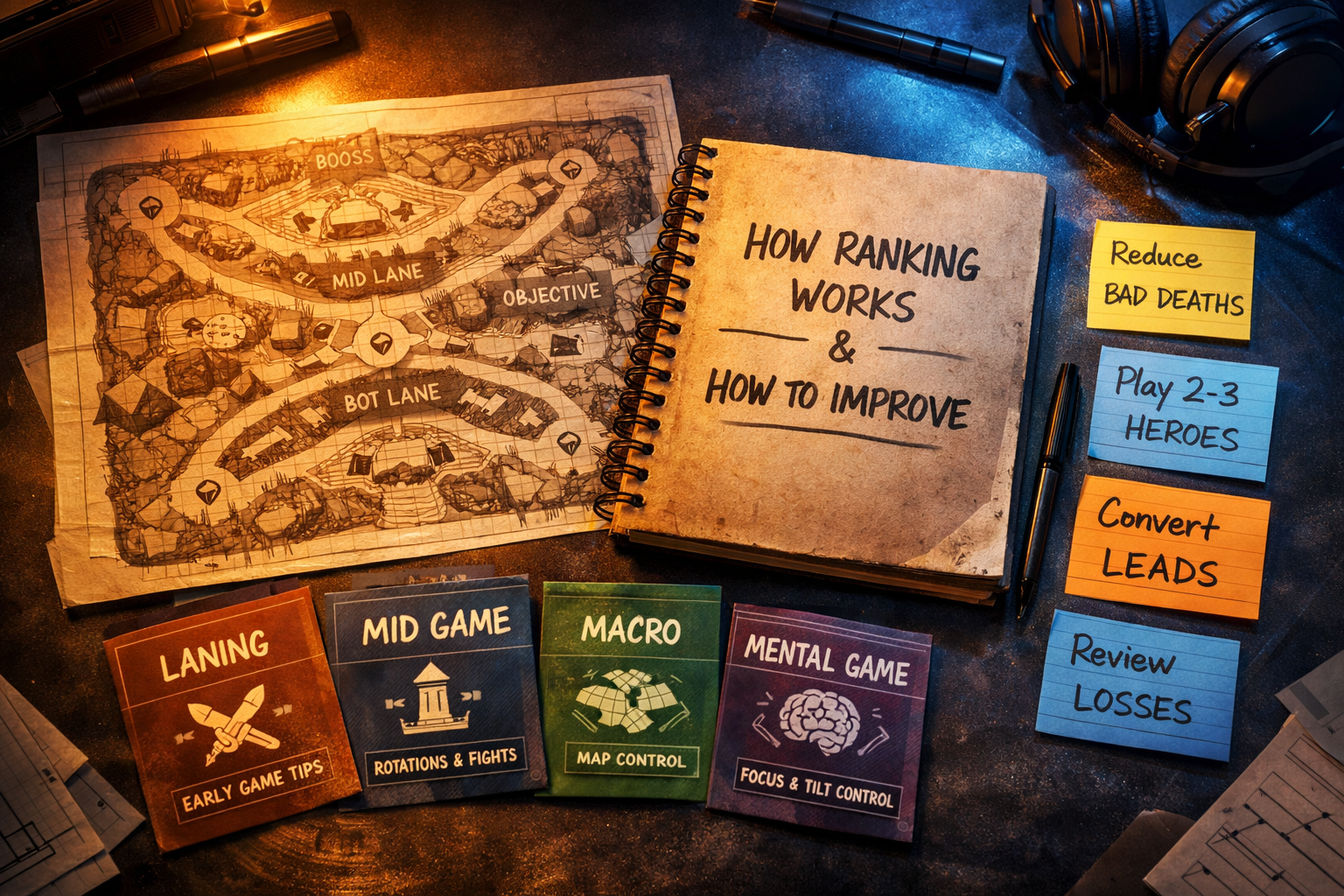
There are many things players obsess over in ranked that do not matter as much as they think. Then there are a few things that repeatedly decide games. If your goal is to improve rank, focus your energy on the second category.
Win contribution matters more than vanity stats
High damage is not automatically good. High healing is not automatically good. A great KDA can hide passive play. You need stats that convert into map control, objective pressure, and fight wins. Deadlock rewards players who create advantages that matter, not just numbers that look impressive after the match.
Deaths are one of the biggest rating killers
Not all deaths are equal, but repeated low-value deaths are devastating. One greedy overextension can erase two minutes of good farming. One mistimed chase can hand over an objective. One late-game catch can end the whole match. If you do not know what to fix first, reduce bad deaths. That alone improves many players’ win rates.
Economy discipline is a skill multiplier
It is not enough to fight well. You need to reach key timings consistently. Efficient farming, cleaner resets, and smarter spending create power spikes that make good decisions easier to execute. Strong players are not always mechanically faster; often they simply arrive at important fights stronger.
Understanding your role in the draft matters
Every match asks a question: who starts, who follows, who protects, who chases, who zones, who scales, who ends? Players lose winnable games because they treat every hero like a carry and every fight like a highlight clip. The better your role understanding, the fewer fights you sabotage without noticing.
Clean mid-game choices separate climbers from non-climbers
Many players can survive lane. Fewer players know what to do after lane. This is where ranked often breaks open: rotations, wave pressure, side control, regroup timing, objective trade-offs, and target focus. If you want a faster climb, improve the part of the game where most players become directionless.
Mental control protects MMR
One tilted session can erase the progress of a calm one. Ranked is not only a knowledge test. It is also an emotional stability test. If you rage queue, force games after frustration, or keep playing when your decision quality collapses, you convert temporary tilt into permanent rating loss.
So what actually helps you climb? In simple terms:
- play a smaller, stronger hero pool
- die less in low-value situations
- hit your economy timings more often
- understand your win condition every match
- make better mid-game choices
- review losses for repeated patterns
- protect your mindset
That list is not flashy, but it is effective.
How to Improve the Early Game
If your early game is unstable, ranked feels much harder than it should. Deadlock is not purely decided in lane, but lane sets the tone for the rest of the match. A player who exits lane with reliable economy, manageable deaths, and some control over tempo gives themselves many more ways to win.
Know your lane objective
Not every lane is won by kills. Sometimes the goal is to push. Sometimes it is to survive. Sometimes it is to hold parity until your first power spike. Sometimes it is to trade health aggressively because your sustain or all-in is stronger. Strong players understand what their hero is supposed to do before the lane becomes chaotic.
Respect the cost of bad trades
Many ranked players lose lane not because they get mechanically outplayed, but because they take low-IQ trades. They fight without cooldown advantage, stand in bad angles, overstep for chip damage, or commit when the wave and positioning are against them. Good laning is often less about aggression and more about choosing profitable aggression.
Track health, resources, and timing windows
The best players always seem “ready” because they notice when a trade is truly live. They watch enemy cooldown usage, spacing, and recovery tools. They understand when the opponent cannot answer back. If you want lane improvement, stop autopiloting your buttons and start actively asking, “What just changed in this lane?”
Use lane pressure to build safer leads
A small CS or economy lead is valuable if you do not throw it away. Many players get ahead, then immediately try to force a kill and hand the lane back. Ranked improvement is often about protecting edges. If you have the better reset timing, the better item timing, or better wave state, use that edge calmly instead of flipping the lane on ego.
Identify your most common first mistake
This is one of the fastest review tricks in any competitive game. In your losses, what is the first meaningful mistake you make in lane?
- standing too far up with no exit?
- trading into a better spike?
- missing your best window to pressure?
- staying too long on low resources?
- resetting too late?
- tunneling on damage instead of lane control?
Fixing your first recurring mistake often fixes the rest of the lane automatically.
Do not confuse “busy” with “effective”
Some players are constantly fighting, poking, and moving, but not actually improving the lane state. Strong laners create outcomes: better health totals, better positioning, better economy, better timings, or kill threat. Your goal is not to look active. It is to create advantage.
A cleaner early game does not guarantee rank gains overnight, but it raises your baseline. And baseline matters in ranked. You climb faster when your bad games are still playable.
How to Win More Mid Games and Late Games
Mid game is where many Deadlock players leak MMR. They survive lane, get a decent start, then lose structure and direction. Ranked becomes frustrating because those losses feel mysterious. In reality, most of them come from a handful of repeatable mistakes.
Stop taking fights with no reason
One of the classic mid-game errors is fighting simply because enemies are visible. Good teams fight for territory, timing, objectives, cooldown windows, or number advantages. Bad teams fight because they are bored. If your team wins lane but loses structure later, random fights are often the reason.
Push your lead in a way your hero actually supports
Some heroes want to force picks. Some want grouped pressure. Some want side threat and delayed collapse. Some want defensive control around key areas. You do not convert a lead by copying another hero’s job. You convert it by using your own kit correctly inside the current map state.
Arrive before the fight starts
Many players think their teamfighting is weak when the real issue is timing. They show up late, path awkwardly, or spend too much time on a side action before a decisive moment. Ranked rewards anticipation. The earlier you identify where the next important fight will happen, the more useful you become.
Learn to read when the game is speeding up
Every match has moments where the tempo suddenly changes. A tower falls. A core item completes. A carry gets picked. A major objective becomes exposed. Good players feel these accelerations quickly and reposition their priorities. Average players continue farming the previous minute’s map.
Late game punishes lazy deaths even harder
In late stages, one mistake can override fifteen good minutes. If you are ahead, your job is to remove comeback openings. If you are behind, your job is to stop creating losing conditions with impatient moves. In both cases, death quality matters more than raw aggression.
The best late-game question is not “Can I kill someone?” It is “If I die here, what do we lose?”
Target selection wins more fights than raw mechanics
Many players tunnel on the first enemy in range or chase whoever annoyed them earlier. That is not ranked discipline. Teamfights are won by solving the enemy composition. Sometimes that means deleting the backline. Sometimes it means peeling your strongest teammate. Sometimes it means zoning one threat while your team handles another. If you do not know what your fight job is, you are gambling.
When players say high-ranked lobbies feel cleaner, this is a big reason why. Better players waste fewer spells, fewer rotations, and fewer lives on the wrong target.
Macro, Objectives, and Decision-Making
If mechanics help you survive your rank, macro helps you leave it.
Macro is the layer above the duel. It is how you manage the map, objectives, tempo, pressure, information, and team movement. Deadlock players often focus too much on direct combat and not enough on the environment that makes combat favorable.
Objectives are usually worth more than ego fights
Ranked players throw leads all the time by turning a winning map into a series of pointless scraps. If your team can secure meaningful progress without taking a coin-flip fight, that is often the better choice. Strong macro players understand that a clean objective can be a bigger victory than a risky highlight play.
Pressure matters even when nobody dies
You do not need a kill for your movement to matter. Pushing a lane can force response. Showing on a side can create space elsewhere. Threatening a collapse can delay an enemy setup. Good macro players think in terms of reactions. What does my movement force the enemy to do?
Bad resets lose hidden value
Some losses come from dramatic throws. Others come from quieter problems: inefficient backs, poor route planning, missed spend timings, or awkward returns to the map. These errors do not look exciting in a replay, but they accumulate. Higher-ranked players often feel “stronger” because they are simply wasting less time between meaningful actions.
Play around your team’s strongest moment
Every draft has power windows. Maybe your team spikes when a specific hero completes a core item. Maybe your engage combo is strongest at a certain stage. Maybe the enemy backline becomes vulnerable once one frontline tool is down. You climb faster when you stop treating every minute as equal and start aligning decisions with power spikes.
Information is a resource
Where are enemies showing? Who is missing? Which side of the map is weak? Which lane is overextended? Which teammate is likely to be pressured next? Good decision-making begins with information discipline. Players who die to obvious rotations or force plays into bad visibility are not losing to mechanics. They are losing to awareness.
One of the easiest ways to improve macro is to narrate your own game mentally:
- What are we strongest at right now?
- What does the enemy want next?
- Where is the next important area of the map?
- What can go wrong if I show here?
- What is the safest useful thing I can do in the next 20 seconds?
You do not need to be a genius strategist. You just need to ask better questions more often than the average player in your bracket.
Solo Queue vs Party Queue
Climbing in solo queue and climbing in party queue are related but not identical skills.
Solo queue rewards self-sufficiency
In solo play, you cannot rely on perfect coordination. That means your hero pool, communication, and map decisions should emphasize reliability. Strong solo queue players usually do three things well:
- they generate value without needing constant setup
- they communicate simply and clearly
- they stabilize chaotic games instead of adding to the chaos
If you want to climb solo, stop waiting for ideal teammates. Build habits that survive imperfect teamwork.
Party queue changes how value is created
In a duo or stack, synergy matters more. Communication can create cleaner engages, better peel, and more reliable objective control. But party queue also creates traps. Some groups become overaggressive because they trust each other too much. Others overforce plays that only work inside the party’s perspective, ignoring what the rest of the team can realistically follow.
A strong party is not just louder communication. It is useful communication.
Wide skill gaps create weird games
If a party contains players from very different skill levels, matchmaking becomes harder. Even if the system creates a nominally fair lobby, the game may still feel unusual because performance consistency inside the party varies so much. That is why some party games feel harder than expected and others feel strangely easy. The rating math is only part of the story; practical synergy and real execution still decide the match.
As a rule:
- Solo queue is best for measuring your independent ranked strength.
- Party queue is best for coordinated improvement if your group has discipline.
If your goal is pure self-evaluation, solo is cleaner. If your goal is winning with a trusted teammate and you genuinely play better together, duo can be excellent. Just do not assume party queue automatically makes climbing easier. It often magnifies both good habits and bad ones.
How to Review Your Games Efficiently
Most players either never review or review badly. They remember one teammate mistake, one annoying death, and one unlucky fight, then call it analysis. That is not review. That is emotional replay.
Good review is short, specific, and repeatable.
Use the 3-mistake method
After a loss, do not try to study everything. Find the three most important mistakes that changed your win chance. They can be mechanical, strategic, or mental, but they should be concrete.
Examples:
- took a bad level-spike trade in lane and lost control
- chased a low-value kill instead of helping secure objective
- died first before key late-game fight by showing too early
That is already enough to improve.
Focus on decision points, not just outcomes
Do not only ask whether a play worked. Ask whether it was correct. A bad play can succeed because the enemy misplayed. A good play can fail because execution was sloppy. Review the decision quality, not just the result screen.
Track repeated themes
If the same error appears in three or four reviews, that is now your priority problem. Maybe you overstay on side lanes. Maybe you delay resets. Maybe you engage without support. Maybe you farm too long after a won fight instead of converting. Patterns matter far more than isolated mistakes.
Clip your deaths
If you only have time for one review habit, make it this one. Study your deaths. Ask:
- Was this death necessary?
- What information did I ignore?
- What was I trying to gain?
- Was that reward worth the risk?
- What would a higher-ranked player likely do here?
Reducing bad deaths improves rank faster than many flashy practice methods.
Review wins too
Players often skip this. Wins can hide bad habits. If you only study losses, you miss the sloppy choices that got covered by a stronger team or a weaker opponent. Clean improvement means understanding why your wins worked, not just why your losses failed.
A simple review routine looks like this:
- pick one recent loss and one recent win
- watch first ten minutes for lane patterns
- watch every death
- identify one mid-game turning point
- write one correction you will focus on next session
That is enough. Effective review does not need to be complicated.
Mental Game, Tilt, and Consistency
MMR is not only influenced by your game knowledge. It is influenced by how well you can apply that knowledge repeatedly under stress.
This is where mental discipline becomes a ranked skill.
Tilt changes your decision threshold
When you are tilted, you take worse risks. You chase more. You trust less. You communicate worse. You assume the worst before fights even happen. Your hands may still work, but your judgment drops. That is why tilt is so expensive. It lowers the quality of every decision after it starts.
Do not chain queue after identity losses
Some losses hit harder because they challenge how you see yourself. Maybe you got stomped on your main hero. Maybe you misplayed a clutch fight. Maybe you lost promotion momentum. Those are the most dangerous moments to instantly queue again. Not because you are weak, but because your next game is likely to be driven by emotion instead of clarity.
Create a stop rule
One of the best ranked habits in any game is a stop rule. For example:
- stop after three losses
- stop after two tilted games in a row
- stop if communication becomes toxic
- stop if you catch yourself blaming every teammate
A stop rule prevents small emotional dips from becoming major MMR losses.
Confidence should be specific
Bad confidence says, “I deserve higher rank.” Good confidence says, “I know what I’m working on, and I can execute it again.” The second type is much more stable. It survives losses because it is built on process, not entitlement.
Consistency beats motivation
You do not need to feel inspired every session. You need a standard. Warm up a little. Queue with intention. Review one game. Protect your mindset. Repeat. Ranked improvement belongs to players who can do useful things even on ordinary days.
The mental game is not extra. It is part of the ladder. Players who control their session quality usually outperform players with slightly better mechanics but worse emotional discipline.
A Simple Weekly Improvement Plan
If you want a practical system instead of theory, use this structure for four weeks.
Step 1: Lock your hero pool
Choose one main hero, one backup hero, and one emergency pick. Do not rotate wildly. Give the system clear information about what your real game looks like.
Step 2: Pick one lane goal
Examples:
- take fewer bad trades before first item
- improve reset timing
- reduce early deaths
- identify enemy spike before committing
Do not try to fix five lane issues at once.
Step 3: Pick one mid-game goal
Examples:
- arrive earlier to key fights
- fight less randomly
- convert won fights into objectives
- reduce side-lane overextensions
Step 4: Review two matches per week properly
One win, one loss. Track recurring mistakes. Keep notes short.
Step 5: Measure progress with better indicators
Do not only watch rank. Also watch:
- death quality
- lane stability
- confidence on your main hero
- number of games thrown by bad decisions
- how often your losses are still competitive
Step 6: End sessions before quality collapses
Protect your rating by protecting your decision-making.
This plan works because it simplifies improvement. Most players fail because they try to transform everything at once. The ladder does not ask for a dramatic reinvention. It asks for slightly better average decisions repeated across many matches.
FAQ: Common Deadlock Ranked Questions
Is Deadlock rank based only on wins and losses?
In most competitive systems, wins and losses are the core signal because the goal of ranked is to estimate how often you help teams succeed against certain opposition. Context may exist around performance, hero familiarity, uncertainty, and lobby quality, but the safest mindset is to assume that consistent winning is still the main driver.
Why does my badge sometimes feel behind my real skill?
Because visible rank and matchmaking strength are not always perfectly synchronized. The system may already be placing you into stronger or weaker games than your profile emotionally suggests. That is why lobby quality is often a better clue than badge emotion.
Why do games on my main hero feel easier?
Because your real skill expression changes with familiarity. Your positioning, timing, resource use, matchup knowledge, and fight choices are all cleaner on comfort picks. That is exactly why a tighter hero pool helps climbing.
Can I climb with a 51% or 52% win rate?
Yes. Climbing does not always look explosive. A modest positive win rate over a large sample is still upward movement. Many players become discouraged because they expect every improvement to produce instant rank jumps.
Should I learn many heroes to climb faster?
Usually no. A small, reliable pool is better for most players. Expand only when your current picks are stable and you have a clear reason to add another hero.
Why do some matches feel wildly uneven?
Because matchmaking is solving a hard problem inside a live competitive environment. Player pools change, hero comfort varies, parties complicate balance, and form fluctuates. No ladder produces perfect games every time. What matters is whether the system sorts players reasonably over the long run.
Does solo queue show my “true” rank better than party queue?
Usually it is a cleaner test of independent skill, yes. Party queue introduces synergy and communication advantages that can help or distort results depending on the group.
What is the fastest way to gain rank in Deadlock?
The least exciting answer is often the correct one: reduce bad deaths, shrink your hero pool, improve your mid-game decisions, and stop tilt queueing. Those changes create the most reliable climb for most players.
How do I know if I am actually improving?
Look for better game quality, fewer repeated mistakes, stronger lane exits, better objective conversion, and more stable performances on your main heroes. Rank follows improvement, but not always instantly.
Final Thoughts
Deadlock ranked feels much less confusing once you stop treating the ladder like a mysterious punishment machine and start treating it like an ongoing measurement system.
Your visible rank matters, but it is not the whole story. Hidden MMR, hero familiarity, consistency, and match impact all shape where you end up. Some sessions will feel unfair. Some streaks will feel slow. Some badge changes will feel surprising. None of that changes the core truth: over time, the ladder is trying to place you where your repeated decisions say you belong.
That is good news, because repeated decisions are trainable.
You can tighten your hero pool. You can clean up lane mistakes. You can stop wasting leads in mid game. You can die less in low-value spots. You can improve your resets, your map reads, your target selection, and your emotional control. Those things are not reserved for elite players. They are learnable habits.
If you focus on those habits, ranked becomes less emotional and more useful. You stop needing every match to validate you. You start using each match as information. And when you do that for long enough, rank usually follows.
So if you feel stuck, do not ask only, “Why won’t Deadlock give me a better rank?” Ask the more powerful question: What would a higher-ranked version of me do differently in the next ten minutes of a real match?
That question leads to better review, better practice, better sessions, and better results.
If you want help accelerating that process, you can check Deadlock boosting options here. If you want to stay updated on official changes, keep watching the official Steam page, the update history, and the Deadlock forums.