



Marvel Rivals Hero Pool Strategy: 2-3 Picks for Most Drafts
Marvel Rivals Hero Pool Strategy: 2-3 Picks That Cover Most Drafts
Most players think hero pool strategy is about finding the strongest characters. It is not. At least not first. In Marvel Rivals, the better question is this: how do you stay useful when your favorite pick is bad for the lobby, awkward for the map, duplicated in function by your teammate, or simply blocked by the way both comps want to fight? The answer is not a giant pool of eight or ten heroes. The answer is a small, disciplined pool of two or three picks that solve different problems while still feeling natural to you.
That is what “covering most drafts” really means. It does not mean you hard-counter every possible enemy composition. It does not mean you can play every style equally well. It means that when hero select ends, you are never trapped on a pick that gives your team no frontline shape, no sustained damage, no peel, no engage, no off-angle pressure, or no backline stability. A good hero pool makes you playable into most normal ranked situations. A great hero pool makes you confident, fast, and consistent in them.
Because Marvel Rivals is a fast 6v6 hero shooter with changing Team-Up interactions, destructible environments, and role pressure that can shift from season to season, broad strategic principles age better than short-lived tier lists. That is why this guide is built around roles, fight patterns, and draft logic rather than fragile “play this one hero only” advice. If you can learn how to build coverage, you will stay relevant longer than the player who chases every patch note and never truly masters anything.
If you want to review the official roster and role lineup while reading, keep the Marvel Rivals heroes page open. It also helps to track the official Hero Hot List and skim developer balance commentary from time to time. For general game overview, the official Steam page is also useful. And if you are already climbing and want a benchmark for ranked progression, Boosteria’s Marvel Rivals boosting prices page is the relevant service link for this title.
Why a Small Hero Pool Wins More
The biggest advantage of a small pool is not simplicity. It is depth. When you play two or three heroes repeatedly, you stop spending mental energy on basic execution and start spending it on the match itself. You notice cooldown windows faster. You understand the range where your pressure actually matters. You know when your hero wants a long front-to-back fight and when it wants a sudden collapse. You learn the difference between “I can go in” and “my kit is technically available but the fight geometry is terrible.” That kind of recognition wins more games than surface-level flexibility.
Large pools feel safe because they give the illusion of an answer to everything. In practice, they often create shallow competence. A player with nine average heroes usually loses to the player with three very polished heroes who fit different scenarios. Why? Because ranked matches are messy. Teams rarely draft perfectly. Players miss timings. Fights break in weird places. In those moments, mechanical comfort and repeatable decision-making are more valuable than theoretical counter charts.
A small pool also improves your review process. If you lose on six different heroes in a week, it is hard to tell whether the problem was positioning, target selection, map pathing, cooldown discipline, or hero unfamiliarity. But if most of your games come from the same two or three picks, patterns become obvious. You can actually fix them. That is how ranked improvement compounds. Better review leads to better decisions, which leads to cleaner games, which gives you even better review material.
Another reason small pools work is emotional stability. Hero shooters punish panic swaps. Many players switch because they feel pressure, not because the draft truly demands it. If you know your small pool deeply, you can tell whether a matchup is genuinely bad or merely uncomfortable. That distinction matters. A mildly awkward but mastered hero is often better than a theoretically cleaner answer you barely play.
Finally, a disciplined pool helps your team more than a random flex habit. Your teammates do not need you to be everything. They need you to cover the missing function. If your pool is built properly, you can do that without becoming mediocre at every role expression. That is the real goal: not maximum variety, but maximum dependable coverage.
What “Covering Most Drafts” Actually Means
Many players misunderstand draft coverage. They think coverage means matchup charts. It is broader than that. A good pool covers fight patterns. In Marvel Rivals, most drafts eventually ask for some mix of five things: reliable space creation, engage threat, sustained pressure, peel or reset tools, and a plan for finishing low targets. Your two or three heroes do not need to do all of those at once, but across the pool they should solve most of them.
Imagine a Vanguard player who only likes pure dive. That player may feel fantastic on aggressive engages, but what happens when the team needs an anchor, a slower front line, or a safer way to hold corners and protect Strategists? Their pool stops covering normal drafts. Or imagine a Duelist player who only plays long-range poke. They may farm damage, but if the team lacks a finisher who can punish cracked backlines, they may still lose fights they “won” on paper. The same problem happens with Strategists who only heal but cannot peel, reset, or survive pressure long enough to stabilize the team.
So coverage is not “Can I answer every enemy hero?” It is “Can I enter most matches with a coherent job?” That is a healthier and more timeless question. A patch may change numbers, but coherent jobs remain. Teams still need somebody to start fights, somebody to keep them playable, and somebody to convert pressure into eliminations.
Another important detail: covering drafts does not require you to mirror the enemy team. In fact, mirroring too often is a trap. If the enemy is heavily dive-oriented, your answer may be a better anti-dive anchor, stronger peel, or smarter angle control rather than a matching dive. If they are slow and poke-heavy, your answer may be faster engage rather than more poke. Hero pools should let you shift the terms of the fight, not merely copy them.
That is why your pool should be built around complementary identities. One hero should feel like your “default good game” pick. Another should change the way your team fights. A third, if you add one, should rescue awkward drafts you otherwise hate. That combination covers most normal ranked environments without bloating your learning curve.
The Three Questions Every Draft Asks
Before locking a hero, ask three questions.
1. How does this lobby want to fight?
Does the match look like a slow front-to-back battle around corners and sightlines? Does it look like repeated skirmishes with quick collapses? Does it look like constant backline pressure where survival and peel matter more than raw damage? You do not need perfect information. You just need a first read. One glance at both teams usually tells you whether this game rewards anchoring, diving, brawling, or range control.
2. What function is my team missing right now?
Do you already have enough engage but no stability? Enough sustain but no damage conversion? Plenty of range but nobody willing to take space? Too much forward pressure and not enough backline protection? Strong drafts are often built by filling the missing piece, not by maximizing personal comfort alone. The beauty of a smart hero pool is that you can stay within your comfort zone while still filling missing functions.
3. What is the easiest way for me to get real value this match?
Not fantasy value. Real value. The kind you can produce consistently with your current mechanics. On some maps, your strongest contribution is being a stable anchor. On others, it is punishing overextensions from an off-angle. On others, it is surviving dive and keeping the team online. If a hero would only work if every teammate coordinates perfectly, it is often the wrong pick for ranked unless you are exceptionally strong on it.
These three questions are enough to guide most hero select decisions. They also explain why tiny pools work. You are not trying to discover a magical universal best pick. You are trying to cycle between a few well-practiced answers depending on what the lobby asks.
How to Build a Two-Pick Foundation
Your first two heroes should never be chosen by popularity alone. They should be chosen by contrast. If your two picks solve the same kinds of games, you do not really have a pool. You have one style wearing two costumes.
A strong two-pick foundation usually follows this formula:
- Pick 1: your default comfort hero — the hero you can blind-pick into most reasonable matches.
- Pick 2: your contrast hero — the hero that changes the job you perform when the first hero would create draft overlap or leave a hole.
For a Vanguard player, that often means one anchor and one engager. For a Duelist, one reliable pressure hero and one finisher or disruptor. For a Strategist, one stabilizer and one peel- or tempo-oriented option. The precise hero names can vary with patches, but the logic remains strong.
When choosing your default comfort hero, prioritize four traits: consistent value, low dependency on rare team setups, clear win condition, and enough room to express skill. You want a hero that still functions when the match is average, not just when everything aligns. Heroes that are only amazing with specific teammates or exact map conditions are better as second or third picks, not as your foundation.
Your contrast hero should not just be “another hero I like.” It should cover the games your default hero dislikes. If your main hero wants long sustained fights, your second hero can favor quicker entries or tighter skirmishes. If your main hero prefers controlled space, your second can help contest mobility and chaos. If your main hero is vulnerable when the team lacks peel, your second can provide more self-sufficiency or better backline support.
One useful test is the lobby test. Ask yourself: if I load into ten random ranked matches, how often would I feel happy to lock hero one, and in how many of the remaining games would hero two feel like a meaningful improvement? If the answer to the second part is “not many,” the contrast is too weak.
Another useful test is the teammate overlap test. Suppose your teammates lock heroes that already provide similar functions to your main. Does your second hero let you shift into a different job? If not, you may create redundancy instead of coverage. Redundancy is one of the biggest hidden drafting mistakes in hero shooters. A team can have plenty of individual power and still feel weak because too many players solve the same problem while another problem goes untouched.
Here is the simplest possible way to build your foundation:
- Write down the kind of fights you naturally enjoy.
- Choose one hero that thrives in those fights and works often.
- List the lobbies where that hero feels worst.
- Choose a second hero that feels comfortable in those exact lobbies.
- Play at least 20-30 serious matches before judging the pair.
Do not skip step five. Many players abandon excellent hero pairs too early because the second hero feels less polished at first. Of course it does. That does not mean the pair is wrong. It often means your comfort is still catching up.
When and How to Add a Third Pick
A third hero is not mandatory. In fact, many players would climb faster by mastering two. But a third pick becomes valuable when your first two heroes leave one recurring hole. The key word is recurring. Do not add a third hero because one match felt bad. Add one because the same kind of draft problem keeps showing up over many games.
The best third hero usually serves one of three purposes:
- Emergency map coverage — a pick that feels better on a recurring mode or geometry problem.
- Emergency composition coverage — a pick for games where your normal pair leaves the team with a missing function.
- Emergency pressure response — a pick you use when the enemy’s preferred fight pattern repeatedly shuts down your first two options.
Notice what the third hero is not: a vanity pick, a boredom pick, or a hero you play only because the community says they are overpowered this week. If your third hero does not solve a specific structural problem, it adds noise rather than value.
Your third hero should also be narrower than your first two. It does not need to be blind-pickable. It just needs to save certain drafts. Think of it as your “break glass in case of awkward lobby” option. Because it is narrower, you can keep your practice time concentrated while still having a release valve for tough games.
A clean three-pick structure looks like this:
- Hero 1: default blind-pick comfort
- Hero 2: contrast style
- Hero 3: emergency patch/map/comp specialist
If your pool no longer fits that logic, it may be getting too wide.
Best Vanguard Pool Structures
Vanguard pools should be built around one central truth: your team needs a believable plan for taking and holding space. The exact form can change, but space must exist. If your pool cannot alternate between safe structure and proactive pressure, it will fail too many normal drafts.
Vanguard Formula: Anchor + Engage (+ Space-Denial Emergency)
The strongest timeless Vanguard pools usually include:
- One anchor who makes front-to-back fights more playable.
- One engage Vanguard who changes tempo and can punish static teams or sloppy backlines.
- Optionally, one space-denial or utility emergency pick for specific maps or compositions.
Why Anchor Matters
Anchor Vanguards are the heroes you lock when your team needs a shape. They reduce chaos, create safer posture for Strategists, and make it easier for Duelists to read the fight. If you never play an anchor, your team may constantly rely on perfect mechanics to compensate for bad structure. That is not a reliable climb strategy.
Doctor Strange is a strong example of an anchor-style foundation. So is Groot in many players’ hands. Magneto can also fit that stabilizing “hold space and make the fight make sense” identity. The exact best pick changes over time, but the role itself never goes away. When your comp looks fragile, scattered, or overcommitted, an anchor often adds more real value than another flashy threat.
Why Engage Matters
The opposite problem is passivity. Some teams look stable but cannot start anything cleanly. They take chip damage, hesitate on corners, and wait forever for the “perfect” moment. This is where an engage Vanguard matters. Captain America or Venom are the kind of heroes that can turn a slow loss into a live game if piloted well, because they force decisions and punish weak spacing.
Engage Vanguards are especially valuable into teams that want comfortable sightlines, predictable rhythm, or endless reset room. They threaten the back half of the enemy comp and keep squishier targets honest. But if you only play engage, you may run into lobbies where your team needed patience and structure instead of more acceleration. That is why the anchor-engage pair works so well.
Sample Vanguard Pair 1: Doctor Strange + Venom
This is one of the cleanest two-pick concepts for players who want broad draft coverage. Doctor Strange gives you a more stable, readable front line and a clearer front-to-back posture. Venom gives you the ability to force pressure and disrupt comfort when the enemy comp wants to play too freely. One says, “We will hold and walk correctly.” The other says, “You do not get to stand there comfortably.”
This pair is powerful because the two heroes solve different failures. If your team already has aggressive Duelists and just needs a reliable body to organize the fight, Doctor Strange is often the better answer. If your team already has stable sustain and ranged follow-up but lacks initiation, Venom can provide the missing spark.
Sample Vanguard Pair 2: Groot + Captain America
This pair is great for players who like clearer physical control over space. Groot often fits players who enjoy shaping fights, controlling approach routes, and turning messy brawls into manageable engagements. Captain America works well when you need more tempo, cleaner commitment, and better punishment on teams that are too static or too greedy with their angles.
The main benefit here is emotional clarity. On Groot-style games, you are playing to make space awkward for the enemy and safe for your team. On Captain America-style games, you are playing to set the pace and break comfort. Those identities do not overlap too much, so the pool stays clean.
Sample Vanguard Pair 3: Magneto + Venom
This pair is excellent for players who want one disciplined frontliner and one chaos-creating diver. It is especially good if you naturally enjoy reading fights from two different speeds: controlled and explosive. Magneto-style games reward patience and structure. Venom-style games reward timing, pressure, and commitment. Together they cover a wide range of ranked lobbies.
When to Add a Third Vanguard
Add a third Vanguard only if a repeated problem keeps appearing. Maybe your anchor is good but your engage option feels too all-in. Maybe your engage is strong but your slower hold tools are too narrow. A third pick can smooth that. For many players, a pool like Doctor Strange + Venom + Groot or Captain America + Groot + Doctor Strange already covers most drafts they will realistically face in ranked.
What you should avoid is stacking three similar Vanguards. If all your picks want the same type of engagement, your pool is not expanding coverage. It is expanding indecision.
Best Duelist Pool Structures
Duelist pools fail most often because players confuse damage with draft value. Damage matters, of course, but raw damage does not automatically solve a match. Your pool should cover pressure patterns: sustained pressure, kill conversion, angle creation, and cleanup. If all your Duelists farm numbers the same way, your team may still lack the exact threat needed to actually win fights.
Duelist Formula: Reliable Pressure + Finisher/Disruptor (+ Specialist)
The best small Duelist pools usually include:
- One reliable pressure hero who can produce value without demanding perfect chaos.
- One finisher or disruptor who punishes openings and collapses quickly.
- Optionally, one specialist for recurring map or matchup problems.
Why Reliable Pressure Matters
Reliable pressure is what keeps your team in the fight before the decisive moment arrives. It softens targets, denies comfort, controls angles, and creates the health or positioning errors that later become eliminations. A Duelist pool without a reliable pressure option is too feast-or-famine. It depends on perfect entries or enemy mistakes.
Punisher is a straightforward example of a reliable pressure pick for many players. He fits the type of Duelist pool that wants stable output, understandable sightline value, and enough consistency that you are never totally disconnected from the fight. If the rest of your team is already volatile, a stable pressure Duelist can be worth more than another high-variance playmaker.
Why Finisher or Disruptor Matters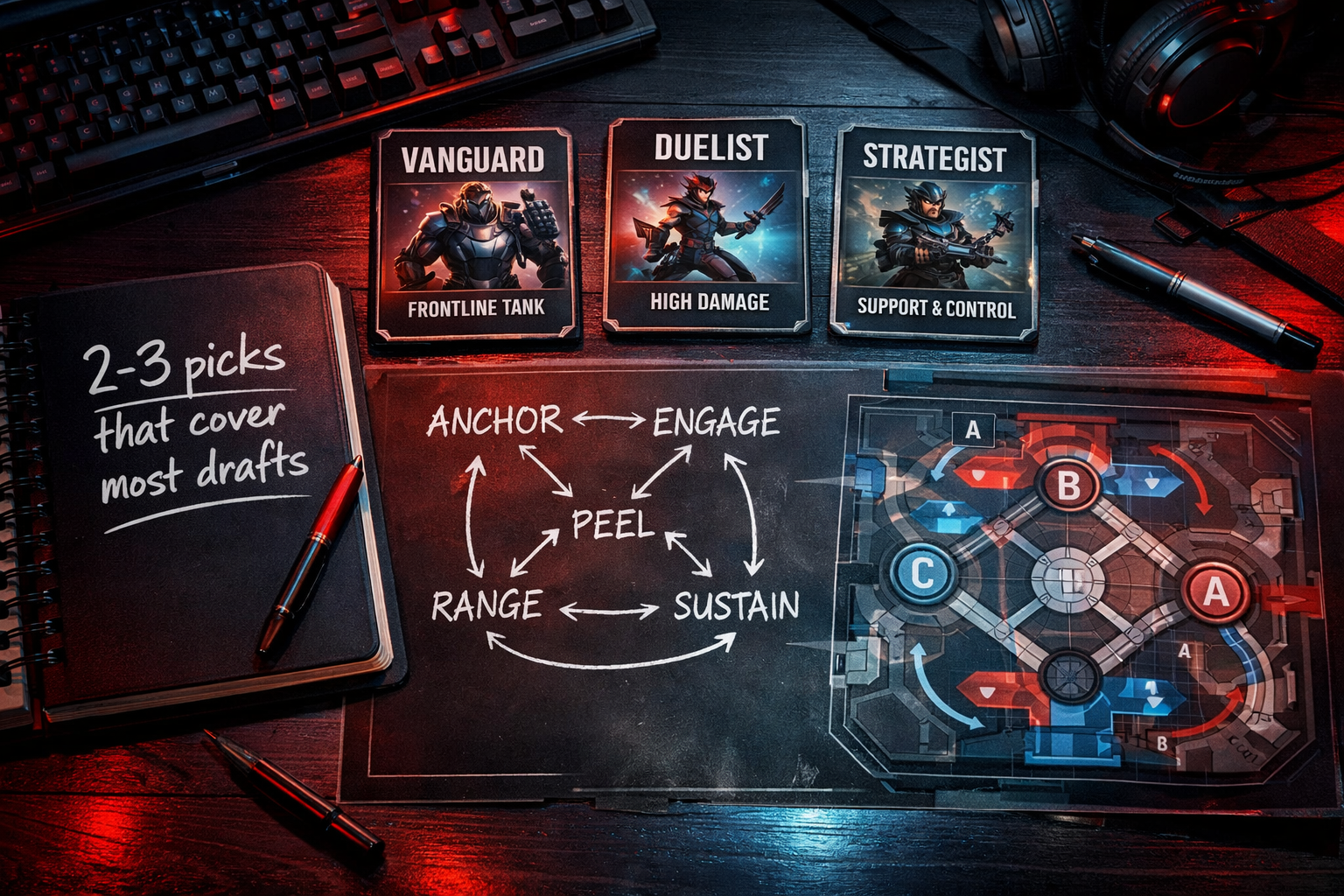
But pure stability has limits. Some games are lost because your team applies pressure and never cashes it in. The enemy escapes, resets, or drags the fight long enough for your earlier work to disappear. That is where a finisher or disruptor matters. Spider-Man is the classic example of a hero who changes how openings are punished. Winter Soldier can also fill a more direct threat-conversion role for certain players. These heroes do not just add damage; they alter the enemy’s risk calculation.
When your team already has decent poke or front pressure, a finisher pick can be the difference between “good pressure, no kills” and “one crack becomes a won fight.” That is why the reliable pressure plus finisher structure is so strong.
Sample Duelist Pair 1: Punisher + Spider-Man
This is perhaps the clearest contrast pair. Punisher covers your stable, readable, angle-based damage games. Spider-Man covers the high-pressure, punish-the-backline, exploit-chaos games. One hero supports slower fight development; the other capitalizes on fast breakpoints. That is real coverage.
This pair is especially useful if you are disciplined enough not to force the Spider-Man pick into bad lobbies. That is where many players go wrong. They treat their flashy second hero as a default. It is not. The pool works because Punisher stabilizes your average matches while Spider-Man gives you a way to punish vulnerable, greedy, or scattered enemy setups.
Sample Duelist Pair 2: Punisher + Winter Soldier
If you want less execution volatility than a hyper-mobile diver, this is an excellent alternative. Punisher remains your pressure foundation. Winter Soldier becomes the more forceful midfight converter. This pair is attractive for players who like Duelists that still feel direct and readable but want a second gear when the team needs more decisive threat.
The pair also teaches a good strategic lesson: contrast does not always mean opposite extremes. Sometimes it means different levels of commitment. One hero keeps the fight clean; the other pushes it over the edge.
Sample Duelist Trio: Punisher + Spider-Man + Winter Soldier
If you want a three-hero Duelist pool that stays tight, this trio is excellent. Punisher handles your stable pressure games. Spider-Man handles games where mobility and backline access matter more. Winter Soldier handles lobbies where you want more direct conversion without going fully into a mobility specialist. There is very little wasted overlap here if you use each hero for the right reason.
What Duelist Players Should Avoid
The most common Duelist pool mistake is building a collection of heroes that all want the same fight. Three angle farmers. Three dive-only assassins. Three squishy “carry” heroes that all collapse when the team has no anchor. That kind of pool feels exciting, but it does not cover most drafts. It magnifies lobby variance.
The second mistake is over-valuing personal highlight potential. Hero pool design is not about the most heroic-looking play. It is about the most repeatable impact. The question is not “Can this hero pop off?” Nearly every Duelist can. The question is “When this lobby gets weird, which of my practiced picks still gives my team a coherent path?”
Best Strategist Pool Structures
Strategist pools are often misbuilt because players focus on healing volume alone. But Strategists do much more than refill health bars. In real ranked games, they stabilize tempo, survive pressure, create breathing room, rescue mispositioned teammates, and sometimes contribute just enough threat or utility to swing the shape of a fight. A good Strategist pool should cover stability, peel, and fight flow.
Strategist Formula: Stabilizer + Peel/Utility (+ Anti-Chaos Emergency)
The strongest small Strategist pools usually include:
- One stabilizer who makes average fights more playable.
- One peel or utility option who changes how pressure is handled.
- Optionally, one anti-chaos emergency hero for dive-heavy or unusually scrappy lobbies.
Why Stabilizers Matter
Stabilizers are your “we need this game to stop feeling impossible” heroes. They make positioning mistakes less fatal, extend fights long enough for your team to use its damage, and give Vanguards and Duelists room to actually perform their jobs. Luna Snow is a strong example of a stabilizer-style pool foundation for many players. She fits the type of Strategist identity that rewards consistent presence, good timing, and team-oriented fight pacing.
If your team comp looks mechanically ambitious, a stabilizer often becomes even more valuable. Strong players love aggressive heroes, but those heroes still need uptime. A Strategist who can preserve rhythm is often the hidden glue that turns high-variance teammates into a real comp.
Why Peel and Utility Matter
The other half of Strategist coverage is not raw sustain. It is control over pressure. Some lobbies are not lost because your healing was low. They are lost because the enemy dictated the terms of entry, forced panic, and denied your team safe resets. That is where utility and peel-oriented Strategists matter.
Invisible Woman is an excellent example of a pick that can add more control and defensive structure to certain drafts. Cloak & Dagger also fit the broader idea of a Strategist who can bring a different kind of flexibility and response pattern when pure stabilization is not enough. If your first Strategist makes the team durable, your second should make the team harder to crack cleanly.
Sample Strategist Pair 1: Luna Snow + Invisible Woman
This is one of the best timeless Strategist pair concepts. Luna Snow gives you a reliable stabilizing baseline. Invisible Woman gives you a different kind of backline shape, especially when the lobby is more about control, peel, and denying clean enemy access. One helps the team stay online. The other helps the team stay protected and organized under pressure.
This pair covers a huge number of normal ranked games because the contrast is practical rather than cosmetic. You are not swapping between two heroes that both merely “heal well.” You are swapping between two different answers to how fights become losable.
Sample Strategist Pair 2: Luna Snow + Cloak & Dagger
This pair is excellent for players who still want one safe stabilizer but prefer a second option with more flexible fight texture. It works especially well if you often feel that your team does not need more raw sustain as much as it needs a Strategist who can respond dynamically to how skirmishes unfold. One hero keeps the floor high. The other helps you adapt to more awkward fight states.
Sample Strategist Trio: Luna Snow + Invisible Woman + Cloak & Dagger
If you want a clean three-hero pool on Strategist, this trio is outstanding. Luna Snow is your dependable default. Invisible Woman becomes the more protective, structure-heavy option. Cloak & Dagger become your flexible response pick for lobbies where you want a different toolkit without abandoning the Strategist role entirely. Together they cover stabilization, peel, and adaptability without becoming bloated.
What Strategist Players Should Avoid
The most common mistake is choosing three Strategists that all solve the same kind of safe, slow game. That creates trouble when the enemy backline access is strong or the fight pace becomes chaotic. The second mistake is overcommitting to niche playmaking picks while neglecting the basic responsibility of making your team playable. A Strategist pool should not begin with ego. It should begin with reliability.
Complete 2-3 Hero Pool Examples
Below are examples of small pools that make strategic sense. These are not meant to be the only correct answers. They are templates that show how contrast creates coverage.
Vanguard Examples
- Doctor Strange + Venom — stable anchor plus disruptive engage
- Groot + Captain America — space control plus tempo initiation
- Doctor Strange + Venom + Groot — blind-pick anchor, dive pressure, and extra map-control insurance
Duelist Examples
- Punisher + Spider-Man — reliable pressure plus high-value punish
- Punisher + Winter Soldier — stable output plus cleaner midfight conversion
- Punisher + Spider-Man + Winter Soldier — pressure, dive punish, and direct conversion in one tight trio
Strategist Examples
- Luna Snow + Invisible Woman — stabilization plus peel/control
- Luna Snow + Cloak & Dagger — dependable sustain plus flexible response
- Luna Snow + Invisible Woman + Cloak & Dagger — one of the cleanest broad-coverage Strategist trios
How to Choose Among These
Do not pick the “best looking” trio. Pick the one whose fight patterns make the most sense to your hands and your instincts. If you hate high-risk entries, do not force a dive-heavy contrast hero just because it completes a theoretical chart. Coverage only matters when you can execute it under pressure.
At the same time, do not choose comfort so narrowly that all your heroes feel identical. Hero pool strategy is about preserving comfort while expanding usefulness. That balance is the whole art.
How Maps and Modes Change Pool Value
Marvel Rivals’ modes matter because they change how often fights reset, how valuable first entry is, and how much sustained angle pressure can matter before the real collapse begins. You do not need a separate hero pool for every map, but you should understand how mode structure nudges your decisions.
Convoy
Convoy-style games often reward teams that can re-clear space repeatedly and survive longer fights around corners and escort routes. Stable anchors, reliable damage, and Strategists who can preserve fight shape often gain value here. That does not mean dive is bad; it means dive must achieve something concrete. If your engage does not actually break the enemy setup, the slower team may get more from raw repeatability.
Domination
Domination tends to amplify speed, contest timing, and the ability to turn small skirmish wins into point control. This can make engage Vanguards, mobile Duelists, and flexible Strategists feel especially good. But again, the lesson is not “always dive Domination.” The lesson is that your pool should have at least one option that thrives when contest frequency and midfight chaos increase.
Convergence
Convergence often sits between the two extremes. These matches can move from range and setup into sharper point-breaking phases. That makes contrast in your pool especially valuable. A hero who feels average in one phase may become excellent in the next. Players with only one fight speed often feel stuck here. Players with a proper two- or three-pick pool usually feel comfortable shifting gears.
Map geometry matters too. Tight spaces, short rotations, open lanes, destructible cover patterns, and height access all change what “easy value” looks like. But the simplest rule is this: if a map repeatedly exposes the same weakness in your pool, that weakness may justify your third hero. If it only feels annoying occasionally, keep practicing the two-pick core.
How to Practice a Small Pool Properly
A hero pool is not finished when you choose the names. It is finished when your decision-making on those heroes becomes automatic enough that you can focus on the draft and the match state instead of basic execution.
Step 1: Define each hero’s job in one sentence
If you cannot summarize a hero’s job in one sentence, you probably do not understand why they are in your pool. Examples:
- Doctor Strange: I use him when my team needs a stable, readable front line.
- Venom: I use him when the enemy should not be allowed to stand comfortably.
- Punisher: I use him when I need dependable pressure from playable angles.
- Spider-Man: I use him when the fight will reward fast punish and backline threat.
- Luna Snow: I use her when the team needs reliable stabilization.
- Invisible Woman: I use her when the backline needs more protection and control.
Step 2: Track why you swapped
After each session, write down every hero change and the reason. “Wanted more range.” “Needed better peel.” “Enemy backline too free.” “My first pick overlapped too much with teammate.” Over time, this reveals whether your pool logic is actually working. If most swaps come from one recurring problem, your pool still has a hole.
Step 3: Review losses by function, not emotion
Do not say, “This hero felt weak.” Ask, “What function was missing?” Did your team lack initiation? Did you fail to protect your Strategists? Did you have pressure but no conversion? Did your choice create overlap instead of coverage? This kind of review is far more useful than blaming the patch.
Step 4: Practice first fights and retake patterns
Most ranked games are shaped by a few recurring situations: the opening approach, the first real engagement, the first failed push, and the first retake. Learn how each hero in your pool wants to play those moments. If you understand your first-fight plan, you will draft more confidently because you can picture the game immediately after lock-in.
Step 5: Protect your identity
Do not let frustration turn your pool into chaos. If you are a strong anchor player, your contrast hero should still feel like you, just solving a different problem. The goal is not to become a stranger on hero select. The goal is to become a broader version of your best self.
Common Hero Pool Mistakes
1. Picking three heroes that all do the same thing
This is the most common mistake by far. The player says they have a pool, but every hero really wants the same fight. The result is fake flexibility. You feel different because the animations change, but your strategic coverage barely improves.
2. Building the pool from social media hype
Patch hype is seductive, especially in a game with constant discussion around balance and Team-Up interactions. But unless a hero truly replaces a function in your pool, hype should not dictate your practice. Timeless improvement comes from role coverage plus mastery, not from chasing temporary noise.
3. Refusing to blind-pick a stable default
Some players want every hero to be a high-expression specialist. That sounds exciting until they land in an average ranked lobby and have no safe answer. Your pool needs at least one hero you can trust when the information is incomplete.
4. Adding a third hero too early
Many players sabotage their climb by expanding before their first two heroes are polished. If your default and contrast picks still feel shaky, adding a third does not solve the problem. It spreads the problem.
5. Treating discomfort as proof of a bad matchup
Sometimes the hero is bad for the lobby. Sometimes you just do not like the rhythm the lobby demands. Those are not the same. Great players learn the difference. Do not rewrite your pool around every uncomfortable game.
6. Ignoring teammate overlap
Hero pools are not built in a vacuum. If your team already has certain functions covered, your best pick may change. Draft overlap quietly loses a lot of games because players focus on what their hero can do instead of what the team still lacks.
7. Confusing “carry potential” with “best pick”
In ranked, the best pick is often the one that makes your team’s average fight easier, not the one with the flashiest solo ceiling. This is especially true when you are climbing through inconsistent teammates. Reliability scales harder than ego.
8. Never updating the pool at all
While this guide is built to stay timeless, timeless does not mean frozen. You should still revisit your pool occasionally. Check whether official balance direction, your own mechanical growth, or repeated map issues suggest a smarter contrast hero. The point is measured updates, not constant reinvention.
When to Expand Beyond Three Heroes
You should only expand beyond three heroes when at least one of the following is true:
- You play organized team environments where draft responsibility is much more specific.
- Your first three heroes are genuinely mastered and no longer consume much practice overhead.
- A recurring role-specific problem cannot be solved by your current trio.
- The meta has shifted so hard that one of your heroes no longer fills its original job.
Even then, be careful. For most ranked players, four or more heroes is where quality starts to leak. Unless you are very disciplined, your fourth pick often steals reps from the heroes that actually win you games.
Final Thoughts
The best Marvel Rivals hero pool is not the one that looks smartest on paper. It is the one that lets you enter most drafts with a clear purpose. Two or three picks are enough if they are chosen well: one default, one contrast, and maybe one emergency answer. That structure gives you stability without rigidity and flexibility without chaos.
If you remember only one thing from this guide, remember this: build your pool around functions, not hype. An anchor plus an engager. A pressure dealer plus a finisher. A stabilizer plus a peel option. That is the kind of logic that survives balance changes, protects your practice time, and translates into consistent ranked improvement.
Master fewer heroes. Understand them better. Cover different fight patterns. That is how you build a Marvel Rivals hero pool that actually covers most drafts.