



Dota 2 High Ground Defense Fundamentals Guide for 2026
High Ground Defense Fundamentals in Dota 2 2026
High ground defense is one of the most important skills in Dota 2, and it is also one of the least understood by average players. Most players think of defending base as a desperate moment where they simply throw spells at creeps and hope the enemy makes a mistake. Stronger players understand something deeper: high ground defense is not chaos. It is a system. It is a sequence of timing windows, resource trades, positioning rules, information checks, and target priorities that can turn a losing game into a completely playable one.
That is why high ground defense remains one of the most timeless concepts in Dota 2. Patch details change. Specific heroes move in and out of the meta. Item numbers get adjusted. But the core logic of defending base barely changes. The team on high ground has shorter reinforcement paths, building support, easier access to buyback re-entry, tighter choke points, and a stronger ability to punish overextensions. The attacking team has initiative, but it also has more risk than many players realize. One bad dive, one wasted BKB, one greedy step onto a ramp without vision, or one split target call can reverse twenty minutes of advantage.
This guide is built to stay useful for as long as possible. Instead of relying on one patch’s hero tier list or one short-lived strategy trend, we are focusing on evergreen Dota 2 fundamentals: wave management, vision denial, cooldown discipline, buyback logic, formation, patience, communication, and the transition from “survive the push” to “win the game after the defense.” If you want to improve your ranked stability, your comeback rate, and your late-game decision-making, this is one of the highest-value macro skills you can learn.
If you want to study hero data, item trends, and public match examples while practicing these concepts, trusted resources such as Dota 2’s official hero page, Dotabuff, OpenDota, and Liquipedia Dota 2 are excellent companions. And if your main goal is to climb more efficiently while sharpening your understanding of macro play, you can also check Boosteria’s Dota 2 boosting prices as part of your broader ranked improvement plan.
Table of Contents
- 1. What High Ground Defense Really Means
- 2. Why Comebacks Happen From Base Defense
- 3. Preparing Before the Enemy Reaches Your Base
- 4. Wave Management: The First Line of Defense
- 5. Vision and Information Control on Defense
- 6. Positioning Fundamentals on High Ground
- 7. Cooldowns, Mana, and Resource Discipline
- 8. Buyback Fundamentals That Win Games
- 9. Glyph, Buildings, and Objective Triage
- 10. Role-by-Role High Ground Responsibilities
- 11. Common Enemy Siege Patterns and How to Punish Them
- 12. Teamfight Execution During the Defense
- 13. What to Do After You Successfully Defend
- 14. Common High Ground Defense Mistakes
- 15. Practice Routine to Improve This Skill Fast
- 16. FAQ
- 17. Final Thoughts
1. What High Ground Defense Really Means
High ground defense is not just “fighting inside your base.” It is the art of denying the enemy a clean siege. A clean siege is what attackers want: stable vision, safe hits on buildings, no commitment from their cores, no wasted cooldowns, and enough map pressure that the defenders are forced to react too late. A good defense ruins that structure. It makes the enemy uncomfortable, impatient, split, or overconfident.
At a deeper level, defending high ground is about buying time while preserving your ability to punish. Time matters because each second can mean one of the following: creeps die before reaching buildings, an important cooldown returns, a dead teammate respawns, buyback becomes available, backdoor protection activates, an enemy duration-based item ends, or another lane starts pushing away from your base. The more time you create without losing key heroes, the more the pressure shifts from the attackers to the defenders.
Many teams fail high ground defense because they see it as a moment to panic. They feel behind, so they force the first engagement they can find. But panic usually helps the stronger team. Good base defense is selective. It asks: what are we defending right now, what are we willing to give, and what exact mistake are we waiting to punish? Sometimes the answer is to defend a tower. Sometimes the answer is to trade one lane of barracks for buyback preservation and a better later fight. Sometimes the answer is to clear one wave, give ground, and wait for the enemy to dive too far.
That distinction matters because not every building is worth the same commitment. Not every wave is worth a death. Not every initiation is good simply because it lands on an enemy core. Dota 2 rewards disciplined desperation, not reckless desperation.
2. Why Comebacks Happen From Base Defense
One reason Dota 2 remains so exciting is that the game gives defenders real comeback tools. Even if the enemy controls most of the map, they still have to enter one of the most dangerous parts of it: your high ground. That shift changes several structural rules.
First, the attackers usually move uphill into tighter terrain. Choke points naturally compress their formation. This can make even a farmed lead feel awkward if your team has strong area control, counter-initiation, or layered spell usage. Second, the defenders re-enter fights faster. A hero who dies with buyback can return to base combat almost immediately, while attackers who die outside can lose the whole push. Third, building support changes target selection. Towers, barracks areas, and terrain edges make diving riskier than skirmishing in open lanes or jungle.
Another major factor is low-ground vision disadvantage. Attackers who walk uphill without true sight or unit vision often expose themselves to hidden angles. Even in games where both teams are extremely farmed, vision asymmetry still decides fights. High ground defense is not just about damage; it is about forcing the enemy to reveal themselves before you reveal your real commitment.
Comebacks also happen because leading teams frequently become impatient. They may feel they are “supposed” to end the game, which pushes them into bad habits: hitting buildings without checking buybacks, splitting formation, diving supports past towers, wasting defensive items too early, or taking a fight after their key cooldowns are already spent. The losing team has only one job in these moments: stay composed long enough for greed to appear.
This is why high ground defense is not only a mechanical skill. It is also a psychological skill. You are defending not just against enemy heroes, but against your own urge to overreact. The best defending teams understand that the enemy lead is real, but not absolute. If the enemy has to end through your base, then they still have a final exam to pass.
3. Preparing Before the Enemy Reaches Your Base
The strongest high ground defenses often start before the siege begins. If your team only starts thinking once enemy creeps hit your tier structures, you are already late. Preparation decides whether the defense feels controlled or desperate.
The first step is recognizing the map state early enough. Is the enemy grouping with Aegis? Are they pushing out two side lanes before coming high ground? Are your outer towers gone, making your jungle unsafe? Is Roshan down, meaning the enemy may feel forced to siege before their timing fades? These questions tell you not only whether a push is coming, but how urgent it is.
Next comes inventory discipline. You must know who needs buyback, who can afford to show on the map, and who must hold gold instead of completing a greedier item component. Many pub games are lost because a core finishes a luxury item before a high ground defense, then dies once without buyback and loses the game. When base pressure is imminent, gold is not only item progress. Gold is potential re-entry. Gold is permission to take a risk. Gold is insurance.
Position your heroes with intention before the wave arrives. Supports should already be thinking about where they can stand without getting jumped first. Heroes with long-range wave clear should be near the correct lane. Heroes who rely on flank angles should not reveal too early. If someone must cut a side wave, that move needs to happen before the enemy fully surrounds the base, not after.
You should also identify your best defensive tools in advance. Is your defense built around one hero’s instant clear? A key save spell? A counter-initiation ultimate? Buyback plus Boots of Travel? Illusions to stall? Strong building defense with summons or traps? Your team needs to know what it is protecting. Good defense is not five players independently “trying something.” It is a coordinated effort to preserve the one or two mechanics that make the siege uncomfortable for the enemy.
Finally, talk about the likely trigger for engagement. Will you fight if they hit barracks? If they commit onto your frontliner? If a support oversteps for warding? If their BKBs are already used? This kind of pre-fight agreement matters because indecision is one of the biggest reasons teams fail to hold high ground. Half-commits are usually worse than patience and often worse than full surrender of one objective.
4. Wave Management: The First Line of Defense
If you remember only one concept from this guide, remember this: waves are your first and best defensive resource. Most players think high ground defense starts at the ramp. In reality, it often starts thirty to sixty seconds earlier, when someone decides whether the incoming lane will be cleaned, stalled, dragged, or allowed to stack pressure with another wave.
The enemy cannot comfortably siege without creeps. This simple fact is responsible for a huge percentage of successful defenses. If you can erase waves quickly, delay reinforcements, or force backdoor protection windows, you reduce the number of safe building hits the attackers can take. Even a stronger lineup can look clumsy when every wave disappears before it reaches the structure.
That is why wave clear matters so much. Heroes with long-range nukes, spam spells, summons, illusions, or durable frontline presence can all buy time in different ways. Sometimes your goal is not to kill enemy heroes at all. It is to remove the wave, force the enemy to step farther in, and make them choose between waiting and overcommitting.
There is also a broader principle here: lane pressure before the siege affects the defense during the siege. If an enemy side lane is already pushing away from your base, they have fewer options to split the map after a failed attempt. If your lanes are all shoved into you at once, the enemy has more time to gather and more ways to rotate. This is why smart teams send one hero to fix side-lane pressure before the real siege begins, even if that hero cannot contribute the first second the enemy arrives.
Another part of wave management is knowing when to defend the wave and when to give space. You do not always need to stand on the front ramp. Sometimes the safest way to handle the push is to clear the wave from deep base positions, hide your real formation, and wait until the attackers are exposed. The goal is not to prove courage. The goal is to stretch the enemy push into an awkward rhythm.
Wave cutting outside base can also be game-saving, but it must be done with discipline. If one hero leaves to cut a wave and gets caught, the defense can collapse instantly. This move is strongest when done early, by a hero with escape tools, or when your team already knows it is not contesting the first contact. Random desperation teleports into fog rarely work. Planned pre-siege lane manipulation often does.
When reviewing your own replays, pause the game ten to fifteen seconds before the first building hit. Ask yourself one question: what did the creep waves look like, and could we have made the enemy siege harder before it started? That question alone will teach you more than watching the fight in real time.
5. Vision and Information Control on Defense
Information decides whether a high ground defense feels impossible or manageable. When defenders lose vision, they often waste spells on the wrong target, expose themselves to jump angles, or fail to recognize that the enemy formation is split. When defenders protect vision, they can delay, poke, and punish with much more confidence.
The most important vision principle on defense is this: you do not need to see everything. You need to know enough to identify who is showing, who is missing, and which route the enemy must use to threaten buildings. Many teams throw the defense by walking too far forward trying to “get full information.” That desire often gives the attackers exactly what they want: a pickoff before the real siege begins.
Defensive wards and sentries should serve your formation, not your curiosity. A ward that covers a likely jump angle or a wraparound path is often more valuable than one placed aggressively to see all five attackers. Think in terms of approach lanes, staircase entries, tree-line flanks, and cliff edges that matter for the next fifteen seconds.
Vision denial matters too. If the attackers have clean uphill sight through summons, illusions, traps, dominated creeps, or aggressive wards, your defense becomes much weaker. Killing these sources of vision is sometimes just as important as damaging the enemy core. Dota 2 punishes hidden information, but it rewards teams who actively fight for it.
Another overlooked part of information control is spell concealment. If the enemy cannot tell whether your key initiator is left, right, smoked, dead, or holding buyback, they will play more cautiously. If you reveal your entire defense lineup too early, they can space around it and hit buildings safely. Sometimes “vision” is not what you see. It is what you deny the enemy from seeing about you.
Communication improves information value. A support calling “their backline is split,” a core calling “Aegis down in twenty,” or a teammate noting “two heroes showed bottom a moment ago” can change whether you commit or wait. The mechanical skill ceiling in Dota is high, but base defense is often won by the team that processes information more calmly.
6. Positioning Fundamentals on High Ground
Positioning is the bridge between theory and survival. You can understand buybacks, wave clear, and timing windows perfectly, but if your formation is wrong, the defense still fails. Good positioning on high ground has one purpose: make the enemy’s first successful move as difficult and as expensive as possible.
Defenders should rarely stack on top of each other unless they are responding to a known dive. Spread is valuable because it prevents one initiation from ending the entire defense. At the same time, spread cannot become isolation. If your support is positioned in a way that no ally can save them, or if your damage dealer is so far back that they cannot contribute until buildings are already half dead, you are not really spread; you are disconnected.
Think of defensive positioning in layers. The front layer handles information, creep contact, and baiting. The middle layer handles damage and save response. The back layer protects against wraparound threats and prepares counter-initiation or buyback return paths. Not every lineup uses the same heroes in the same layers, but every effective defense has some version of this structure.
One of the most common mistakes is putting the wrong hero in the most visible spot. Your strongest damage hero is not always the best front presence. Your best initiator is not always the one who should show first. Your fragile save support should almost never be the easiest hero to jump. Ask what job each hero does in the first three seconds, the next five seconds, and the last part of the fight. Position for sequence, not just for comfort.
Use terrain intelligently. Corners, tower arcs, tree lines, stairs, and base edges all change the geometry of fights. Heroes with instant saves or counter-spells often want to stand where they are protected from direct sight but still close enough to react. Heroes with long cast range may want diagonal angles rather than straight-line positions. Melee cores often need to resist the temptation to show early because once they are visible, the attackers can shape the fight around them.
Remember that the defense often improves after the enemy commits. That means your early positioning should value concealment and stability more than instant aggression. Many fights are won not because the defenders jumped first, but because they stayed uncommitted until the attackers stepped too far in.
7. Cooldowns, Mana, and Resource Discipline
Base defense is a resource battle. Players love to talk about farm advantage and hero matchups, but high ground fights are frequently decided by who manages finite resources better. That includes obvious things such as long cooldown ultimates, but it also includes mana pools, defensive items, glyph timing, teleport status, charges, and even the emotional willingness to wait one more wave.
The most important rule is simple: do not spend your best defensive tool on a low-value moment unless failing to do so loses the objective immediately. Many teams blow their highest-impact spell just to remove one wave or punish one support, then discover they cannot stop the actual dive that follows. A good defense distinguishes between nuisance and true commitment.
Mana management is another silent killer. A hero can be alive, in position, and technically ready to cast, but if they lack mana for the key sequence, the defense is functionally weaker. Before the siege begins, make sure your most important defenders are topped up. This sounds basic, but many pub defenses fail because supports spent too much mana outside base or cores arrived without enough to combine mobility, control, and survivability.
Item usage must also be layered rather than overlapped blindly. If two saves answer the same threat at the same time, the enemy can simply re-engage after both are gone. If you can trade a smaller tool for the first wave of pressure and hold the bigger answer for the real fight, your odds improve significantly. This is especially important against lineups that want to force one defensive panic and then dive during the cooldown gap.
Track enemy cooldowns too. The entire defense can change depending on whether the enemy has already used BKBs, a major teamfight ultimate, sustain tools, or their key building hitter’s steroid ability. Some high ground fights become winnable only after the attackers have already “started wrong.” If you are not mentally tracking those resources, you may miss the exact opening you were waiting for.
Resource discipline is really about refusing false urgency. The enemy wants you to feel that every second is your last chance. Often it is not. Often the real win condition is preserving enough resources for the moment after they get impatient.
8. Buyback Fundamentals That Win Games
Buyback is one of the defining mechanics of high ground defense. More than almost any other concept in Dota 2, it transforms a seemingly lost fight into a playable one. Yet players consistently misuse it. They either spend it too late, spend it without a plan, or fail to save for it in the first place.
The first principle is preventive: if the game state suggests a base siege is coming soon, key heroes must think about buyback before they think about their next luxury purchase. Not every hero needs it equally, but your highest-impact late-fight heroes usually do. A carry without buyback during high ground defense is not just missing a mechanic; they are missing an entire threat layer that forces the enemy to respect your base.
The second principle is that buyback without re-entry is wasted potential. A hero should not just ask “Can I buy back?” but “If I buy back, what am I returning to do?” This might mean having teleport availability, Boots of Travel, mobility items, or even just a clear path to the fight. If the enemy can instantly disengage before you rejoin, the buyback may save buildings but not win the fight.
Third, buyback timing matters more than many players think. Buying back too early can signal weakness and let the enemy retreat cleanly. Buying back too late can mean your surviving teammates already died without enough support. The best timing often happens when the enemy has committed deep enough that retreat is costly but not so late that your base is already gone.
There is also a strategic layer to buyback concealment. If the enemy knows your crucial hero has no buyback, they can commit harder. If they are uncertain, they must evaluate risk more carefully. This is why dying carelessly outside base before a high ground defense is so damaging: you may not only lose time, but also reveal that your team’s re-entry power is gone.
In some games, the mere possibility of buyback is enough to stop a full commit. In others, a deliberate death-and-return sequence is exactly how the defense wins. For example, a core may trade life for cooldowns, re-enter instantly, and then clean up an overextended enemy team whose own resources are now exhausted. That is not luck. That is planned high ground defense.
Every serious Dota player should ask after each lost base fight: who needed buyback, who had it, who lacked it, and if we used it, was there a real plan attached? These questions reveal structural mistakes that are invisible if you only focus on mechanical execution.
9. Glyph, Buildings, and Objective Triage
Not every objective deserves the same defensive commitment. One of the hardest and most important high ground skills is objective triage: deciding what can be saved, what can be delayed, and what must be traded for a better later fight.
Glyph of Fortification is central to this process. The biggest mistake with glyph is using it automatically. The best glyphs create something meaningful. They may buy time for respawns, deny one crucial siege wave, break the enemy’s rhythm, preserve a building until an ultimate comes back, or force the attackers to stay exposed longer than they wanted. If glyph does not change the next few seconds in a meaningful way, it is often wasted.
Buildings themselves should be thought of in layers of value. Sometimes defending a ranged barracks at all cost is correct because your lineup suffers badly against permanent lane pressure. Sometimes the right call is to give one lane, preserve buybacks and ultimates, and fight for the next objective. Sometimes defending tier structures matters less than waiting for the enemy to step into the exact position where your lineup functions best.
Players often lose because they emotionally tie themselves to saving every structure. That mindset creates forced fights with poor resources. Dota 2 does not reward symbolic resistance. It rewards high-value resistance. Ask whether committing right now preserves more than it risks. If not, your team may need to retreat deeper, clear another wave, and wait.
Backdoor protection can also become part of your defense logic. If you can delay creep contact or kill the wave, the enemy’s “siege” can suddenly turn into a very awkward posture with little real damage output. Teams that understand this are much harder to close out against. They know that sometimes a building is not saved by fighting heroes. It is saved by denying the structural conditions that let the heroes hit it.
10. Role-by-Role High Ground Responsibilities
Every role contributes differently in high ground defense, and confusion here causes huge problems in pubs. When players misunderstand their job, they either overplay or underplay the moment.
Carry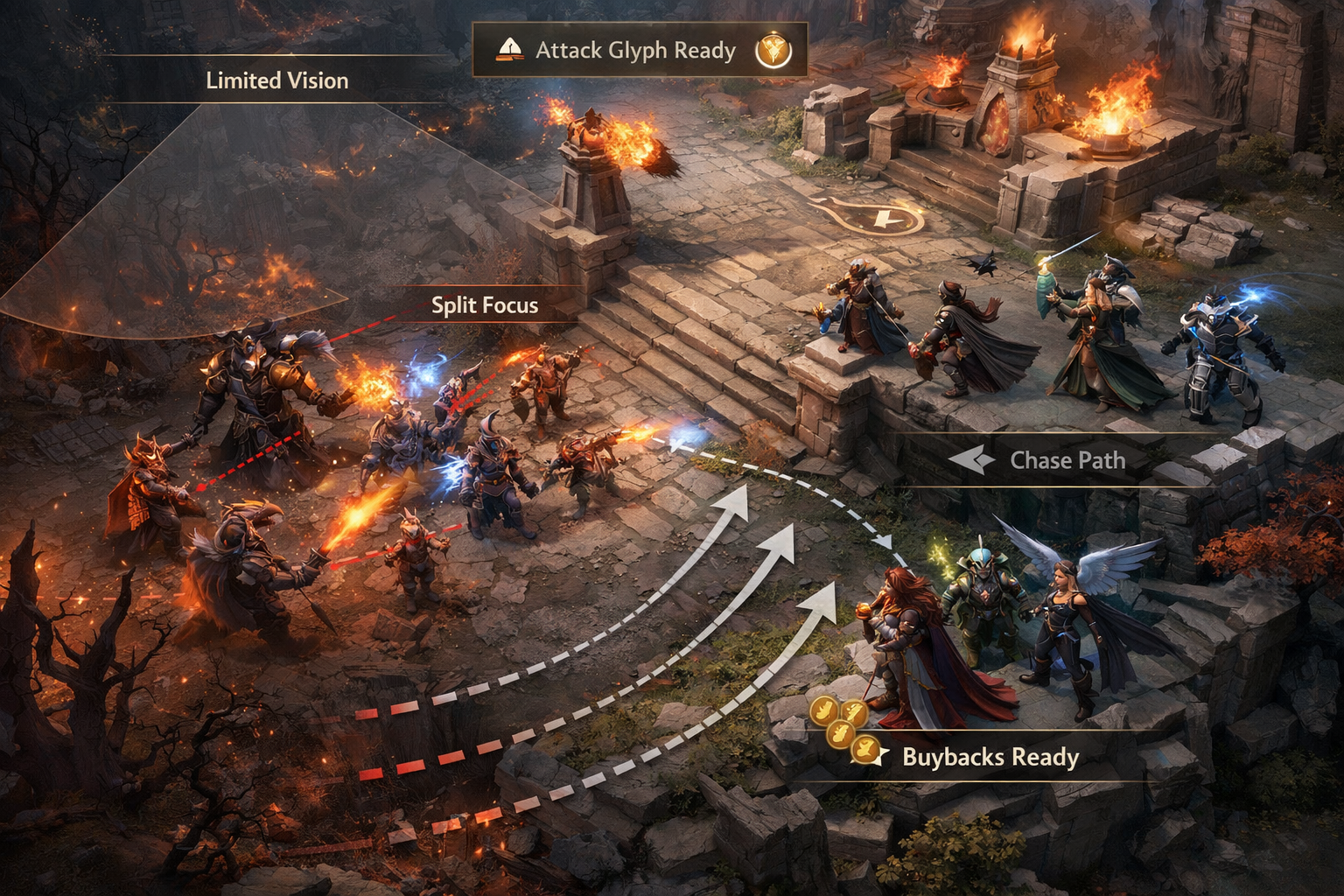
The carry is usually the damage anchor and late-fight finisher, not always the first engager. Many carries die in bad defenses because they walk too far forward trying to “do something” before the enemy truly commits. Your primary job is to stay alive long enough to punish exposed targets, protect buyback value, and convert a successful hold into map control. If your lineup requires you to frontline, you still need to do so with discipline, not ego.
Mid
The mid hero is often the defense stabilizer. Depending on the hero, this can mean wave clear, burst punishment, control, or tempo communication. Mid players must be especially aware of cooldown sequencing and lane state because they often bridge the gap between stall and fight. If you are the main catch hero, revealing too early weakens the defense. If you are the main clear hero, conserving mana and position is everything.
Offlane
The offlaner is frequently the structural glue of base defense. This role often handles vision contest, front presence, aura value, counter-initiation posture, and space creation for the true damage sources. Offlaners need to understand whether they are bait, wall, or dagger. In many defenses, the offlaner is not expected to “win the fight” alone, but to make the fight shape favorable for everyone else.
Soft Support
The soft support often decides how punishing the defense can become. This role may provide scouting, disables, defensive saves, poke damage, or flank threat. The biggest challenge is balancing visibility and survival. Show too early and you die for free. Hide too much and your team lacks information or setup. Strong support play on high ground is about being present without being easy.
Hard Support
The hard support is usually the defensive spine of order and utility. Your job may include warding safe areas, preserving detection, saving key allies, force-staffing targets, using defensive items efficiently, and communicating buybacks or enemy commitment. Hard supports often die first in failed defenses because they stand where they can be reached too easily. Your value comes from living long enough to spend your tools well.
Across all roles, one universal rule applies: know whether your hero is more valuable alive than active. Some heroes must cast early. Others win the defense simply by being an unseen threat the enemy must respect.
11. Common Enemy Siege Patterns and How to Punish Them
Understanding the attacker’s goals makes defense dramatically easier. Most high ground pushes fall into a few recognizable patterns.
Pattern 1: Safe Building Hit Behind Aegis
The enemy frontlines with their most durable or highest-net-worth hero, trusting Aegis or durability to absorb the first contact. Against this, do not panic. Often the correct response is to clear waves, poke support heroes, force item usage, and wait until the real body behind the frontline becomes vulnerable. Killing the Aegis carrier is not always the point. Distorting the shape of the siege often is.
Pattern 2: Slow Siege With Summons, Illusions, or Long-Range Poke
This pattern aims to starve you out and gain free chip damage. Here, wave clear and vision denial are everything. Kill the support structures of the siege: summons, wards, traps, creep waves, or backline poke angles. If the enemy wants to end without exposing heroes, your job is to remove the conditions that let them do that.
Pattern 3: Hard Dive After Forcing Small Cooldowns
Some teams probe first, then commit once they believe your saves or big spells are gone. Against this, resist over-responding to the probe. Small pressure does not always require a big answer. If the enemy reads that you are nervous, they will chain that into the true dive timing.
Pattern 4: Split Formation With Backline Protection
The enemy intentionally spreads to avoid one initiation while still hitting objectives. The weakness of this pattern is communication and distance. If you can identify the split early, there may be a punishable support or damage source too far from protection. Good defenders are always asking: who is actually safe right now, and who only looks safe because we have not challenged the angle?
Pattern 5: Fake Retreat Into Re-Engage
After taking some damage or using a few spells, the attackers back off slightly, hoping defenders chase out of formation. This trap is common after a seemingly successful wave clear. Never chase downhill blindly unless you know the enemy lacks buybacks, cooldowns, or positioning to turn. High ground defense often succeeds precisely because defenders refuse the tempting but low-value chase.
If you can label the enemy’s pattern in real time, your defense becomes far less emotional. Instead of feeling overwhelmed, you begin to see structure, and structure creates good decisions.
12. Teamfight Execution During the Defense
Once the fight really starts, execution matters. But even here, fundamentals beat chaos. The first rule is target relevance over target proximity. The hero closest to you is not always the correct target. Sometimes the right move is to ignore the tank hitting your building and instead disable the save support, the real damage source, or the hero who enables the retreat.
Second, avoid split commitment. Nothing ruins a good defense faster than half the team hitting the frontline while the other half dives somewhere else. When the base is under pressure, clarity beats creativity. Decide what breaks the enemy siege fastest: forcing out the sustain core, killing the backline control, punishing one overextended jumper, or simply surviving until key durations end.
Third, respect sequencing. The defense often improves if your team layers its tools rather than expending them in a single emotional burst. Control after enemy dispels. Save after the real initiation, not before it. Commit follow-up damage only when the enemy’s exit route is difficult. This sounds obvious, but in real base fights many players cast as soon as they feel fear. Fear-casting is one of the most expensive habits in Dota 2.
Fourth, understand when the fight is won. A successful high ground defense is not always a full team wipe. Sometimes it is enough to end the enemy’s building threat, force critical cooldowns, burn Aegis, or make them retreat with low resources. Overchasing after you already stabilized can throw the whole recovery away. A defense is successful when the enemy can no longer continue the objective on good terms.
Finally, communication during execution should be short and functional. “Hold buyback.” “Ignore front.” “Backline left.” “No BKB.” “Wave first.” “Do not chase.” In intense defensive moments, long explanations are worse than clean signal words. The team that stays legible under pressure usually wins more of these fights.
13. What to Do After You Successfully Defend
Many teams finally survive the siege and then immediately throw the comeback window by making the wrong next decision. A good defense does not end when the enemy retreats. It ends when you choose the correct conversion.
The first question is always: can we safely leave base? If lanes are terrible, if buybacks are gone, or if the enemy still has strong turn potential, charging across the map is often a mistake. Sometimes the best reward for defending is simply reclaiming lane equilibrium, restoring vision, and taking back map space step by step.
The second question is whether major enemy resources were spent. If the attackers lost buybacks, Aegis, crucial cooldowns, or multiple heroes without response options, then your defense may have opened Roshan, deep lane pressure, or even a direct objective opportunity. But if the enemy merely retreated with moderate losses, your job is to stabilize, not fantasize.
Push out lanes immediately after a successful hold if it is safe to do so. This resets the map and forces the enemy to answer pressure instead of regrouping for free. High ground defense is strongest when it becomes the start of a momentum reversal, not just a brief delay before the next inevitable siege.
Heal, replenish mana, and repair your information structure. Replace wards, deward likely approach paths, and talk honestly about which buybacks are now missing. The period after a successful defense is one of the most strategically rich moments in Dota 2 because both teams are often low on clarity. The team that resets faster usually gains the next advantage.
If you got the hold because the enemy overcommitted, remember the lesson. They may do it again. Many comeback games are won not because the stronger team stopped making mistakes, but because the defenders recognized the exact mistake pattern and positioned to punish it a second time.
14. Common High Ground Defense Mistakes
Let’s make the most common errors explicit.
- Forcing the first engagement out of panic. Just because the enemy reaches your base does not mean you must instantly fight.
- Ignoring creep waves. Many lost defenses were actually lost thirty seconds earlier in lane management.
- Showing key heroes too early. Once the enemy knows exactly where your biggest threat is, their siege becomes easier.
- Using glyph automatically. Glyph should buy something meaningful, not just delay damage by habit.
- Completing items instead of saving buyback gold. This single greed decision can lose otherwise defendable games.
- Chasing downhill after stabilizing. Defenders often throw away their structural advantage by pursuing too far.
- Stacking too tightly. One initiation should not break your whole defense.
- Splitting target focus. Base fights punish indecision more than open-map skirmishes do.
- Misusing saves. Overlapping defensive items or spells gives the enemy a cleaner second wave of engagement.
- Failing to identify what must actually be defended. Not every barracks is worth the same sacrifice.
If you regularly lose high ground, it is usually not because your team lacks “clutch factor.” It is because one or more of these structural mistakes keeps repeating. The good news is that structural mistakes are very trainable once you start reviewing them honestly.
15. Practice Routine to Improve This Skill Fast
If you want to improve at high ground defense faster than most players, do not just spam more matches. Review your games with a focused checklist.
After every game where your team defended base, answer these questions:
- What did the lanes look like before the siege started?
- Who on our team needed buyback, and did they have it?
- Did we know which enemy hero actually enabled the siege?
- Did we preserve our best defensive cooldown for the real commitment?
- Did anyone die before the real push for avoidable reasons?
- Did we use glyph at a moment that bought something specific?
- Who showed too early, and who hid too long?
- Was our target priority correct once the fight began?
- Did we overchase after stabilizing?
- What one decision, if changed, would most improve the next defense?
This review process works because high ground defense is highly repeatable in concept. Even though hero combinations differ, the same macro mistakes appear again and again. If you train yourself to spot those patterns, your defensive instincts improve quickly.
You can also study professional or high-MMR examples for reference, but do not copy them blindly. Instead, observe what they preserve, what they give up, and what exact error they wait for. Great defenders do not look frantic even in losing games. They look patient, because they understand which moments are real and which are fake urgency.
Another useful training habit is to pause your own replay right before the enemy reaches high ground and predict the best defensive plan. Then watch what actually happened. Over time, this builds real-time decision-making, not just hindsight criticism.
16. FAQ
Should you always fight for the first lane of barracks?
No. If your buybacks are weak, your key cooldowns are down, or the enemy has too much advantage at that exact second, trading one set of barracks for a better later fight can be correct. The key is making that choice deliberately rather than passively.
How important is low-ground vision disadvantage?
It is extremely important. A team hitting uphill without clear vision is more vulnerable to misses, jump threats, and bad target selection. Even heavily advantaged teams can lose fights because they approach high ground carelessly.
Should supports play very far back on defense?
They should play safely, but not uselessly. Supports need to be close enough to save, disable, or provide information. The goal is protected relevance, not maximum distance.
When is buyback strongest?
Buyback is strongest when the enemy has committed deeply enough that your return changes the fight immediately. It is weaker when the enemy can disengage for free before you rejoin.
What matters more: wave clear or teamfight?
Both matter, but wave control often comes first because it determines whether the enemy can even siege safely. Many “teamfight losses” on high ground were actually wave-management failures in disguise.
Should you chase after a successful defense?
Only if the map, resources, and enemy cooldowns make it clearly favorable. Many comeback opportunities are thrown because defenders get emotionally carried away and abandon the structure that made the defense work.
17. Final Thoughts
High ground defense is one of the purest expressions of Dota 2 strategy. It combines mechanics, patience, map reading, psychology, and discipline into one repeated exam. That is exactly why players who master it become far harder to close out against. They stop seeing the enemy’s lead as a death sentence and start seeing the base as a position of conditional strength.
The timeless fundamentals are clear. Prepare before the siege. Control waves. Protect information. Position in layers. Preserve resources. Save for buyback. Use glyph with purpose. Know what objective is actually worth your life. Punish overcommitment instead of inventing your own disaster. And once you hold, convert the defense into structure, not chaos.
In ranked play, this skill is massively underrated because many players focus only on lane wins, hero picks, or mechanical outplays. Those things matter, but games are often decided much later, at the exact moment when one team tries to finish and the other team proves it still understands Dota better under pressure. That is the real value of learning high ground defense: it gives you more chances to win games that other players would mentally surrender.
If you want a lasting edge in Dota 2, do not treat base defense as a random emergency. Treat it as a craft. The more calmly and deliberately you handle these moments, the more often you will turn “almost lost” into “completely winnable.”