



Dota 2 Neutral Items Timing Guide 2026: Tiers and Power Spikes
Neutral Items Timing Guide in Dota 2 2026: Tier Priorities and Power Spikes
Neutral items are one of the most misunderstood sources of power in Dota 2. Most players know the basic idea: farm camps, unlock tiers, take something useful. But that simple description hides one of the biggest competitive edges in the game. Neutral items do not just add stats. They change when heroes can shove waves, survive smokes, enter Roshan fights, defend high ground, break map control, or win a late-game manfight. In even matches, the team that understands neutral timing better often reaches the next playable move first.
This is why strong players treat neutral items as part of macro, not as random bonus loot. They think about who should farm the next cap first, who benefits most from an early craft, which lane should be pushed before a new tier unlocks, and whether the upcoming tier changes the value of fighting, smoking, or dodging. That is the core idea of this guide: not memorizing every item name, but learning a reliable framework that works even when item pools change.
If you want to follow the system itself, Valve’s official Dota 2 patch notes explain the Madstone-based neutral item structure, and later balance adjustments are tracked in the official 7.41 patch notes. For current pools and quick cross-checking, Liquipedia’s neutral items page is a useful reference, while Dotabuff hero trends can help you think about which archetypes value stats, mobility, cast range, sustain, or defensive utility most.
This guide is written to stay useful for a long time. Specific artifacts and enchantments will rotate, get buffed, or get moved between tiers. The decision-making principles do not. If you learn how to read neutral item timing as a sequence of power spikes, you will improve in almost every patch.
Table of Contents
- Why Neutral Items Matter More Than Most Players Think
- Neutral Tier Timing Overview
- The Core Macro Principle Behind Neutral Items
- Tier 1 Priorities: First Tempo Window
- Tier 2 Priorities: Midgame Activation
- Tier 3 Priorities: Map Control and Fight Conversion
- Tier 4 Priorities: Siege, Survivability and Roshan Pressure
- Tier 5 Priorities: Endgame Identity
- Role-Based Priority: Who Should Get Value First
- How to Farm Madstone Without Griefing Your Game
- How to Distribute Neutral Items Across a Team
- When to Recraft and When to Keep What You Have
- Common Neutral Item Mistakes That Lose Games
- Advanced Timing Framework for Real Matches
- Simple Neutral Item Checklist
- Final Thoughts
Why Neutral Items Matter More Than Most Players Think
Players often undervalue neutral items because they do not cost gold in the traditional sense. That makes them feel optional or secondary compared with core purchases like BKB, Blink, Shiva’s Guard, or Butterfly. In reality, neutral item value often arrives earlier than the next big bought item, and that timing can decide whether you win the fight that gives you Roshan, an outpost, map control, or enough space to finish your next slot.
Think of neutral items as compressed efficiency. A small amount of survivability can be the difference between dying during a smoke and living long enough to cast two more spells. A little extra mana sustain can turn a support from a one-rotation hero into a constant wave-clear and save machine. A modest mobility tool can create the angle a core needs to reach backlines or escape after pushing one more dangerous wave. A farming-leaning neutral item can accelerate a carry’s next major purchase by one or two creep waves, which in high-level Dota is often all that matters.
Neutral items also matter because they hit both teams at roughly similar game times. That means the advantage goes not to the team that knows the items exist, but to the team that converts them faster. If your team unlocks a tier and instantly equips upgrades on the right heroes, you may hit a fight 60 to 90 seconds earlier with better stat efficiency, better utility, and better positioning options. If the enemy team delays crafting, leaves a support on an outdated neutral item, or gives a survivability tool to the wrong hero, the actual net-worth graph may not show it clearly, but the game will.
This is especially true in close pubs. Many fights between minute 15 and minute 35 are decided by narrow margins: one spell range difference, one defensive proc, one extra slow, one more round of spells, one support surviving the jump, one carry farming one more lane before retreating. Neutral items consistently create those margins.
Neutral Tier Timing Overview
The first step is treating tier unlocks as scheduled power windows, not as random events. If you know when new options become available, you can shape your farming pattern and your movement before the window opens instead of reacting late.
| Tier | Approximate Timing Window | Main Strategic Meaning | What You Should Be Asking |
|---|---|---|---|
| Tier 1 | 5:00+ | Lane stabilization, small tempo burst, early sustain or damage | Who can convert one small upgrade into better lane pressure or safer farming? |
| Tier 2 | 15:00+ | Midgame activation, first true team-move spike | Which hero becomes ready to fight, invade, or defend towers better with one upgrade? |
| Tier 3 | 25:00+ | Map control, objective fights, scaling crossover | Do we want better initiation, better survivability, or better backline access? |
| Tier 4 | 35:00+ | Siege and high-stakes fight preparation | Which item setup makes Roshan, high ground, or buyback fights easier? |
| Tier 5 | 60:00+ | Endgame identity and extreme scaling | How do we redefine each hero’s role for ultra-late-game fights? |
The key is not only recognizing these times, but preparing for them. If Tier 2 opens soon and your position 4 is wandering without stacking, pushing, or contesting vision, you are wasting a window. If Tier 3 is close and your carry is still showing in a dead lane instead of moving toward triangle efficiency, you are losing value. If Tier 4 is about to arrive and your team starts an awkward low-ground fight instead of setting up for vision and lanes, you may enter the most important mid-late-game phase without the best neutral distribution.
Strong teams use the minute before a new tier opens to create access. They push the nearest lane, secure a safe camp zone, bring detection if needed, and prepare heroes to receive upgrades immediately. This is why neutral timing is macro. It changes where you want to be on the map before the items even appear.
The Core Macro Principle Behind Neutral Items
Here is the simplest high-level rule in this entire guide: neutral items are strongest when they arrive just before a decision, not after it.
If your team gets an item and then spends two minutes farming disconnected camps with no plan, the upgrade is still useful, but its timing value is partially wasted. If your team gets an item and immediately turns that into lane pressure, a smoke, Roshan setup, tower defense, or farming acceleration on the most important hero, that same item becomes much stronger than its tooltip suggests.
So do not ask only, “Which neutral item is best?” Ask, “Which neutral item changes the next two minutes of play most?” This question is more important than raw stats. An item that is slightly weaker in a vacuum but lets your offlaner start the next fight correctly may be worth more than a greedier item on a core who is not going to fight yet. A support item that enables one more save, one safer deward, or one cleaner wave cut can easily outperform a selfish stat choice.
Another principle: neutral item timing should follow your lineup’s win condition. If your lineup wants to group early, prioritize items that improve engagement, sustain, and cast reliability. If your lineup wants to split the map and stretch the enemy, prioritize items that improve wave pressure, mobility, safety, and farming continuity. If your lineup wants to play for one huge late-game carry, you should still upgrade supports correctly, but your map movement around each tier should protect and empower that carry’s next breakpoint.
The best players do not see neutral items as loot. They see them as scheduled role enhancers. That mindset alone will make your decisions cleaner.
Tier 1 Priorities: First Tempo Window
Tier 1 is small on paper but important in practice. At this stage, the map is still lane-shaped. Supports are often underfarmed, side lanes may still be unstable, and cores are deciding whether to extend lane dominance, recover from a bad start, or transition into jungle routes. Because the numbers are smaller, many players treat Tier 1 casually. That is a mistake.
The first real question is conversion. Which hero turns a small bonus into immediate lane control or safer resource flow? That is usually more important than which hero gets the single most efficient raw stats. A neutral item that gives your mid one extra wave of shove before rotating can matter more than one that gives your carry slightly cleaner last-hitting. A sustain or mana-oriented item on a support can matter more than a damage bump on a farming core if that support is the one protecting stacks, contesting runes, and keeping towers alive.
Tier 1 usually creates one of four benefits: sustain, mana reliability, lane trading, or early mobility. Sustain lets a hero occupy lane or jungle longer. Mana reliability increases spell volume, which is often stronger than small damage increments. Lane-trading improvements matter on offlaners and mids who want to force enemy reactions. Early mobility or utility helps supports rotate faster, scout better, or avoid feeding during deep ward attempts.
For carries, Tier 1 should often be judged by farming continuity. Can this item let you clear one extra camp before returning to lane? Can it protect you from being forced out after one spell cycle? Can it smooth your damage pattern or speed? For mids, ask whether it helps kill waves faster, survive rotations, or participate in skirmishes without ruining farming pace. For offlaners, ask whether it improves tower pressure, front-line durability, or the ability to contest dangerous space. For supports, think about spell uptime, positioning, and how often you can step into fog without dying.
The biggest Tier 1 mistake is greed. Players often hold out mentally for “better later items” and fail to maximize what they already have. But Tier 1 is not about perfection. It is about converting a modest advantage into earlier map freedom. If a support can now hold a lane longer, that frees a core. If a core can jungle cleaner, that frees a support. Those small redistributions are what create tempo.
Another frequent mistake is poor distribution after lanes break. Once the first few towers become vulnerable, the hero who benefits most from stable resource flow should usually get first practical use, not necessarily the hero with the highest net worth. Early neutral decisions should reduce friction inside your map, not satisfy ego.
Tier 2 Priorities: Midgame Activation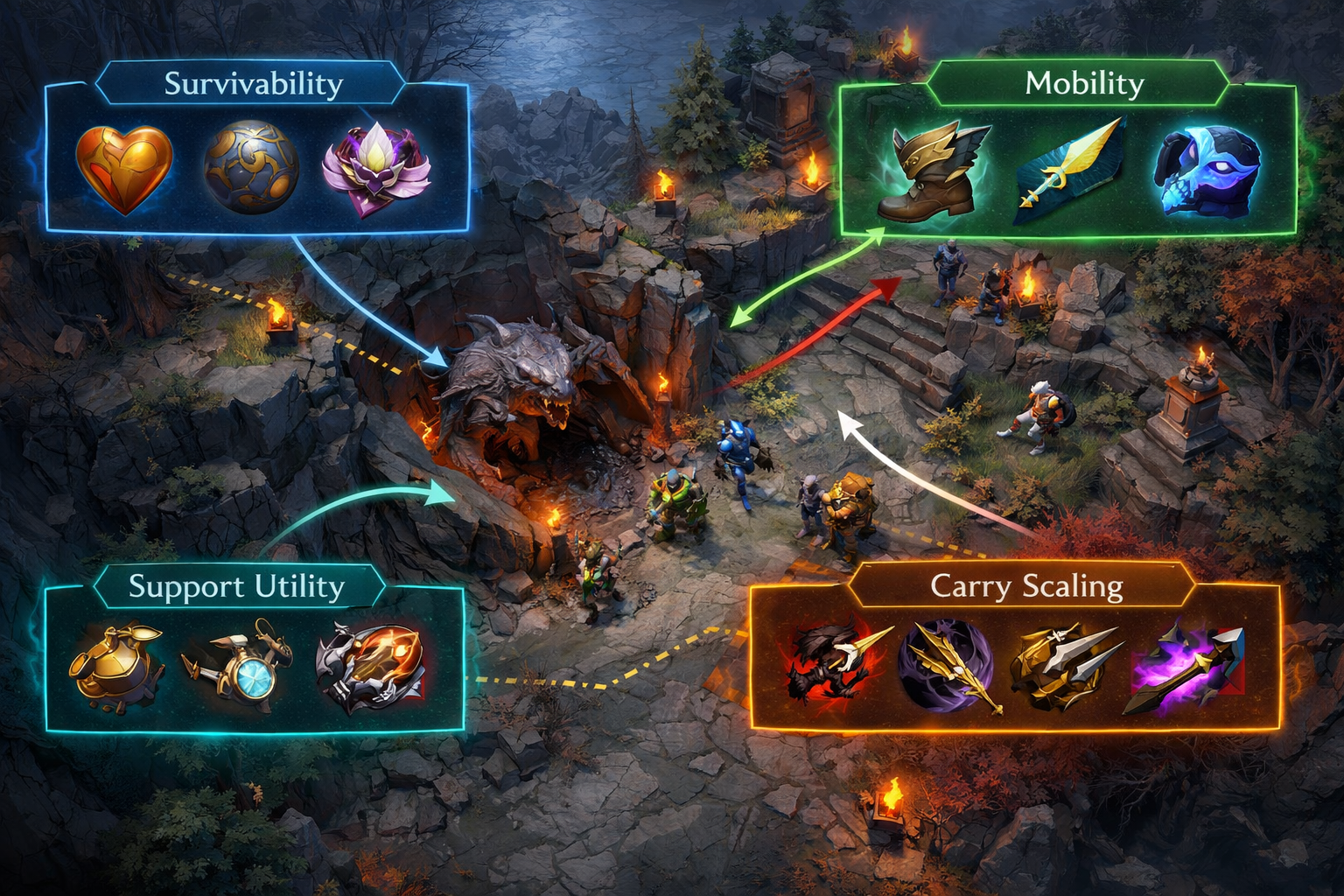
Tier 2 is where neutral items stop being “nice to have” and start affecting the shape of fights in a serious way. Around this window, lineups begin grouping more often, outer towers matter heavily, supports need better casting conditions, and cores start hitting their first meaningful bought-item breakpoints. This is why Tier 2 is often the first neutral window that genuinely swings momentum.
At this stage, ask a sharper question: which hero becomes playable on the map because of a neutral upgrade? A support who lacked cast range, mana sustain, or survivability may suddenly become able to defend waves or stand behind a core in a smoke. A tempo core may suddenly gain enough utility or safety to force towers. A farming carry may gain enough efficiency to hit the next store-bought timing sooner. The value is not abstract. It changes what actions your team can take.
Tier 2 usually amplifies one of three game plans. First, grouping and taking map control. Second, defending and extending a farm-heavy lineup until bigger items arrive. Third, skirmishing around pickoffs and vision. If your lineup is stronger in early-midgame fights, Tier 2 should often be distributed with immediate engagement in mind. If your lineup is weaker and wants to stall, Tier 2 should make the map safer and the wave-clear more reliable. If the game is scattered and both teams are trading pickoffs, prioritize survivability, cast reliability, and mobility over greed.
This is also the tier where supports often get massive value from correct choices. In many pubs, supports remain on whatever neutral item they first equipped because cores instinctively claim the new options. That is often backward. A carry who is still hard-farming may benefit a little from a new neutral. A support who is currently responsible for warding, saving, smoking, or cutting waves may benefit a lot. The more active the role, the more urgent correct neutral allocation becomes.
Think about Tier 2 in relation to tower fights. Can the neutral item help a hero start the fight at the right range? Can it help survive the counter-initiation? Can it let a support remain close enough to cast one save or one extra disable? Can it help your core stay on the tower longer before backing? If yes, the item is probably better than a stat line alone suggests.
Tier 2 is also where your team should start talking more intentionally. Not long speeches. Just useful information. “This one is better for our save support.” “Give that to the hero showing side lane.” “Take this until your next item, then swap.” Fast coordination around Tier 2 wins many public games because most teams do not do it.
Tier 3 Priorities: Map Control and Fight Conversion
Tier 3 is often the bridge between midgame structure and late-game identity. By the time this tier opens, the map is usually more fragmented. Side lanes are more dangerous, Roshan becomes increasingly important, buybacks matter more, and one lost fight can suddenly expose base structures. Because of that, Tier 3 is less about small comfort and more about serious fight conversion.
This is where you should think in terms of role definition. Who is actually starting fights? Who is soaking the first wave of spells? Who must stay alive to save the core? Who needs to threaten backline access? Who is responsible for showing in the dangerous lane? Your neutral distribution should answer those questions directly.
Tier 3 tends to favor one of four outcomes: better front-lining, cleaner initiation, improved anti-burst survivability, or stronger pressure on the edges of the map. Front-liners want durability, status resistance, armor, health, or utility that buys time. Initiators want reliability: movement, cast range, angle creation, or follow-through. Backline heroes want to survive jump attempts while maintaining spell output. Split-map heroes want safe lane access, mobility, or farming continuity that does not force a full retreat after every wave.
This is also the tier where neutral items begin interacting more directly with objective planning. Suppose your team wants Roshan. The right neutral items may matter more than one extra wave of farm because they determine whether you can hold the perimeter, survive the contest, or disengage and re-enter. Suppose your team wants to defend outer towers and delay. The right neutral items can turn a weak defense into a successful stall if they let supports cast safely and let cores trim waves without dying. Suppose your team wants to hunt. The right neutral choices can raise your catch percentage dramatically.
For carries, Tier 3 is often about choosing between acceleration and combat relevance. In lower-skill games, players stay greedy too long. If the map is collapsing, the “best farming item” may no longer be best. The correct question is whether the item helps you reach the next two fights in a stronger state, not whether it increases theoretical GPM over ten minutes. When the game becomes compressed, immediacy matters more.
For supports, Tier 3 can be game-saving. A support that can finally survive the first blink, maintain mana through a full fight, or position one step farther away often becomes the hidden MVP of the mid-late game. Many teams lose here because all attention stays on carry scaling while the actual teamfight hinge was support functionality.
Tier 4 Priorities: Siege, Survivability and Roshan Pressure
Tier 4 is where neutral item logic becomes brutally practical. The game is now old enough that many heroes have core inventories mostly online. Buybacks, lane states, Roshan control, and high-ground attempts define the match. A neutral item at this stage is not just a bonus. It is part of your total fight build.
The easiest way to think about Tier 4 is this: which heroes need the biggest reliability boost under maximum pressure? During sieges and high-ground defenses, heroes die faster, spacing becomes tighter, and mistakes are punished harder. Any neutral item that improves reliability gains value. That can mean raw survivability, better positioning, stronger save potential, stronger initiation certainty, or improved ability to stand and hit during a contested objective.
When your team is ahead, Tier 4 should often help you close the game safely. That means valuing items that protect your first hitter, improve the support layer behind that hero, or allow your initiator to threaten without instantly dying. Siege is not only about damage. It is about giving your team the ability to absorb the first response and continue. If a neutral item lets your front-liner stand one extra second on a ramp or lets your backline keep vision and cast discipline, it is doing closing work.
When your team is behind, Tier 4 should usually be viewed through defense and comeback geometry. Can the item help you clear waves more safely? Can it let a support survive the first dive? Can it give your core enough durability to punish overextension? Can it increase your team’s chance of resetting after the enemy commits BKBs and ults? Defensive Tier 4 decisions are often smarter than greedy damage picks.
Roshan is a special case. Neutral items around Tier 4 often affect who can tank the pit, who controls entry routes, who can disengage after contest, and who can re-enter for cleanup. If your team is setting up Roshan, think beyond the pit itself. Who holds the river? Who cuts the nearby wave? Who survives the first smoke clash outside? The best neutral distribution may go to heroes controlling those interactions, not simply the hero dealing the most Roshan damage.
This is also the stage where inventory discipline matters. Do not keep a familiar but outdated neutral item just because it “feels fine.” Compare the actual impact on the likely next fight. Many players throw away Tier 4 value by defaulting to comfort. Comfort does not win 40-minute games. Correct function does.
Tier 5 Priorities: Endgame Identity
Tier 5 is not just “more stats.” It often transforms what a hero can be in a fight. In ultra-late Dota, teams already have multiple major items, buyback becomes central, and fight structure gets weird. Front-liners may need to survive absurd damage. Supports may need impossible positioning. Carries may need one more layer of reach, control, or survivability to finish a target through layered saves.
This is why Tier 5 should be handled like role redefinition. Ask what each hero must do now, not what that hero was doing 20 minutes earlier. The farming carry may now need durability more than acceleration. The utility core may now need angle creation more than generic stats. The support may now need pure survival because one extra spell decides the fight. Endgame neutral items often convert a hero from “good enough” into “must answer.”
At this point, the map is usually secondary to fight execution, but not irrelevant. Lane pressure still matters because buyback plus lane state wins games. So the right Tier 5 item is often the one that lets your team threaten buildings after winning a fight or defend instantly after buying back. Even in minute-60+ scenarios, movement and wave access can be more valuable than theoretical maximum DPS.
Another crucial idea: do not overvalue pure greed on Tier 5 if your team lacks a stable fight shape. In many late games, one team has better damage but worse execution. The weaker-executing team can still win if its neutral distribution improves initiation layering, defensive resets, and support survival. If your lineup cannot get spells off cleanly, more damage is not always the answer.
Tier 5 also magnifies adaptation. If the enemy has overwhelming jump, prioritize staying alive to respond. If the enemy kites endlessly, prioritize access and control. If the enemy relies on one core with buyback, prioritize the item setup that lets you either kill that hero twice or ignore them long enough to destroy structures. Endgame neutral choices are not about “best item overall.” They are about “best item for this exact endgame puzzle.”
Role-Based Priority: Who Should Get Value First
Neutral item priority is one of the biggest sources of hidden inefficiency in public matches. Many players default to net worth: highest farm gets best item. That logic is too shallow. Net worth matters, but role function matters more.
Position 1 carry: carries often deserve priority when the neutral item directly accelerates their next critical store-bought timing or makes them meaningfully stronger in the next forced fight. But if the carry is still avoiding fights and the team is under pressure now, not every new neutral item belongs to them first.
Position 2 mid: mids frequently convert neutral items extremely well because they bridge farming and fighting. They often move first, pressure waves, contest runes, defend towers, and connect skirmishes. If a neutral item helps a mid do all of that better, the real value can exceed what the same item would do on a greedier hero.
Position 3 offlane: offlaners are often the best users of timing-based neutral upgrades because they stand in dangerous areas, start engagements, pressure towers, and absorb enemy attention. If a neutral item improves their ability to enter, survive, or force reactions, it may be the most impactful allocation on the team.
Position 4 and 5 supports: supports should never be an afterthought. A neutral item that enables one more save, one safer deward, one extra disable, or one cleaner wave defense often changes the fight more than a small damage increase on a core. In coordinated teams, support neutral allocation is often much sharper than in pubs for exactly this reason.
A better rule than “highest farm gets first choice” is this: the hero who can convert the item into the next important action should get priority. Sometimes that is the carry. Sometimes it is the support protecting the carry. Sometimes it is the offlaner creating the whole fight.
How to Farm Madstone Without Griefing Your Game
Knowing the timings is not enough if your pathing around them is bad. The biggest trap is over-forcing jungle access and losing lanes, towers, or hero positioning just to chase the next neutral craft. Madstone matters, but map shape matters more.
The ideal approach is to farm Madstone through efficient map movement, not isolated obsession. Before a tier opens, identify which side of the map is already safe or can become safe with one wave shove. Then route the hero most likely to convert the upcoming tier through that space. Supports should help by stacking when possible, securing vision, and trimming waves so cores are not choosing between lane equilibrium and camp access.
Do not force all five heroes into neutral camps because a new tier is close. That often loses more than it gains. Your team still needs lanes pushed, vision maintained, and dangerous areas respected. The right balance is usually this: one or two heroes actively farm toward the cap, one support enables safety, and the rest maintain the map. If the enemy contests, you either fight from prepared positions or concede a few camps while protecting the more important objective.
Also remember that not every hero should be the one farming toward the next neutral. Some heroes should create access instead. A support cutting a wave or planting vision may be more valuable than that same support hitting medium camp creeps. An offlaner occupying the dangerous lane may be what allows the carry to claim safe camps. Madstone collection is a team process, but not every player contributes to it the same way.
Good teams also think in advance about who will likely craft first. If your lineup’s next move depends on a specific support upgrade or offlaner utility spike, set that hero up to receive resources safely. Neutral item timing becomes much cleaner when the team already knows the likely recipient before the cap arrives.
How to Distribute Neutral Items Across a Team
Distribution is where theoretical knowledge becomes visible discipline. The worst teams treat neutral items like personal property. The best teams treat them like team resources assigned to roles.
A simple framework helps. First, identify the upcoming decision: farm, fight, defend, siege, Roshan, split map, or recover. Second, ask which heroes are central to that decision. Third, assign neutral items according to those responsibilities. That approach prevents autopilot.
If you are about to fight, prioritize survivability, casting reliability, initiation support, and mobility. If you are about to split the map, prioritize lane access, escape tools, wave pressure, and sustainable resource use. If you are about to siege, prioritize front-line stability and support positioning. If you are defending, prioritize anti-burst, wave clear safety, and reset tools.
It is also smart to think in pairs. Which neutral item on your front-liner works best when combined with which neutral item on your save support? Which item on your split-pushing core works best when your other core can threaten the opposite side? Distribution is not only individual. Synergy matters.
Temporary swaps are underused as well. A neutral item does not have to stay on one hero forever. If your carry needs it to finish one farming sequence and your next move is then a five-man smoke where the support would gain more, swap it. Treat neutral items as flexible loadouts, not permanent identity markers.
The more fluid your team is with distribution, the more overall value you get from the system.
When to Recraft and When to Keep What You Have
Recrafting decisions are often where players either gain hidden edge or burn resources for little reason. The correct question is not “Can I get something better?” It is “Is the expected value of a new choice higher than the certainty of the item already helping me right now?”
Keep your current neutral item when it clearly supports your hero’s live job. If you are the offlaner front-lining, a proven survivability or control-enhancing setup is often more valuable than gambling for a theoretically stronger but less relevant outcome. If you are a support whose current setup lets you cast from safe range and survive jump attempts, stability may be best.
Recraft when your role has changed, the game state has shifted sharply, or your current item is now clearly underperforming. For example, maybe you spent the last ten minutes split-pushing and farming, but now the game is all about Roshan fights. Or maybe you were defending high ground, but now your team has buyback and wants to force. Or maybe your carry finally has enough damage and now needs durability or reach. Those are good recraft moments.
Another good recraft moment is when one hero no longer needs the old neutral item as much as another hero would. If a core completed the store-bought item that covers the same weakness, the neutral slot can often be repurposed toward a new problem. This is especially common when a hero buys more mobility, mana, or survivability and can hand team-oriented value back into the shared pool.
The biggest recraft mistake is chasing novelty. New does not automatically mean better. Recraft with a purpose, preferably tied to the next major interaction on the map.
Common Neutral Item Mistakes That Lose Games
1. Treating tier unlocks as passive events. If you only notice a new tier after a fight already started, you are late. Anticipate the window.
2. Leaving supports on outdated items for too long. This is one of the most common pub errors. Support functionality is often the hidden hinge of midgame and late-game fights.
3. Giving every best-looking item to the carry. Carries matter, but fights are won by lineups, not by one inventory alone.
4. Farming camps blindly for Madstone while losing lanes. The next tier is not worth sacrificing map structure or handing over tower pressure for free.
5. Over-greeding after a new tier opens. If the next item timing gives you a fight advantage now, use it now. Do not spend two extra minutes farming for a prettier graph while the enemy regains map control.
6. Refusing to swap neutral items between heroes. Temporary assignment is powerful. Many teams never use it.
7. Keeping an old neutral item out of habit. Reevaluate based on the next likely fight, not on comfort.
8. Ignoring the interaction between neutral items and buyback fights. In late games, survival, movement, and re-entry value can outweigh greedier offensive choices.
9. Not aligning neutral distribution with win condition. If your lineup wins through pickoffs, do not distribute as if you are a deathball lineup. If your lineup wins through one scaling core, protect that path while still enabling the support structure around it.
10. Thinking item names matter more than item functions. The function is what stays relevant across patches.
Advanced Timing Framework for Real Matches
To get the most from neutral items, it helps to think in phases rather than isolated moments.
Phase 1: 30 to 60 seconds before a tier unlock. Push the nearest lane you can safely show. Establish where your next camps will be taken. Place or refresh the most relevant vision. Identify which hero should likely receive the next useful upgrade first.
Phase 2: first minute after the tier unlock. Craft quickly, equip intelligently, and decide whether the upgrade changes your next move. If yes, do not hesitate. Smoke, invade, defend, or pressure immediately while the enemy is still inefficiently sorting their own items.
Phase 3: adaptation after the first reveal. Once both teams have their new tier active, re-evaluate whether your lineup is stronger, equal, or weaker in direct conflict. If stronger, compress the map. If equal, leverage vision and lane pressure. If weaker, use the new items to delay, split, or protect the next core purchase.
Phase 4: the next objective cycle. Neutral items should feed directly into the next Roshan, tower, smoke, or lane shove cycle. When players say “we got better items but nothing changed,” this is the part they missed. Something should change.
A few match examples make this clearer.
Example one: you are ahead around Tier 2. Your mid and offlane are active, your carry is decent but not fully online, and the enemy wants to delay. In this scenario, the best neutral allocation is often the setup that lets your active heroes force outer towers and supports hold their spell range. Giving everything to the carry may actually slow your lead.
Example two: you are behind around Tier 3. Your carry needs time, your supports are poor, and the enemy is closing the map. Here, safe wave clear and support survivability may be more important than carry greed. If your supports die instantly, your carry never gets the time anyway.
Example three: the game is even at Tier 4 with Roshan looming. Think about perimeter control. Who needs to stand on the river edge? Who needs to protect the backline? Who is likely to be jumped? Neutral items should solve those specific jobs first.
Example four: ultra-late game at Tier 5. Buybacks are available, lanes are pushed unevenly, and one fight decides the game. This is not the time for autopilot. Rebuild each hero’s neutral logic around survival, access, buyback re-entry, and objective finish potential.
The strongest players are not just better at picking strong neutral items. They are better at matching neutral timing to the next problem the game is about to ask.
Simple Neutral Item Checklist
- Know the next tier timing before it arrives.
- Push lanes and secure a safe camp area shortly before unlock.
- Decide which hero can convert the next upgrade fastest.
- Prioritize role function over ego and raw net worth.
- Upgrade supports aggressively when their functionality is the real fight hinge.
- Do not grief lanes or objectives just to farm Madstone.
- Use new tiers to trigger action, not just to decorate inventories.
- Swap neutral items when the next game state demands it.
- Recraft only with a clear purpose.
- Judge every neutral item by what it changes in the next two minutes.
Final Thoughts
The easiest way to improve your neutral item play in Dota 2 is to stop thinking about them as random extras and start thinking about them as scheduled macro tools. Each tier is a timing window. Each timing window creates a question. Your team wins more when you answer that question faster and more accurately than the enemy.
Tier 1 is about stabilization and small tempo. Tier 2 is about activation. Tier 3 is about map control and fight conversion. Tier 4 is about reliability in the game’s most stressful objectives. Tier 5 is about redefining roles for the endgame. If you internalize those ideas, you will make better decisions even when item pools shift.
And if you want to turn that macro understanding into faster rank progress, you can also check Boosteria’s Dota 2 boosting prices for additional options around climbing and improvement support.
The big lesson is simple: neutral items are not won by luck. They are won by timing, distribution, and conversion. Learn those three, and your Dota 2 games will feel much more controllable.