



Dota 2 Replay Review Every 5 Minutes | Simple Checklist
Dota 2 Replay Review Every 5 Minutes: A Simple Checklist That Works
Dota 2 improvement often feels harder than it should. Many players grind match after match, switch heroes, copy builds, and watch highlights, yet their real in-game problems remain the same. They miss waves, rotate without purpose, force bad fights, arrive late to objectives, and forget why a winning position slowly turned into a loss. The issue is usually not effort. The issue is feedback.
That is why a structured Dota 2 replay review matters so much. A replay lets you slow the game down and see what ranked pressure hides from you in real time. But many players still waste reviews because they either watch the whole replay passively or focus on random mistakes without a system. The fix is simple: review your game in 5-minute blocks and use the same checklist every time.
This guide gives you a timeless method for Dota 2 replay analysis that works across patches, hero pools, and skill brackets. You do not need advanced stats, pro-level mechanics, or a coach beside you. You need a repeatable structure that helps you answer the same important questions in the early game, mid game, and late game. The goal is not to memorize every second. The goal is to identify the few decisions that actually changed your game.
Used correctly, this method helps you improve lane discipline, farm patterns, map movement, objective timing, teamfight selection, item decisions, vision habits, and overall consistency. It also helps you stop blaming random variables and start seeing the patterns that follow you from match to match. You may lose because of teammates sometimes, but your replay will still show where your own impact could have been cleaner, earlier, and more reliable.
If you also use trusted tools like the official Dota 2 site, Dotabuff, and OpenDota, you can pair visual replay review with match data, item timing comparisons, and broader performance trends. And if you want additional structured help alongside your self-review process, you can check Boosteria’s Dota 2 boosting prices page for services built around faster progression goals.
Table of Contents
- Why the 5-Minute Replay Review Method Works
- Before You Review a Dota 2 Replay
- The Master Replay Review Checklist
- 0:00 to 5:00 — Lane Setup, First Waves, Resource Control
- 5:00 to 10:00 — First Rotations, Catapult Pressure, Early Objectives
- 10:00 to 15:00 — Farm Routes, Map Shape, and Midgame Direction
- 15:00 to 20:00 — Objective Discipline, Vision, and Fight Selection
- 20:00+ — Closing the Game, Comeback Prevention, and Late-Game Decisions
- Role-Specific Replay Review Focus
- How to Take Notes Without Overcomplicating It
- Common Dota 2 Replay Review Mistakes
- A Sample 15-Minute Review Session
- Final Thoughts
- SEO Title, Meta Description, Schema, Image Prompts, and Tags
Why the 5-Minute Replay Review Method Works
The best replay review systems reduce chaos. Dota 2 is a huge game with multiple lanes, different power spikes, item timings, ward battles, smoke windows, Roshan pressure, split push threats, and hero-specific interactions happening at the same time. If you open a replay with no plan, your brain naturally jumps toward dramatic moments: a throw near high ground, a failed Black King Bar usage, a missed spell, or a frustrating teammate move. Those moments matter, but they are often only the final symptom of mistakes made several minutes earlier.
The 5-minute system solves this by breaking the replay into manageable decision windows. Every 5 minutes, the map asks a slightly different question. In the lane phase, the question is usually about wave control, trades, pulls, resource efficiency, creep equilibrium, and last hits. A few minutes later, the question becomes tempo: who can rotate, who should farm, who can pressure a tower, and who is late to the first important move. Later still, the questions shift toward map occupation, teamfight setup, objective conversion, buyback discipline, and risk management.
When you review the game in these windows, you stop asking vague questions like “Why did we lose?” and start asking specific ones like “Did I protect my lane resources?” “Did I rotate on a real timing or out of emotion?” “Did I farm the safe side of the map efficiently?” “Did I show on a wave before an objective spawn?” That is where improvement starts.
This method also works because it is repeatable. You can use the same framework whether you are a support player learning lane control, a mid player learning rune and power-spike discipline, or a carry player refining farm patterns. Even when patches change hero strength, item balance, or map details, the core review questions remain useful: Was the wave in a good place? Did I spend my time well? Did I play around vision? Did I respect enemy threats? Did I convert advantage into objective progress?
Another strength of this method is emotional distance. Many players watch a replay only to confirm that somebody else ruined the game. That mindset blocks learning. A structured checklist brings you back to the only part of the match that truly helps you improve: your decisions. You are not reviewing a replay to prove innocence. You are reviewing it to build a better default pattern for your next hundred games.
Finally, the 5-minute checklist saves time. You do not need to watch the full replay at normal speed every time. You can skip dead areas, pause at key choices, and make short notes. Over time, you will recognize recurring mistakes quickly. That means your review becomes shorter while your learning becomes stronger.
Before You Review a Dota 2 Replay
A replay review is only useful if you know what you are looking for. Before pressing play, take one minute and write down four basics:
- Your role and hero
- Your intended game plan
- The enemy heroes you needed to respect most
- The exact moment the game felt like it slipped away
This short setup matters because it gives your review context. A position five Crystal Maiden and a mid Storm Spirit should not evaluate the same replay the same way. Their responsibilities, timings, and map priorities are different. You want to judge your decisions against your job in the game, not against a generic standard.
It also helps to choose one main theme for the review. Examples include:
- Laning discipline
- Farm efficiency
- Map awareness
- Objective conversion
- Deaths and positioning
- Missed power spikes
- Support movement and ward timing
You can still note other mistakes, but one theme keeps the review focused. If you try to fix everything at once, you usually fix nothing.
Use a notebook, a text file, or a simple spreadsheet. Your note format can be basic:
- Time: 7:20
- Mistake: Left lane for a low-value rune fight while wave was pushing into tower
- Why it mattered: Lost two waves and delayed level six
- Fix: Only rotate when lane is secured or the move creates a clear objective
If you have access to match tracking tools, they can support your review. Dotabuff is useful for broad match history and hero trends, while OpenDota can help you inspect timings and performance details across multiple matches. These tools should support your replay, not replace it. Data tells you what happened. The replay shows you why.
One more important rule: do not only review losses. Some of your most useful lessons come from wins, especially sloppy wins. If you only study defeats, you risk learning a false idea that your mistakes only exist when the result is negative. In reality, many bad habits survive because the match result hides them.
The Master Replay Review Checklist
Use this core checklist every time you review a Dota 2 replay. It is simple on purpose.
- What was my job in this phase of the game?
- Was I in the correct area of the map for that job?
- Did I spend my time efficiently, or was I drifting between low-value actions?
- Did I play around my hero’s timing, or did I act randomly?
- Did I respect the enemy heroes that could punish me?
- Did I manage waves, camps, resources, and cooldowns with purpose?
- Did my movement create pressure, safety, or information?
- Did I join the right fights and ignore the wrong ones?
- After a win or loss in a fight, did I convert the outcome into something useful?
- What is the one repeated habit from this replay I should fix next?
If you answer these honestly every 5 minutes, your review becomes practical instead of theoretical. You stop collecting random thoughts and start building specific habits.
0:00 to 5:00 — Lane Setup, First Waves, Resource Control
The first five minutes create the foundation for everything that follows. Many games feel “unlucky” later because the first two waves were handled badly. Your replay review here should focus on lane setup, first contact, resources, and discipline.
Questions to Ask in the First 5 Minutes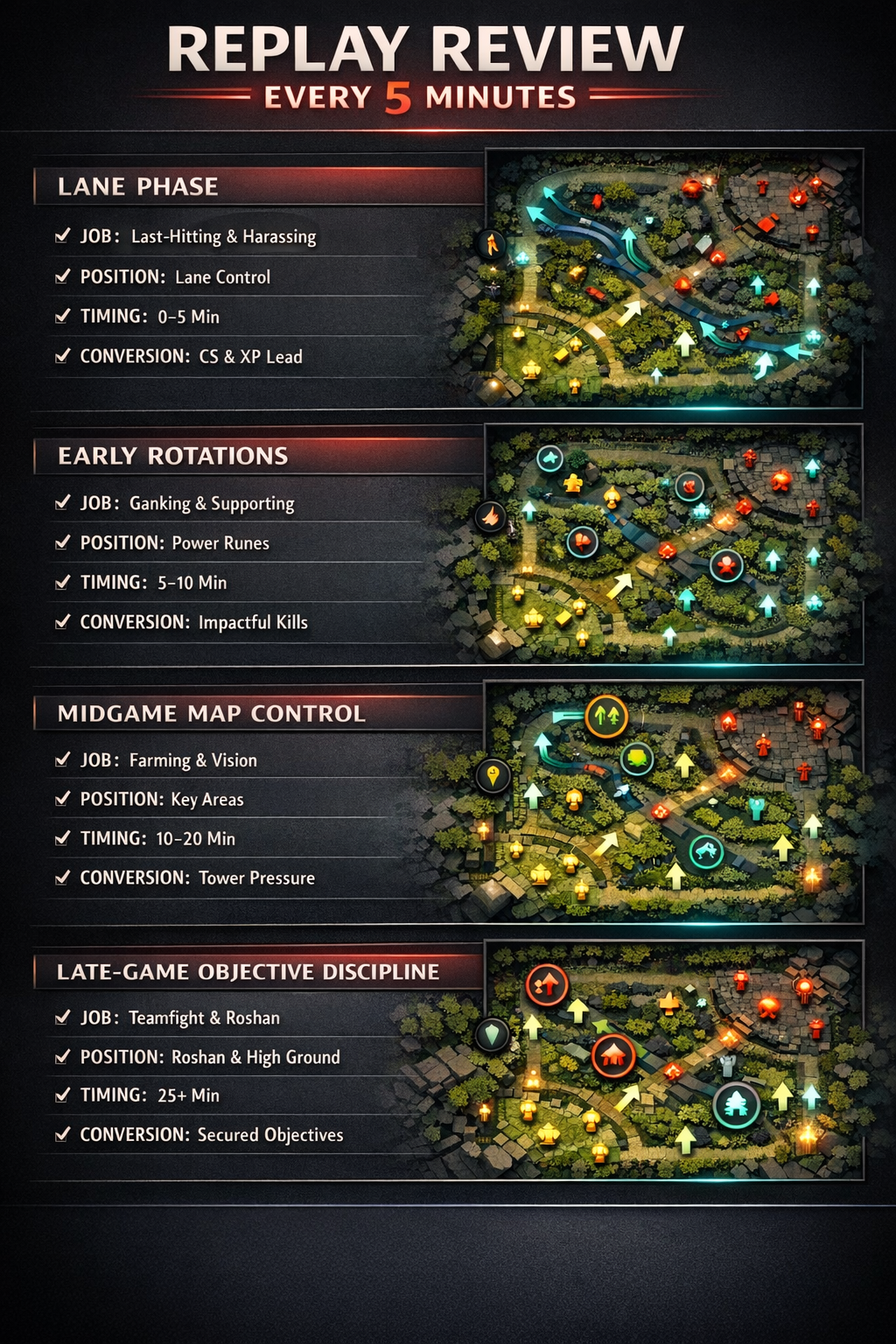
- Did I arrive to lane with a real plan or on autopilot?
- Was my starting item choice logical for the lane matchup?
- Did I contest bounty runes or vision areas intelligently?
- Was the first wave in a good position for my role?
- Did I secure ranged creeps or deny enemy ranged creeps when possible?
- Did I trade health and mana efficiently?
- Did I use regen early enough instead of greedily holding it?
- Did I understand whether my lane should shove, hold, or reset?
- Did I pull or block at the right times?
- Did I die or get forced out for a preventable reason?
For core players, this phase is often about last hits, denies, lane equilibrium, and avoiding unnecessary damage. Watch the first three waves closely. Were you hitting creeps too early and pushing the lane without purpose? Were you missing denies because your camera or attention was elsewhere? Did you trade with the enemy when your own creep wave was smaller? Were you stepping forward for one creep and losing half your health?
For support players, review your lane impact honestly. Did you pressure the enemy or just stand nearby? Did you pull the lane at the right moment, or did you pull automatically while your core was under pressure? Did you protect the small camp, block the enemy pull, secure lotus or rune control, and trade with purpose? Good support movement in the first five minutes is rarely flashy. It is clean, efficient, and timed around the lane’s actual needs.
A major replay habit here is to pause every time the wave becomes bad. Ask: Who caused this wave position, and why? If the lane is under the enemy tower, was that good because you wanted a reset, or bad because you handed the enemy safe farm? If the lane is frozen near the enemy side, did you fail to pull, overtrade, or hit creeps carelessly?
Another useful angle is resource discipline. Many players remember deaths but forget the small inefficiencies that caused them. Did you burn too much mana on low-value harassment? Did you sit at low health for 40 seconds instead of using regen? Did you walk back to lane without planning your courier usage? These things do not look dramatic, but they shape who controls the lane.
Also review your camera attention. Were you actually watching the lane state, or were you distracted by other parts of the map? In low and mid brackets, many players lose early lane value simply because they are reacting to pings or staring at side fights while missing creeps. Replay review makes this obvious.
If you are a mid player, add rune and bottle discipline to this phase. Did you secure the wave before moving? Did you chase a rune while giving up two ranged creeps? Did you pressure with your advantage or just reset back to neutral? Your replay should show whether your movement had a reason.
If you are an offlaner, pay special attention to the point where aggression becomes greed. Did you step too far for harassment and lose the lane’s structure? Did you cut behind the wave without vision or support? If the lane became unstable, did you adapt by dragging, pulling, or changing where you stood, or did you keep repeating the same losing pattern?
The biggest lesson from the first five minutes is simple: your early game is not only about kills. It is about whether you built a stable base for the next ten minutes. If the replay shows poor wave management, bad regen timing, and loose positioning, fix that first. You do not need a complicated conclusion.
5:00 to 10:00 — First Rotations, Catapult Pressure, Early Objectives
The second 5-minute block is where many players destroy their own game by moving emotionally instead of logically. The lane phase is still active, but the map begins to open. Towers become more vulnerable, supports rotate, mids look for angles, and carries decide whether to stay, jungle, or pressure. Your replay review now should focus on tempo.
Questions to Ask Between 5 and 10 Minutes
- Did I know whether my hero wanted to stay in lane, rotate, or farm nearby camps?
- Did I leave lane too early?
- Did I stay in lane too long after it became dangerous or low-value?
- Did my movement connect to a catapult wave, rune timing, or item spike?
- When I rotated, did the move create pressure or only waste time?
- Did I respond correctly when enemies left my lane?
- Did I pressure the right tower or wrong side of the map?
- Was I farming the nearest efficient resource, or wandering?
- Did I TP reactively without checking whether the fight was playable?
- Did I notice who on either team was strongest in this window?
This is the stage where the average player starts making “activity mistakes.” Activity mistakes are not always obvious throws. They are moments where you are busy but not productive. You rotate to a fight that ends before you arrive. You defend a dead tower with no resources. You smoke without lane setup. You chase a support while three waves die. You run to a fight because allies pinged, not because your hero was actually ready.
Replay review should separate urgent-looking plays from good plays. A good play at minute seven is usually connected to one of four things: wave state, hero power spike, number advantage, or objective pressure. If your movement had none of those behind it, it was probably weak.
For carry players, this block is about answering one major question: When did I stop converting the map efficiently? Maybe you should have left the lane one minute earlier and stacked your farm pattern. Maybe you left too early and abandoned free lane creeps. Maybe you teleported to a fight that your team could never win and delayed your first item by two minutes. The replay will show that clearly if you watch your pathing instead of just your deaths.
For mid players, look at your first real move after securing levels and resources. Did your rotation punish an exposed side lane, protect a tower, or force enemy reactions? Or did you drift into fog hoping for something random? Good mid movement is usually clean: push wave, secure resource, move with purpose. Bad mid movement is vague and expensive.
For supports, ask whether your movement served the game’s strongest hero. Strong support rotations are not about being everywhere. They are about being where your presence changes the outcome. Did you refill mid, protect a dive, secure vision for a tower push, or enable your offlaner? Or did you hover between lanes and arrive late to everything?
At this stage, tower pressure matters because it changes the map’s safe areas. In your replay, every early objective should trigger a follow-up question: Did we or I understand what that tower meant? Losing a tower is not only about gold. It changes farming lanes, ward lines, smoke routes, and who feels safe showing on the wave. Review what happened immediately before and after tower damage, not only the tower itself.
This is also the point where many players misuse teleport scrolls. Review every TP. Was it defensive panic, good conversion, or a full waste? A bad teleport is often worse than a missed kill because it leaves you stuck on the wrong side of the map with no way to reset your position. In replay review, mark every TP that produced nothing and ask what the better default action was.
One more important detail: this phase often reveals whether you understand who wants the game to speed up. Some lineups want to fight early, take towers, and shrink the map. Others want to trade space while key heroes hit item timings. If your actions fought against your lineup’s natural rhythm, your replay will show repeated friction. You were present but out of sync.
10:00 to 15:00 — Farm Routes, Map Shape, and Midgame Direction
This is where replay review becomes especially valuable because the game stops being mostly lane-based and starts becoming about map shape. Which side owns more area? Which waves are pushed? Which jungle entrances are dangerous? Which hero can show first? Which objective is next? If your games often feel fine until midgame and then suddenly collapse, this 10-to-15-minute block is probably where the real leak begins.
Questions to Ask Between 10 and 15 Minutes
- Did I farm toward a purpose, or just take random camps?
- Was I showing on dangerous waves without information?
- Did I move with vision support or blind greed?
- Did I force fights before key item timings?
- Did I ignore a strong timing and miss a good fight?
- Were my deaths connected to poor lane pressure or poor map reading?
- Did I mirror the enemy’s strongest heroes correctly?
- Was I on the active side of the map when my team wanted to play?
- Did I convert farm into pressure, or into more passive drifting?
- Which one bad habit appears multiple times in this window?
Many Dota 2 players think they are farming efficiently because they are constantly hitting creeps. Replay review often reveals the opposite. Efficient farm is not just high action. It is safe, layered, and connected to the next move. A good farming route clears lane first when safe, then nearby camps, then exits toward team options. A bad farming route sends you deep into dead zones, double-backs across empty terrain, or leaves lanes pushing into your towers for no reason.
When reviewing this phase, track your hero on the minimap and ignore almost everything else for one minute. That alone can be eye-opening. Did your movement make sense? Were you drifting between camps because you had no plan? Did you keep farming the same shrinking area while the enemy owned vision and tempo? Were you showing on a wave at the exact moment the enemy team disappeared from the map?
This is also where map pressure becomes a major keyword. Pressure is not only a tower hit. Pushed lanes create information. They force enemy reactions. They reveal where heroes are missing from. They make future smoke moves easier. In replay review, pause when your team takes a fight with bad lane setup. Ask whether the fight was bad before it started because no wave was pushed and no information was gained. Often the answer is yes.
Core players should review item timing discipline here. Did you join a fight 500 gold before a major item and lose both the fight and the item timing? Or did you tunnel on farming while your newly completed timing could have taken an objective? Improvement often comes from recognizing these small windows where your hero is strongest and acting there instead of one minute too early or too late.
Support players should focus on vision logic and pairing. Were your wards connected to the side of the map your cores were actually using? Did you place vision before a move, or after somebody died? Did you walk into dark areas alone with no lane pressure? Did you shadow the correct core, or stay attached to the wrong area out of habit?
Another critical replay question is what caused each death? Not the final blow. Not the spell combo. The cause. Was it showing on the wrong wave? Farming without escape tools? Walking through an unwarded choke? Joining a lost fight late? Breaking smoke discipline by showing on lane first? If you write causes instead of events, your notes become more powerful.
Between minutes 10 and 15, teams often make the first big mistake of overchasing. In your replay, study every successful fight and ask what happened after. Did you convert into tower damage, Roshan setup, deep wards, or wave push? Or did you hunt for one more kill, lose formation, and give the map back? Conversion is one of the cleanest improvement areas in Dota 2 because it repeats in every patch.
If you frequently play solo queue, this phase also teaches you when to stop expecting perfect coordination and start making better independent choices. Your teammates may not always move ideally, but your replay can still show whether your own wave pressure, positioning, or patience could have made the fight easier. Strong players improve by finding the choice that remains good even when the team is imperfect.
15:00 to 20:00 — Objective Discipline, Vision, and Fight Selection
By this point, many games are decided less by mechanics and more by discipline. Teams either play around the map’s important areas with structure, or they throw themselves into low-value skirmishes. Your replay review in this block should focus on whether your actions connected to real goals.
Questions to Ask Between 15 and 20 Minutes
- Did we fight for a reason, or because enemies were visible?
- Were lanes in good shape before major movement?
- Did I play near our vision or away from it?
- Did I force high-risk moves without buyback, cooldowns, or numbers?
- Did I understand whether Roshan, tower pressure, or map control was the real objective?
- Did I start fights on the right target?
- Was my positioning shaped by enemy initiation threats?
- Did I waste time after a won fight?
- Did I overstay after taking an objective?
- What one decision in this block changed the game most?
This is where many players confuse available fights with good fights. Just because the enemy shows on a lane does not mean you should commit. Replay review helps you see whether the map underneath the fight was actually favorable. Were lanes pushing in? Was your team spread? Did your carry just reveal bottom while you smoked top? Did you try to force around an area where the enemy had first access?
Vision should be reviewed with purpose. A ward is not automatically good because it sees a cliff or entrance. It is good if it supports the next 60 to 120 seconds of your team’s play. In your replay, every time a fight breaks out, ask: What information did we have before choosing this fight? If the answer is “almost none,” then the problem may have started with vision, lane pressure, or patience.
Positioning is another huge review point in this window. Supports often die first because they entered the map too early. Cores often die because they stood on the wrong line relative to enemy jump range. A replay can show this clearly. Pause two seconds before a death. Were you too far forward compared to your team? Did you reveal first when your hero should hit second? Did you stand near an obvious initiation path?
Teamfight review should stay practical. Do not overfocus on spell perfection unless you are already sure the fight was good. First ask whether the fight should have been taken. Then ask whether your hero’s target priority and positioning matched the plan. Many players review the last moment of a fight while ignoring that the fight began from a losing shape.
If Roshan becomes relevant in this stage, your replay should track how your team approached that area. Did you push nearby lanes first? Did you force enemy reactions on the opposite side? Did you enter with vision and cooldown awareness? Or did you walk into the pit zone with no structure? Objective discipline is mostly about preparation, not only execution.
Another repeated issue in this phase is overstaying. A team wins a fight, takes a tower, and then lingers for another wave, another support kill, another spell cycle. The replay often shows that the game turned right there. Improvement means recognizing the point where the play was already successful and leaving before greed opened a comeback window.
This is also a good place to review your communication timing, even if you play solo queue. Did your movement at least signal a clear idea? Did you hit a lane before pinging objective? Did you group near the area you wanted to contest? Replay review is not only about voice comms. It is also about whether your decisions were readable and coherent for allies.
20:00+ — Closing the Game, Comeback Prevention, and Late-Game Decisions
Late-game Dota 2 rewards patience, information, and discipline. Most players know this in theory, but their replay shows repeated emotional choices: farming too far out, forcing high ground without waves, showing on side lanes before major objectives, or burning important resources for low-value picks. When you review 20 minutes and beyond, focus on risk management.
Questions to Ask After 20 Minutes
- Was I respecting death timers, buybacks, and big cooldowns?
- Did I show on the map at bad moments?
- Did I farm unsafe areas while objectives were contested?
- Did we try to high ground with a real advantage or just impatience?
- After winning a fight, did we choose the highest-value conversion?
- After losing a fight, did I make the map easier or harder for the team?
- Did my inventory decisions support survivability, damage, utility, or none of them clearly?
- Did I keep buyback status in mind before committing?
- Were we playing on the correct side of the map around major objectives?
- Which late-game death was actually avoidable three decisions earlier?
Late-game replay review is where many players finally realize that they were not losing teamfights because of mechanics. They were losing because they started from worse information. Someone showed on a side lane too early. A support dewarded without backup. A core farmed one more wave near no vision. A team grouped in an obvious choke. These are not dramatic errors while playing, but they are obvious in replay.
When reviewing late-game farming, always ask what information your hero gave away. A single wave clear can reveal enough for the enemy to smoke, place a deep ward, start Roshan, or set a trap. If your replay shows repeated dangerous reveals, mark them. This is one of the easiest high-level habits to improve.
High ground attempts deserve their own review logic. Do not only ask, “Did we execute badly?” Ask:
- Were side lanes prepared?
- Did we have an item or Aegis timing?
- Did we understand enemy initiation range and buyback threat?
- Did we stop after getting value, or did we force too deep?
If you lost a huge fight while sieging, watch 20 seconds before the first spell. Often the real error is not a missed button. It is formation, impatience, or lack of lane pressure.
Late-game replay study should also include buyback logic. Did you die with no buyback because you bought the wrong component at the wrong time? Did you buy back into a dead fight? Did you save buyback correctly but then position carelessly in the next minute? These patterns matter more than one flashy play.
For supports, ask whether your later-game utility decisions created space for cores to play confidently. Did your warding and positioning give them a safe area to occupy? Did you hold an important save or use it reactively after the target was already dead? Did you stand far enough back against jump heroes? Replay review makes support impact much easier to measure than the scoreboard does.
For cores, late-game improvement usually comes from knowing when not to show, not to chase, and not to commit. A lot of rating is gained simply by cutting a few reckless late-game deaths from your average week.
Role-Specific Replay Review Focus
The same replay checklist works for everyone, but your role changes what matters most.
Carry
- How many lane creeps did I miss for avoidable reasons?
- Did I leave lane at the correct time?
- Did my farming route protect my item timing?
- Did I join fights that actually matched my power spike?
- Did I hit the nearest safe resource first, or waste movement?
- Was I the first hero showing on dangerous waves too often?
Mid
- Did I control wave state before runes and rotations?
- Did my first rotation create real advantage?
- Did I pressure the correct side of the map after winning lane?
- Did I waste tempo after a strong level or item timing?
- Did I overforce fights when I should have farmed one more wave or camp?
Offlane
- Did I understand whether my lane should pressure or stabilize?
- Did I connect my early item timing to tower pressure?
- Did I stand on the correct front line in fights?
- Did I take dangerous farm that my carry could not safely take, or did I steal safe farm unnecessarily?
- Did my movement create space, or did I farm passively with no threat?
Soft Support
- Did my lane actions make life easier for my core?
- Did I rotate with a specific purpose?
- Did I play around the strongest hero on my team?
- Did my wards match our active area?
- Did I die first too often because of greedy positioning?
Hard Support
- Did I secure the first waves correctly?
- Did I use pulls and regen to stabilize lane, not just follow habit?
- Did I defend important areas with vision before fights started?
- Did I save key spells for priority targets?
- Did I move with my team’s timing or lag one step behind?
If you only remember one role-specific principle, let it be this: review yourself based on responsibility, not only on KDA. The scoreboard often lies. The replay usually does not.
How to Take Notes Without Overcomplicating It
Good notes are short, specific, and actionable. Bad notes are emotional or vague. “My team griefed me” is not a learning note. “Pushed one extra wave with no vision after enemy smoke window” is a learning note.
Use a four-line template:
- Time
- Decision
- Why it was weak or strong
- New rule for next games
Here are strong examples:
- 6:40 — TP to lost side lane skirmish. Why weak: arrived late, lost two mid waves, no tower defense possible. New rule: do not TP unless the fight changes with my arrival.
- 12:10 — Farmed triangle while safe lane wave died. Why weak: missed lane gold and gave enemy freedom to move first. New rule: take pushed safe lane first when enemy heroes are visible elsewhere.
- 18:25 — Chased support after winning fight. Why weak: no tower damage, enemy cores respawned. New rule: after won fight, ask objective question immediately.
After each replay, write one weekly focus rule. Keep it simple:
- I will not TP to uncertain fights before minute 10.
- I will push the closest safe wave before moving to jungle camps.
- I will check enemy initiators before showing on side lanes.
- I will ward where my cores actually want to farm.
If you do this for ten matches, you will start seeing your real pattern faster than if you watch ten random educational videos.
Common Dota 2 Replay Review Mistakes
Many players say they review replays, but their process does not actually create improvement. Here are the most common mistakes:
1. Watching passively
If you just sit back and watch the replay like entertainment, you will notice obvious chaos but miss repeatable causes. Pause often. Ask questions. Track your movement.
2. Focusing only on teamfights
Most fights are shaped by earlier wave state, vision, item timing, and map position. Review the setup, not just the explosion.
3. Only studying losses
Bad habits appear in wins too. Sloppy wins are excellent learning material because they expose mistakes without the emotional sting of a loss.
4. Taking too many notes
If your page is full of twenty small comments, you probably will not fix any of them. Find the biggest repeated leak and make one rule from it.
5. Looking for blame instead of patterns
Your team may make mistakes. That is normal. Replay review is still about identifying which better default from you would hold up more often over time.
6. Ignoring quiet mistakes
The most expensive errors are often not flashy. They are bad wave touches, wasted teleports, poor pathing, greedy reveals, and missed objective conversions.
7. Not connecting review to the next queue session
A replay is only valuable if it changes behavior in future games. End every review with one clear improvement rule.
A Sample 15-Minute Review Session
Here is what a practical review session can look like after one ranked game:
- Minute 1: Write your role, hero, intended plan, and the moment the game felt lost.
- Minutes 2–5: Review 0:00 to 5:00. Focus only on wave, regen, trades, lane equilibrium, and early resource discipline.
- Minutes 6–8: Review 5:00 to 10:00. Focus on rotations, TPs, first tower pressure, and whether you stayed or left correctly.
- Minutes 9–11: Review 10:00 to 15:00. Track your hero on the minimap. Look for bad pathing, unsafe waves, and missed farm-to-pressure flow.
- Minutes 12–14: Review the biggest midgame fight or objective sequence. Ask what setup made it good or bad.
- Minute 15: Write one repeated mistake and one rule for your next matches.
This is enough. You do not need a one-hour review after every game. The key is consistency. Five short, focused reviews across the week will usually improve your ranked habits more than one giant review marathon.
If you want extra support, compare your conclusions with external tools. Dotabuff can help you see long-term hero and match trends, while OpenDota can help you inspect certain performance details across games. But always return to the replay itself. The replay shows whether your in-game choices matched the situation in front of you.
Final Thoughts
The best Dota 2 replay review checklist is not the one with the most complexity. It is the one you will actually use after your games. Reviewing every 5 minutes works because it matches how Dota 2 naturally changes over time. The questions of the lane are not the questions of the midgame, and the questions of the midgame are not the questions of late-game objective play.
If you stick to this system, you will start noticing the same small leaks again and again: one extra wave, one bad TP, one greedy reveal, one late movement, one fight without setup. That is good news. Repeated mistakes are fixable mistakes.
Review with honesty, keep your notes short, and take one rule into your next queue session. Over time, that is how replay analysis becomes rating gain instead of just another “productive” habit that changes nothing.