



Rocket League Warm-Up Plan for Better Mechanics Daily
Rocket League Mechanical Warm-Up Plan: Recoveries, First Touch, Car Control
Mechanical consistency is one of the biggest separators in Rocket League. Most players do not lose ranked games because they do not know what they want to do. They lose because their car does not do exactly what their brain asked for at the right speed, on the right line, with the right first touch. One poor landing slows a rotation. One heavy touch throws away possession. One awkward approach ruins a simple clear. Over time, these small errors decide matches.
That is why a proper warm-up matters. A strong Rocket League warm-up is not just about “getting loose” before queueing. It is a repeatable routine that prepares the exact mechanics you use in real games: landing cleanly after challenges, correcting your car quickly after awkward moments, controlling the ball on first contact, and moving with purpose instead of panic. If your routine trains those areas every day, your ranked play becomes sharper without needing endless grinding.
This guide gives you a timeless mechanical warm-up plan built around three pillars: recoveries, first touch, and car control. These skills stay relevant across ranks, metas, and playstyles because they are part of the game’s foundation. Whether you are a newer player trying to feel more stable or an experienced player cleaning up bad habits, this plan is designed to help you enter matches with better rhythm, more confidence, and higher consistency.
The routine below is intentionally evergreen. It does not depend on one patch, one trend, or one flashy mechanic. Instead, it focuses on movement quality, boost efficiency, possession value, and touch intention. Those ideas always matter. You can run this plan in Free Play, adapt it with custom training packs, and scale it up or down depending on available time.
If your goal is steady improvement rather than random ranked sessions, a pre-match structure like this will help. And if you also want a direct path toward faster competitive progress, you can compare your practice routine with more performance-focused options on Boosteria’s Rocket League pricing page.
Table of Contents
- Why a Rocket League Warm-Up Matters
- The Core Principles of an Effective Warm-Up
- The Full Mechanical Warm-Up Plan Overview
- Phase 1: Movement Reset and Baseline Rhythm
- Phase 2: Recoveries That Save Speed and Boost
- Phase 3: First Touch Training for Possession and Pressure
- Phase 4: Car Control for Cleaner Execution
- Phase 5: Match Readiness and Competitive Transfer
- 15, 25, and 40 Minute Versions of the Plan
- How to Adapt the Routine to Your Rank
- Common Warm-Up Mistakes
- How to Review Your Progress
- How to Fit This into a Weekly Improvement Plan
- Frequently Asked Questions
- Final Thoughts
Why a Rocket League Warm-Up Matters
Many players treat warm-up like a superstition. They jump into Free Play for a few minutes, hit the ball hard, maybe go for a few aerials, and then queue because they feel “ready enough.” That is better than nothing, but it often misses the point. A real warm-up should reduce the number of avoidable mistakes in your first few matches. It should make your car feel predictable. It should raise your floor, not just your ceiling.
Think about how ranked games usually begin. Your first challenge may be slightly late. Your first landing may be heavy. Your first two touches may be stronger than you intended. Your camera transitions may feel rushed. Those early errors are rarely because you forgot strategy. They happen because your hands, eyes, and timing are not fully synced yet. A good routine solves that.
Mechanical warm-ups matter in Rocket League for five reasons:
- They improve touch intention. You stop hitting the ball just because you can reach it, and start touching it with a purpose.
- They increase speed without panic. Faster movement becomes smoother, not sloppier.
- They protect boost economy. Better recoveries mean fewer full stops and fewer emergency boosts.
- They stabilize your first ranked games. Instead of spending game one “waking up,” you start closer to your real level.
- They create measurable habits. Repeating the same structure makes improvement easier to track.
Rocket League is a game of chain reactions. One awkward recovery creates a late rotation. A late rotation causes a rushed clear. A rushed clear gives away possession. A lost possession forces another defensive touch under pressure. That is why warm-up work on simple mechanical details pays off more than many players realize. It affects everything that happens after the first touch.
The official support and ecosystem around the game continue to reinforce how central movement, control, and training are to long-term development, whether you use built-in modes or additional learning resources from the broader community at places like Epic Games support or competitive reference hubs such as Liquipedia’s Rocket League section. But no external resource will replace a routine you actually perform consistently.
The Core Principles of an Effective Warm-Up
Before building the plan, it helps to understand what makes a warm-up work. The best routines are not random collections of drills. They follow a few clear principles.
1. Start simple, then add speed
Your mechanics improve fastest when you begin with control and then gradually increase pace. If you start by forcing peak-speed inputs immediately, you rehearse tension and inaccuracy. Smooth first, fast second.
2. Train common situations more than flashy ones
The most useful warm-up drills are the ones that appear constantly in ranked games: landing after contact, turning tightly, collecting small pads, approaching the ball under different bounce patterns, cushioning a first touch, and accelerating back into rotation. Fancy mechanics are optional. Common mechanics are mandatory.
3. Use short focused blocks
Warm-up is preparation, not exhaustion. You want enough reps to sharpen your hands, but not so many that you burn mental energy before queueing. Short blocks of purposeful repetition work better than long, unfocused sessions.
4. Build a bridge to real games
Every drill should answer one question: where does this show up in a match? Recoveries matter after challenges, demos, 50s, wall touches, and awkward saves. First touch matters on every possession. Car control matters on literally every movement. If the transfer is clear, the drill is valuable.
5. Repeat the same structure often enough to compare results
Random training feels productive but makes it harder to notice whether your mechanics are actually improving. A repeatable routine gives you a baseline. You learn which parts feel weak, which parts feel automatic, and which parts break under pressure.
6. Prioritize quality over volume
Ten deliberate recoveries with clean landings are more useful than fifty rushed reps where you never correct your mistakes. Mechanical improvement is not just repetition. It is repetition plus awareness.
The Full Mechanical Warm-Up Plan Overview
Here is the core version of the routine. It takes about 30 minutes and is long enough for real preparation while still being practical before ranked play.
| Phase | Focus | Time | Main Goal |
|---|---|---|---|
| 1 | Movement Reset and Baseline Rhythm | 5 minutes | Wake up steering, boost control, camera comfort, and basic flow |
| 2 | Recoveries | 8 minutes | Land cleanly, keep momentum, and waste less boost after awkward moments |
| 3 | First Touch | 8 minutes | Control the ball instead of giving it away on contact |
| 4 | Car Control | 7 minutes | Improve turning quality, path efficiency, and body orientation |
| 5 | Match Readiness | 2 minutes | Transfer practice pace into ranked rhythm |
You can do almost all of this in Free Play. If you enjoy custom training packs or workshop-style movement maps, they can support the plan, but they are not required. That is important because a timeless routine should remain useful across platforms and setups.
Phase 1: Movement Reset and Baseline Rhythm
The first phase is about syncing your hands with the car again. Do not overcomplicate it. You are not trying to prove anything here. You are trying to remove stiffness, wake up visual tracking, and establish a clean movement baseline.
Drill A: Free Play laps with purposeful pad routes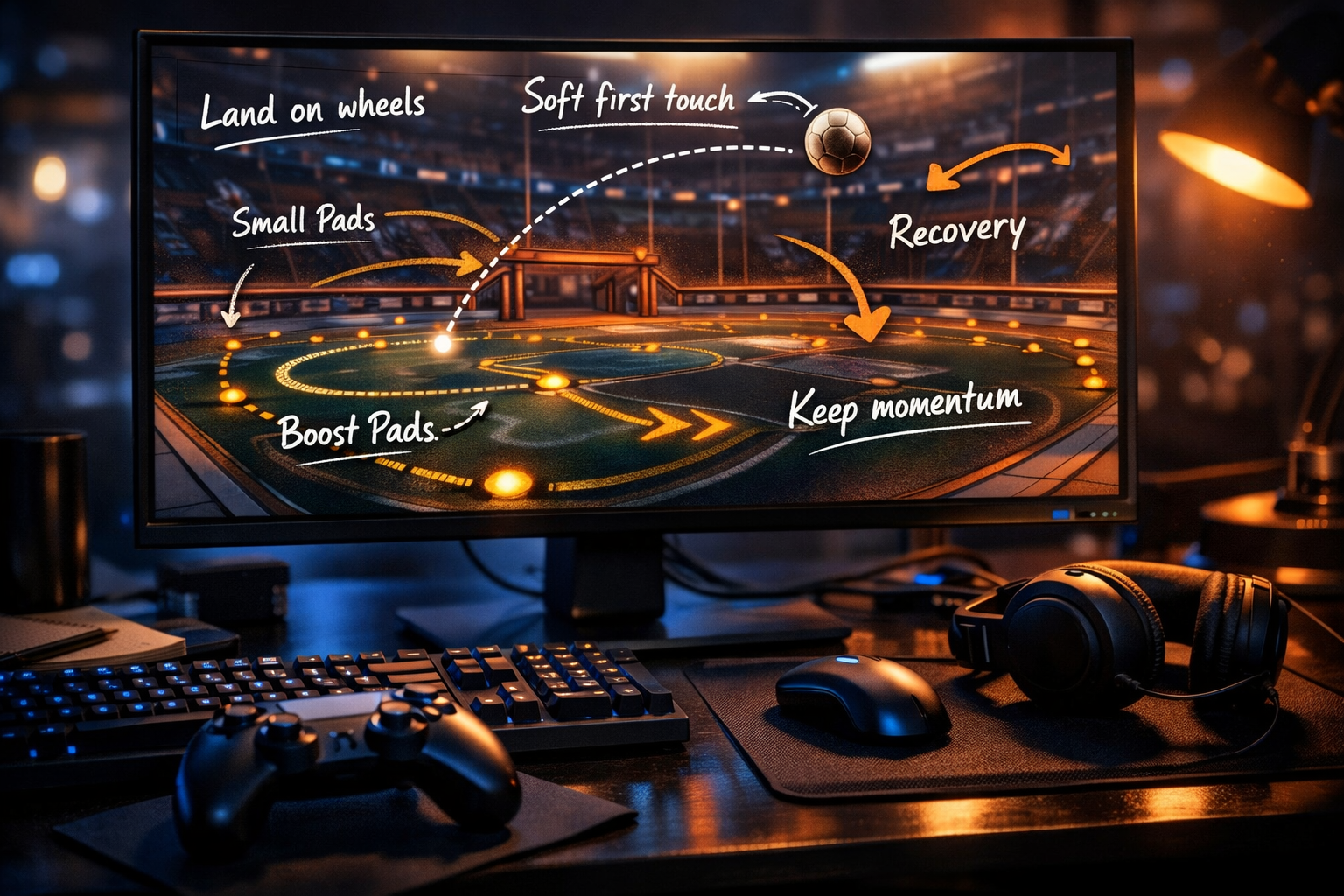
Drive around the field at moderate speed and collect small pads in simple routes. Use wide turns, then tighter turns. Move through corners, across midfield, and back into the opposite half. The goal is not boost count. The goal is efficient pathing. You want to feel how your car carries speed through curves without forcing heavy corrections.
Focus on these details:
- Minimal steering overcorrection
- Controlled use of boost instead of constant holding
- Clean transitions from straight lines into arcs
- Awareness of where the next small pad would be in a real game
Drill B: Powerslide turns
Spend one to two minutes doing deliberate powerslide entries and exits. Approach a turn, feather powerslide, and exit in a straight line. Then repeat on the opposite side. This helps wake up your timing on one of the most useful movement tools in the game.
Many players either never powerslide enough or they hold it too long. The right feeling is a short, intentional adjustment that preserves momentum while changing angle. Good powerslide use makes everything easier later: recoveries, shadow defense, pad routes, and challenge setups.
Drill C: Basic ball path reading
Now add the ball. Tap it lightly, let it bounce, and drive toward it from different angles without trying to score. Read the bounce early, choose an approach line, and make contact only when balanced. This transitions your eyes from raw driving into game-like decision timing.
At the end of Phase 1, you should feel looser, calmer, and more precise. If you still feel tense, stay here another minute before moving on. A rushed warm-up is worse than a shorter one done properly.
Phase 2: Recoveries That Save Speed and Boost
Recoveries are one of the highest-value mechanics in Rocket League because they quietly improve everything. Better recoveries mean you get back into the play faster, defend sooner, challenge earlier, and spend less boost fixing bad landings. They are not flashy, but they win games constantly.
In practice, “recovery” means any action that helps your car return to a useful state after contact, a jump, a challenge, a landing, or a directional mistake. The best recovery players are rarely out of the play for long. They absorb awkward moments and keep moving.
Drill A: Land on your wheels, every time
Jump, tilt your car, and land intentionally on all four wheels while already thinking about your next direction. Repeat from different speeds and angles. Then do the same after light aerial touches off the wall or after small flips.
The key idea is this: the landing is not the end of the mechanic. It is the start of the next action. You should land already prepared to accelerate, turn, or challenge. If you only think about “not crashing,” you are still too late.
What to focus on:
- Using air roll only as much as needed to orient the car
- Lining up the landing with your next route
- Holding momentum through the landing instead of fully resetting
- Avoiding panic jumps right after landing
Drill B: Wall-to-ground recoveries
Drive onto the wall with the ball or without it, drop off at different heights, and recover into a smooth ground path. You can jump off, twist slightly, and aim to land ready to continue the play. This is extremely useful because real matches constantly produce half-controlled wall exits, awkward challenge drops, and transitions from sidewall pressure into defense.
Try these variations:
- Drive up the sidewall and fall off without jumping
- Jump off the sidewall and air roll into a forward landing
- Touch the ball lightly off the wall, then recover under it
- Drop from the backboard or corner wall and land facing the next play
Drill C: Half-flip recovery reps
The half-flip remains one of the most valuable movement mechanics for changing direction quickly. It helps in defensive resets, back-post rotation corrections, kickoff mistakes, and many awkward backward moments. Practice it in short sets rather than spamming it mindlessly. Quality matters more than quantity.
Do five to ten clean reps. Between each rep, ask:
- Did I cancel the flip cleanly?
- Did I end up facing the right line?
- Could I have boosted out of that into a real play?
If your half-flip feels unstable, slow it down. A slightly slower clean half-flip is much more useful than a faster messy one.
Drill D: Recovery chains
This is where recoveries start to become match-relevant. Create short sequences in Free Play: hit the ball into a wall, follow it, jump for a touch, land, powerslide turn, grab a small pad, and continue. Or challenge the ball into a corner, recover off the sidewall, then turn into midfield. You are training the ability to stay useful across multiple actions without freezing between them.
That is the hidden purpose of recovery practice. It is not just to stand up faster. It is to keep your mind and your car connected during chaos.
Signs your recovery block is working
- You stop bouncing awkwardly after simple jumps
- Your landings feel quieter and more directed
- You burn less boost to fix mistakes
- You re-enter the play faster after wall touches or challenges
- Your defense feels calmer because turning around is less stressful
Phase 3: First Touch Training for Possession and Pressure
First touch is one of the most misunderstood skills in Rocket League. Many players think a good touch is a strong touch. Sometimes it is. But in many situations, the best first touch is soft, angled, delayed, cushioned, or directed into space you can actually use. The real question is not “Did I hit the ball well?” It is “Did my touch create a better next action?”
This part of the warm-up teaches you to make contact with intention.
Drill A: Soft catch touches
Pop the ball lightly into yourself or let it bounce toward you. Approach under control and try to keep the ball close after contact rather than launching it away. You can angle your car slightly, reduce speed, or meet the ball on the bounce depending on what feels natural.
This drill improves:
- Possession retention
- Dribble entry quality
- Calmness under incoming ball pressure
- Understanding of touch weight
A player with a strong first touch does not always start a dribble, but they almost always keep their options open.
Drill B: Directional first touches into space
Hit the ball off a wall or let it roll out from a side lane, then meet it with the goal of sending it somewhere useful: into the corner for follow-up, toward the sidewall for a controlled carry, across your body into the center, or away from an imaginary defender. This teaches you that first touch is connected to field geography, not just contact quality.
Use these targets:
- Into open side space
- Off the wall with a controllable rebound
- Ahead of your car for a fast follow
- Across your nose for angle change
When practicing, vary your speed. Slow approaches teach touch control. Faster approaches teach decision timing. You need both.
Drill C: Bounce read touches
The ball bouncing in Rocket League creates hesitation for many players. They either go too early and get a weak under-hit, or wait too long and lose the window. Spend several minutes reading different bounce heights and choosing whether to take the ball before, at, or after the bounce peak.
This teaches an important ranked skill: you do not always need the same timing. Sometimes you want to meet the ball early for pressure. Sometimes you want to let it rise and cushion it. Sometimes you want the second bounce because it opens a better angle. Reading bounce options is part of first-touch mastery.
Drill D: Controlled clears, not panic clears
Set the ball near your half and practice clearing with intention rather than blasting it away. Aim for a sidewall, a corner, or a followable lane. Many players lose possession in defense because every clear is an emergency hit. Warm-up is the perfect place to retrain that instinct.
Ask yourself:
- Could I follow this touch?
- Would this be safe in a match?
- Did I buy time for my team or hand over the ball?
Drill E: First touch after awkward approach
This is where first touch connects back to recoveries and car control. Approach the ball from an imperfect angle on purpose and still try to produce a useful touch. In real games, you rarely get the perfect line. Training only perfect setups creates fake confidence. Training slightly awkward approaches creates real confidence.
By the end of Phase 3, the ball should feel less random. You should feel that your approach line matters, your speed matters, and your contact point matters. That awareness is the foundation of better possession play.
Phase 4: Car Control for Cleaner Execution
Car control is the glue that connects all mechanics. Recoveries do not work without orientation control. First touch does not work without approach control. Defense breaks down when turning quality is poor. Offense becomes rushed when your body line is wrong before contact. That is why car control belongs in every warm-up.
Car control does not only mean aerial spinning or advanced mechanics. At its core, it means placing your car exactly where it needs to be, with the right speed and angle, as efficiently as possible.
Drill A: Figure-eight movement around imaginary points
Use boost pads, field markings, or mental checkpoints to drive figure-eight patterns. Alternate between wider arcs and tighter cuts. Add light boost, then remove it. Use occasional powerslides to tighten the shape. This is simple, but it is one of the best ways to sharpen steering feel.
The goal is smoothness. If the car jerks through the pattern, slow down and clean it up.
Drill B: Small-pad chaining
Drive routes that intentionally collect small pads while keeping speed. This helps your pathing, field awareness, and control under imperfect boost totals. Players with good car control do not need full boost every few seconds because they move efficiently between useful points on the field.
In ranked matches, small-pad control supports:
- Faster rotations
- Safer shadow defense
- Longer offensive pressure without overcommitting
- More freedom to challenge without feeling empty
Drill C: Jump, turn, land, accelerate
Do short movement chains where you jump, reorient slightly in the air, land, and immediately accelerate into a chosen line. These mini-sequences are excellent for training the connection between body orientation and momentum. They also reinforce calm inputs under slight instability.
Drill D: Ball carry without rushing
Push the ball forward gently with the front of your car or keep it close in short ground-control sequences. You are not trying to produce a full dribble every time. You are teaching your hands to match your eyes. If the ball gets away, reset and continue. Car control is often about restraint, not aggression.
Drill E: Wall approach and exit control
Drive onto the wall, continue for a short distance, then descend cleanly. Repeat from different angles and speeds. Even if your playstyle is not highly aerial, wall comfort matters constantly in Rocket League. A large percentage of awkward touches start with poor wall body control.
Good car control creates a specific feeling: you stop fighting the car. Instead of reacting late and fixing problems after they happen, you begin arriving in the right shape more often.
Phase 5: Match Readiness and Competitive Transfer
The final phase is short but important. Warm-up should end with something that feels close to ranked. Otherwise, your first game still becomes a transition zone between practice speed and competitive speed.
For two minutes, do one of the following:
- Play Free Play at higher pace while keeping touch intention
- Run short challenge-recovery-touch chains without stopping
- Queue one fast casual game if you personally need live rhythm before ranked
The key is controlled intensity. You want to leave warm-up feeling active, not tired. Your last reps should remind you of the main priorities you want to carry into matches:
- Land cleanly
- Approach with a plan
- Use your first touch to create something playable
- Keep momentum after mistakes
15, 25, and 40 Minute Versions of the Plan
Not every session gives you the same amount of time. Here is how to scale the warm-up without losing its purpose.
15-Minute Version
| Block | Time | Focus |
|---|---|---|
| Movement Reset | 3 minutes | Pad routes, powerslides, ball reading |
| Recoveries | 5 minutes | Landings, wall drops, half-flips |
| First Touch | 5 minutes | Soft touches, directional touches, bounce reads |
| Match Transfer | 2 minutes | Fast controlled Free Play |
25-Minute Version
This is the best option for most players. Keep the balance close to the full routine but reduce each section slightly.
40-Minute Version
Use this when you are training mechanics as a major session, not just preparing for ranked. Add more recovery chains, more awkward first-touch reps, and more wall control work. Do not simply extend time. Extend specificity.
How to Adapt the Routine to Your Rank
The structure stays the same across ranks, but the emphasis changes.
Beginner to lower intermediate
Focus on stability. Spend more time on basic landings, powerslide turns, ball approach angles, and controlled touches. Do not rush into advanced air mechanics if simple ground movement still feels unreliable. At this level, reducing awkward moments creates huge improvement.
Intermediate to high intermediate
Focus on speed with control. Your recoveries should become faster, your directional first touches should create clearer follow-ups, and your small-pad routes should feel more natural. This is often where players begin to understand that mechanical speed is really movement efficiency.
Advanced players
Focus on precision under imperfect setups. Use more awkward approach drills, more chained sequences, and more transition reps from wall to ground to ball. At higher levels, the difference is often not “Can you do the mechanic?” but “Can you do it after a messy previous action?”
Common Warm-Up Mistakes
Even good players can turn warm-up into wasted time. Here are the most common mistakes.
1. Hitting the ball hard without intention
This feels active, but it often trains bad habits. Random booming touches do not improve possession, control, or match-specific rhythm unless they are done with purpose.
2. Warming up only one comfort mechanic
Some players spam aerials. Others only dribble. Others only speed around the map. Warm-up should prepare the whole movement chain, especially the basics you use every game.
3. Going too fast too early
If your first five minutes are frantic, you rehearse tension. Start controlled, then build speed.
4. Never correcting mistakes
If a rep feels bad, pause mentally and identify why. Wrong angle? Too much boost? Poor landing orientation? Awareness is part of training.
5. Practicing mechanics that do not transfer to your current games
Warm-up should solve real problems. If you are constantly missing simple recoveries and giving away first touches, that is where your warm-up should live.
6. Making the routine so long that you avoid doing it
The best warm-up is the one you can repeat consistently. A strong 15-minute plan performed daily beats a perfect 45-minute plan you skip most days.
How to Review Your Progress
A warm-up becomes much more powerful when you track whether it is working. You do not need a complicated spreadsheet. You just need a few indicators.
| Skill Area | Question to Ask | Good Sign |
|---|---|---|
| Recoveries | Am I back in the play faster after awkward moments? | Less boost wasted, fewer heavy landings, calmer defense |
| First Touch | Do my touches create follow-ups instead of giveaways? | More possession, fewer panic clears, easier second touches |
| Car Control | Does my car go where I expect under pressure? | Cleaner turns, better pad routes, smoother approach lines |
| Match Start | Are my first ranked games stronger than before? | Fewer early mistakes and less “warming up during ranked” |
After a ranked session, take one minute to reflect:
- Did I lose speed after challenges too often?
- Did I give away the ball on first touch?
- Did awkward movement cause my decision-making to break down?
If the same answer appears repeatedly, adjust the next warm-up. That is how the routine stays personal without becoming random.
How to Fit This into a Weekly Improvement Plan
A warm-up is not your entire improvement system, but it can anchor one. Here is a simple weekly structure:
- Most ranked days: Use the 15-25 minute version before queueing.
- One or two focused training days: Use the 40-minute version and add replay review.
- After rough sessions: Spend extra time on whichever pillar failed most often.
- Before important matches: Keep the routine familiar instead of experimenting.
That last point matters. Warm-up is not the place for chaos. On days when you care most about performance, you should rely on structure you trust.
Over time, this routine can also help you separate two different goals: preparing to play well today and training to become better next month. A warm-up primarily serves the first goal, but when repeated consistently, it supports the second one too.
Frequently Asked Questions
Should I warm up in Free Play or custom training?
Free Play is enough for most of this routine because it allows constant movement and fast repetition. Custom training is useful when you want very specific first-touch reps or repeated awkward reads. The best answer is usually both, with Free Play as the base.
How long should my Rocket League warm-up be before ranked?
For most players, 15 to 25 minutes is enough. Go longer only if you are deliberately training mechanics or you know you personally need extra time to feel sharp.
Should I include aerial mechanics?
You can, but only if they support your real needs. This guide emphasizes recoveries, first touch, and car control because those affect nearly every level of play. If advanced aerial control is one of your weak points, add it after the core routine, not before it.
What if I only have five minutes?
Do pad routes, powerslide turns, a few wall drops into recoveries, and several controlled first touches. In a short window, prioritize rhythm and touch quality over complexity.
Can this routine help in all modes?
Yes. Recoveries, first touch, and car control matter in 1v1, 2v2, and 3v3. The game mode changes decision-making, but these mechanics remain foundational everywhere.
How do I know if my first touch is improving?
You will notice more playable second touches, fewer instant giveaways, cleaner dribble entries, and more options after contact. The ball will start feeling like something you guide instead of something you merely survive.
Final Thoughts
A great Rocket League warm-up is not about showing off. It is about entering matches with mechanics you can trust. Recoveries keep you alive in the play. First touch turns contact into possession. Car control makes every route, turn, landing, and challenge more efficient. Put together, these skills raise the quality of almost every second you spend on the field.
If you want this routine to work, keep it simple and repeatable. Do not judge it by whether it feels flashy. Judge it by whether your first ranked games become cleaner, whether your movement feels calmer under pressure, and whether the ball starts staying playable after contact. That is real progress.
Use this warm-up as a daily foundation. Adjust it based on your mistakes. Track what feels weak. Keep the structure stable enough that you can notice change. Over weeks and months, that consistency will do more for your mechanics than endless random reps.
Rocket League rewards players who combine speed with control. This warm-up helps you build exactly that balance. Not rushed speed. Useful speed. Not random touches. Intentional touches. Not panic movement. Controlled movement. That is how ranked performance becomes more stable, and that is how mechanical training starts producing visible results.