



Fortnite Building & Editing: 10 Drills That Matter
Fortnite — Building/Editing Fundamentals: 10 Drills That Matter Most
Fortnite rewards mechanics in a different way than almost any other competitive game. In many shooters, a good crosshair and clean movement are enough to keep you in most fights. In Fortnite, those still matter, but they are only part of the equation. Every engagement is also a test of how fast you can create cover, how safely you can edit that cover, how well you can claim space before your opponent does, and how calmly you can reset everything when the fight gets messy. That is why so many players feel “good” in casual games but fall apart under pressure. Their hands know flashy moves, yet their fundamentals are not stable enough to survive real pace, real damage, and real decision-making.
This guide focuses on the part that actually changes results: building and editing fundamentals drilled with intention. Not highlight-reel mechanics. Not endless random freebuilding. Not fancy sequences you can only hit in a perfect lobby. The goal here is to build repeatable habits that transfer into ranked games, scrims, tournaments, realistic 1v1s, zone wars, and ordinary Battle Royale fights. If your mechanics become cleaner, your choices become easier. You stop panicking after taking damage. You stop giving away free openings. You stop overbuilding. You start controlling fights instead of chasing them.
The good news is that mechanical improvement in Fortnite is not random. It is trainable, and it becomes much more trainable when you stop thinking in vague terms like “I need faster edits” and start thinking in specific patterns: protect first, edit with a reason, reset on time, claim tiles before forcing damage, and keep your movement tied to your build placement. Those principles stay useful even when metas change. Weapons can change. ranked formats can change. Competitive formats can change. But a player who can box cleanly, peek safely, tarp without wasting pieces, and recover after pressure will always have a stronger base than a player who only knows speed.
If you need official resources while practicing, Epic provides guidance on changing your Fortnite controls, custom controller layouts including Builder Pro and custom mapping, and an official hub for practice maps. If you want to study how top players manage space and pressure, Fortnite’s official competitive portal is also worth browsing between sessions. In this article, though, the focus is not entertainment. It is skill transfer.
Below, you will find the 10 drills that matter most for building and editing fundamentals. Each drill includes what it teaches, how to run it, what to look for, and which bad habits it fixes. If you take these seriously for a few weeks, you will build a mechanical base that holds up far better in real fights than random grinding ever will.
Table of Contents
- Why Fundamentals Win More Fights Than Fancy Mechanics
- Before You Start: Setup, Mindset, and Practice Rules
- Drill 1: The One-Tile Safety Stack
- Drill 2: Fast Boxing and Re-Boxing
- Drill 3: Right-Hand Peek Edit Reps
- Drill 4: Edit-Reset Discipline
- Drill 5: Protected Ramp Pressure
- Drill 6: Basic Tarping Without Waste
- Drill 7: Piece Control Around a Box
- Drill 8: Recovery After Getting Cracked
- Drill 9: Clean Route Editing
- Drill 10: Damage-to-Conversion Build Fights
- A Simple Weekly Routine That Works
- Common Mistakes That Slow Improvement
- How to Track Progress Without Guessing
- Final Thoughts
Why Fundamentals Win More Fights Than Fancy Mechanics
A lot of Fortnite players train the wrong thing for the wrong reason. They see a fast editor on social media, a flashy retake in a montage, or a highly mechanical creative player, and they assume that the answer is simply more speed. Speed matters, but speed without structure creates sloppy habits. Sloppy habits are exactly what opponents punish: open edits, delayed resets, unprotected swings, awkward movement, and panic builds that leave blind spots. The player may feel fast, yet they are giving away control on every repetition.
Fundamentals win because they reduce uncertainty. If you know how to create a one-tile base instantly, you buy time. If you know how to edit from strong angles, you take less return damage. If you know how to reset automatically after pressure, you stay alive longer. If you know how to piece-control the outside of a box before diving in, you stop gambling on low-percentage plays. In other words, the more stable your fundamentals are, the fewer desperate situations you create for yourself.
Another reason fundamentals matter is that Fortnite fights are layered. A clean fight is rarely just one input. It is usually a sequence: cover, angle, edit, shot, reset, move, claim, pressure, finish. If one link is weak, the whole sequence breaks. This is why some players can do triple edits in practice but still lose ordinary box fights. Their mechanics exist in isolation. They have not connected movement, cover, timing, and decision-making into one reliable chain.
That is also why the drills in this guide are deliberately unglamorous. They are built around survivability, control, spacing, and conversion. When you improve those, you do not just look better in practice. You waste fewer mats. You take fewer bad 50/50s. You keep more health into endgame. You create easier shots. You force more mistakes. Those are the improvements that climb ranks and hold up in serious lobbies.
Before You Start: Setup, Mindset, and Practice Rules
Before any drill works, your practice environment needs to stop fighting you. That does not mean chasing perfect settings every day. It means building consistency. If your binds, sensitivity, edit method, or controller layout constantly change, your brain never gets enough stable repetitions to automate movement. Epic allows players to adjust controls and layouts directly in settings, so take the time to settle on something you can actually stick with rather than endlessly copying what a pro uses. Your setup should help you repeat actions cleanly, not impress anyone.
Here are the rules that make practice productive:
First, train one mechanical idea at a time. A session where you try to improve piece control, retakes, speed edits, box fighting, peeks, and tunneling all at once usually improves none of them. The brain learns faster when the task is narrow. Each drill below has one main purpose. Keep it that way.
Second, start slower than your ego wants. The fastest way to build a bad habit is to grind at a pace where your form collapses. The best players do not only move fast; they keep shape while moving fast. If your crosshair flies off the tile, if your movement path is inconsistent, or if your edits leave you exposed, slow down until the motion becomes precise. Speed comes after structure.
Third, use short, sharp sets. Ten focused minutes on one pattern can be worth more than forty minutes of mindless repetition. Mechanical quality drops when attention drops. It is better to do six clean sets of a drill than to mash inputs for an hour while half-watching something else.
Fourth, always connect a drill to a fight use case. Ask yourself: when would I do this in a real game? If you cannot answer that, the drill may be entertainment instead of training. The point is not to become a Creative-only player. The point is to make real engagements easier.
Fifth, review your failures honestly. If a drill feels bad, that is useful information. Maybe your crosshair placement is lazy. Maybe your movement path is too wide. Maybe you edit before cover is placed. Maybe you never reset on time. Improvement starts the moment you stop labeling every miss as “just input delay” or “bad luck.”
It also helps to divide mechanics into four categories:
- Protection: Can you make yourself safe quickly?
- Access: Can you create a clean angle when you choose?
- Control: Can you claim space before forcing the fight?
- Recovery: Can you escape and rebuild after taking damage?
The 10 drills below cover all four. That matters because many players only train access. They learn edits and peeks, but not enough protection, control, or recovery. That makes them mechanically aggressive but strategically fragile. A complete player needs the full set.
One more important point: official practice maps can help you keep sessions fresh, but the map itself does not improve you. The quality of your repetitions does. A simple blank environment works if your routine is clear. Use maps as tools, not as a substitute for structure.
Drill 1: The One-Tile Safety Stack
Purpose: Build instant protection from open space.
This is the most basic drill in the guide, and that is exactly why it matters. In real Fortnite fights, panic begins when players fail to create safety quickly. They hesitate on the first wall, misplace the ramp, forget the cone, or leave open angles while turning. The one-tile safety stack fixes that. It teaches you to create a mini-base immediately: wall, wall, wall, wall, floor, ramp or cone depending on your need, and then your next move. It is not flashy, but it is the first layer of almost every survival sequence in the game.
How to run it: Start in open space. On a signal you choose, instantly build a full protective box with a roof layer and a directional piece inside. Then exit, move a short distance, and repeat. Do this from different camera angles and movement directions. Start standing still, then progress into sprinting, sliding, turning, and reacting after a jump.
What to focus on: The goal is not just speed. It is completeness and order. Are all walls placed? Did you protect the top? Did your internal piece help your next action? Did you overflick and miss a side wall? Did you stop moving awkwardly after boxing? A good repetition feels compact. Nothing extra, nothing missing.
Why it matters in real fights: The better your one-tile safety stack is, the less likely you are to freeze after getting tagged, third-partied, or surprised. You also buy yourself mental space. Players with poor emergency builds often lose before the fight really starts because the first damage creates panic. Players with reliable emergency builds stay composed enough to choose the next option.
Common mistake: Treating a box like the end of the action. It is only the start. After you secure yourself, ask: heal, peek, rotate, extend, or escape? The drill gets stronger when every repetition ends with one deliberate follow-up input.
Drill 2: Fast Boxing and Re-Boxing
Purpose: Move from one safe tile to the next without turning into a free target.
Boxing once is not enough. Fortnite fights move. Pressure shifts. Opponents claim walls. Third parties arrive. Storm closes. If you cannot re-box quickly and cleanly, your defense becomes predictable. This drill trains your ability to move one or two tiles away while rebuilding cover around yourself, keeping your health and your options intact.
How to run it: Start in a box. Open one side, move into the next tile, and rebuild a full box there. Repeat in different directions. Add variations: re-box upward, re-box downward, re-box diagonally, or re-box after a fake peek. Later, combine it with a reset before the transition so the sequence becomes: hold pressure, reset, leave, rebuild.
What to focus on: The important part is pathing. Many players know the inputs but take a messy route. They drift too wide, expose their back, or place pieces after stepping into danger instead of before. Think of the movement like carrying your cover with you. Your body should travel through protected space, not through hope.
Why it matters in real fights: Re-boxing is the foundation of defensive composure. If you get pressured by a strong mechanical player, the answer is not always to swing back instantly. Often the answer is to reposition and make their read harder. Clean re-boxing forces opponents to keep spending mats, time, and focus just to stay on you. That often creates their mistake.
Common mistake: Re-boxing too many tiles at once. Start with one clean transfer. That is enough to break timing and regain control. Greedy movement creates open angles and makes your protection late. Master one tile, then two, then variable routes.
Drill 3: Right-Hand Peek Edit Reps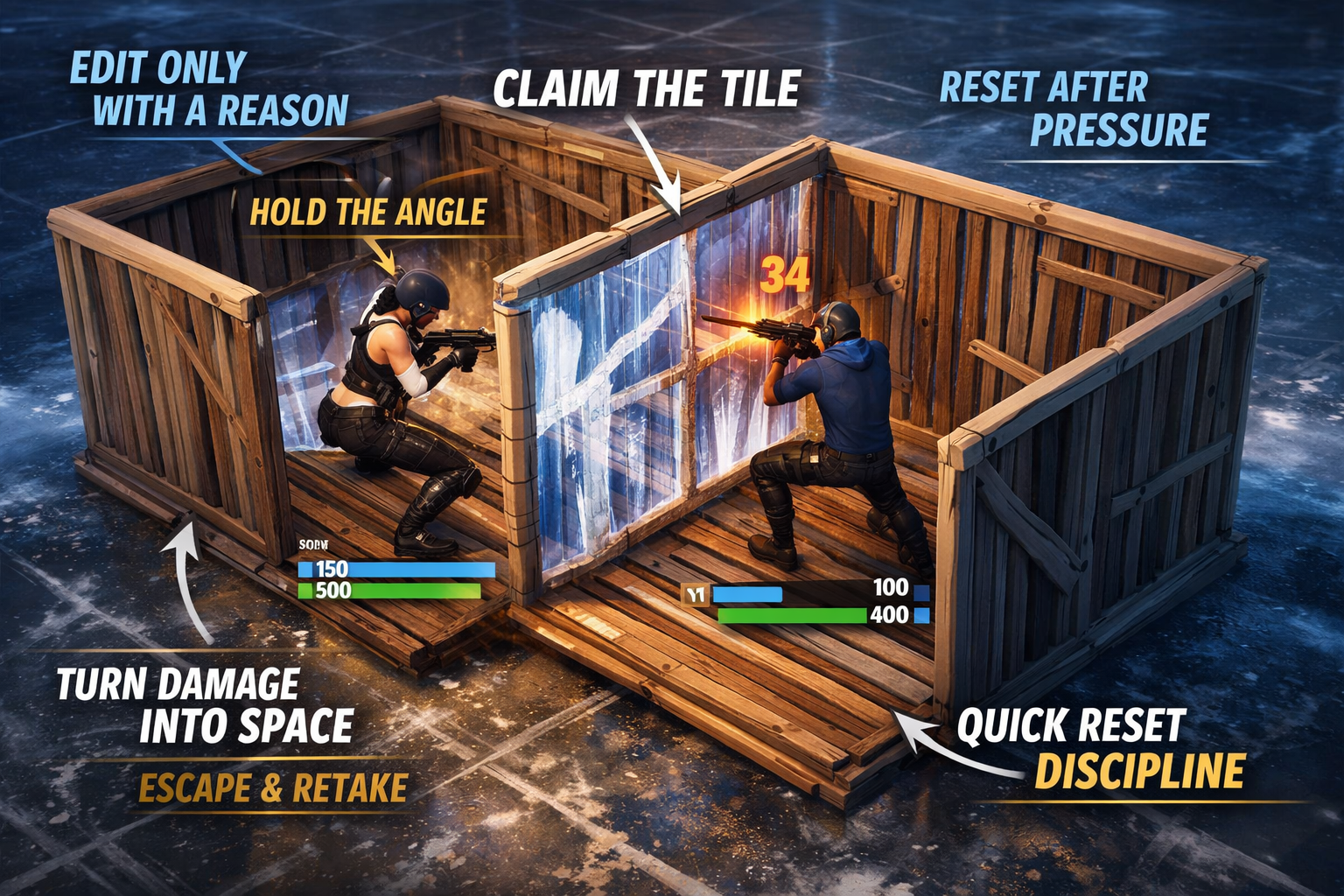
Purpose: Create safer shots by editing from favorable angles.
If you only remember one phrase from this guide, let it be this: edit to create an advantage, not just an opening. Too many players edit because they feel pressure to do something. They open a window or side edit without proper body placement, expose too much of themselves, then blame the trade. Right-hand peek reps teach patience and geometry. The goal is to expose the minimum amount of your character model while keeping a clear line for your shot.
How to run it: Stand behind your wall or box structure with a target in front of you. Practice a small set of reliable edits: right-side window, peanut butter, top-corner angle, and any standard peek you actually use in matches. Open the edit, take the line, imagine or fire the shot, then reset. Repeat from varying distances and elevations.
What to focus on: Your feet and shoulders matter as much as your edit speed. Before opening the wall, position so your body naturally favors the right-hand angle. After the edit, do not drift into the center of the opening. Hold the edge. Let the structure protect you. This is where many players lose the benefit of the peek they just created.
Why it matters in real fights: Clean peeks reduce return damage. Over time, that changes entire matches. Winning a fight with 150 health left is not the same as winning it with 30. Better peeks mean more margin for the next engagement, more confidence when pressuring, and less forced healing. This is one of the fastest ways to become “harder to hit” without changing aim settings.
Common mistake: Practicing too many edits. You do not need a giant library. You need a small group of peeks you can trust under pressure. Choose the ones that feel repeatable, then make them sharp.
Drill 4: Edit-Reset Discipline
Purpose: Stop leaving openings after pressure.
One of the biggest differences between average and strong mechanical players is reset timing. Average players edit, shoot, and admire the play. Strong players edit, shoot, and close the door. Reset discipline is what turns an aggressive mechanic into a safe mechanic. Without it, every successful peek becomes an invitation for the opponent to trade back, counterpressure, or escape through an opening you forgot to close.
How to run it: Use any common peek setup. Open the edit, simulate or fire the shot, then instantly reset and hold. Repeat until the close feels automatic. Then add variations: edit twice before the shot, fake the open and reset without shooting, or shoot and move into a new box after the reset. The pattern you want is action followed by immediate denial.
What to focus on: There should be almost no pause between the attack and the reset. A long admiring delay is exactly what gets punished in real fights. Also watch for messy crosshair routes. If your edit and reset path is inefficient, your timing will always feel late.
Why it matters in real fights: Reset discipline keeps pressure in your hands. It means you can poke repeatedly without donating free damage. It also helps you fake intentions. Sometimes the threat of the edit matters more than the edit itself. If opponents know you always close fast, they hesitate longer before countering.
Common mistake: Practicing reset speed only after a clean shot. Real fights are ugly. Train resets even after bad timing, poor aim, or a whiff. Good defensive habits must survive imperfect offense.
Drill 5: Protected Ramp Pressure
Purpose: Advance on an opponent without walking into free damage.
A lot of players know how to push, but not how to protect the push. They sprint at a wall, swing too early, or expose themselves while trying to take space. Protected ramp pressure teaches you to move forward behind your own structure, using ramps, walls, floors, and occasional cones to close distance in a way that shrinks the opponent’s options.
How to run it: Set a target box or imaginary enemy structure in front of you. Approach it using a protected route: wall plus ramp, floor plus wall, or other standard combinations that keep your body covered while advancing. When you reach the box, stop and identify what you would claim next: wall, cone, side tile, or a baited edit.
What to focus on: Pressure should feel layered, not rushed. Your cover should arrive before your body does. Also pay attention to posture. If you are always staring at the opponent instead of the tiles you need to place, your protection becomes late. Strong pressure is built through structure first, exposure second.
Why it matters in real fights: This drill is the bridge between defense and offense. It teaches you how to turn safety into initiative. Instead of waiting passively or jumping into a 50/50, you move into a position where your next play has more control. That is the essence of good Fortnite aggression.
Common mistake: Confusing aggression with speed. Good pressure is not reckless. It is deliberate forward control. If you can reach the opponent’s space while staying protected, you are already winning a large part of the exchange.
Drill 6: Basic Tarping Without Waste
Purpose: Move through dangerous space efficiently while conserving materials and angles.
Tarping is often treated like an advanced mechanic only relevant in stacked endgames. That is too narrow. In reality, tarping is simply the art of moving safely from one space to another under threat. That can apply in scrims, stacked late games, rotates through open terrain, or even ordinary midgame situations where multiple players can see you. The reason this drill matters so much is that it teaches controlled movement under pressure.
How to run it: Choose a direction and tarp a set distance using a simple, repeatable pattern. Keep it basic at first: floor, wall, wall, roof; or your preferred protected path depending on elevation and scenario. Practice straight lines before curves. Then add height changes, diagonal movement, and low-ground versus mid-ground versions.
What to focus on: Efficiency. Do not overbuild. Do not place extra pieces just because your hands are nervous. Every piece should solve a specific exposure. Keep your movement smooth and your camera calm. Wild mouse swings and panic turns usually create gaps or unnecessary builds.
Why it matters in real fights: Basic tarping helps in every phase of the game. It teaches disciplined movement, resource awareness, and timing. It also improves your ability to survive when rotating through open zones or when shifting from one box to another under multiple threats. Even if your lobbies are not tournament-stacked, this skill gives you cleaner movement and fewer desperate scrambles.
Common mistake: Training only the fastest tarp routes. Start with the route you can maintain while staying protected. Fancy speed is useless if it creates holes. Strong tarping is measured by survival, not clip value.
Drill 7: Piece Control Around a Box
Purpose: Claim surrounding tiles before forcing a close fight.
Piece control is one of the clearest markers of advanced Fortnite understanding, but it is often explained too vaguely. At its core, it means this: before you fully commit to the opponent’s space, try to own the pieces that limit their escape and shape their next move. That could mean taking a wall, placing a cone, controlling a side tile, or owning the tile above. The drill is not about diving recklessly into someone’s box. It is about turning the fight into a smaller puzzle for them and a simpler one for you.
How to run it: Build a target box. Practice approaching it and claiming one or two surrounding pieces before editing for access. Examples include wall plus cone, side wall plus roof, or front wall plus adjacent side tile. Then imagine the opponent’s likely exits and practice denying them in sequence.
What to focus on: Order matters. Claim first, force second. Many players reverse this and end up in low-odds 50/50 situations. Also watch your spacing. You want to be close enough to pressure but not so close that you become easy to punish through a sudden edit.
Why it matters in real fights: Piece control turns chaos into structure. Instead of hoping the opponent misplays, you create a narrower set of outcomes. That makes your reads better and your follow-ups faster. It also helps prevent the classic problem of dealing damage but losing the fight because the opponent escaped into a better angle while you chased blindly.
Common mistake: Treating piece control like a scripted combo. It is better understood as a principle: claim the pieces that matter most for the immediate situation. Sometimes that is the roof. Sometimes it is the side. Sometimes it is not worth diving at all. Train recognition, not just memorization.
Drill 8: Recovery After Getting Cracked
Purpose: Regain structure and composure immediately after taking heavy damage.
This drill is not glamorous, but it saves games. Many fights are lost not on the first shot, but in the four seconds after it. A player gets cracked, panics, misbuilds, tunnels into a dead end, or swings back with no cover because their emotions outrun their mechanics. Recovery practice teaches you to respond to damage with a stable survival pattern instead of a random one.
How to run it: Simulate getting hit. The moment you imagine or receive the signal, perform your recovery sequence: instant box, second layer if needed, quick re-box, reposition, then either heal window, counterpeek window, or escape route. Repeat until the sequence becomes more reflexive than panic.
What to focus on: Calmness through order. Your first action should usually be protection, not revenge. Make the sequence simple enough that you can execute it while stressed. Complexity breaks under pressure. Good recovery mechanics feel almost boring, and that is a compliment.
Why it matters in real fights: The best players are not immune to getting hit. They are just harder to finish. If you recover cleanly after taking damage, you force opponents to do more work, spend more mats, and take more risks. That often flips momentum. A player who expected a free finish suddenly has to fight a stable target again.
Common mistake: Healing too early. Safety comes first. If your cover is weak, trying to pop a heal is often just asking to get broken or dove. Secure the structure, then earn the heal timing.
Drill 9: Clean Route Editing
Purpose: Move through builds smoothly without losing crosshair control or body alignment.
Route editing is where many players expose the difference between raw speed and true control. They can edit individual pieces quickly, but the route between pieces is clumsy. Their character catches edges, the crosshair overtravels, or the camera swings so far that the next input becomes inconsistent. This drill trains your editing as a path rather than a series of isolated tricks.
How to run it: Create a short course using the common structures you encounter in fights: walls, floors, cones, ramps, and box exits. Move through them with the goal of staying centered and efficient. Keep the course short at first. Add difficulty only when your route looks clean from start to finish.
What to focus on: Rhythm. Good route editing feels like one connected sentence, not a stutter. Your crosshair should travel the shortest useful line. Your movement should support the next edit instead of forcing a correction. If you keep bumping into pieces, the issue is usually alignment, not reaction time.
Why it matters in real fights: This improves everything from chasing to escaping to repositioning during build fights. It also lowers mental load. When your movement through your own structures is automatic, your attention can stay on the opponent and the game state instead of your own hands.
Common mistake: Measuring success only by time. Fast and ugly route editing often fails in matches because the angles are imperfect and the pressure is real. Clean first, fast second.
Drill 10: Damage-to-Conversion Build Fights
Purpose: Turn a winning moment into a finished fight instead of a throw.
Many players can land damage. Fewer can convert that damage into a controlled finish. They hit a good shot, get excited, overchase, forget protection, and suddenly the opponent has reset the fight or reversed it. This final drill teaches one of the most important competitive habits in Fortnite: after you gain an advantage, tighten control instead of rushing for glory.
How to run it: Simulate a successful opening shot. From there, execute a controlled follow-up sequence: protect your angle, claim one relevant tile, pressure the likely exit, and only then go for the finishing edit or forced close-range play. The point is to rehearse the discipline of conversion, not just the thrill of first damage.
What to focus on: Restraint. Your brain will want to sprint forward the instant you feel ahead. Resist that urge. Ask: what is the safest way to remove their options? Good conversion often looks almost slow because it is built on ownership and timing, not emotion.
Why it matters in real fights: This is the drill that connects all the others. Protection, peeks, resets, pressure, piece control, and recovery all meet here. If you cannot convert advantages, your other mechanics remain incomplete. Once you can, your fights become shorter, cleaner, and less expensive.
Common mistake: Thinking every damaged opponent must be hard-dived instantly. Sometimes the correct play is to hold them in a bad position and let their options shrink. Pressure is not always a sprint. Often it is a cage.
A Simple Weekly Routine That Works
You do not need a complicated spreadsheet to improve. You need consistency and enough repetition to make patterns automatic. Here is a simple weekly structure you can adapt:
Day 1 — Protection and Recovery: Drill 1, Drill 2, Drill 8. This day teaches you how to stay alive, re-box, and rebuild composure after damage.
Day 2 — Peeks and Resets: Drill 3 and Drill 4. Keep the session short and high quality. This is where discipline matters more than volume.
Day 3 — Forward Pressure: Drill 5 and Drill 7. Learn how to move toward opponents without donating your advantage.
Day 4 — Movement Through Builds: Drill 6 and Drill 9. Focus on smoothness, not ego speed.
Day 5 — Conversion: Drill 10 plus realistic 1v1s, box fights, or controlled build fights where you consciously try to convert damage properly.
Day 6 — Mixed Review: Revisit the two drills that still feel weakest. Do not always repeat the ones you already enjoy.
Day 7 — Light Session or Rest: Mechanical gains stick better when fatigue does not turn every session into sludge.
Within each practice day, keep the pattern simple: brief warm-up, two or three drill blocks, then a transfer mode such as box fights, realistic fights, or a focused public match session where you choose one priority. For example, tell yourself: today I care most about reset timing. That keeps your matches from turning into random play with no learning target.
If you want extra structure, use the official Fortnite practice hub to rotate environments and keep repetition fresh. If you enjoy watching high-level applications of these skills, the official Fortnite Competitive site can be useful for seeing how strong players manage pressure, angles, and space in serious lobbies. Watch with purpose: not “wow, they are fast,” but “why was that peek safe?” or “which tile did they claim first?”
Common Mistakes That Slow Improvement
1. Practicing only when you feel inspired.
Mechanics improve through consistency, not emotion. A player who trains cleanly for twenty minutes most days will usually pass the player who occasionally has a two-hour hype session and disappears for the rest of the week.
2. Chasing speed before consistency.
If your repetition looks different every time, you are not building trust in the motion. You are building randomness. Clean movement is what becomes fast later.
3. Treating every fight like a race.
Many players lose because they are in a hurry to prove they are mechanical. Real strength often looks quieter: safe angle, claimed tile, reset, pressure, finish. The game rewards control more than drama.
4. Overbuilding from anxiety.
Extra pieces are often a stress response, not a smart response. They cost mats, clutter your own route, and sometimes block your best angle. Learn to place pieces because they solve something, not because your hands need to be busy.
5. Ignoring recovery mechanics.
Players love training offense. Fewer love training what happens after getting cracked. But the latter saves more fights than the former. Recovery is not weakness. It is the skill that gives offense a second chance.
6. Copying every new technique you see.
Fortnite evolves, but fundamentals still carry the most weight. Build your game around simple, dependable actions. Add specialty mechanics only when your base is already reliable.
7. Playing too many empty matches.
Some players think volume alone creates improvement. It does not. Repeating the same bad habits in ranked is still repetition. You need deliberate attention. Enter matches with one mechanic in mind and review key moments afterward.
8. Training without feedback.
You do not need a coach for every session, but you do need honest observation. Record a few minutes. Watch where your camera drifts, where your resets are late, where your movement becomes wide, and where your cover arrives after your body. Those details are gold.
If you ever feel stuck, simplify. Go back to one protection drill, one peek drill, and one conversion drill. Most plateaus are not solved by adding complexity. They are solved by restoring clarity.
How to Track Progress Without Guessing
Improvement feels better when you can see it. The problem is that many Fortnite players track the wrong outcomes. They look only at eliminations, montage clips, or whether a session “felt fast.” Those are unreliable. A better approach is to track behaviors that reflect stronger fundamentals.
Ask yourself these questions at the end of a session or match block:
- How often did I create a full safe box instantly after pressure?
- How often did I take a peek and reset on time?
- How often did I deal damage and then overchase instead of converting safely?
- How often did I die because I opened an edit without advantage?
- How often did I re-box cleanly instead of freezing in the first tile?
- How often did I claim a piece before forcing entry?
Those answers tell you much more than raw kills. A player who loses a fight after making three correct decisions may be improving faster than a player who wins a sloppy fight through aim alone. Over the long run, structure wins more consistently than chaos.
You can also create a very simple scoring system. Give yourself one point every time you successfully perform the behavior you are training in a real match. For example, if your theme for the week is reset discipline, count successful peek-and-reset sequences. If your theme is recovery, count the number of times you get cracked and still stabilize the fight instead of instantly losing. These small metrics keep your attention on habits that actually scale.
Another smart habit is to separate practice success from transfer success. Practice success means you performed the drill cleanly in a controlled environment. Transfer success means you used it in a live fight. Both matter, but transfer is the real test. The purpose of training is not to become impressive in an empty arena. It is to become dependable when the lobby is trying to punish you.
How These Drills Transfer Into Real Game Modes
One reason players become frustrated is that they practice mechanics in isolation and then expect perfect transfer into every mode immediately. Transfer is real, but it is not automatic. You still need context.
In ranked Battle Royale, these drills help you survive third parties, manage midgame pressure, win cleaner close-range fights, and keep more materials for later zones. Drill 1, Drill 2, and Drill 8 are especially valuable here because they keep bad situations from becoming instant losses.
In box fights, Drill 3, Drill 4, and Drill 7 often provide the biggest edge. Better peeks, faster resets, and smarter piece control make your fights less random and more methodical.
In build fights and realistic 1v1s, Drill 5, Drill 9, and Drill 10 become more visible. Your ability to pressure safely, move through builds cleanly, and convert damage without throwing determines whether your mechanics create control or just chaos.
In scrims and more competitive environments, Drill 6 becomes increasingly valuable. Even a basic tarp done cleanly can save huge amounts of health, materials, and mental energy during late rotations.
That is why the full package matters. Each drill supports a different part of the same larger skill: controlled fighting. Fortnite is not just about being able to build and edit. It is about using those mechanics to create better outcomes than the opponent can create against you.
When to Add More Advanced Mechanics
Players often ask when they should move beyond fundamentals into more advanced retakes, faster multi-edits, or highly specific piece-control sequences. The answer is simple: add complexity when your basics remain stable at speed. If your emergency boxing fails under pressure, if your resets are late, or if your peeks still expose too much of your body, advanced tech is not your bottleneck yet.
A good checkpoint is this: can you protect, peek, reset, re-box, and convert damage with minimal panic in ordinary fights? If yes, then adding new layers makes sense. If not, more advanced mechanics may simply decorate an unstable base.
There is nothing wrong with learning flashy movement or difficult edit chains for enjoyment. Fortnite should still be fun. But if your goal is real improvement, the fastest path is usually deeper mastery of simple patterns rather than shallow familiarity with complicated ones.
Why Coaching and External Feedback Can Speed Things Up
Self-training works, but players often normalize their own bad habits because those habits feel familiar. A second set of eyes can quickly spot the things you no longer notice: crosshair drifting off the tile before every edit, jumping unnecessarily before pressure, exposing the center of your body on right-hand peeks, or converting damage with too much emotion and too little structure.
If you prefer to improve through guided review or structured sessions instead of pure solo grinding, Boosteria also has a Fortnite boosting prices page where you can explore available service options. Even if you mainly improve through your own work, occasional outside feedback can make your repetitions much more efficient by pointing you toward the exact habit that needs fixing.
Final Thoughts
Fortnite building and editing fundamentals are not about looking impressive for ten seconds. They are about making good habits so automatic that pressure stops stealing your mechanics. The 10 drills in this guide matter because they target the things that actually decide consistent fights: protection, positioning, peeks, resets, pressure, control, recovery, and conversion.
If you take one lesson from all of this, let it be that mechanics are most powerful when they reduce chaos. Your goal is not to do more. Your goal is to do the right thing faster, cleaner, and with less panic. A player who boxes instantly, peeks safely, resets on time, moves through builds with structure, and converts damage with discipline will beat a “faster” player surprisingly often.
So train with intent. Keep your drill pool focused. Watch your own habits honestly. Build speed on top of structure, not in place of it. And remember: the best Fortnite mechanics are not the ones that look the wildest in practice. They are the ones that still work when the match gets stressful.