



Hearthstone Ranked Explained: Stars, MMR, Streaks, Consistency
Hearthstone Ranked Explained: Stars, MMR, Streaks, and Consistency
If Hearthstone Ranked sometimes feels “random,” you’re not imagining the swings — but you can make the system predictable. Once you understand how stars move your visible rank, how hidden MMR shapes your opponents, and how streaks + star bonuses accelerate (or slow) the climb, your progress becomes a process you can repeat every month.
This guide breaks down Ranked in a timeless way: the core ladder rules, what matchmaking is really doing, why you can face “Legend-level” players in Bronze, and how to build consistency with better decisions, better habits, and a smarter climb plan.
Helpful references while reading:
Official Blizzard post: Ranked changes & star bonus basics
Blizzard forums: win streak rules and Diamond 5 cutoff
Wiki.gg: Ranked overview (leagues, ranks, star bonus)
HSReplay: meta snapshots and matchup data
Vicious Syndicate: meta reports and deck guidance
Table of Contents
- 1) Ranked Basics: Leagues, Ranks, Stars, and Floors
- 2) Stars, Win Streaks, and the Diamond 5 Rule
- 3) Star Bonus (Multiplier): What It Is and Why It Matters
- 4) Hidden MMR: What Matchmaking Really Uses
- 5) Why Ranked Feels Random (and What’s Actually Happening)
- 6) The Math of a Consistent Climb: Expectations and Benchmarks
- 7) Deck Choice for Climbing: Consistency Over “Perfect Meta”
- 8) Skill That Moves Stars: Mulligans, Planning, and Win Conditions
- 9) Tilt-Proofing: How to Stop Donations and Keep Your MMR Clean
- 10) A Repeatable Monthly Plan (Bronze to Diamond, Diamond to Legend)
- 11) Legend Explained: Entering, Climbing, and Why It Feels Different
- 12) FAQ: Common Ranked Questions Answered
- 13) Faster Climb Option (Boosteria)
- Image Prompts + SEO Alt Text
- Tags
1) Ranked Basics: Leagues, Ranks, Stars, and Floors
Hearthstone Ranked is built around a simple visible ladder:
- Leagues: Bronze, Silver, Gold, Platinum, Diamond
- Ranks within each league: typically 10 down to 1
- Legend: above Diamond 1
To move up, you earn stars. In modern Ranked, each rank is typically a short “mini-bar” of stars. Win a game, gain stars; lose, drop stars. Reach the required stars, you advance a rank.
The ladder also includes rank floors — safe checkpoints where you can’t fall below that floor during the season. Floors reduce the emotional and statistical cost of learning, experimenting, or hitting a rough patch.
Why floors matter: floors create “plateaus” where players behave differently. Above a floor, players often play riskier decks; at a floor, many players experiment or play meme decks because losses don’t drop them. This changes the meta from one pocket to another, even within the same league.
Finally, Ranked is split by format (commonly Standard and Wild). Each format has its own ladder and its own matchmaking context.
Timeless takeaway: Visible rank is your progress bar. Hidden MMR is your matchmaking fuel. Stars are the currency you spend and earn to climb.
2) Stars, Win Streaks, and the Diamond 5 Rule
Stars are the visible unit of progress:
- Win: you gain stars (usually 1 by default)
- Loss: you lose a star (unless you’re at a floor)
Now add two accelerators that make early-season climbing much faster:
- Star Bonus (Multiplier): grants extra stars for wins (covered in the next section)
- Win Streak Bonus: when you win several games in a row, your next wins can award extra stars
The key rule many players miss: win streak bonuses do not apply at or above Diamond 5 in the modern system. This is commonly explained in Blizzard community discussions and is consistent with the idea that the final push should be more “true ladder” than “turbo climb.”
What this means in practice:
- Below Diamond 5: streaks can swing you upward quickly, especially when combined with a star bonus multiplier.
- Diamond 5 to Legend: progression becomes more directly tied to win rate and match quality. Your decisions matter more, and tilt is punished harder.
Why this is healthy for consistency: below Diamond 5, the system helps you return to your “proper” neighborhood quickly. Above Diamond 5, the system asks: can you actually maintain a positive win rate against players at your skill band?
3) Star Bonus (Multiplier): What It Is and Why It Matters
The Star Bonus is the main reason a new season doesn’t feel like starting from zero. When the season resets, your visible rank goes back down — but the game gives you a multiplier so you can climb back to your skill neighborhood faster.
At a high level:
- Your Star Bonus is influenced by your previous season performance and/or your MMR.
- While you have a Star Bonus, winning gives you multiple stars per win.
- As you climb and hit certain checkpoints, the Star Bonus typically decreases (it tapers as you approach your prior “true” rank).
Blizzard has described the concept plainly: if you have a star bonus and win, you earn that many stars (and streaks can double the gain), and matchmaking during this phase uses MMR to keep games fair even when your visible rank is low. You can read this in the official overview of Ranked changes in the Year of the Phoenix announcement.
Common confusion: players assume the star bonus is based only on their final visible rank last season. In reality, many players notice they can get a higher multiplier than expected — typically because their MMR is higher than what their visible finish suggests. In other words: the system often chooses the “higher” of your visible finish and your underlying skill signal.
Why it exists:
- To prevent high-skill players from farming low ranks for weeks.
- To reduce season reset frustration.
- To make your “real games” happen sooner, not after 200 matches.
Timeless takeaway: star bonus is a speed boost back toward your normal neighborhood. It’s not the ladder “being generous”; it’s the ladder trying to place you where you belong faster.
4) Hidden MMR: What Matchmaking Really Uses
MMR (Matchmaking Rating) is the hidden number (or set of numbers) Hearthstone uses to estimate your skill and find appropriate opponents. You don’t see it directly, but you feel it every time you queue.
Core concept: matchmaking can prioritize MMR more than visible rank — especially early in the season, and especially when you have a star bonus. Blizzard has explicitly stated that when playing with a Star Bonus you’ll be matched by MMR, so your opponents will reflect your skill even if your badge says “Bronze.”
This explains the classic experience:
- You reset to Bronze.
- You queue into opponents who play like Diamond/Legend players.
- You think, “Why is Bronze so hard?”
It’s not Bronze. It’s your MMR band — with Bronze cosmetics.
What affects MMR?
- Winning and losing (obviously).
- Opponent strength: beating stronger opponents can move you faster than beating weaker ones.
- Volume and stability: the more games you play, the more the system becomes confident about your level.
What does NOT reliably affect MMR (in a way you should plan around):
- How long your game took.
- How “close” it was.
- How flashy your deck is.
Timeless takeaway: if your opponents feel “too good for your rank,” your MMR is likely higher than your visible badge — or you’re playing at a time when the player pool in your region/timezone is small and the matchmaker widens slightly for queue speed.
5) Why Ranked Feels Random (and What’s Actually Happening)
Ranked feels random when your expectations are based on visible rank. The truth is that Hearthstone Ranked is a blend of visible progression and hidden matchmaking. Here are the most common “random” feelings and their real causes.
5.1 “I’m stuck at the same place every month”
This is often the system working as intended. If your overall decision quality and deck quality are stable, you’ll stabilize at the same MMR band. Floors make it easier to hover near the same checkpoints.
Fix: change one variable at a time (deck, mulligan plan, session rules, matchup prep). Random changes create random results.
5.2 “Some days I can’t win no matter what I do”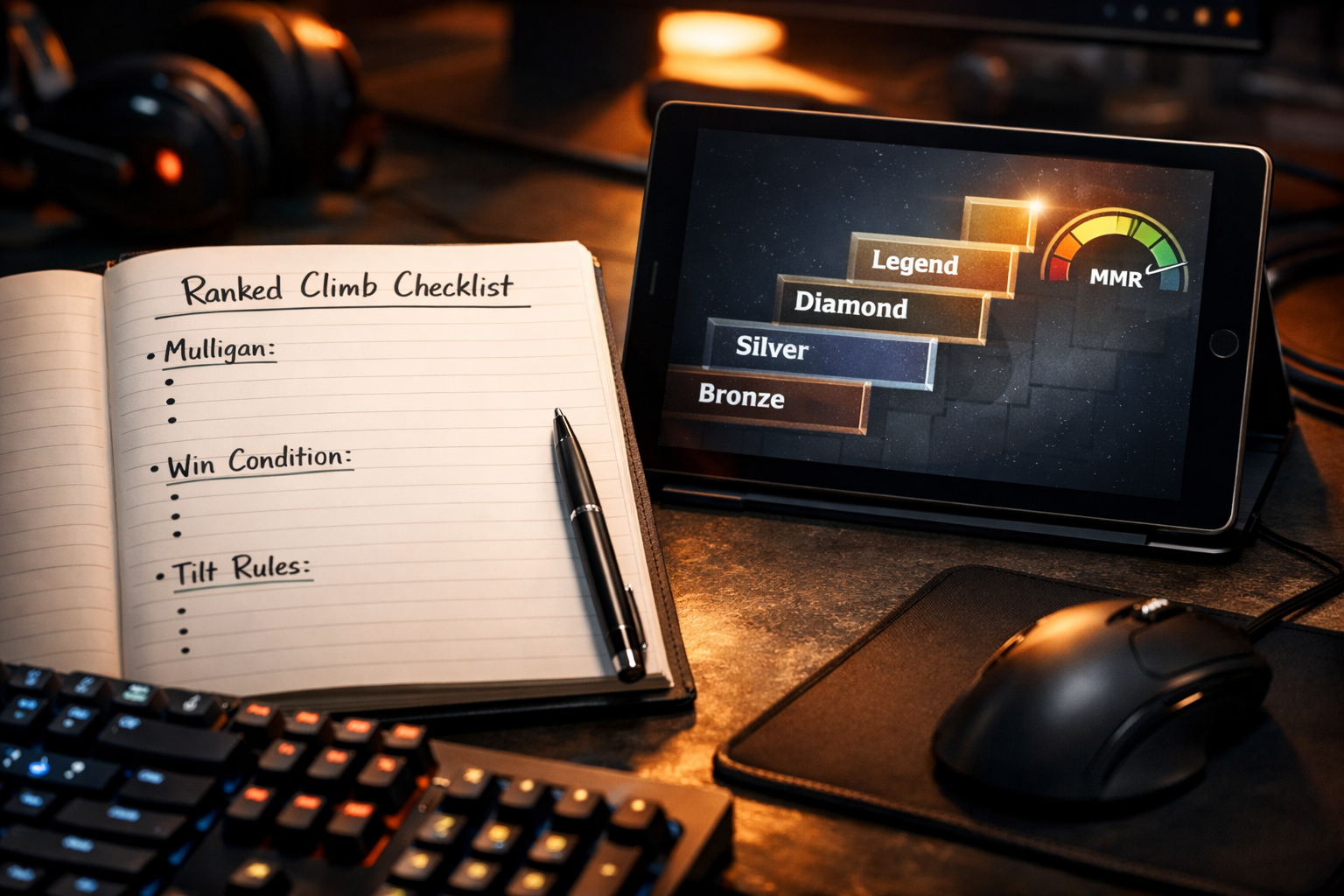
Variance exists: draw order, matchup spread, and the meta pocket you queue into can spike. But “no matter what I do” is often tilt + poor deck selection for the pocket.
Fix: define a stop-loss (example: quit ranked after 3 consecutive losses, or after 2 losses where you clearly misplayed). This protects MMR and sanity.
5.3 “I face the same archetypes over and over”
That’s not random — that’s a meta pocket. At certain ranks, times of day, and MMR bands, specific decks dominate. As soon as you hit a floor, people change decks and the pocket shifts.
Fix: track 20–30 games. If you see a pattern (e.g., 40% Aggro), adjust tech choices or pick a more polarized counter deck.
5.4 “I have a good win rate but climb slowly”
Above Diamond 5 (where streak boosts stop) climbing becomes more linear. A 55% win rate will climb, but it will not feel fast.
Fix: measure in blocks of 50 games, not 10. Hearthstone is a variance-heavy ladder; small sample feelings lie.
5.5 “My deck is good but I’m still losing”
“Good deck” is contextual. A Tier 1 deck can still be a bad choice if the pocket is hostile, if you don’t know the mulligans, or if you mis-sequence key turns.
Fix: choose a deck you can pilot near-perfectly, not a deck that is theoretically 2% better in a pro report.
6) The Math of a Consistent Climb: Expectations and Benchmarks
Consistency in Hearthstone is about turning “luck” into “math you can live with.” Let’s build realistic benchmarks.
6.1 Win rate targets that actually matter
- 50%: you are stable in your band; progress depends heavily on bonuses/floors and can stall at higher checkpoints.
- 52–54%: you climb slowly but steadily, especially in long samples.
- 55–58%: reliable climb; Diamond to Legend becomes realistic with good habits.
- 60%+: strong edge; usually indicates either excellent play, a perfect pocket matchup, or both.
Important: your win rate is not a “skill badge” unless the sample is big. A 10-game run can say nothing. A 100-game run says a lot.
6.2 Why Diamond 5 to Legend feels like a wall
Below Diamond 5, streaks and star bonuses can amplify a small edge. Above Diamond 5, those amplifiers largely disappear. So your climb becomes close to: net wins.
If you play 100 games at 55% win rate, that’s 55 wins and 45 losses: +10 net wins. That’s progress — but it won’t feel like “zooming.” The wall is often just the math becoming honest.
6.3 The “quality win” concept
In practice, consistent climbers win in three ways:
- Free wins: opponent misplays, bad mulligan, wrong archetype tech.
- Edge wins: you navigate a close game better (sequencing, resource planning).
- Discipline wins: you stop playing when you’re tilted, protecting your next 20 games.
If you want to climb, focus on turning “close losses” into “edge wins.” That is where MMR shifts happen.
7) Deck Choice for Climbing: Consistency Over “Perfect Meta”
Your deck choice is your biggest lever — not because one deck is always best, but because consistency and repetition create skill faster than constant swapping.
7.1 The three best climbing deck profiles
A) Low-decision aggressive decks (clean execution)
These decks climb by compressing game length and punishing greedy pockets. They also reduce fatigue and tilt because games finish quickly.
- Pros: fast sessions, good for grinding, punishes slow decks
- Cons: can feel helpless in bad matchups; requires discipline on resource turns
B) Midrange/tempo decks (best all-around learning)
Tempo decks teach you when to push damage, when to trade, and how to convert small edges. These are often the best “improvement decks” for consistent players.
- Pros: flexible game plans, fewer auto-losses
- Cons: requires matchup knowledge and clean sequencing
C) “I win if I survive” control/combo decks (meta call)
These decks climb when the pocket is predictable and you can tech for it. They are often slower but can be brutally consistent if tuned correctly.
- Pros: strong into specific metas, clear win condition
- Cons: longer games, higher tilt risk, can be punished by counters
7.2 Choose your deck using this simple rule
Pick the deck you misplay the least, not the deck that is “ranked #1.”
A deck that is 2% stronger on a meta report is meaningless if you make 2–3 extra mistakes per match. For climbing, execution beats theory.
7.3 Use meta data correctly (without becoming a slave to it)
Sites like HSReplay and Vicious Syndicate help you understand:
- Which decks are common at your rank.
- Which matchups are polarized.
- What tech cards shift win rates.
But your ladder pocket matters more than “overall meta.” If your pocket is 35% one archetype, tech for that — even if it slightly hurts other matchups.
8) Skill That Moves Stars: Mulligans, Planning, and Win Conditions
Most players think Ranked is decided by topdecks. In reality, most games are decided by:
- Mulligan decisions (your first big fork)
- Sequencing (how you spend mana and resources)
- Win condition clarity (what you’re actually trying to do)
8.1 Mulligan: the highest ROI skill in Hearthstone
If you want immediate ladder gains, improve mulligans first. A good mulligan raises win rate without changing your deck.
Timeless mulligan framework:
- Identify opponent archetype fast: class + early cards + likely meta pocket.
- Choose your role: are you the beatdown, or are you stabilizing?
- Keep for your plan: keep cards that enable your first 3 turns, not “cool cards.”
- Respect breakpoints: if you must answer an early threat, mulligan for the answer.
Many players keep “value” cards and then die before value matters. Climbing punishes that.
8.2 Turn planning: play your next two turns, not only this turn
A simple habit that improves win rate quickly:
- Before you act, ask: What is my best line if I draw nothing helpful next turn?
- Then ask: What is my best line if I draw my key card next turn?
This stops you from making “pretty” plays that ruin your curve or waste resources.
8.3 Win condition clarity: define how you win in one sentence
For every matchup, you should be able to say:
- “I win by sticking a board and pushing damage before they stabilize.”
- “I win by surviving until my swing turn, then locking the game.”
- “I win by exhausting removals and landing an unanswerable threat.”
If you can’t say how you win, you’ll take random lines and feel like the game is random.
8.4 Trading vs face: the most common ladder mistake
Climbers learn when to trade and when to race. A timeless rule:
- Trade when it prevents your opponent’s win condition.
- Go face when it accelerates your win condition more than their counterplay accelerates theirs.
To apply it, ask: “If I don’t trade, do I die faster than they do?” If yes, trade. If no, push.
9) Tilt-Proofing: How to Stop Donations and Keep Your MMR Clean
MMR is sensitive to streaks of poor decision-making. The fastest way to “ruin” your ladder experience is to play while tilted.
9.1 Define a stop-loss rule (and follow it)
Pick one:
- Rule A: stop after 3 consecutive losses.
- Rule B: stop after 2 losses where you clearly misplayed.
- Rule C: stop after 1 loss that makes you angry enough to queue instantly.
Why this works: the goal isn’t to “avoid losing.” It’s to avoid losing your next 10 games because your brain is tilted.
9.2 Short sessions beat marathon sessions
If you want consistent climbing:
- Play in blocks of 5–10 games.
- Take 2 minutes between games to reset.
- Review one mistake after the block.
This creates steady improvement without burnout.
9.3 Don’t change decks while emotional
Deck swapping after a bad run is usually tilt disguised as “strategy.” If you must swap, do it after reviewing your last 10 games and confirming the pocket is hostile.
10) A Repeatable Monthly Plan (Bronze to Diamond, Diamond to Legend)
Here’s a timeless monthly structure you can reuse every season.
10.1 Step 1: Pick one main deck (and commit)
Choose a deck that:
- You enjoy enough to repeat.
- You can pilot with low mistakes.
- Has at least “playable” matchups across the field.
If you want a second deck, pick it for one purpose only (e.g., a counter deck for a dominant pocket).
10.2 Step 2: Build a mulligan sheet (simple, not perfect)
Create three columns:
- Always keep (core openers)
- Keep vs Aggro (survival tools)
- Keep vs Slow (pressure/value enablers)
This alone can add multiple win-rate points because it removes indecision.
10.3 Step 3: Track 30 games (minimum)
After 30 games, answer:
- What archetype do I face most?
- What matchup do I lose most?
- Do I lose because of tech, mulligan, or sequencing?
Then adjust one thing: a tech card, a mulligan rule, or a turn-plan habit.
10.4 Step 4: Use time-of-day to your advantage
Ladder pockets change by time and day:
- Weekends can be more experimental.
- Late nights can concentrate grinders and high-MMR players.
- After a patch or balance change, the pocket can be chaotic for days.
Timeless advice: if you hit a terrible pocket, don’t force games. Come back at a different time.
10.5 Step 5: Diamond 5 to Legend plan
This is where most players stall. Use a dedicated approach:
- Play fewer games per session (5–8) to reduce tilt.
- Review one loss per block and identify the first mistake.
- Avoid “fun tech” unless it directly targets your pocket.
- Respect win rate math: you’re not racing; you’re building net wins.
Many Legend pushes fail because the player plays too many games in one sitting and turns a small downswing into a disaster.
11) Legend Explained: Entering, Climbing, and Why It Feels Different
Entering Legend is a milestone, but it’s also a system shift:
- Players in Legend are often matched with heavier weight on MMR (the game wants “skill-appropriate” games).
- The meta can feel sharper: more refined lists, fewer obvious mistakes.
- Small sequencing edges matter more because opponents punish inefficiency.
11.1 Why Legend can feel easier (sometimes)
Some players report that low Legend feels “easier” than Diamond 1–2. This can happen because Diamond is full of players in peak grind mode, while low Legend includes people experimenting after achieving their goal.
Timeless takeaway: don’t judge the system by one pocket. Judge it by your long sample and your habits.
11.2 How to climb within Legend
If you want to climb inside Legend:
- Pick decks with strong matchup plans, not only raw power.
- Track matchups and tech based on your local pocket.
- Play when you’re sharp — your opponents often are.
12) FAQ: Common Ranked Questions Answered
“Why do I face strong opponents in Bronze?”
Because matchmaking can use hidden MMR heavily, especially while star bonuses are active. Your visible rank reset does not mean your skill estimate reset.
“Does my visible rank affect matchmaking?”
It can in some cases, but MMR is a major driver — particularly early season and when star bonuses apply. In practice, you should assume you’re playing your MMR band.
“Do win streaks still exist?”
Yes, but they typically stop giving extra progress at/above Diamond 5 in modern Ranked, making the final climb more win-rate dependent.
“How do I climb faster without becoming inconsistent?”
Play a deck you execute well, improve mulligans, define session stop-loss rules, and avoid tilt queues. Consistency beats “grinding harder.”
“Is it better to play fast aggro for climbing?”
Fast decks can be excellent for volume and mental stamina, but only if you enjoy them and can pilot cleanly. A slower deck can climb just as well if it has a strong plan and you avoid fatigue.
“Should I switch decks when I lose a lot?”
Only after you confirm it’s a meta pocket issue, not a tilt issue. Track 20–30 games before making a change.
13) Faster Climb Option (Boosteria)
If you’d rather skip the grind or you’re stuck at a checkpoint, you can explore Boosteria’s Hearthstone Ranked options here:
https://boosteria.org/hearthstone-boosting/prices
Whether you climb solo or get help, the best long-term result comes from understanding the system: stars show progress, MMR shapes difficulty, and consistency is built through habits — not hope.