



Honor of Kings: Daily Routine + Replay Checklist to Improve Fast
Honor of Kings — Improve Faster: Daily Routine + Replay Checklist
If you want to improve quickly in Honor of Kings, the biggest upgrade isn’t a secret hero pick or grinding endless matches. It’s a repeatable system: a daily routine that trains the right skills, and a replay checklist that turns every loss (and every win) into clear, actionable lessons.
This guide is designed to stay timeless. Instead of patch-specific tips, you’ll learn fundamentals that work across metas: how to practice efficiently, what to review, how to spot the real reason you lost tempo, and how to build habits that translate directly into higher rank.
By the end, you’ll have:
- A daily routine you can run in 30 / 60 / 90 / 120 minutes
- Warm-ups that improve mechanics without burning mental energy
- A replay checklist that reveals the one decision that caused the next three problems
- Role-specific review prompts (Jungle, Roaming, Mid, Clash Lane, Farm Lane)
- A weekly plan so you don’t “practice everything” and improve at nothing
Optional shortcut: If you’re short on time and want faster results with expert help, you can also check Boosteria’s Honor of Kings boosting pricing to accelerate your climb while you keep learning the fundamentals.
Table of Contents
- Why You’re Not Improving (Even If You Play a Lot)
- The Improvement Loop: Play → Review → Focus
- Setup Foundations: Controls, Performance, Consistency
- Daily Routine Templates (30/60/90/120 Minutes)
- Micro Drills: Mechanics That Actually Matter
- Macro Habits: The Decisions That Win Games
- Replay Checklist (Step-by-Step)
- Role-Specific Replay Prompts
- Weekly Plan: Improve Faster Without Burnout
- Common Mistakes (And Simple Fixes)
- Mental, Tilt Control, and Consistency
- FAQ
1) Why You’re Not Improving (Even If You Play a Lot)
Most players “practice” by queuing games and hoping repetition does the job. The problem: repetition builds habits, but it doesn’t guarantee they’re good habits. If you repeatedly make the same rotation mistake at minute 4, playing 200 games can make that mistake feel normal.
Fast improvement requires two things:
- Focused input: You practice a small skill on purpose (one theme at a time).
- Accurate feedback: You confirm what actually happened in replay, not what it felt like.
There’s a reason professional training in sports and esports relies on feedback loops. In psychology, this style of training aligns with principles of deliberate practice: targeted effort, clear goals, and feedback. If you want to explore the concept broadly, see the American Psychological Association’s overview of learning and performance topics at apa.org.
Timeless truth: Your rank increases when your average decision quality increases. Mechanics matter, but most games are decided by repeated small choices: when you rotate, when you fight, when you reset, and how you manage risk when you’re ahead.
2) The Improvement Loop: Play → Review → Focus
Here’s the simplest improvement loop that works for almost everyone:
- Play 1–3 matches with one focus theme (example: “arrive early to objectives”).
- Review one key moment per match (not the whole replay).
- Write one sentence: “Next game I will ______.”
- Repeat until the new habit becomes automatic.
This guide gives you two tools to make that loop easy:
- A daily routine so you always know what to do before you queue.
- A replay checklist so you always know what to look for after you play.
Rule: If you don’t review, you’re gambling on improvement. If you do review, you’re engineering it.
3) Setup Foundations: Controls, Performance, Consistency
Before routines and checklists, lock your foundation. Consistency makes learning faster because your brain can compare matches accurately.
3.1 Control layout: choose comfort over “pro settings”
- Place key abilities where your thumb naturally rests.
- Minimize finger travel for your most-used actions (basic attacks, movement, primary skill).
- Keep your layout stable for at least 2–4 weeks before changing anything.
3.2 Sensitivity and camera discipline
Your goal is to check information quickly without losing control in fights.
- Set camera sensitivity so you can glance map areas smoothly.
- Practice “micro-checks”: short, intentional camera checks between last hits and during rotations.
- In fights, prefer controlled camera movement over constant dragging.
3.3 Performance: reduce lag and input delay
Honor of Kings is a high-tempo MOBA. Input delay changes mechanics and decision timing. Keep performance stable:
- Use stable Wi-Fi or reliable mobile data.
- Close background apps before ranked sessions.
- Keep your device cool; heat can reduce performance.
Trusted references for general device performance basics:
- Android performance guidance: developer.android.com
- Apple support and performance tips: support.apple.com
3.4 Pick a small hero pool
If you’re trying to improve quickly, reduce variables:
- 2–3 heroes for your main role
- 1 backup for off-role or bans
- One comfort pick you can perform on even when tired
When your hero pool is small, your brain stops spending energy on “how does this kit work?” and starts improving at what matters: positioning, rotations, and fight selection.
4) Daily Routine Templates (30/60/90/120 Minutes)
Below are practical templates. Pick one based on your real schedule and run it consistently. Consistency beats the “perfect plan” you only follow twice.
4.1 The 30-minute routine (busy days)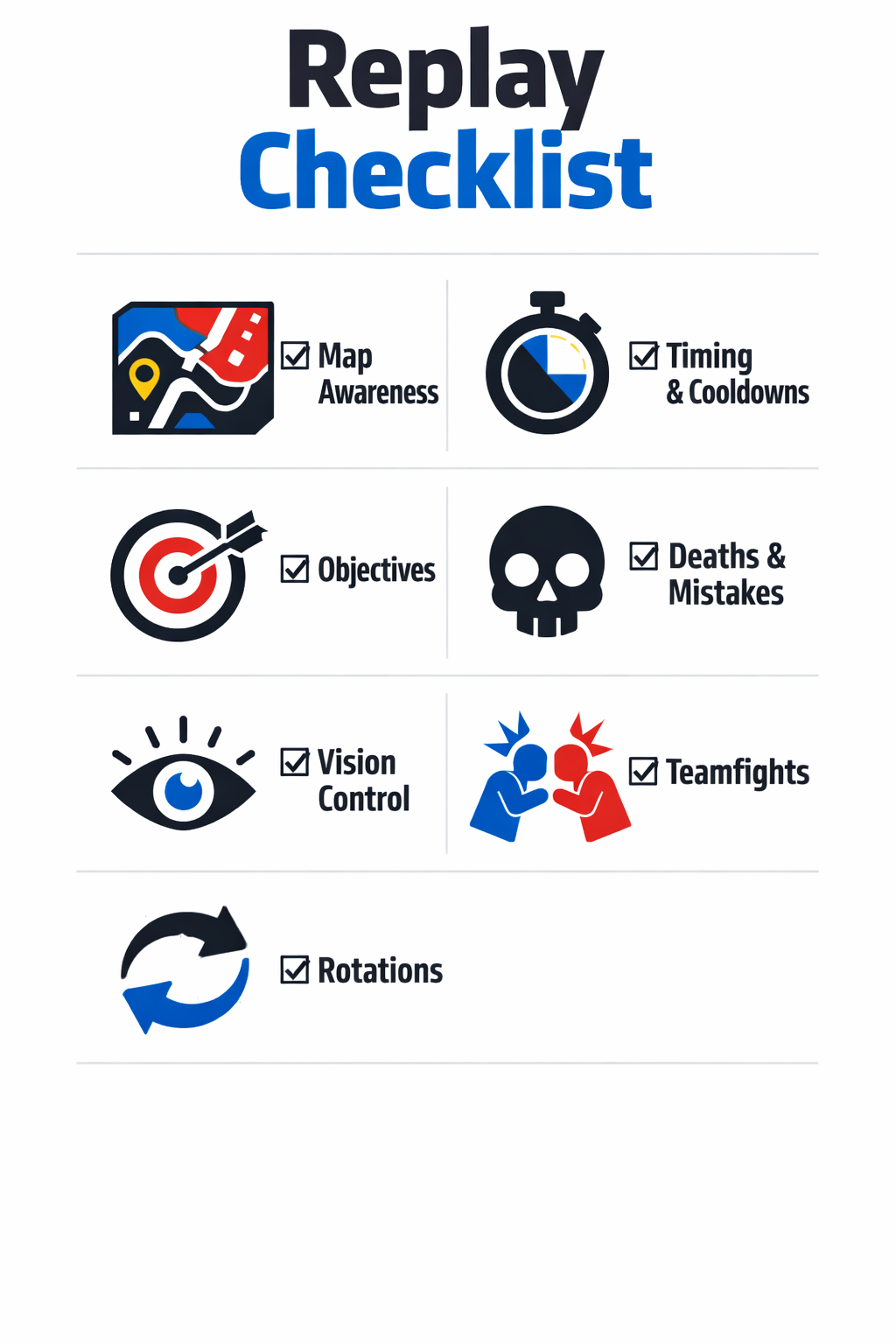
- 3 min — intention + focus theme (write 1 sentence)
- 5 min — warm-up drill (mechanics)
- 18–20 min — 1 match (ranked or focused normal)
- 3–5 min — micro review (one key moment)
Best for: building habits, maintaining skill, staying sharp on schedule chaos.
4.2 The 60-minute routine (most efficient for improvement)
- 5 min — focus theme + quick plan
- 10 min — warm-up (2 drills)
- 35–40 min — 2 matches
- 5–10 min — replay review (one mistake + one good play)
Best for: steady progress with minimal burnout risk.
4.3 The 90-minute routine (serious climb sessions)
- 5 min — focus theme + plan
- 12–15 min — warm-up (3 drills)
- 60 min — 3 matches
- 10 min — replay review + notes
4.4 The 120-minute routine (deep learning + ranked)
- 10 min — focus theme + yesterday’s notes
- 15–20 min — warm-up + role drill
- 75 min — 3–4 matches
- 15 min — replay review: one full objective cycle
Important: Longer sessions are not automatically better. If your decision quality drops after match 3, stop. Ranking up is about high-quality games, not maximum games.
5) Micro Drills: Mechanics That Actually Matter
Mechanics in a MOBA aren’t just flashy combos. The highest ROI mechanics are the ones that reduce your mistakes under pressure.
5.1 Drill A: last-hit and wave control (5 minutes)
Even if your role isn’t Farm Lane, basic gold/tempo matters. Run a short drill where you focus on:
- Last-hitting consistently
- Not over-pushing without information
- Resetting the wave before roaming (when appropriate)
Goal: Your hands learn calm precision so fights don’t feel like panic.
5.2 Drill B: “two-beat trading” (5 minutes)
Practice a simple pattern: step in → trade one ability/basic → step out. This teaches controlled aggression and spacing.
- Trade only when you have a clear advantage (cooldowns, minion support, positioning).
- Leave immediately after your “win condition” hits.
5.3 Drill C: combo consistency (3–5 minutes)
Pick one combo sequence for your hero and repeat it until you can do it cleanly while moving and adjusting camera. This is about consistency, not speed.
5.4 Drill D: “map glance timer” (3 minutes)
Set a simple goal: glance at the minimap every few seconds during low-intensity moments.
- Between last hits
- While walking back to lane
- After clearing a camp
Why it matters: Most deaths in MOBAs happen when players stop collecting information. Map glances are a decision-making mechanic.
5.5 Drill E: fight patience (3 minutes)
In practice mode or low-stakes matches, focus on not using your key cooldown instantly. Your goal is to hold it until:
- An enemy commits
- A target is locked down
- You have a safe angle
Many players lose fights not because their mechanics are weak, but because their timing is impulsive.
6) Macro Habits: The Decisions That Win Games
Macro is how you turn small advantages into objectives. This section stays timeless because it’s not about specific items or patch changes; it’s about consistent winning behavior.
6.1 Think in “objective cycles”
Instead of playing minute-by-minute, play cycle-by-cycle. A cycle is:
- Clear your wave/camp safely
- Gain priority (or at least avoid losing it)
- Move first toward the next objective area
- Force a fight only if you have setup and numbers
- Reset cleanly after the objective (don’t overstay)
When you lose games, it’s often because one step breaks: you overstay, you reset late, you arrive second, and then you fight anyway.
6.2 The “arrive early” rule
Arriving 10–20 seconds earlier to objectives wins more games than any mechanical trick.
- Early arrival gives vision/control.
- It forces the enemy to face-check or rush.
- It gives your team time to set angles and cooldowns.
6.3 Don’t fight on “no information”
Before you commit, ask:
- Where is the enemy jungler likely to be?
- Which enemies are visible?
- Do we have numbers?
- Do we have key cooldowns?
If you can’t answer, your fight is usually a coin flip.
6.4 Learn to reset
Resetting is a skill: after a successful play, many players stay too long, donate shutdowns, and lose the tempo they just earned.
Good reset signs:
- You spent major cooldowns
- Your HP/resources are low
- You achieved a clear objective
- The next wave/camps need attention
Resetting at the right time keeps your advantage compounding.
6.5 Track “risk per minute”
Ask yourself: “Am I taking high risk for low reward?” Examples:
- Chasing deep for one kill while objectives spawn soon
- Fighting when your wave is crashing into your turret
- Starting a fight with no vision of key enemies
Winning players reduce unnecessary risk. You can be aggressive without being reckless.
7) Replay Checklist (Step-by-Step)
Replays are your fastest coach. But only if you watch them correctly. Most players watch replays like entertainment: “Wow, that fight was messy.” That’s not learning. Learning is turning moments into repeatable rules.
Use this checklist in order. It’s built to be efficient so you’ll actually do it.
7.1 The 60-second setup
- Pick one match (preferably a close loss).
- Choose one timestamp where the game “turned.”
- Write your guess first: “We lost because ______.”
Now you’re ready to test reality.
7.2 Pass 1: Macro timeline (fast scan)
Scrub through the match and mark these moments:
- First death (yours or your team’s)
- First objective contest
- First major teamfight
- First time you lost tempo (late rotation, late reset, bad fight)
Goal: find the earliest moment where your team’s options became worse.
7.3 Pass 2: The “decision before the mistake”
Here’s the most important replay skill: identify the decision before the mistake.
Example:
- Mistake: you died at the objective.
- Decision before: you stayed for one more wave instead of resetting.
- Real cause: you arrived late and face-checked into setup.
Most players only correct the surface mistake (“don’t die”). You want the root cause (“reset earlier when objective timer is approaching”).
7.4 Pass 3: Micro execution (only if it matters)
Check mechanics only after macro. If you lost because you arrived late, mechanics won’t fix it.
When micro matters, ask:
- Did I use key cooldowns on the right target?
- Did I position to hit safely?
- Did I respect enemy threat range?
- Did I commit too early or too late?
7.5 Your replay notes template (copy/paste)
Use this simple format so your notes stay usable:
- Timestamp: 00:00
- What happened: (one sentence)
- Root cause: (one sentence)
- Fix next game: (one sentence)
7.6 The Replay Checklist (printable)
| Category | Questions to Answer | Quick Score (0–2) |
|---|---|---|
| Information | Did I check map before committing? Did I know where key enemies were? | 0 1 2 |
| Timing | Did I reset early enough to arrive first? Did I fight on bad timers? | 0 1 2 |
| Positioning | Was I in threat range unnecessarily? Did I have an exit path? | 0 1 2 |
| Objective Focus | Did my actions increase objective control? Or chase low-value kills? | 0 1 2 |
| Cooldown Use | Did I use key skills at the correct moment? Did I waste them? | 0 1 2 |
| Team Play | Did I match my team’s plan? Did I split when grouping was needed? | 0 1 2 |
| Risk Management | Did I take high risk for low reward? Did I protect my advantage? | 0 1 2 |
How to use it: Don’t score everything perfectly. Circle the lowest category and make that your focus theme for the next 3–5 matches.
8) Role-Specific Replay Prompts
Honor of Kings roles have different responsibilities. The same replay checklist works, but your “root cause” questions should match your role.
8.1 Jungle: tempo, pathing, and objective control
Replay prompts:
- Was my first clear efficient and safe?
- Did I gank lanes with priority, or did I force low-percentage plays?
- Did I track the enemy jungler’s likely position based on camps/objectives?
- Did I arrive early to objectives, or show up after the enemy set up?
- After a successful gank, did I convert it into an objective or map control?
Common root causes for junglers:
- Pathing without a plan (clearing randomly instead of playing toward a side)
- Forcing fights when lanes can’t move first
- Starting objectives without information
8.2 Roaming: vision, protection, and starting good fights
Replay prompts:
- Did I move first with my mid/jungle or wander alone?
- Was I protecting the carry at key moments, or chasing side fights?
- Did I initiate when my team could follow?
- Did I waste engage tools before objectives?
Common root causes for roamers:
- Engaging without follow-up angles
- Leaving your carry vulnerable for low-value roams
- Not syncing with objective timers
8.3 Mid Lane: priority, rotations, and fight control
Replay prompts:
- Did I get wave priority before roaming?
- Did I rotate on time to skirmishes, or arrive after the fight starts?
- Was my positioning safe while still applying pressure?
- Did I use crowd control on the correct target at the correct time?
Common root causes for mid:
- Roaming without priority (losing tower/tempo)
- Over-trading and getting forced to reset at bad times
- Entering fights from the wrong angle
8.4 Clash Lane: pressure, wave management, and flanks
Replay prompts:
- Did I manage the wave to protect myself from ganks?
- Did I trade when I had advantage, or coin-flip fights?
- Did I join objectives on time, or stay for “one more wave”?
- Was my flank timing correct, or did I show too early?
Common root causes for clash:
- Over-pushing with no map information
- Late rotations to objectives
- Bad flank timing that isolates you
8.5 Farm Lane: safe damage, spacing, and objective output
Replay prompts:
- Did I farm safely, or take unnecessary early risks?
- Did I position behind my frontline and keep hitting?
- Did I respect enemy engage ranges and flanks?
- In fights, did I switch targets correctly (closest threat vs priority target)?
Common root causes for farm:
- Front-lining as a damage dealer
- Chasing kills instead of protecting DPS uptime
- Not resetting before objectives (arriving late with low resources)
9) Weekly Plan: Improve Faster Without Burnout
Daily routines work best when you also have a weekly structure. Otherwise you end up “kind of” working on everything.
9.1 Pick one weekly theme
Choose one improvement theme for 7 days:
- Arrive early to objectives
- Die less before the first objective
- Better resets (stop overstaying)
- Map awareness and tracking
- Positioning in teamfights
Rule: If you can’t describe your weekly theme in 6 words or less, it’s too broad.
9.2 The “3–5 match focus block”
Within the week, focus blocks are how habits form:
- Play 3–5 matches with only that theme in mind.
- Review one key moment per match using the checklist.
- Adjust one small behavior next block.
9.3 One deep review day per week
Once a week, do a longer review:
- Pick your two most confusing losses.
- Review one full objective cycle each (setup → fight → reset).
- Write 3 rules you will follow next week.
If you want to learn more about building effective habits and consistency, a widely trusted source for habit science basics is the National Institutes of Health site (nih.gov), which hosts general health and behavior resources and links to research.
10) Common Mistakes (And Simple Fixes)
10.1 “I always lose because my team is bad”
Even if teammates make mistakes, your improvement comes from controlling what you can control. Use replays to find:
- One early decision that would have stabilized the game
- One fight you could have avoided
- One objective cycle you could have arrived earlier for
10.2 Fighting too often
In MOBAs, fights are tools, not goals. Fight when it improves your position:
- To secure an objective
- To punish a mistake with numbers advantage
- To stop the enemy from taking control
10.3 Overstaying after wins
If you get a kill and then die 15 seconds later, you often traded your advantage away. Practice:
- Win small → reset → return stronger
10.4 Ignoring timers
You don’t need exact timers memorized. You need a habit: when objectives are approaching, your decisions become more conservative and preparation-focused.
10.5 Hero hopping
Switching heroes constantly is like changing your keyboard every day. Narrow your pool, learn matchups, and your improvement becomes measurable.
11) Mental, Tilt Control, and Consistency
Decision-making collapses when you’re tilted or tired. That’s true in every competitive game, and it’s why routines matter: they protect quality.
11.1 Your “stop queue” rules
Use simple rules:
- Stop after 2 tilt losses in a row.
- Stop if you feel rushed, angry, or distracted.
- Stop if your hands feel slow and your map checks disappear.
11.2 The 2-minute reset
- Stand up, drink water
- Two slow breaths
- Write one focus sentence for the next game
11.3 Sleep and consistency are “hidden MMR”
Even minimal improvements to sleep and routine can raise your average decision quality. If you want general sleep guidance from a trusted medical source, the U.S. National Library of Medicine’s MedlinePlus is a reliable starting point: medlineplus.gov.
12) FAQ
How many games per day do I need to improve?
You can improve with as little as one focused match per day if you review and practice a theme. If you play 6 games with no review, improvement is slower and less consistent.
Should I watch full replays or highlights?
For most players, highlight review misses the root cause. Start with one key moment, then expand to a full objective cycle once a week.
What if I don’t know what my mistake was?
Use the checklist in order: information → timing → positioning → objective focus. The mistake is usually earlier than you think.
Is it better to play ranked or normal while improving?
Ranked creates pressure (useful for learning), but normal modes can be better for drilling new habits. A good balance: drill in normal, then apply in ranked.
Can I improve faster with coaching or help?
Yes—external feedback reduces blind spots. If you want a time-saving option, Boosteria’s Honor of Kings boosting pricing can help you climb while you focus your practice on fundamentals and role mastery.
Closing: Your Next 7 Days
If you want a simple action plan, do this for one week:
- Pick one theme (example: arrive early to objectives).
- Run the 60-minute routine most days.
- After each match, review one moment and write one fix sentence.
- At the end of the week, do one longer review of two close losses.
That’s it. No complicated systems, no patch chasing—just a repeatable loop that builds real skill.
Remember: In Honor of Kings, you don’t rank up from one huge play. You rank up from hundreds of small decisions that become automatic.