



LoL Jungle Pathing Basics: Tempo, Tracking & Gank Windows
LoL Jungle Pathing Basics: Tempo, Tracking, and Gank Windows
Jungle pathing in LoL looks complicated because every game has new matchups, new lane states, and new “what ifs.” But the fundamentals are simple: you want to move across the map with tempo, collect information to track the enemy jungler, and convert that information into gank windows, objectives, or safe farming.
This guide is built to stay useful long-term. Instead of relying on patch-specific clears or exact timer numbers, you’ll learn durable rules and repeatable decision-making: what to do when lanes are pushing, when you’re weak early, when you’re strong early, when you lose vision, and how to stop feeling “random” as a jungler.
If you want to sanity-check matchups, champions, and trends, use reliable references like the official LoL site (leagueoflegends.com), Riot Support articles (support.riotgames.com), and reputable stat sites for general patterns (not absolute truth) like OP.GG or U.GG.
1) The Jungle Mindset: Pathing Is a Plan, Not a Script
A common mistake is treating jungle pathing like a memorized route: “I always full clear,” or “I always gank at level 3.” That works only until the game doesn’t cooperate—your lane dies early, you get invaded, or the enemy jungler shows up somewhere unexpected.
Think of pathing as a plan built from three questions:
- Where do I get guaranteed value? (camps, safe vision, a stable reset)
- Where can I create value? (ganks, counterganks, invades, objectives)
- What do I lose if I choose wrong? (tempo, camps, lane deaths, objectives)
“Good pathing” is mostly about reducing randomness. You can’t control everything, but you can control: your resets, your route direction, your information, and whether you take fights with advantage.
If you remember nothing else, remember this: Jungle is about being on the right side of the map at the right time, with the right resources. That’s tempo + tracking + gank windows in one sentence.
What “timeless” jungle fundamentals look like
- You plan your first two minutes before minions spawn (start side, first move, first ward/sweeper).
- You avoid “half plays” that cost camps and don’t convert into something real.
- You reset on purpose (spend gold, restore HP/mana, return with tempo) instead of resetting because you’re forced.
- You track the enemy jungler with clues, not guesses.
- You gank when it’s high percentage—and you stop ganking when it’s not.
2) Tempo: The Currency of Jungle
Tempo is your ability to act before the enemy can respond. In LoL jungle terms, tempo is created by doing efficient actions back-to-back: clearing camps smoothly, showing up to fights first, forcing the enemy to react, and resetting at good moments.
When you have tempo, you choose the play. When you lose tempo, you’re the one reacting: you arrive late, your lanes die before you can cover, or you’re forced into bad fights.
What creates tempo?
- Efficient clears: minimizing wasted movement and downtime.
- Health management: staying healthy enough to contest or gank without panicking.
- Clean resets: spending gold and returning to the map quickly on purpose.
- Information: knowing where to go next without hesitation.
What kills tempo?
- Hovering: standing near a lane “thinking” while camps sit up.
- Low-percentage ganks: forcing a gank that doesn’t work and losing camps/objectives.
- Bad resets: recalling with camps up on your side, or recalling while an objective is about to be contested.
- Chasing: spending 20 seconds chasing a kill while the map collapses elsewhere.
The tempo triangle: Clear → Influence → Reset
A strong jungler cycles between three phases:
- Clear efficiently to build levels and gold.
- Influence the map with ganks, covers, invades, vision, or objectives.
- Reset at a moment that preserves or increases your tempo.
Most players get stuck in “influence mode” with no structure: constant hovering, constant skirmishing, and no consistent income. If you feel behind often, it’s usually because your cycle breaks: you influence without clearing, or you reset at bad times.
Tempo check: the 10-second rule
When you finish a camp, ask: “What is my next action in the next 10 seconds?”
- If the answer is clear: do it immediately.
- If the answer is “I don’t know”: you need more information (tracking/vision) or a default route (clear toward a lane).
3) Tracking: How to Know Where the Enemy Jungler Is
“Tracking” isn’t magic. It’s collecting clues and making the most likely map prediction. You do not need perfect accuracy. You need enough accuracy to decide: Can I gank safely? Can I invade? Do I need to cover a lane? Can we start an objective?
Tracking starts before the game begins
Your first tracking clue is the matchup:
- Early fighters tend to look for early skirmishes, invades, and river control.
- Scaling farmers tend to protect their first clear and avoid risky fights early.
- Heavy gankers look for fast pathing into lanes with crowd control or volatile matchups.
Then you layer in lane matchups: which lanes are likely to push early? which lanes have early crowd control? which lanes are fragile? That predicts the enemy jungler’s “best” gank lane.
Clue #1: Where did they start?
The most important early clue is the enemy start side. Common ways to infer it:
- Lane late arrival: if top arrives late, the start is likely on that side; same for bot.
- Early ward info: a ward on a buff or jungle entrance can confirm.
- Leash patterns: some lanes show early damage taken or mana use from helping (not always reliable).
Once you know the start side, you can predict their first clear direction: most junglers clear toward the opposite side to keep flowing. Even if the meta shifts, the concept remains: start side + direction = first two minutes of predictions.
Clue #2: Camp count and “jungle CS” reading
When the enemy jungler shows on the map, look at their camp count (often visible as a CS number). The exact conversion can vary by season, so don’t overfit. Use it as a rough indicator:
- Low camp count early often means they ganked quickly or got disrupted.
- Higher camp count early often means they cleared multiple camps before showing.
The goal isn’t perfect math; it’s deciding: Did they likely skip camps to gank? Are camps likely still up?
Clue #3: Lane states tell you where they want to be
Junglers gravitate to lanes that are:
- Overextended (free angle)
- Low mobility (hard to escape)
- CC setup (your laner can lock the target)
- Volatile (a kill swings the lane hard)
If your bot lane is perma-pushing with no wards, you don’t need to “guess” where the enemy jungler might be. You should assume they want to punish that.
Clue #4: Objective timing and reset timing
Junglers tend to appear on the side of the map where:
- a major objective is about to matter,
- their camps are up and efficient to take,
- they can reset and return with items for a fight.
If an objective is approaching and the enemy jungler just showed top and recalled, they are very likely to path back toward the next important side—unless their lanes force them elsewhere.
Clue #5: What did they NOT do?
The most underrated tracking tool is absence:
- If they haven’t shown for a while and your pushing lane has no vision, assume a gank or a trap.
- If they showed top but bot camps should be up, they may be clearing down next.
- If they are missing and an objective is available, assume they’re setting vision or looking for a pick.
The tracking loop: Predict → Verify → Update
Tracking is a loop:
- Predict where they should be based on start side + lane states.
- Verify with wards, lane info, and map appearances.
- Update your plan (gank opposite, invade, cover, or secure vision/objective).
A huge skill jump happens when you stop thinking “Where are they?” and start thinking “If they are here, what do I do? If they are not here, what do I do?” That turns uncertainty into decisions.
4) Gank Windows: When a Gank Is Actually Good
New junglers often gank because they see an enemy champion. Strong junglers gank because they see a window: a short moment where the gank is high probability and low cost.
The three ingredients of a high-percentage gank
- Angle: Can you approach without being seen and without taking too long?
- Control: Do you or your laner have CC, slow, or burst to convert?
- Wave: Is the enemy committed (pushing), low mobility, or forced to farm near your side?
If you’re missing two of these, you’re probably forcing it. Forced ganks lose tempo and hand the enemy jungler a free objective or invade.
Wave states that create gank windows
You don’t need to be a lane expert to read gankable waves. Learn these patterns:
- Enemy pushing past the river: easiest gank angle, longer chase for them, shorter for you.
- Your laner stacking a wave: great for dives or forcing summoners when the wave crashes.
- Freeze near your tower: repeated gank threat; the enemy must overstep to farm.
- Bounce (wave crashes then returns): predictable timing where the enemy may step forward to fix the wave.
Cooldown windows: the “no buttons” moment
A gank becomes dramatically stronger when the target lacks:
- flash / mobility spell,
- ultimate that blocks or escapes,
- key defensive cooldown (shield, dash, cleanse, etc.).
Your job is to remember these windows. If you force a flash, path back on your next cycle. That’s how you stop “random” ganks and start creating repeatable pressure.
Health and resource windows
A target at 60% HP might be ungankable if they have flash and a big wave. A target at 80% HP can be gankable if they are overextended with no vision and no mobility. Instead of fixating on health bars, evaluate:
- How far are they from safety?
- How long will it take them to reach tower?
- Can we lock them down before they get there?
- Is my laner healthy enough to follow?
Gank timing: arrive when the lane is “busy”
The best ganks hit when the enemy is occupied:
- last-hitting under pressure,
- trading aggressively,
- crashing a wave,
- walking up to ward,
- fixing a wave after a crash.
If you show while nothing is happening, they simply walk away. If you show while they are committed, you take summoners or get the kill.
Two gank types to master first
Type A: “Drive-by” gank (low cost)
You path near a lane and only commit if the window is obvious. If it’s not, you keep moving and keep tempo. This is the safest ganking style and the best for consistency.
Type B: “Reset gank” (after recall)
After you reset, your lanes often reset too. Enemies may push for plate pressure, ward late, or trade on fresh buys. A post-reset gank can be powerful because you return with items and full resources, and the enemy may not respect it.
Stop wasting time: the 5-second commit rule
When you approach a lane, give yourself 5 seconds to decide:
- If the gank is live: go.
- If the gank is not live: leave immediately and return to your cycle.
This single rule prevents the #1 tempo killer in low and mid ranks: hovering.
5) First Clear Foundations: Stable Routes That Don’t Age
The first clear changes in details (champion strength, camp values, seasons), but the structure stays stable: you choose a start side, you choose a clear direction, and you plan your first influence moment.
Instead of memorizing one “best” route, learn three route templates you can adapt forever.
Template 1: Full clear toward your best lane (stable scaling)
Use this when:
- you scale well and want consistent levels/gold,
- you don’t win early skirmishes,
- your lanes need time,
- you want a predictable, repeatable cycle.
Key idea: full clear is not “AFK farming.” It’s building tempo so you can show up first, take objectives, or punish later with a level advantage.
Template 2: Three-camp into a guaranteed play (early influence)
Use this when:
- you have strong early gank tools,
- a lane is extremely volatile and gankable,
- you need to prevent an enemy snowball,
- your laner has reliable setup (hard CC).
“Guaranteed play” doesn’t mean guaranteed kill. It means guaranteed value: burning flash, forcing a recall, fixing a bad wave, or securing river control.
Template 3: Split clear + vision (anti-invade, anti-random)
Use this when:
- you fear an early invade,
- your lanes can’t help you early,
- you want to protect one side while still clearing,
- you want early information before committing.
In this style, you clear a few camps, place or deny vision, and avoid being forced into a bad fight. You trade early aggression for stability and information.
Choosing start side: a timeless checklist
Pick your start side by asking:
- Which lane do I want to path toward? (my best gank lane, or my most important lane to protect)
- Which lane will have priority early? (priority helps you contest river/scuttle/objectives safely)
- Where is the enemy jungler likely to path? (avoid being forced into bad early fights)
- Do I need a stronger leash? (some champs clear healthier with help; others prefer leashless)
Your goal is not “perfect.” Your goal is to avoid the worst start: starting in a way that forces you to fight early when you’re weak, or pathing toward lanes that cannot help you.
First influence moment: plan it before the game starts
Before minions spawn, decide your first influence moment:
- level 3 gank top/mid/bot,
- river control and vision,
- countergank a likely enemy gank lane,
- invade if you win the 1v1 and have lane priority.
If you don’t plan this, you will drift—and drifting kills tempo.
6) Practical Pathing Rules (The “If/Then” System)
These rules are designed to be evergreen. You can apply them regardless of season changes, because they are based on map logic, not patch numbers.
Rule 1: Path toward value, not toward hope
If you are choosing between:
- a guaranteed camp cycle that keeps you strong, and
- a low-percentage gank that might work,
take the guaranteed value and look for a better window on the way. Good jungling is about stacking small advantages, not gambling your tempo every minute.
Rule 2: Don’t be on a side with no plays
If the top side has:
- no gankable lane,
- no invade angle,
- no objective setup,
then top side is a farming side only. That means: clear efficiently and rotate away. Don’t hover hoping something appears.
Rule 3: When you show, make it worth it
Showing on the map gives information. If you gank and fail, you’ve told the enemy: where you are and what you’re doing. So whenever you show, try to convert into at least one of these:
- kill,
- summoner spell,
- plate / wave crash,
- deep ward / vision denial,
- objective setup (river control),
- enemy recall (tempo win).
Rule 4: Your recall is part of your path
Don’t recall randomly. Use these recall triggers:
- Gold breakpoints: you can buy a meaningful power spike.
- Objective approaching: you want to reset first and arrive with items.
- Low resources: you can’t contest or gank safely with your current HP/mana.
- Nothing to do: all nearby camps are down and no play is available—reset to keep tempo.
Rule 5: Match the enemy’s tempo or punish it
When the enemy jungler makes a move, you have two strong responses:
- Match it if you can win the fight (countergank, contest, collapse).
- Punish it if you can’t (take camps, take vision, take an objective on the other side).
The worst response is doing nothing: watching a gank happen and still not taking anything in return.
Rule 6: Clear toward the next important event
The “event” can be:
- a gank window you created (flash down lane),
- an objective spawn you plan to contest,
- a lane you must protect from a predictable gank,
- a vulnerable camp you can invade safely.
If you clear away from the next event, you will arrive late and lose tempo.
7) Jungle Matchups: Farming vs Ganking vs Invading
Jungle matchups can feel intimidating because every champion has different power spikes. You don’t need perfect knowledge to path well. You need one simple classification:
- I win early fights (duelist / strong early)
- I lose early fights (scaler / needs levels)
- I win early ganks (high CC / strong early pressure)
Then pair it with the enemy jungler:
- If you win early fights and have priority: you can contest river and invade more aggressively.
- If you lose early fights: you should protect your clear, avoid risky river fights, and trade cross-map.
- If you win ganks but not fights: you want lanes, not 1v1s. Avoid invades unless you have lane support.
Invading: the “three checks” before you enter
An invade is only good if you pass these checks:
- Fight check: can I win the 1v1 or escape safely if spotted?
- Lane check: do my nearby lanes have priority to move first?
- Info check: do I have enough vision/knowledge to avoid collapsing into fog?
If you fail two of these, your invade is a gamble. If you pass two, it’s often good. If you pass all three, it’s usually excellent.
Counter-jungling vs “stealing one camp”
Many players think invading means taking everything. In reality, the safest invade is often: take one high-value camp, place one deep ward, leave immediately.
That creates:
- gold/XP advantage,
- tracking information,
- future pathing control (you know where they’ll go next).
When you are weaker: the “mirror and trade” plan
If the enemy jungler wins early fights, you should avoid meeting them on equal terms. Your plan becomes:
- mirror their path only when you can countergank with lane support,
- trade cross-map when they commit to one side,
- protect your camps with smart vision and efficient clears,
- hit level breakpoints and then start contesting.
This is how you stop “getting choked out” by aggressive junglers. You don’t outfight them early—you out-tempo and out-trade them until you’re strong.
8) Objectives Without Coinflip: Setup, Timing, and Resets
Objectives are where jungle pathing becomes “real.” Anyone can clear camps. Strong junglers convert tempo into dragons, Rift Herald, towers, and eventually Baron setups.
The timeless rule is: Objectives are won before you start them. They’re won through setup: wave states, vision, resets, and having the right people on the right side of the map.
Objective setup checklist (simple and repeatable)
- Reset first if possible (arrive with items and full resources).
- Clear toward the objective (so you are already on that side).
- Get lane priority (push waves so laners can move).
- Control vision (remove wards, place your own).
- Track enemy jungler (force them to show or make them face-check).
When should you start an objective?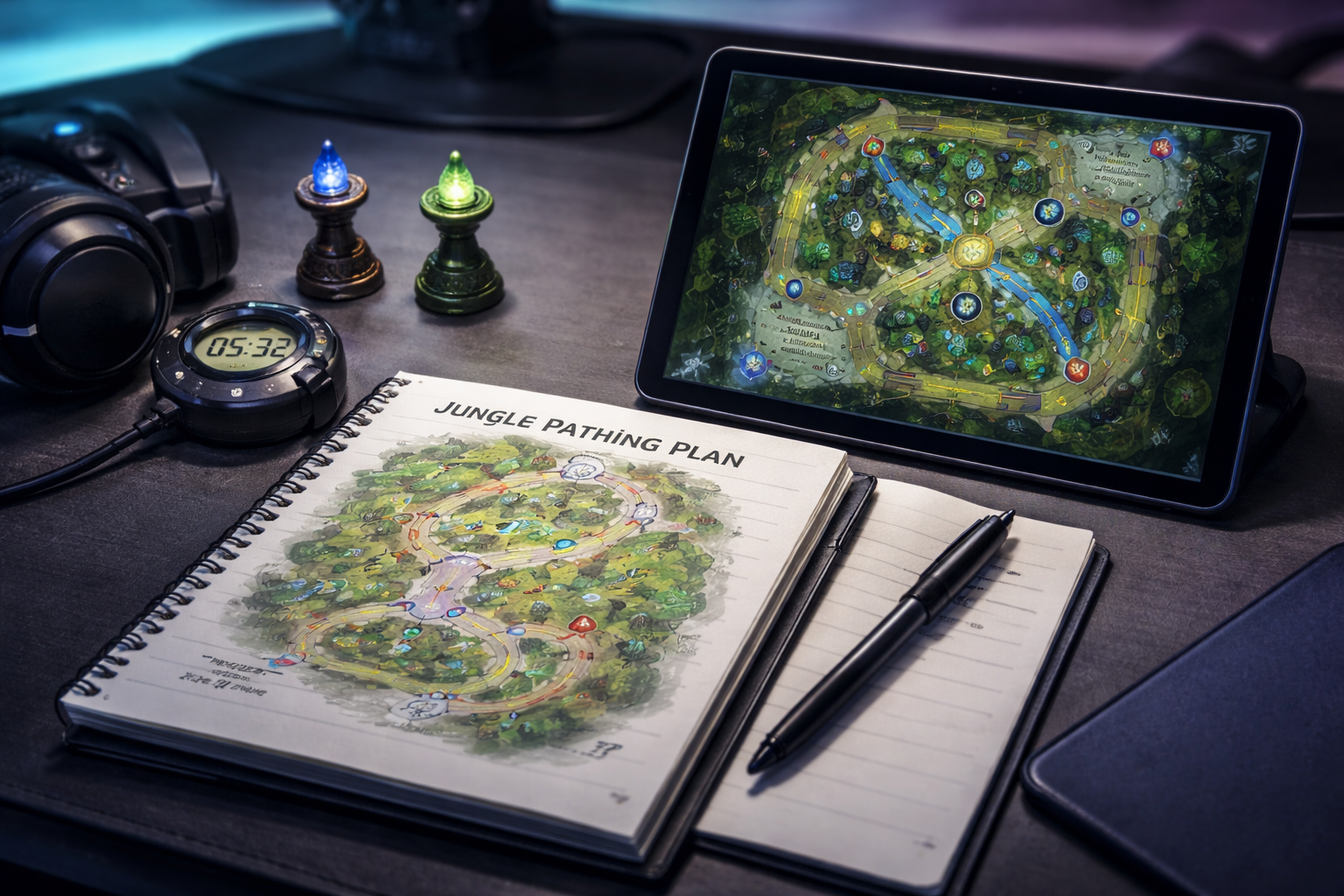
Start when at least one of these is true:
- You saw the enemy jungler on the other side of the map.
- You have stronger nearby lanes that can move first.
- You have vision control and can turn to fight.
- The enemy is low or forced to recall.
If none are true, you’re often starting a coinflip. Better options: take camps, take vision, force a pick, or trade the objective cross-map.
Trading objectives: the adult way to jungle
Trading is not “losing.” It’s choosing the best map value available. If the enemy commits multiple players to a dragon, a clean trade could be:
- Rift Herald + plates,
- enemy top-side camps,
- a tower dive on the opposite lane,
- deep vision that sets up your next play.
The key is being decisive. If you trade, trade hard—don’t half-contest and get nothing.
Smite fights and why you should avoid them
“50/50” smite fights feel dramatic, but they’re unreliable. Your goal is to remove the 50/50 by:
- forcing the enemy jungler to show elsewhere,
- zoning them with vision control and lane priority,
- turning to fight them before the objective is low.
If you must take a contested objective, set it up so you can turn and win the fight first. Objectives are safer when your team is ready to stop the enemy from walking in for free.
9) Counterganks, Covers, and “Shadowing” Lanes
Many games are decided not by flashy ganks, but by preventing disaster. A countergank is when you are ready for the enemy gank and turn it into a win. A cover is when you hover briefly to protect a lane from an obvious threat, then leave. Shadowing is moving through fog near a lane so the enemy can’t gank it safely.
How to know a lane is about to be ganked
- Your lane is pushing with no vision.
- Your laner is low and trying to crash a wave.
- The enemy laner suddenly plays more aggressively.
- The enemy jungler’s predicted path lines up with this lane.
- River wards go dark right before the wave reaches mid-river.
Countergank timing: arrive before it starts
Counterganks fail when you show late. If you suspect a gank, you want to be there slightly early, hidden, so the enemy commits. If you wait until you see the enemy jungler, it’s often too late—your laner is already using cooldowns or dying.
The best part: counterganks protect tempo
Good counterganks don’t require long hovering. You path near the lane as part of your route, gather information, and only commit when it’s live. That means you protect lanes without sacrificing your entire clear.
10) Vision for Junglers: Wards That Create Real Information
Vision isn’t just “place wards.” It’s placing wards that answer a question: Where is the enemy jungler going next?
Two categories of vision: defensive and offensive
Defensive vision (protect your lanes and camps)
- river entrances near pushing lanes,
- your jungle entrances when you fear invades,
- objective approaches when an objective matters soon.
Offensive vision (track and punish)
- deep wards on enemy camp paths (not just bushes),
- wards behind objectives to spot rotations,
- wards that reveal whether a camp was taken recently.
Vision timing: place wards when you have tempo
The best time to place deep vision is when:
- you just saw the enemy jungler on the other side,
- your lanes have priority,
- you are resetting and can refresh wards safely,
- you are moving through enemy jungle for a planned invade.
The worst time is when you’re weak, your lanes can’t move, and you’re walking into fog. That’s not “vision”; that’s donating tempo (or a death).
Sweeper and control wards: what they really do
Vision denial is how you create gank windows. If the enemy sees you, your gank angle collapses. So whenever you plan to influence a lane or objective:
- clear the common ward spots on approach,
- place a control ward that protects the route you’re using,
- then commit quickly—don’t clear wards and then waste time.
A small but important habit: after clearing a ward, ask: “What did this ward protect?” That often tells you what the enemy was afraid of—ganks, objectives, or invades.
11) Midgame Pathing: Side-to-Side Cycles and Pressure
Early game is about building your foundation. Midgame is about repeating your advantage. The best junglers run a simple midgame concept: side-to-side cycles.
You clear camps on one side, influence that side (gank, objective, vision), then reset and move to the other side when your camps and the next event call you there.
Midgame pathing goals
- Protect your carry lanes by covering predictable threats.
- Create numbers by being first to skirmishes.
- Convert kills into towers (don’t stop at the kill).
- Keep your income stable so you don’t fall behind in levels.
How to stop “wandering” in midgame
Wandering happens when you don’t have a next event. Fix it with a simple rule: After every reset, choose a side and commit to a full cycle there.
Then ask:
- Which lane on this side has the best window in the next minute?
- Which objective could matter soon?
- Where can I place one high-value ward without dying?
If you do this consistently, you will naturally be more “present” at fights without forcing random ganks.
Pressure pathing: gank once, threaten twice
High-level jungle pressure is about making the enemy feel unsafe. If you gank top and burn flash, your next cycle should often include a top revisit—even if you don’t fully commit. The threat itself changes how the enemy plays and can win a lane without another kill.
12) Replay Checklist: Fix Your Pathing Fast
Watching full replays is slow. Use a checklist that targets jungle fundamentals. Review these moments:
A) The first 4 minutes
- Did I choose a start side based on a plan, or habit?
- Did I know the enemy start side? If not, why?
- Did I waste time hovering early?
- Did I take a low-percentage gank that cost camps?
- Did I fight early without lane priority?
B) Every time I showed on the map
- What did I gain from showing? (kill, flash, wave, vision, objective)
- What did the enemy gain while I showed? (camps, objective, gank elsewhere)
- Was my action worth the information I gave away?
C) My resets
- Did I reset on a purpose (buy spike / objective setup) or because I was forced?
- Did I reset when camps were up on my side?
- Did I arrive late to an objective because I delayed my reset?
D) Objective windows
- Did we set vision first?
- Did we have lane priority?
- Did I track the enemy jungler before starting?
- Did we turn to fight when we should have?
E) Gank windows
- Was the wave actually gankable?
- Did we have enough control (CC/angle) to convert?
- Did I commit quickly or hover too long?
- Did I repeat-gank after a burned flash?
If you score yourself honestly, you’ll usually find one big leak: hovering, bad resets, or missing tracking basics. Fix one leak at a time and your rank will move.
13) Practice Drills: Build Instincts in 20 Minutes
Jungle skill improves fast when you train “micro-decisions,” not just play games. Here are drills you can repeat without relying on patch-specific tricks.
Drill 1: The “10-second plan” drill
- Enter a practice environment or a normal game.
- After every camp, say out loud: “Next 10 seconds: ____.”
- If you can’t answer, default to clearing toward your planned lane or placing a safe ward.
This builds tempo awareness and reduces wandering.
Drill 2: Start-side tracking drill
- In your next 10 games, focus only on identifying the enemy start side.
- Write it down mentally at 0:45–1:00 based on lane arrivals/wards.
- At 3:00–4:00, check if your prediction matched their first appearance.
This trains the most valuable early tracking skill.
Drill 3: The 5-second gank commit
- Approach a lane on your route.
- Count to five while evaluating angle/control/wave.
- Commit or leave—no hovering.
This single habit boosts tempo and keeps your income stable.
Drill 4: Objective setup rehearsal
- Pick one upcoming objective in a game.
- One minute before it matters, do the setup checklist: reset, clear toward, vision, lane priority.
- Win or lose, review whether you were early enough and whether you had vision control.
These drills build consistency. Consistency is what climbs.
14) FAQ
Should I always full clear?
Not always. Full clearing is a stable default, especially for scaling junglers or volatile games where forced ganks lose tempo. But if a lane is truly free (overextended, no flash, strong setup), a three-camp into gank can be correct. The timeless answer is: clear by default, deviate for guaranteed value.
How do I track better if my teammates don’t ward?
Use the clues you control: start side inference, lane states, and the enemy jungler’s appearances. Place one high-value defensive ward near the lane most likely to be ganked, and one deeper ward when you have tempo. Tracking is a loop—predict, verify, update—even with imperfect vision.
Why do my ganks “never work”?
Usually one of these:
- you’re ganking without a real window (wave not gankable),
- your angle is warded,
- your laner can’t follow (low HP, big wave, no cooldowns),
- you hover too long and lose tempo.
Fix it by using the angle/control/wave checklist and the 5-second commit rule.
What if the enemy jungler is perma-ganking and my lanes are losing?
First, stop bleeding: cover the most punishable lane and place defensive vision. Second, punish cross-map: take camps, take vision, take an objective trade. Third, stabilize your tempo with clean resets and efficient clears so you don’t fall behind in levels. Perma-gankers rely on you panicking—don’t give them that.
What’s the fastest way to improve jungle decision-making?
Reduce your biggest tempo leak (usually hovering or bad resets) and improve one tracking habit (start-side prediction). Do that for 20 games and you will feel a real difference.
15) Optional Help for Faster Climb
If you’re applying these fundamentals but still feel stuck—often because you’re in inconsistent games or you want a faster push to a goal rank— you can also explore competitive help options. For example, Boosteria’s pricing page for ranked climb services is here: https://boosteria.org/elo-boost/prices. Whether you use it or not, keep the core focus: strong tempo, reliable tracking, and ganks only when the window is real.
Jungle isn’t about doing everything. It’s about doing a few things consistently: clear with purpose, move with tempo, track with clues, and punish with high-percentage windows. Master that, and LoL starts to feel controllable.