



Overwatch 2 Positioning: Tank Space, DPS Angles, Support Safety
Overwatch 2 — Positioning by Role: Tank Space, DPS Angles, Support Safety
If your aim is average but your wins are inconsistent, positioning is usually the missing piece. In Overwatch 2, fights are fast, sightlines are long, and one misstep can snowball into a lost objective. The good news: positioning is learnable, repeatable, and largely timeless. Balance patches change numbers, but they rarely change the geometry of maps or the core truths of space, angles, and safety.
This guide breaks down positioning through a simple role framework that works in any rank and across metas: Tanks manage space, DPS create pressure with angles, and supports stay safe while enabling. You’ll learn how to read the map, choose strong “default” spots, rotate without feeding, and move through the phases of a fight with intention.
We’ll reference a few stable, trusted resources for official role/game context and general terminology. For official Overwatch information, see the game’s homepage on overwatch.blizzard.com. For account, safety, and general policies, Blizzard’s support portal is a reliable hub: us.battle.net/support. For a plain-language definition of line of sight (LOS), you can also reference Wikipedia’s Line of sight page.
The Positioning Triangle: Space, Angles, Safety
Think of Overwatch 2 positioning as a triangle where each role “owns” a core responsibility: tanks own space, DPS own angles, and supports own safety. You still overlap (a tank can play an angle, a support can take an angle, a DPS can be safe), but the triangle keeps your decisions consistent.
What “space” means in Overwatch 2
Space is the part of the map your team can occupy without instantly dying. When your tank wins space, your team gains better sightlines, shorter rotations, and safer access to objectives. When your tank loses space, everyone else gets squeezed into predictable routes where you’re easy to spam, dive, or collapse on.
What “angles” mean in Overwatch 2
An angle is any position that changes the direction of threat. If two DPS shoot from the same place, the enemy can hide behind one corner and reduce both threats at once. If your DPS create multiple angles (even small off-angles), the enemy must split attention, cooldowns, and positioning. Angles are how you turn “damage” into “pressure.”
What “safety” means in Overwatch 2
Support safety is not passive hiding. It’s survivable access to your team: staying alive while maintaining line of sight, healing/utility uptime, and escape options. A support who is alive with good LOS is usually more valuable than a support who took a greedy angle, forced a play, and died first.
When the triangle is healthy:
- The tank occupies (or threatens) a forward corner, doorway, or lane that controls movement.
- DPS spread to create at least two threat directions (main lane + off-angle or high ground).
- Supports sit in cover with LOS to the tank and at least one DPS, with a clean retreat path.
Universal Rules That Don’t Age
Metas shift, heroes rotate in and out, and numbers change. But these positioning rules stay relevant because they’re based on geometry, human reaction time, and how fights actually unfold.
Rule 1: “Corner before courage”
Corners are the strongest “ability” in the game. A corner gives you instant cover, breaks enemy line of sight, and forces opponents to walk into danger to keep shooting. If you don’t know where to stand, stand one step from cover where you can peek to contribute and duck to reset.
Rule 2: Always have two exits
A safe position usually has two escape routes: a backwards retreat and a sideways rotation (or a vertical drop). If your only escape is “walk forward through them,” you’re in a trap. Before you commit to an angle, ask: “If they look at me right now, where do I go?”
Rule 3: Win the fight, then take space
After you secure a pick or force major cooldowns, you should often step forward to claim better ground. Many teams fail to convert advantages because they keep standing in the old spot. Space gained after a win is what turns one fight win into objective progress and ult economy advantage.
Rule 4: Don’t stack the same sightline
If three people see the same angle, the enemy can counter with one piece of cover, one shield/ability, or one flanker. Spread just enough that the enemy can’t answer everything at once, but not so much you can’t help each other.
Rule 5: High ground is a privilege, not a religion
High ground is powerful because it improves visibility, reduces enemy headshot angles, and offers safe drop options. But high ground becomes bad if:
- You can’t influence the objective from there.
- You can’t escape a dive.
- You’re isolated from your support line of sight.
Take high ground when it provides value + survivability. Leave it when it becomes a cage.
Rule 6: Positioning is timing
The same spot can be genius or grief depending on when you take it. The classic example: a DPS flank that starts after the fight begins is often too late. A flank that starts before the fight and connects exactly as your tank engages is often fight-winning. Positioning decisions must match the fight phase (we’ll cover this in detail).
Rule 7: Spend health like a currency
Good positions reduce how much health you “spend” to do your job. If you’re taking constant spam damage just to exist, your supports are forced to heal you instead of using utility, and your tank is forced to slow down. The best default positions let you contribute while taking minimal “chip damage.”
How to Read Any Map in 20 Seconds
You don’t need to memorize every map to position well. You need a repeatable process to identify lanes, chokes, cover, and rotation options. Use this quick scan at the start of every round and after every reset.
Step 1: Identify the main lane
The main lane is the most direct path from your spawn to the objective. It usually has the widest sightline and the highest spam risk. Main lane is where tanks often show presence, but it’s rarely where all five players should stand.
Step 2: Find the “power corner”
The power corner is the corner or doorway closest to the objective that offers strong cover and lets your tank threaten forward. If your tank can hold this corner without instantly exploding, your team has a stable anchor.
Step 3: Mark one high ground and one off-lane
Look for:
- High ground that overlooks the fight (good for DPS and some supports).
- An off-lane that leads to a side angle (a short flank, not a 20-second adventure).
Step 4: Choose a support “safe room”
Supports should identify a spot that has:
- Hard cover (a wall, pillar, doorway) within one step.
- Line of sight to the tank’s anchor area.
- A retreat route that doesn’t cross the enemy’s main sightline.
Step 5: Ask the golden question
“Where do we go next if we win this fight?” Great teams pre-plan the next position. If you win, you push to the next corner. If you lose, you fall back to a known reset point. This alone prevents stagger deaths and messy trickle fights.
If you want a mental model: imagine the map as three connected “rooms” (even outdoors): your room (safe), the contest room (the fight), and their room (danger). Tanks decide how far into the contest room you can stand, DPS decide which doors you threaten from, and supports decide where the safe door is.
Positioning Through the Phases of a Fight
Most positioning mistakes come from playing the wrong phase. People either engage too early (before resources are ready) or too late (after the fight is already decided). Treat each fight as five phases: setup, engage, brawl, cleanup, and reset.
Phase 1: Setup (staging)
Setup is where positioning matters the most because it determines whether you start the fight with advantage or desperation. In setup:
- Tanks take a forward corner or “show presence” to stop enemy free walks.
- DPS take early angles that are safe and quick to leave.
- Supports take LOS spots with cover and identify peel options.
Setup ends the moment a team commits resources (a hard engage, a dive, a big cooldown).
Phase 2: Engage (the first commitment)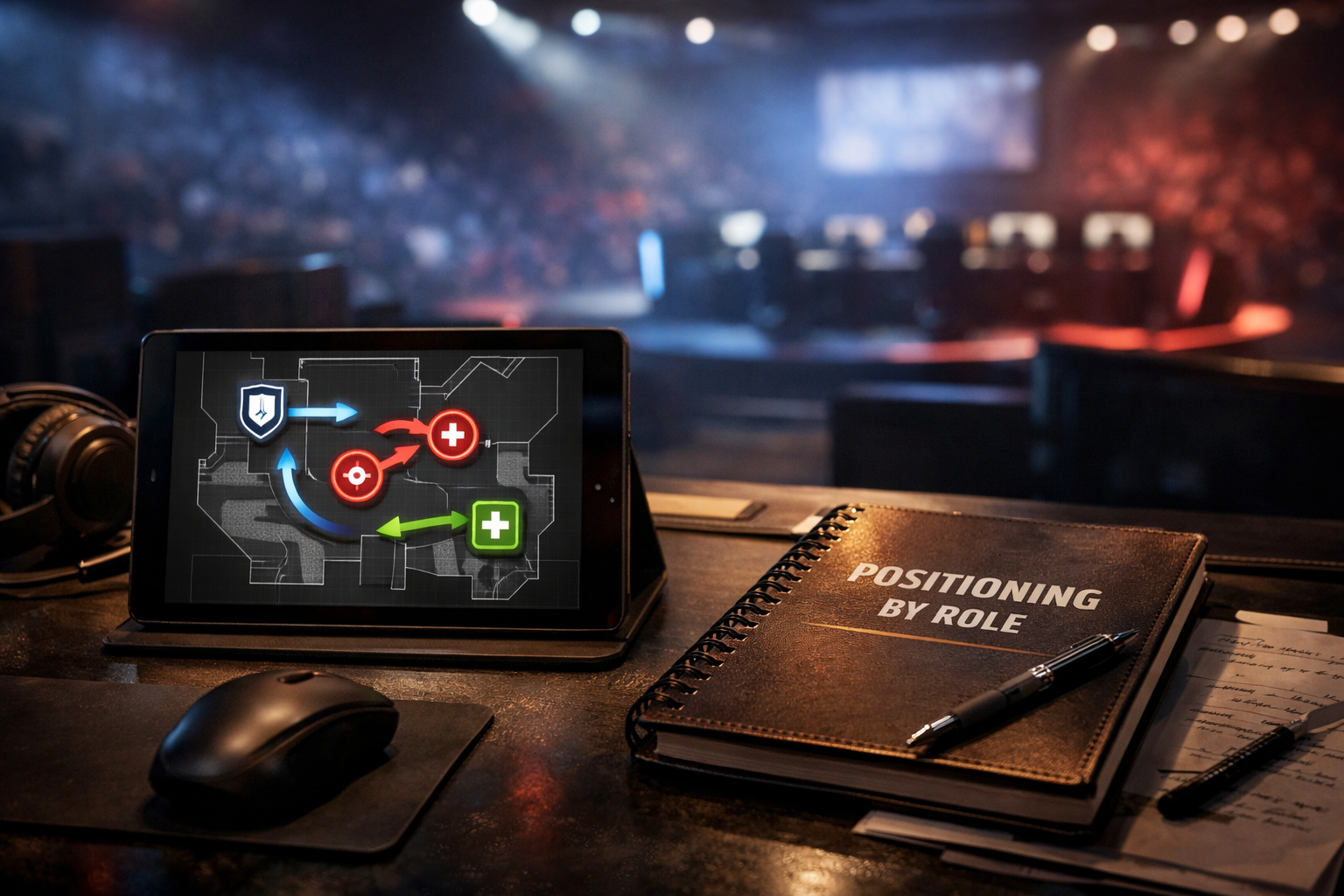
Engage is the first moment someone is forced to respond. The best engages happen when:
- The tank threatens space at the same time DPS angles become active.
- Supports are already in a safe position with LOS, not scrambling.
- Your team has a clear target: an isolated enemy, a trapped support, or an overextended DPS.
Phase 3: Brawl (resource trading)
This is the “messy” part of the fight where cooldowns trade and people take damage. Positioning here is about:
- Keeping your cover relationship (peek-shoot-hide rhythm).
- Maintaining lines of support (LOS and range).
- Not drifting into open space just because you’re excited.
Phase 4: Cleanup (convert picks)
When you gain an advantage, you can widen your positioning: push angles, deny exits, and take space that prevents re-contests. Cleanup is also where you must avoid feeding: don’t chase into their spawn doors, and don’t split so far you get traded.
Phase 5: Reset (no staggering)
The reset phase is where discipline wins games. If the fight is lost, stop taking “one more peek.” Use positioning to survive and regroup: give space, fall back behind cover, and meet at a consistent spot. A clean reset saves ult economy, reduces staggers, and makes your next setup stronger.
Tank Positioning: Creating and Holding Space
Tanks are not just damage sponges. They are space managers. Your goal is to create a playable area where your team can stand, shoot, heal, and rotate. The easiest way to improve tank positioning is to stop thinking “Where do I fight?” and start thinking “Which space do I deny, and which space do I claim?”
The three kinds of tank space
- Hard space: physically occupied space. If you are standing there, the enemy must respect it.
- Soft space: space controlled by threat. You don’t stand there, but you could punish someone who does.
- Rotational space: safe paths your team can use to move between positions.
Great tanks win fights by converting soft space into hard space at the right time, while keeping rotational space available for their supports and DPS.
Default tank positioning: the “anchor corner”
Your default should be a corner, doorway, or natural cover point near the objective that:
- Lets you contest or threaten the objective without standing in the open.
- Allows your supports line of sight from a safe backline angle.
- Creates a clear “line” your DPS can play off (main lane pressure).
If you are tanking in the open, you are giving the enemy free value. Corners force enemies to step into your threat range. They also let you take “micro-peeks”: show presence, bait cooldowns, then reset.
Space timing: when to step forward and when to give ground
A tank’s biggest positioning mistake is holding space at the wrong time. Use this simple rule: step forward when you have resources; step back when you don’t.
Resources include:
- Your defensive cooldowns (or mobility to disengage).
- Your support’s ability to see and help you (LOS and range).
- Your DPS readiness (angles established, not rotating mid-fight).
- Enemy cooldowns forced or unavailable.
If any of these are missing, you can still “show” at the corner, but don’t hard-commit into open space. Tanks that die first almost always committed while one of these resources was missing.
Playing chokes: make them pay to enter
Chokes are where you convert positioning into value. Your goal is not to stand in the choke and get melted. Your goal is to hold a corner that controls the choke. That means:
- You can see the choke entrance.
- You can punish anyone walking through it.
- You can retreat behind cover if pressured.
If you walk into the choke too early, you remove the enemy’s decision-making cost. Instead, hold the doorframe/corner, let them step in, then take a decisive engage when they are committed and your team is ready.
Vertical space: contesting high ground without feeding
High ground is often controlled by DPS, but tanks influence it by threat and timing. If the enemy owns high ground and it is deciding fights, you have three positioning answers:
- Ignore it and rush the objective (force them to drop).
- Contest it with a timed push (only when supports can follow or you can escape).
- Cut off rotations (hold a spot that stops them from returning to high ground).
The most common error is “solo contest high ground” without your team’s angles set. You jump up, get focused, supports can’t see you, and you lose the entire fight. High ground contests must be coordinated in timing and line of sight.
Tank positioning by playstyle: brawl, poke, dive
Brawl-style space (close-range pressure)
In brawl, you want to hold a corner near the objective and force fights where your close-range damage and sustain matter. Positioning keys:
- Shorten distances: move corner-to-corner, not open-to-open.
- Protect supports by staying within peel distance when needed.
- Engage when your DPS are in position to follow, not when they are rotating.
Poke-style space (sightline control)
In poke, space is about denying lanes and slowly forcing the enemy out of cover. Positioning keys:
- Stand where you can break LOS quickly to avoid burst damage.
- Hold angles that protect supports from long sightlines.
- Advance only after forcing key cooldowns or a pick.
Dive-style space (threat zones and collapse timing)
In dive, your “space” is often a threat bubble. You may not stand forward permanently, but the enemy must respect your ability to collapse. Positioning keys:
- Stage from cover where you can engage quickly and disengage safely.
- Track where your supports can see you (or where you can return for help).
- Engage in sync with DPS angles—diving alone is just feeding.
Micro-positioning: the tank “peek rhythm”
A simple habit that improves tank survivability: peek, pressure, retreat. Peek to show presence and gather information. Pressure to force enemy attention or cooldowns. Retreat to reset and preserve resources. This rhythm keeps you alive longer and makes your engages cleaner.
Tank checklist (timeless)
- Am I one step from cover?
- Can my supports see me from a safe spot?
- Are my DPS angles active, or are they still rotating?
- If I step forward, do I have an exit plan?
- After a pick, did I claim the next corner?
DPS Positioning: Off-Angles, Crossfires, and Timing
DPS positioning is where most games are quietly decided. You don’t need highlight-reel mechanics if you consistently take angles that force the enemy into impossible decisions. The goal is simple: make the enemy choose between two bad options.
Main angle vs off-angle
The main angle is where your tank is pressuring (the “front”). The off-angle is a position that sees the same fight from a different direction—often a side doorway, a short flank, or high ground.
Off-angles are powerful because they:
- Break enemy cover usage (their corner no longer blocks all damage).
- Force enemy supports to heal while moving (lowering efficiency).
- Create pick opportunities on distracted targets.
But off-angles must be short and survivable. A good off-angle is usually 2–6 seconds from your team, not 15–20 seconds away. If you need a long journey to reach your angle, the fight will start without you.
The “crossfire” win condition
A crossfire happens when the enemy is threatened from two directions such that any cover they use exposes them to the other angle. Crossfires are the most consistent way to win fights without relying on a single big ultimate.
To build a crossfire:
- Identify the enemy’s likely cover spot (their corner, doorway, payload edge).
- Take an angle that punishes that cover (a side view or elevation).
- Time your pressure with your tank’s engage so attention is split.
Angle discipline: don’t die for the angle
Most DPS players over-learn “take off-angles” and under-learn “leave off-angles.” The moment you are looked at by multiple enemies, your job becomes survival, not stubbornness.
A healthy rule: If you are forced to use your only escape cooldown just to stay alive, the angle was too greedy. Great DPS rotate between angles, applying pressure in bursts, not standing in one spot until they get collapsed on.
High ground DPS positioning
High ground is often a DPS home because it offers:
- Cleaner shots and better target access.
- Safer retreat options (drop down, step back, break LOS).
- Better control of enemy rotations.
But you still need an exit plan. Before you commit to high ground, confirm:
- Where is the nearest cover on the high ground?
- If I’m dived, can I drop to my supports or to my tank?
- Will my supports have LOS to me if I take damage?
Short flanks vs long flanks
A short flank is an angle that reconnects quickly to your team and keeps you relevant in the fight. A long flank is a route that takes too long and often leaves your team fighting 4v5.
Short flanks usually:
- Take one side doorway or staircase.
- Put you at a diagonal angle to the objective.
- Let you rejoin your supports within a few seconds.
Long flanks usually:
- Go behind the enemy’s entire position.
- Require multiple corridors and no quick retreat.
- Only work if the enemy is heavily distracted and slow to respond.
In most ranked games, short flanks win more consistently because they’re safer and match the pace of fights.
DPS positioning by archetype (timeless)
Hitscan / ranged pressure
Your positioning goal is stable sightlines with cover: you want to see targets as they cross open space, but you don’t want to be the first person visible to the entire enemy team.
- Play near a corner with a narrow peek window.
- Use high ground when it gives clean LOS and safe drops.
- Rotate after you get attention—don’t duel 1v5 sightlines.
Flankers / close-range assassins
Your positioning is about timing and escape routes.
- Stage near the fight before it starts (setup phase).
- Engage when the tank pressure begins, not after.
- Keep an exit path that avoids the enemy’s main lane.
Projectile / spam pressure
Your positioning aims to control chokes and punish predictable routes.
- Use angles that force enemies off corners and off payload edges.
- Position so you can spam safely without being hard focused.
- Rotate with your tank’s space—spam from the new corner after wins.
DPS synergy with tank space
The cleanest DPS positioning aligns with your tank’s space plan:
- If the tank holds a corner, you take a diagonal angle that sees around that corner.
- If the tank dives, you take an angle that threatens the same target from another direction.
- If the tank is forced to retreat, you rotate early so you don’t get caught alone.
DPS checklist (timeless)
- Am I creating a different threat direction than my tank?
- Do I have two exits (back + sideways/drop)?
- Can my supports realistically see me if I take damage?
- Is my angle short enough to be active when the fight starts?
- After I get attention, do I rotate instead of ego-dueling?
Support Positioning: Safety Without Losing Value
Support players often hear “stay in the back,” but that advice is incomplete. You need safe access: a position that keeps you alive while letting you heal, enable, and use utility at high uptime. Support positioning is less about distance and more about cover + LOS + escape.
The support safety triangle
A support-safe position usually satisfies three conditions:
- Cover: you can break line of sight instantly.
- LOS: you can see your tank’s anchor area and at least one DPS angle.
- Escape: you can retreat without crossing open main lane.
If you only have two of the three, you are vulnerable. For example: LOS + cover but no escape can still get you trapped by a dive. Escape + cover but no LOS makes you useless.
Distance is a tool, not the goal
Being far away reduces the chance of getting instantly burst, but it also:
- Makes it harder to heal fast-moving teammates.
- Reduces your ability to follow a tank’s space push.
- Can isolate you if a flanker cuts you off.
Instead of “play far,” aim to play at your maximum safe effectiveness: close enough to contribute reliably, far enough to survive.
Line of sight management (the most underrated support skill)
Supports win games by controlling LOS. You want to see your team, but you don’t want the enemy to see you. That often means:
- Standing behind a corner and “shoulder peeking” to heal.
- Using windows and doorframes as narrow sightline tools.
- Breaking LOS during enemy burst windows, then re-peeking to stabilize.
A key concept: heal from safety, rotate during calm. Many supports rotate at the worst time—mid-burst—because they were positioned with no retreat path. Pick positions where you can stay calm during pressure.
Anti-dive positioning: making yourself expensive to kill
Divers and flankers thrive on isolated supports. Your goal is to make a dive require too many resources. “Expensive to kill” looks like:
- You are near cover that breaks LOS quickly.
- You are within peel distance of your tank or a DPS.
- You can kite through a doorway into teammates, not away from them.
- You avoid standing in predictable open backline sightlines.
If you get dived and your first instinct is to run in a straight line into open space, you were likely positioned without a plan. Instead, pre-plan a “kite route” that drags the diver into your team’s threat.
Support positioning when your tank pushes space
This is where most support players feel “left behind.” The answer is usually not “follow deeper.” The answer is rotate in parallel.
Parallel rotation means: as your tank moves from one corner to the next, you also move from one safe cover point to the next, maintaining LOS without exposing yourself to the enemy main lane. You are moving forward, but sideways and behind cover.
Support positioning by style: tempo vs stability
Supports generally fall into two positioning mindsets:
- Tempo supports (playmakers): may take short angles to use utility, then return to safety.
- Stability supports (anchors): prioritize survival and consistent LOS to keep the team alive.
Both styles work, but both require discipline. If you play tempo, make your peeks short and planned. If you play stability, don’t become so passive that you lose LOS and let teammates die outside your view.
The “support pocket trap”
A common positioning mistake is hard-pocketing a teammate from a bad location. You stand in the open to keep LOS to a DPS on a greedy angle, then you die first and the DPS dies second. Fix this by prioritizing your own survivable position: if a teammate’s angle forces you into danger, it’s often the angle that should change.
Support checklist (timeless)
- Am I one step from hard cover?
- Do I have LOS to my tank’s anchor corner?
- Do I have a kite route that leads into my team (not away)?
- Am I rotating in parallel when we take space?
- Am I avoiding “saving” someone in a way that gets me killed?
Team Shapes: Where the Roles Should Sit Together
Great positioning is not five independent choices. It’s a shape. When teams lose, they often look like: everyone stacked on one line, or everyone scattered in five directions. A strong team shape usually resembles: tank forward, DPS split, supports behind cover.
The “T” shape (simple and effective)
Picture a capital T:
- The tank is the top of the T, holding the forward corner.
- One DPS is near the tank (main lane), the other is on a short off-angle (the other side of the top bar).
- Supports are the stem: behind cover, centered enough to see both sides.
This shape creates crossfire without isolation and gives supports predictable LOS lines.
The “Triangle” (dive-friendly)
Dive-friendly positioning often forms a triangle:
- Tank and one DPS threaten an engage point.
- Second DPS threatens from an angle that forces attention split.
- Supports hold a safe vertex that can see the engage and provide peel routes.
The triangle collapses when the engage starts, then re-forms after the fight.
Spacing rules between teammates
- Don’t stack: avoid giving the enemy easy multi-target value.
- Don’t isolate: stay within help range (peel distance) unless you have a clear escape plan.
- Stagger angles: DPS should rarely be shoulder-to-shoulder unless finishing cleanup.
Who should see whom?
A timeless LOS priority:
- Supports should reliably see the tank’s anchor area.
- At least one support should have LOS to each DPS most of the time.
- DPS should see targets the tank pressures, but from different angles.
Objective Types: Payload, Control, Push, Hybrid
Positioning changes slightly depending on the objective because the “must stand here” requirement changes. The principles remain the same, but where you anchor and where you angle shifts.
Payload (Escort)
The payload is moving cover. Treat it as:
- A shield: play corners and payload edges to break LOS.
- A magnet: don’t stack all five on it; use it while DPS hold angles.
- A timing tool: push after wins, stabilize behind it after losses.
Tank positioning often anchors at the next corner ahead of the payload, not on the payload itself. DPS can use nearby high ground and side angles to deny re-contests. Supports should use payload cover while maintaining LOS to forward space.
Control (King of the Hill)
Control maps reward winning the area around the point, not just standing on the point. A common timeless rule: Win the surrounding power positions, then the point becomes easy.
Tanks often anchor near the most important entrance or power corner. DPS take high grounds and off-angles that watch the main entrances. Supports pick safe rooms with cover and easy retreat.
Push
Push often creates long, repeating fights around corners and mid-map power positions. Positioning tips:
- After each win, take the next corner before the robot walks there.
- Use off-angles to punish enemies attempting to re-enter through predictable doors.
- Supports rotate in parallel to keep LOS as the fight moves.
Hybrid
Hybrid mixes the “first-point fight” (often tight chokes) with escort-style rotations. Treat first point like a choke-control puzzle: tanks control the door/corner, DPS take off-angles that punish the choke, supports hold safe LOS. After capture, shift to payload rules: take forward corners and high grounds, use the cart as moving cover, and keep crossfires active.
Common Positioning Mistakes (and Quick Fixes)
Tank mistakes
- Standing in open main lane.
Fix: Play one step from cover; use corners to peek and reset. - Engaging before DPS angles are set.
Fix: Count a short “setup beat” before hard committing; engage when pressure arrives from multiple directions. - Not taking space after a pick.
Fix: After advantage, claim the next corner and deny the enemy’s retreat/rotation. - Chasing too deep in cleanup.
Fix: Convert fight wins into objective progress; don’t donate staggers to the enemy.
DPS mistakes
- Stacking with the team and shooting the same angle.
Fix: Take a small off-angle or high ground that changes threat direction. - Long flanking and missing the fight.
Fix: Prefer short flanks; be active when the engage begins. - Refusing to rotate after getting attention.
Fix: Apply pressure in bursts; rotate when focused to stay alive and re-threaten from a new angle. - Angle with no exit.
Fix: Always identify two escapes before committing.
Support mistakes
- Healing in the open “because LOS.”
Fix: Use corners and shoulder peeks; make LOS narrow and safe. - Rotating during enemy burst windows.
Fix: Rotate in calm moments (setup or after trades), not mid-collapse. - Running away from the team when dived.
Fix: Kite through doors and corners toward teammates; make the dive expensive. - Hard-pocketing a greedy teammate from a bad spot.
Fix: Prioritize your survivable position; encourage teammates to take angles you can actually support.
Team-wide mistakes
- Everyone on objective, no angles.
Fix: One person can “touch”; others should hold power positions and sightlines. - No plan after winning a fight.
Fix: Identify the next corner/high ground and rotate immediately after the fight win. - Staggering after a lost fight.
Fix: Fall back early, regroup, and re-stage together.
Drills, Checklists, and VOD Review Prompts
The fastest way to improve positioning is to build simple habits and review one concept at a time. Use these drills 10–15 minutes a day or apply them in VOD reviews.
Drill 1: “Cover step” habit (all roles)
- Pick a corner near the objective.
- Practice peeking to shoot/heal for 1–2 seconds.
- Return behind cover for 1 second.
- Repeat, maintaining calm rhythm.
Goal: make “one step from cover” automatic, even in chaotic fights.
Drill 2: 20-second map scan (between fights)
Every time you reset, quickly call out (even to yourself):
- Main lane
- Power corner
- One high ground
- One off-lane angle
- Support safe room
Goal: stop autopiloting the same route every fight.
Drill 3: “Angle timing” for DPS
In replays or quickplay, practice arriving at your off-angle before the engage. Your rule: angle first, shots second. If the engage happens and you are still walking, you were late.
Drill 4: “Parallel rotate” for supports
In any match, when your tank takes one corner forward, you take one safe cover point forward that keeps LOS but avoids open main lane. If you ever lose LOS, you rotated too late or chose the wrong route.
VOD review: 10 questions that reveal everything
- Where was my nearest cover at the moment I took fatal damage?
- Did I have two exits from my position?
- Was my team split into angles or stacked?
- Did my tank have support LOS during the engage?
- Did DPS angles become active before the engage?
- Did supports rotate in parallel or get stranded?
- After a pick, did we take space or stay still?
- After a lost fight, did we reset cleanly or stagger?
- Which enemy position forced us into bad movement?
- What would one “corner earlier” rotation have changed?
A practical improvement plan (1 week)
- Days 1–2: Only focus on being one step from cover.
- Days 3–4: Add two-exit discipline for every angle/spot.
- Days 5–6: Focus on post-pick space taking (next corner).
- Day 7: Review one VOD and answer the 10 questions above.
FAQ: Practical Positioning Questions
How do I know if my off-angle is “too greedy”?
If your angle requires a long travel time, has only one escape, or forces your supports to stand in the open to help you, it’s usually too greedy. A good off-angle lets you shoot, force attention, and leave safely.
Should supports always play far back?
Not always. Play where you have cover, LOS, and a kite route. Sometimes that’s far; sometimes it’s mid-range behind a corner that moves forward with your team.
What’s the simplest tank positioning rule?
Hold a corner that your supports can see. Step forward when you have resources; step back when you don’t. Take the next corner after you win.
What if my team won’t take angles?
You can still improve your own positioning. As DPS, take a small off-angle that keeps you safe. As support, position to enable whoever is doing something. As tank, make your space “obvious” by anchoring corners and moving after wins. Small improvements still raise win rate over time.
Is positioning more important than mechanics?
They multiply each other. Better positioning gives you easier shots and more survivable fights, which makes your mechanics more effective. For most players, improving positioning yields faster results than grinding aim alone.
Wrap-Up: A Simple Plan to Improve Fast
If you remember only one thing, remember the triangle: tanks manage space, DPS create angles, supports protect safety. Positioning is not a single “best spot”—it’s choosing the right spot for the fight phase, your team shape, and your escape options.
Want a quick routine for every match?
- Scan the map: main lane, power corner, one high ground, one off-lane.
- Take setup positions before the engage.
- Fight from cover; keep two exits.
- After a pick, take the next corner.
- If the fight is lost, reset cleanly.
If you’re short on time and still want faster rank progress, you can explore Boosteria’s Overwatch options here: Overwatch Boosting Prices. (Always play responsibly and follow Blizzard’s rules and code of conduct.)