



League Macro Basics: Roams, Lane Swaps & Objectives
LoL Macro Basics: When to Roam, Swap Lanes, and Play for Objectives
Macro is the part of LoL that makes “even” games feel easy and “hard” games feel winnable. Mechanics win moments; macro wins minutes. If you’ve ever asked “Where should I be right now?” or “Do we fight this dragon?” this guide is for you. We’ll build a timeless decision framework for roams, lane swaps, and objective play that stays relevant across patches because it’s based on fundamentals: waves, information, tempo, and numbers.
This is written to be copy-paste friendly for WordPress and evergreen for long-term traffic. If you’re looking for faster improvement, you can also check Boosteria LoL Elo Boost pricing.
What “Macro” Actually Means in LoL
Macro is the set of decisions that converts small advantages into objective progress. It’s not “just rotations.” It’s choosing the right place, at the right time, for the right reason. Macro answers questions like:
- Should we push or reset before dragon?
- Is roaming worth losing a wave?
- Can we swap lanes to protect a weak side or unlock a tower?
- Do we trade Herald for dragon, or contest?
- Where should vision go to create a play?
Good macro reduces risk: you win without flipping fights. Bad macro increases chaos: you rely on outplaying constantly. The goal is to make your games feel “scripted” in your favor.
For official game fundamentals and terminology, Riot’s own LoL site is a solid baseline reference: League of Legends (official).
The 5 Core Macro Principles (Timeless)
1) Waves Decide Freedom
Roams, swaps, and objectives all start with one question: what is the wave doing? If you roam on a bad wave, you pay for it with plates, XP, and tempo. If you roam on a good wave, you get a “free” move. Your wave is your permission slip.
2) Information Creates Winning Odds
Macro is probability. You want to take plays that are 70–90% rather than 50/50. Vision, tracking, and lane states increase certainty. Blind plays are coin flips.
3) Tempo Beats Gold in the Short Term
Gold matters, but tempo determines who acts first. A 200 gold lead is meaningless if you’re late to every objective. Tempo is how you “spend” time to force the enemy to answer you.
4) Numbers Win Fights Before Mechanics
Being up one player at a skirmish is often more decisive than being up a component item. Your best roams and swaps create numbers advantages.
5) Objectives Are the Scoreboard, Not Kills
Kills should create objective access: towers, dragons, Herald, Baron, and deep vision. If a kill doesn’t lead to progress, it’s a detour.
Map Reading: The 10-Second Scan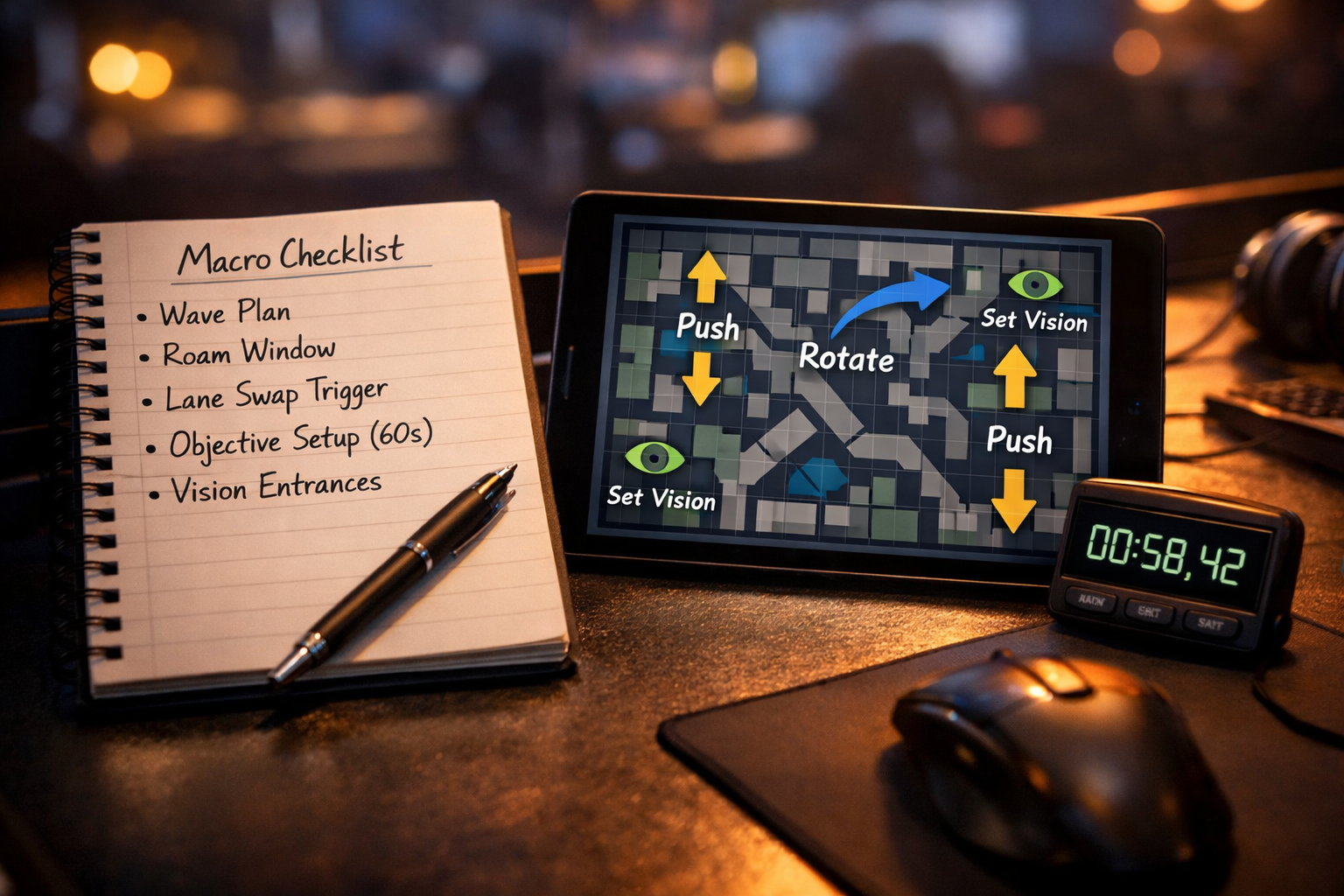
Strong macro players constantly run a short mental scan. You can do this every time you last-hit a cannon, recall, or finish a camp:
- Wave states: Which lanes are pushing, crashing, or bouncing?
- Junglers: Last seen? Likely side? Is a gank angle open?
- Ultimates/summoners: Who is vulnerable? What’s up for the next fight?
- Next objective: What spawns next and who has priority?
- Win condition: Are we playing for pick, split, or 5v5?
This scan turns “random roaming” into purposeful action. It also prevents the classic mistake: fighting on the wrong side of the map for the wrong reason.
Tempo: The Hidden Currency of Winning
Tempo is the ability to act while the opponent is forced to react. You gain tempo when:
- You crash a big wave and the enemy must clear it.
- You reset first and return with items while the enemy is stuck on the map.
- You take vision control while the enemy is catching waves.
- You threaten an objective that forces rotation.
You lose tempo when:
- You roam without pushing and the enemy takes plates and denies XP.
- You take a “greedy” wave right before an objective and arrive late.
- You chase a kill too long and miss the reset window.
Tempo Rule of Thumb
If you can make the enemy show on a wave, you can make plays elsewhere. If you can’t, your play is likely forced or risky.
Wave Control for Macro: Crash, Bounce, Freeze, Reset
You don’t need to be a wave theory expert, but you need a practical macro toolkit. Here’s the version that wins games.
Crash
A crash means you push your wave into the enemy tower so the tower kills your minions. The enemy must farm under tower or lose gold/XP. Crashing creates the best roam and reset windows.
Bounce
If you crash a wave, the next waves often push back toward you (because the enemy wave meets closer to their side after the crash). This “bounce” sets up safe farming and can bait the enemy to overextend.
Freeze
Freezing means holding the wave near your tower so the enemy must walk up far to farm. It’s powerful when you’re ahead and want to deny, or when you’re behind and want safety. But freezing can reduce your ability to roam because you’re committing to lane presence.
Reset
A reset is a recall timed so you lose minimal resources and return at the right moment. Good macro often looks like: push → crash → reset → arrive first.
The Cannon Wave Window
Cannon waves take longer to clear and often create slightly larger roam/reset windows. You don’t have to memorize timings: just recognize that cannon waves are “stickier” and can buy you seconds.
Wave Priority (Prio)
Priority means you can move first because your wave is pushed and the enemy is busy last-hitting. Prio is the permission to roam, ward, or start an objective without instantly losing your tower.
When to Roam (Mid, Support, Jungle, Even Top)
Roaming is not “leaving lane.” Roaming is spending a wave advantage to create a numbers advantage. Your best roams happen when you can leave without bleeding too much.
The Roam Checklist (Quick)
- Wave: Did I crash or at least secure the wave so I won’t lose a plate for free?
- Time: Is there enough time to move and return (or commit to a longer play)?
- Target: Is there a lane/objective that can actually be impacted?
- Info: Where is the enemy jungle/support? Is the river safe?
- Reward: If the roam works, what do we get (dragon, Herald, tower, deep wards)?
When Roaming Is Correct
- You have prio and the enemy cannot match without losing farm.
- An objective is coming and your roam secures vision or a pick.
- Your lane is stale (no kill pressure) but side lanes are volatile (low HP, no sums).
- You can cover a dive or countergank with numbers.
- Enemy is overextended in a side lane with limited escape.
When Roaming Is a Trap
- Your wave is pushing to you and leaving will cost you multiple waves and tower damage.
- You don’t know where the enemy is and your roam route crosses fog of war.
- Your roam has no follow-up (ally wave is bad, ally has no HP, target has summoners).
- You roam out of frustration (common in solo queue) instead of timing.
Role-Specific Roam Priorities
Mid Lane
Mid roams are powerful because you’re central. Your macro job is to convert mid prio into side control. Best mid roams often follow: push wave → disappear. Even if you don’t gank, your disappearance pressures the map. “Threatening a roam” can be as valuable as roaming.
Support
Supports roam to create numbers and vision advantage. Your roam timing often depends on bot wave state: when your ADC can safely farm (wave pushing to you) or when you can crash bot and move. A support roam that secures dragon vision 60–90 seconds early often wins objectives without fighting.
Jungle
Jungle “roams” are your default. The macro question is not “do I gank” but “which side do I play toward?” Your strongest moments are when lanes have prio and can move first. If your lanes are pushed in, forcing invades and fights is usually losing macro.
Top Lane
Top roams are rarer early, but they matter around Herald, mid tower, and deep vision. Teleport and timers make top macro unique: sometimes you don’t “walk roam” at all—you set a wave, reset, and arrive to a fight with TP advantage.
How to Roam: Routes, Vision, and Timing
Roam Types
- Direct roam: fast path to a gank angle when you know it’s open.
- Vision roam: you roam primarily to ward, clear wards, and threaten picks.
- Hover roam: you move toward a side lane to protect it, ready to countergank.
- Objective roam: you move to set up dragon/Herald control before it spawns.
Route Rule
If you don’t have information, don’t take the shortest route—take the safest route. A roam that gets you killed is worse than staying in lane.
Roam Timing: The “Crash and Go” Pattern
The simplest reliable roam timing is:
- Push the wave.
- Crash it.
- Move while the enemy clears.
- Commit fast (or return if nothing is available).
A key skill is the ability to abort a roam quickly. If the play isn’t there, take a ward, show briefly, and return. Overcommitting is the difference between good macro and “I missed two waves for nothing.”
Roam Payoff: Always Convert
A successful roam should lead to one of these conversions:
- Objective: dragon, Herald, tower plates, or Baron control.
- Vision: deep wards and cleared wards that enable the next play.
- Wave state: help crash a lane or fix a wave so your teammate can reset.
Trusted Fundamentals (Optional Reading)
If you want deeper general MOBA/strategy fundamentals, it can help to study map control concepts in broader esports contexts. Resources like Liquipedia are useful for competitive terminology and role concepts across esports. (Not LoL-only, but helpful for macro vocabulary and disciplined play.)
Lane Swaps: When to Swap and What You Gain
Lane swaps in modern solo queue are usually not the old-school “full swap at level 1” strategy. Today, lane swaps are often mid-game macro decisions: moving the right champion to the right lane to unlock towers, protect someone, or prepare for the next objective.
Why Swap Lanes?
- To put a strong champion into a long lane (side lane) to pressure towers.
- To protect a weak champion by moving them to the safer lane.
- To match enemy side pressure without losing objectives.
- To set up the next objective by placing your team near it with better wave states.
- To take outer towers efficiently (especially after plates drop).
The Swap Decision Framework
Before you swap, answer:
- Which objective is next? (dragon vs Herald/Baron vs towers)
- Who can safely side lane? (mobility, dueling, vision support)
- Who needs protection? (immobile carry without summoners)
- Which lane has the easiest tower? (wave access + numbers)
- Can we keep mid wave controlled? (mid wave gives map access)
Common “Default” Swap
A classic mid-game pattern is: ADC + Support go mid to siege and rotate faster, while solo laners take sides. This isn’t always correct, but it’s a reliable default because mid lane gives the shortest path to objectives and both sides.
Common Lane Swap Scenarios (With Checklists)
Scenario A: Bot Tower Down Early (Your Team)
If your bot lane took the first tower, you’ve created map freedom. Now convert it.
- Swap bot duo to mid to pressure mid tower and open the map.
- Send a solo laner bot to catch waves safely and pressure the next tower when safe.
- Ward enemy jungle entrances near the side you will play for the next objective.
- Don’t ARAM for no reason: if five people stand mid with no side waves pushed, you lose tempo.
Scenario B: You’re Losing Bot Lane Hard
If your ADC is fragile and bot is unplayable, a swap can stop the bleeding.
- Move ADC to mid where the lane is shorter and safer.
- Send your waveclear champ to the dangerous side lane if needed.
- Trade objectives instead of forcing fights: cross-map plays are your friend.
Scenario C: Herald Is Up and Top Has Priority
- Play top side if you can secure Herald reliably.
- Push mid first so your team can move.
- Use Herald to break first mid tower when possible (opening the map is huge macro value).
Scenario D: Next Dragon Is the Win Condition
- Swap toward dragon side earlier so your team naturally occupies the map near it.
- Push side waves so the enemy must answer them while you set vision.
- Reset together and arrive first to establish river control.
Scenario E: Enemy Has a Strong Split Pusher
- Assign a suitable responder (someone who can hold the lane without dying).
- Keep mid wave managed so you can rotate quickly.
- Look for 4v4 or 4v3 plays when the split pusher shows far.
- Don’t send two people blindly unless you have vision and a clear trap.
Playing for Objectives: Dragons, Herald, Baron, Towers
Objectives are macro “checkpoints.” Each one changes the map and the value of lanes. The key is to stop thinking: “Do we fight?” and start thinking: “How do we set the fight so it’s favorable?”
Objective Value (Evergreen)
- Towers: permanent map control, vision expansion, and safer rotations.
- Dragons: stacking win condition that forces future fights and movement.
- Herald: tempo tool to break towers, especially mid (map unlock).
- Baron: siege power and the strongest “end the game” lever.
Objective Choice: Contest vs Trade
Not every objective must be contested. In fact, many games are won by taking smart trades. Contest when you have:
- Numbers (someone can move first, or the enemy is showing far).
- Position (you’re already set up in river, not walking into fog).
- Power (key ultimates available, item spikes hit, health/mana ready).
Trade when:
- You cannot arrive first and would face-check into darkness.
- Your waves are bad and you’ll lose towers for free if you group.
- You have a clear cross-map gain: tower, plates, camps, vision, or a pick elsewhere.
The “Objective Triangle”
To secure an objective reliably, you need at least two of three: priority (pushed waves), vision (control of entrances), numbers (first move). If you only have one, your contest is risky.
Objective Setup: 60 Seconds Before It Spawns
Most solo queue teams lose objectives before they even spawn—by resetting late, leaving waves unpushed, or walking into fog. Here’s a simple setup that works in every patch.
At ~60 Seconds
- Push mid wave first. Mid wave is the most important wave for objective access.
- Push the adjacent side wave (bot for dragon, top for Baron/Herald) or at least neutralize it.
- Reset if you need to spend gold. A late reset is a lost objective.
At ~45–30 Seconds
- Establish vision at entrances: river, pixel brush, ramps, and common paths.
- Clear enemy vision so they must face-check or give space.
- Position first and hold the area—don’t wander into lanes unnecessarily.
At Spawn
- Decide your plan: start objective, look for pick, or bait turn.
- Track flanks: your backline dies to side angles more than front-to-back fights.
- Commit cleanly: indecision loses more games than “wrong plan executed well.”
The Bait-and-Turn Concept
Many fights are won by starting the objective only to force the enemy to walk into a bad choke. You don’t have to finish the dragon/Baron immediately—sometimes the goal is to create a pick or win the fight first.
Mid Game Macro: 1-3-1 vs 4-1 vs 5-Man
Mid game is where most players “stall” and ARAM mid. Better macro uses lane assignments to stretch the map. Choose a formation based on your champions and game state.
5-Man Group (Siege / Force)
Best when you have strong engage, strong siege, or a clear numbers advantage. Risk: you lose side waves and give the enemy comeback gold if you overstay.
- Keep side waves pushed before grouping.
- Don’t chase deep: take tower → reset → repeat.
4-1 (One Side Pusher)
Best when one champion can safely pressure a side lane and escape, while four hold mid and threaten objectives. This is one of the most reliable solo queue setups.
- The “1” should not die. Their job is pressure and survival.
- The “4” must manage mid wave and be ready to move.
- If enemy sends two to stop the split, the “4” can take something on the other side.
1-3-1 (Two Side Pushers)
Best when you have two champions who can side lane and avoid being collapsed on. This setup is powerful but requires discipline.
- Mid trio must not engage a losing fight while side laners are far.
- Vision is mandatory—without it, side laners are free kills.
- Use the pressure to secure objectives when enemies show to catch waves.
Simple Formation Rule
If you can’t protect side laners with vision and information, play 4-1 or 5-man instead of forcing 1-3-1.
Vision Macro: Wards That Create Plays (Not Just Safety)
Many players ward as a habit, not as a strategy. Good vision is placed to answer a question: Where can the enemy come from, and what do we want to do next?
Three Vision Goals
- Protection: prevent ganks and collapses.
- Information: track jungle pathing and rotations.
- Playmaking: enable picks, flanks, and objective setups.
High-Value Ward Timing
- After you crash a wave (you have time to leave lane).
- Before an objective (30–60 seconds early).
- When the enemy shows on the opposite side (safe window for deep wards).
Vision That Matches Your Plan
If you want to play dragon side, ward dragon entrances and the adjacent enemy jungle paths. If you want to split push top, ward the routes that collapse on top lane. “Random wards” don’t create a macro advantage.
Tracking Without Wards
Even without perfect vision, you can infer enemy positions by waves and last known information. If the enemy bot is clearing mid and top wave is stacking toward you, it’s less likely the enemy is top side right now. Macro is reading the map like a story.
Shotcalling: Simple Calls That Actually Work in Solo Queue
You don’t need complex comms. You need clear, short, actionable calls. The best shotcalls are objective-focused and time-based.
Examples of High-Impact Calls
- “Push mid then reset for dragon.”
- “Don’t fight—trade top tower for dragon.”
- “Hover bot, I’ll push top.”
- “We have prio—start Herald, turn on them.”
- “Group mid with wave, don’t chase after tower.”
Call Structure That Works
Use this pattern: Action → Location → Timing → Reason. Example: “Reset now → dragon side → 40 seconds → we need vision first.”
Ping Discipline
Spam pings don’t help; informational pings do. Ping enemy location, objective timers, and your intention. Your goal is to reduce uncertainty for your team.
Macro When Behind: Trade Up, Don’t “Hope Fight”
Behind teams often lose by taking 50/50 fights. Comebacks usually happen through: cross-map trades, pick opportunities, and objective denial.
Behind Macro Principles
- Protect your waves: don’t bleed towers for free.
- Take guaranteed gold: catch side waves, take safe camps, avoid face-checks.
- Trade instead of contesting blind: if you can’t set vision, don’t flip the objective.
- Look for picks: punish overextensions, especially when enemies split to catch waves.
- Delay and scale: sometimes the best macro is buying time for item spikes.
When to Contest While Behind
Contest if:
- You can arrive first due to a wave advantage.
- You have a clear engage/pick setup and the enemy must walk into you.
- The objective is match point (e.g., soul point) and you must fight—but still set waves first.
The “One Good Fight” Setup
If you’re behind, aim to fight where you can control angles—chokes and entrances near your vision. Don’t chase into open space. Let them come into you.
Top Macro Mistakes and How to Fix Them
Mistake 1: Roaming Without a Wave Plan
Fix: roam after a crash or when your lane is stable. If you can’t, keep it short and prioritize vision.
Mistake 2: Resetting at the Wrong Time
Fix: reset early enough to arrive first to the objective. Late resets are the silent reason objectives are lost.
Mistake 3: ARAM Mid While Side Waves Die
Fix: assign someone to catch waves. Push side waves before grouping. Side pressure creates objective windows.
Mistake 4: Starting Objectives With No Vision
Fix: push mid, ward entrances, clear enemy wards, then start. Don’t flip.
Mistake 5: Chasing Kills Instead of Taking Towers
Fix: after a win, take the nearest guaranteed objective. Towers are permanent; kills are temporary.
Mistake 6: Swapping Lanes With No Purpose
Fix: swaps should be about objective timing, safety, and tower access—never “because it feels right.”
Mistake 7: Ignoring Mid Wave
Fix: mid wave is your access key to the map. If mid is shoved into you, you are trapped.
Practice Plan: How to Build Macro Skill Fast
Macro improvement is about repetition with a framework. Use this plan for 2–3 weeks and you’ll feel your decisions become clearer.
Game Focus #1: One Roam Rule
Pick one roam rule and follow it for every game: “I only roam after I crash.” This alone fixes most losing roams.
Game Focus #2: The 60-Second Objective Habit
Every game, when you notice an objective is coming, say (out loud if possible): “Push mid. Push side. Reset. Ward.” Train the sequence until it is automatic.
Game Focus #3: One Formation Default
Choose a default mid-game plan when ahead: 4-1 is usually the easiest. One side pusher, four mid controlling wave and vision.
Review Habit (5 Minutes)
After each game, answer three questions:
- Did I miss an objective because of a bad reset?
- Did I roam on a bad wave and get punished?
- Did we group while side waves were free?
Macro mistakes repeat. If you spot one pattern, you can fix it quickly.
Optional: Faster Progress
If you want a direct push toward your target rank with experienced help, Boosteria’s LoL Elo Boost pricing is a relevant option for this guide topic.
FAQ: Quick Answers to Common Macro Questions
How do I know if I should contest dragon?
Check the “objective triangle”: do you have at least two of priority, vision, and numbers? If not, consider trading.
Is it worth roaming if my lane opponent gets plates?
Only if your roam converts into something bigger: a kill plus dragon/Herald, mid tower damage, or deep vision that wins the next play. If you roam and get nothing, plates are a huge punishment.
When should bot lane go mid?
Often after the first bot tower falls (yours or theirs), or when mid tower becomes the next major objective. Mid lane gives faster rotations and safer farming for ADCs in many game states.
Should I always take Herald?
Not always. Herald is a tempo tool—take it when it leads to a tower, especially mid. If taking it costs a dragon you needed or forces a losing fight, trade instead.
What’s the most important wave on the map?
In objective setups, it’s usually mid wave—because it determines who can move first and who gets trapped under tower.
How do I stop my team from ARAMing?
You can’t fully control teammates, but you can influence: push a side wave, ping objective timers, and make simple calls like “push side then group.” If you create side pressure, your team often naturally gets better fights.