



LoL Global Ultimates Guide: Map Impact and Long-Range Threats
LoL Global Ultimates & Map Impact: Playing Around Long-Range Threats
Some of the most game-warping tools in LoL are not the flashy combos everyone notices in a close fight. They are the abilities that change a play from another lane, another jungle quadrant, or another side of the map entirely. A bot lane trade that looks won can suddenly become a disaster when a shield, engage, execute, or follow-up arrives from far away. A side-lane duel can turn into a numbers trap. A neutral objective can become impossible to finish because a long-range threat is hovering in fog and forcing hesitation.
That is why learning to play around global ultimates and long-range map pressure is one of the cleanest ways to improve your macro in ranked. Even when exact balance changes from season to season, the underlying principles stay consistent: identify who can influence a fight from range, track what information they need to do it, deny that information when possible, and create windows where your team acts faster than the enemy can respond. This is not just about memorizing cooldowns. It is about understanding how wave states, vision, tempo, lane priority, recall timing, and objective setup all interact with cross-map threat.
In this guide, we will build a timeless framework for playing with and against global or semi-global ultimates in LoL. We will cover drafting, load screen planning, wave management, vision habits, objective setups, side-lane rules, teamfight positioning, and role-specific adjustments. We will also break down the main categories of long-range threats so you can think clearly whether the enemy is threatening an engage, a save, a reveal, or a finisher. If you want to become more consistent in solo queue, this topic matters because map-wide pressure punishes lazy habits harder than almost anything else.
For official champion details and broad game resources, it is always smart to verify current information through LoL’s official site and the official Riot support hub. For studying trends, match data, and player tendencies, many competitive players also review resources such as League of Graphs and GOL. And if you want direct help climbing with more structure, you can also review Boosteria’s LoL boosting prices as part of your ranked improvement plan.
Table of Contents
- 1. What Counts as a Global Ultimate or Long-Range Threat?
- 2. Why Cross-Map Threats Decide So Many Games
- 3. Load Screen Planning: Build the Threat Map Before Minions Spawn
- 4. Cooldown Tracking, Information Control, and Enemy Intent
- 5. Wave Management: The Real Language of Global Pressure
- 6. Vision, Fog, and Pathing Around Long-Range Threats
- 7. Dragon, Baron, Towers, and Cross-Map Trade Logic
- 8. How to Play With Global Ultimates on Your Team
- 9. How to Play Against Global Ultimates by Role
- 10. Side Lanes, Mid Game Rotations, and Map Compression
- 11. Teamfights, Baiting, and Positioning Against Long-Range Finishers
- 12. Common Mistakes and How to Fix Them
- 13. Practice Routine: How to Improve This Skill Fast
- 14. Final Thoughts
1. What Counts as a Global Ultimate or Long-Range Threat?
When players say “global ultimate,” they often mean any ability that can affect a fight from very far away. In strict terms, some abilities are truly global while others are long-range or semi-global, but for practical macro purposes you should group them by function, not by technical wording. The question is simple: can this champion change a fight without walking there in a normal way?
There are four main categories.
Engage and arrival tools
These are abilities that let a champion join or start a fight from another part of the map. Think about champions that can appear in a side-lane skirmish, collapse onto a dive, or force a numbers advantage with speed. Their pressure is not only in the cast itself. It is in the possibility of the cast, which can freeze your aggression before the fight even starts.
Long-range damage and execute tools
These abilities punish low-health targets, secure kills that would otherwise escape, soften an objective fight before it begins, or force enemy carries to respect a finishing angle even when they are not in normal combat range. The important idea is that low health becomes less playable against these champions. If your team repeatedly wins trades but stays on the map with slivers of health, you are often not actually winning.
Save and reinforcement tools
Some long-range threats are not about attacking. They are about preventing a pick, flipping a dive, or buying enough time for reinforcements to arrive. This changes how you should evaluate “isolated” fights. A one-versus-one or two-versus-two is only truly isolated if the enemy has no realistic way to influence it. Otherwise, you are gambling into hidden support value.
Reveal, information, and setup tools
A long-range ability can also shape the map by granting information, slowing disengage, cutting off escape routes, or creating a screen that forces certain paths. This is why global pressure is rarely just mechanical. It is informational warfare. The player with better information can create cleaner numbers advantages, safer objective starts, and more punish windows.
A timeless way to think about any long-range threat is this: what condition makes it dangerous? Does it need vision? Does it need you to be extended? Does it need a low-health target? Does it need your wave stuck in a bad place? Does it become stronger in river, in choke points, or under towers? When you answer those questions, the matchup becomes much easier to play.
2. Why Cross-Map Threats Decide So Many Games
Global ultimates are powerful because they compress decision time. In a normal fight, you can often see the enemy champions entering, count numbers, and react to movement. Against long-range map impact, the danger appears faster than many players can process. A small mechanical misstep is suddenly fatal because the enemy team planned the sequence two steps earlier.
This is why these champions often feel more oppressive in solo queue than in theory. Random teammates do not always track cooldowns, communicate missing windows, or manage waves with discipline. That creates free openings for long-range threats. One player takes a greedy trade with a stacked enemy wave. Another walks into river with no lane priority. Someone else recalls late and leaves an objective 4v5. None of these mistakes look dramatic by themselves, but cross-map champions punish chains of small errors more reliably than many lane bullies do.
The map impact of these abilities is also psychological. They alter how the enemy team is allowed to position. If a side lane is permanently scared to push because a global arrival is available, that threat has already created value without being cast. If a carry must recall early after every close fight due to long-range execute pressure, the enemy has gained tempo. If your support cannot place deep vision safely because a semi-global engage is in fog, the enemy controls information and therefore the next play.
Another reason they matter is that they magnify good macro. On a disorganized team, a long-range ultimate may be wasted or late. On a coordinated team, it becomes a force multiplier. It allows stronger dives, cleaner tower trades, more reliable punish on overextensions, and safer objective contests. That means learning this topic improves two things at once: your ability to defend against map-wide pressure and your ability to create it.
In ranked, many players focus on their lane mechanics and never develop a stable model for map influence. That is why this skill creates a real edge. You do not need perfect mechanics to climb if you consistently understand whether the fight is truly local or secretly global. The player who knows that difference dies less, rotates earlier, chooses cleaner recalls, and turns more small leads into real objectives.
3. Load Screen Planning: Build the Threat Map Before Minions Spawn
The best time to start playing around global ultimates is before the game begins. Most ranked players waste load screen on autopilot. Instead, use it to build a simple threat map. Ask four questions.
- Which champions can affect a fight from far away?
- At what levels or item timings do they become truly dangerous?
- Which lanes are most vulnerable to that pressure?
- What does my team need in order to play around it well?
Suppose the enemy has a global arrival champion in a solo lane and a long-range finisher in the backline. That means your early side-lane trades must be cleaner, your deep wards matter more, and your team should value wave control before neutral objectives. If your own team has a strong cross-map follow-up tool, then you want to create situations where a side lane baits pressure or where a pushing wave forces the enemy to show first.
You should also note the lane pairings that create the highest swing potential. A weak early bot lane with poor vision support can become a perfect target for enemy global reinforcement. A snowball top lane with ignite and strong dive setup may become a priority lane for your team’s long-range arrival tool. Thinking in these pairings is more useful than only thinking champion by champion.
One underrated load screen habit is identifying who needs tempo the most. Some cross-map champions want stable lanes until level breakpoints. Others want early priority so they can move first. Others mostly punish overextensions after first recall cycles. If you know when they become active, your early plan gets much cleaner. You stop taking coin-flip fights before your team’s tools are online, and you stop giving unnecessary respect after key enemy cooldowns are down.
A practical checklist can look like this:
- “Enemy top can join bot fights after six.”
- “Enemy mid threatens side-lane collapse if my wave is bad.”
- “Enemy marksman punishes low-health recalls from long range.”
- “Our comp wins if we push side first, then force vision or objective.”
That kind of planning sounds simple, but it changes how you see the game. Instead of reacting late, you start anticipating which fights are likely to become unfair. And once you anticipate correctly, you can either avoid the bad fight or turn it into a trap for the enemy.
4. Cooldown Tracking, Information Control, and Enemy Intent
Good players do not merely ask whether an ultimate exists. They ask whether it is available now, whether the enemy has the information needed to use it, and whether their current map position suggests intent. Those three layers separate basic awareness from real macro understanding.
Track availability, not memory clutter
You do not need to remember exact numbers all game in perfect detail. You need a reliable habit: whenever a major long-range ability is used, say to yourself what that changes for the next minute or two. Does it mean your side lane can now pressure harder? Does it mean your bot lane can contest the next wave more aggressively? Does it mean your team should force a vision fight before the enemy tool returns?
The easiest way to improve this is by linking cooldowns to map actions. For example: “That threat is down, so we can shove one more wave.” Or: “That ultimate is down, so the next dragon setup is easier.” Cooldown tracking becomes much easier when it is attached to a decision instead of treated like isolated trivia.
Ask what information the enemy needs
Many global ultimates are much weaker without vision, lane setup, or clear target commitment. If the enemy does not know whether you stayed in the brush, reset, moved to river, or rotated to mid, their timing becomes riskier. That means denying information can be just as valuable as winning a short trade.
This is why fake tempo matters. A quick disappear from lane, a hover in fog, or an early path away from a predictable route can all reduce the quality of the enemy’s long-range response. You are not just hiding yourself. You are forcing the enemy to guess. Cross-map abilities become much less oppressive when they are cast into uncertainty.
Read body language on the map
Enemy intent often shows before the ability itself does. A side laner holding wave instead of instantly clearing it may be waiting to react across the map. A mid laner who disappears from vision without committing to a normal roam may be threatening a long-range play. A support who enters river too early may be trying to bait your face-check into layered engage.
When you notice these patterns, do not panic. Just update the risk. Perhaps you no longer force the dive. Perhaps you hit the tower and back away. Perhaps you recall on time instead of squeezing one extra plate. Many deaths against global pressure come from players correctly sensing danger and then ignoring that feeling because they want a slightly greedier outcome.
Use pings for windows, not essays
In solo queue, communication must be fast. The most useful ping patterns are simple: enemy ultimate down, enemy missing on a lane with cross-map pressure, or your own team ready to play through a pushing side. You do not need perfect teamwork. You just need to raise the chance that teammates recognize the same window you do.
The important principle is that long-range threats punish silence. If your team never shares availability or missing information, the enemy effectively gets more surprise value than they deserve.
5. Wave Management: The Real Language of Global Pressure
If you take only one big lesson from this guide, make it this: wave state decides whether global ultimates feel broken or manageable. Most players think of long-range threats as champion problems. In reality, they are often wave problems first.
Why? Because waves determine time. And time determines whether the enemy can leave lane, hold position, disappear into fog, or punish your extension. A bad wave gives the enemy freedom. A good wave takes freedom away.
Why pushing and crashing matter so much
When you crash a wave correctly, you buy time. The enemy must answer minions under tower or lose resources. That reduces their ability to move instantly, hover cross-map, or set a trap in fog. If your team wants to start a neutral objective or threaten a tower dive while enemy long-range tools exist, synchronized wave crashes are one of the cleanest ways to create a fair timing window.
By contrast, if your side lane is frozen or your bot lane is stuck catching under tower, the enemy cross-map champion gains freedom. They can move first, hold threat, or use fog pressure while your team is still cleaning up wave problems. This is why strong macro players often look “safe” against globals. They are not lucky. They simply refuse to be busy with bad lane states during important windows.
Do not fight on ugly waves
An ugly wave is any wave state that makes your team late, overextended, or split in a way the enemy can punish. Examples include fighting while your side lane is bouncing against you, trading hard while a huge enemy wave is arriving, or contesting river when your nearby lane has no priority. These situations are already fragile before global ultimates enter the equation. Add long-range threat and they become far worse.
A timeless solo queue rule is this: the more cross-map threat exists, the more disciplined you should be about fighting only after wave tasks are done. Push first, then move. Crash first, then threaten. Fix lane state first, then posture. It sounds boring, but it wins games.
Slow push versus fast shove around global windows
Both tools matter, but for different reasons. Slow pushing creates future pressure and can draw the enemy into a side lane later. Fast shoving creates immediate time. If the next 30 seconds matter because an objective is spawning or an ultimate window is available, fast shove is often more practical. If you are setting up a cross-map trade one minute ahead, a slow push can become the trap that forces a response and opens the real play.
Players often misuse global ultimates by looking only for direct plays. The better use is frequently indirect: create a side wave that must be answered, then punish the answering champion with map-wide collapse or superior numbers elsewhere.
Recall timing and low-health greed
One of the most common mistakes against long-range finishers is staying on the map after “winning” a fight while too low to actually function. If the enemy has map-wide damage threat, your real health bar is lower than it looks. Recalling one wave earlier is often correct. The same principle applies to objectives. Starting or lingering while key players are chunked invites cross-map punishment.
Waves also matter here. A good recall usually happens after you thin, crash, or stabilize the lane so you do not lose everything. A bad recall happens when the wave is awful and you return to a disaster. Learning to combine safe health thresholds with clean wave exits is a major part of defeating long-range pressure.
6. Vision, Fog, and Pathing Around Long-Range Threats
Vision is not just about spotting enemies. Against global ultimates, vision is about controlling the quality of decisions. If the enemy sees your setup too early, their long-range influence becomes cleaner. If you move through the map in predictable ways, they know where to cast or where to hold threat. If you deny enough information, many supposed “free” cross-map plays turn messy.
Defensive vision is not passive vision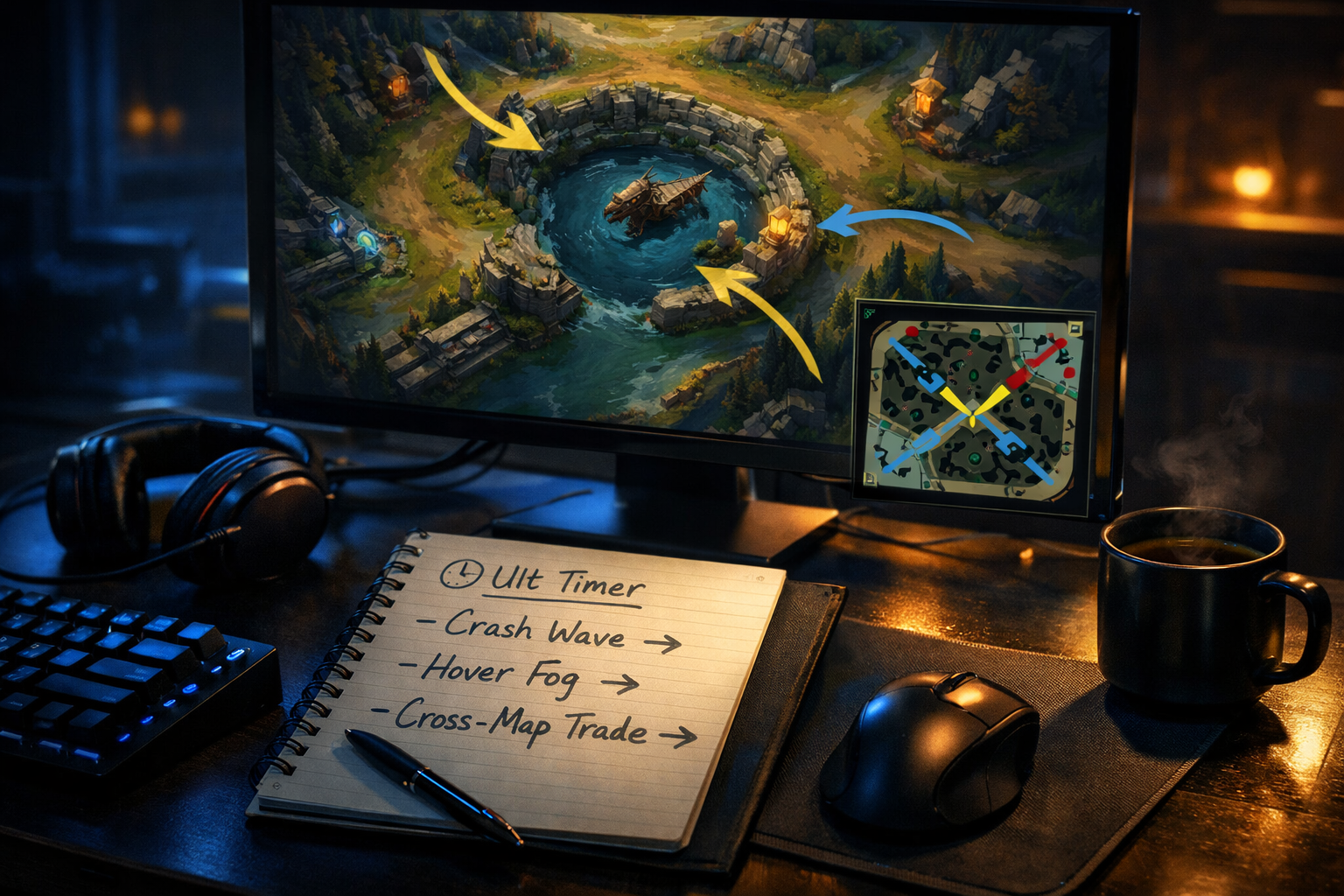
Many players treat defensive wards as a sign of weakness. That is the wrong mindset. Against long-range engage or reinforcement, defensive vision is proactive because it lets you see the setup before the cast. A ward that shows a champion leaving lane, entering river, or hovering in fog can save a fight before it begins. That is often more valuable than a late ward that only confirms what is already happening.
Layer vision by objective and lane state
Your vision should answer the question that matters now. If dragon is next and the enemy has strong long-range follow-up, river entrances, flank paths, and lane brushes near bot side matter more than random deep wards in the opposite quadrant. If your side-laner is pushing far and vulnerable to cross-map collapse, entrances behind them and the nearest jungle crossroads matter more than generic coverage.
Do not ward just because you have a trinket. Ward because a specific future action needs protection. That future action might be a side-lane push, a tower siege, a reset, an invade, or an objective start. The more intentional your wards are, the more predictable your safe windows become.
Respect fog when the enemy wants indecision
Fog is strongest when it forces hesitation. Suppose the enemy’s long-range engager is not visible. Even if they are not literally in range yet, your team now hesitates on the dive, the face-check, or the tower step. That hesitation has value. Good enemy teams will pair it with wave pressure or objective timing so that your uncertainty becomes expensive.
The answer is not to become passive forever. The answer is to make the uncertainty smaller. Clear one more ward. Push one more nearby wave. Group one lane sooner. Walk with support instead of alone. Start the objective only when your exit paths are clearer. Every one of those decisions reduces the quality of enemy fog pressure.
Path as if you are being watched
A timeless anti-global habit is to choose paths that stay flexible. Hugging safer terrain, avoiding unnecessary choke points when major cooldowns are up, and moving with information rather than hope all reduce the enemy’s odds of creating a surprise play. Carries in particular should think this way. If your route from lane to river is obvious and unprotected, long-range threats become much easier to layer onto you.
Meanwhile, when your team has the global pressure tool, your pathing should support that tool. Entering fog before the enemy sees your full setup increases fear. Hovering where multiple lanes are threatened creates more response pressure. Good pathing does not only avoid danger. It manufactures ambiguity for the enemy.
7. Dragon, Baron, Towers, and Cross-Map Trade Logic
Neutral objectives are where global ultimates often feel most unfair, because both teams are drawn to the same area and the pressure is concentrated. The solution is not “always force” or “always back off.” The solution is understanding whether your team is stronger in a direct contest, better at cross-map trading, or best when baiting the enemy into a bad entry.
Do not start objectives with unresolved lanes
If side waves are crashing into you, the enemy has more freedom to hover, hide, or threaten long-range entry. You are already losing time to minions, which means you either rush the objective unsafely or give up position while someone catches wave. Clean side lanes reduce these choices. That is why elite macro often looks repetitive: push sides, take vision, then force the objective decision.
Different long-range threats change objective posture differently
If the enemy has engage from distance, your team should care more about flanks, choke points, and whether your backline has room to kite. If the enemy has long-range execute pressure, health bars and reset timing matter more. If the enemy has reinforcement tools, isolated picks before the objective become less reliable unless you are sure the window is real.
One common mistake is treating all cross-map champions the same. They do not pressure objectives in the same way. Some demand spread formations. Some punish spread formations. Some make zoning stronger. Some make burst securing harder because low-health members cannot safely stay. Learn what problem the enemy tool creates, then solve that problem specifically.
Cross-map trade is a skill, not a surrender
Players often think that giving one objective for something else is a sign of weakness. In reality, smart cross-map trading is one of the cleanest answers to global pressure. If the enemy is committed with stronger numbers, better wave state, and a superior long-range contest tool, forcing the fight can be low percentage. Taking plates, towers, jungle camps, vision, or opposite-side pressure may create a better game state than a doomed contest.
The key is making the trade early, not late. A late trade is what happens when you arrive too slowly, fail to contest, and only then decide to take something. A good trade is pre-planned. Your side wave was already moving. Your players were already positioned to threaten the opposite side. Your recall timing already supported the decision.
Baiting the long-range ultimate
Some of the best objective fights happen when you force the enemy to cast early or from bad information. This can happen through fake starts, controlled turn angles, or showing just enough commit to trigger the response. Once the ability is used poorly, the map often opens. However, this only works if your team actually has the discipline to disengage or turn with structure. Baiting is powerful; fake confidence without coordination is not.
Whenever you approach dragon or Baron against strong globals, ask this: are we starting to finish, starting to force them into a check, or starting to bait a cast? Knowing which one it is prevents a lot of chaotic throws.
8. How to Play With Global Ultimates on Your Team
Most players think having a global ultimate means “look for cross-map hero plays.” That is sometimes true, but the more consistent value usually comes from pressure, not highlight clips. Your team’s long-range threat should shape the enemy’s map decisions before the cast ever happens.
Create believable pressure, not random hope
If your side lane is overextended with no wave support, your global follow-up may arrive into a bad fight and simply donate more gold. But if the wave is good, nearby vision exists, and the enemy has limited exits, the same ultimate becomes devastating. The difference is setup. Use your tool to reinforce good states, not rescue bad habits.
Side lanes are where these abilities often earn their keep
A side-laner with good wave control can bait enemy attention, draw a second defender, or threaten tower damage. If your team has a global arrival or strong long-range assist, that side-lane pressure becomes much more dangerous for the opponent to answer. This is one of the best ways to stretch the map. The enemy either sends enough people and risks losing tempo elsewhere, or sends too few and risks getting outnumbered instantly.
Use ultimates to secure tempo, not only kills
Sometimes the best cast is the one that wins a wave, saves a tower, protects a reset, or guarantees objective setup. Kills are obvious, but tempo is often more valuable. If a long-range play lets your team reset first and own vision for the next major objective, that can be worth more than a greedy attempt at a highlight kill in a side lane.
Pair map tools with simple communication
If you have the global threat on your team, teammates need to know what conditions make it usable. Can they take a heavier trade bot? Can the jungler invade if mid is pushing? Can the top laner hold the wave and bait? Short, clear pings help. The less your team knows, the more often your powerful tool sits unused while everyone plays as if the game were purely local.
Do not overforce because you feel powerful
This is the classic mistake. A team with a global ability begins to believe every skirmish is playable. It is not. Cooldowns, item spikes, vision, wave state, and enemy disengage still matter. The correct mindset is not “we can always join.” It is “we can convert good setups more reliably than most teams.” That distinction protects you from low-percentage plays.
Used well, global ultimates make your comp feel larger than five players. Used badly, they make your team chase fantasies while losing farm, tempo, and structure.
9. How to Play Against Global Ultimates by Role
The best counterplay depends on role. Everyone should track the same major cooldowns, but each role expresses that information differently.
Top lane
Top lane often becomes the early laboratory for cross-map pressure. If the enemy top can influence bot or river from afar, your job is not only to survive lane. It is to manage the wave so that the enemy pays a cost for leaving or holding threat. Crash when possible. Punish bad leaves with plates, wave denial, or stronger resets. If your champion cannot punish directly, then communicate the timing and stop taking isolated fights that assume the enemy top is locked in lane.
If your own team has the cross-map top tool, then your lane should be about preserving flexibility. Do not waste health on pointless trades that remove your ability to support elsewhere. A healthy top with wave control and a ready map tool can influence the entire game.
Jungle
Junglers feel global pressure in route planning and contest logic. Before entering river, invading, or covering a dive, ask which enemy lanes can influence the fight without moving normally. Your goal is to create plays where your nearby lanes have priority and the enemy long-range response is late, blind, or punished by wave cost.
Against long-range finishers, junglers should also be disciplined about objective health bars and teammate health bars. A won skirmish is not really won if your carries are stuck low on a neutral start against a cross-map finisher. Good junglers often decide whether the team resets or continues. Make that call with the enemy’s map tools in mind.
Mid lane
Mid lane is central because it touches both sides of the map. If you are against long-range roam or arrival tools, your wave control matters hugely. Losing mid priority at the wrong time opens too many doors. Clear, crash, and move with intent. If you vanish from enemy vision at the right times, you also create fear, which can cancel their aggression elsewhere.
Mid laners should especially respect recall timing. Many devastating cross-map sequences begin because one mid laner reset first, pushed first, and hid first. Even before any ultimate is cast, the map is already tilted.
ADC
ADCs are often the most punished role by long-range finishers and reinforcement tools. Your biggest job is not to play scared; it is to understand your real safety threshold. If the enemy can convert low health into death from distance, then “surviving lane with 20 percent” is often fake survival. Recall earlier, position farther from blind angles, and do not greed for one extra wave without support or vision.
In objective fights, ADCs should care deeply about spacing from predictable engage lines and whether the team is fighting in areas where peel can actually function. A carry who has room to kite makes long-range pressure less decisive. A carry trapped in a choke makes enemy execution much easier.
Support
Support is the role that can make global ultimates feel unbeatable or irrelevant. Your wards, sweeps, hover timing, and lane communication determine how many clean casts the enemy sees. If you are late to river or careless with vision setup, the enemy gets ideal information. If you move first, protect wave states, and escort your team into fog responsibly, the map becomes much harder for enemy globals to exploit.
Supports should also think one step ahead in side lanes. Which teammate is likely to be pressured? Which route needs coverage? Which objective setup demands earlier warding because enemy long-range engage exists? The support who answers those questions early often wins the map before a fight begins.
10. Side Lanes, Mid Game Rotations, and Map Compression
Mid game is where long-range threats often create the most confusion, because the map opens and players spread into imperfect side-lane assignments. If your team does not understand side-lane rules, global ultimates turn every extended lane into a potential trap.
Do not side-lane without an exit plan
A side-laner needs to know more than “I beat this champion.” They need to know who else can arrive, who has not shown on the map, where the nearest safe reset path is, and what objective might force a rotation soon. Without that awareness, strong side-lane pressure becomes a donation.
An exit plan can be as simple as this: push one more wave, place vision on the nearest entrance, and leave before the enemy long-range tool and nearby roamer can connect. Good side-laners constantly ask whether the next 20 seconds still belong to them. If not, they cash out the pressure and move.
Map compression is a powerful answer
When enemy global pressure is strongest, sometimes the correct adaptation is to compress the map. Group sooner, clear vision together, and move side waves only as far as is safe before reconnecting. This reduces the enemy’s angles, limits isolated targets, and forces their long-range tools into more obvious fronts rather than elegant collapses.
Compression is not permanent. It is a temporary response to danger windows. Once key cooldowns are gone or the next wave cycle is favorable, you can expand again. Strong macro teams constantly alternate between expansion and compression based on information and cooldowns.
Who shows first matters
In mid game, the team that shows first in a side lane often gives away whether a long-range play is possible. If your cross-map champion remains hidden while side pressure builds, the enemy must guess. If that champion shows too early, the threat drops. Likewise, when the enemy threat is hidden, you should assume the map is more dangerous until information improves.
This is why disciplined players are patient with reveals. Showing in the wrong place at the wrong time can relieve pressure for the enemy team instantly.
Rotations should follow waves, not feelings
Many poor mid-game fights happen because players rotate based on urgency instead of lane logic. Someone sees an enemy in river and runs there immediately, abandoning a bad side wave. Another player chases a low target while the map state screams objective setup. Against long-range threats, emotional rotations are punished even harder because the enemy can reinforce from farther away.
Good rotations feel slower at first because they start with the wave. In reality, they are faster where it matters, because they arrive with better structure and fewer hidden costs.
11. Teamfights, Baiting, and Positioning Against Long-Range Finishers
Not every global threat matters before the fight. Some matter most during or after it. Teamfights against long-range engage or finishers are often decided by formation discipline rather than raw mechanics.
Front-to-back becomes more valuable when uncertainty is high
When the enemy has tools that punish overchasing, simple front-to-back structure usually gains value. The more your team extends in uneven directions, the easier it becomes for a distant threat to isolate a low target or reinforce a flank. Keeping cleaner layers between front line, peel, and backline reduces the number of angles the enemy can exploit.
Health bars are strategic information
Against long-range finishers, low-health teammates distort the fight even if they are not dead yet. A carry at low health may no longer be able to step up for damage. A support at low health may not be able to ward or peel aggressively. A jungler at low health may not be able to secure the objective safely. Treat health as permission, not decoration. If the enemy can cash in from distance, damaged members change everything.
Bait with discipline
It is sometimes correct to show vulnerability and invite a long-range cast, especially if your team is ready to disengage, shield, turn, or punish the committing enemy. But baiting only works when everyone understands the plan. If half the team wants to retreat and half wants to hard commit, the enemy often gets the best of both worlds.
A good bait usually has three ingredients: a controlled amount of visible commitment, nearby hidden support, and a clear punish target once the enemy tool is spent. Without those ingredients, bait becomes recklessness.
Respect post-fight trajectories
Some teams win the fight and then lose the map because they chase too long, stay too low, or start an objective without enough resets. Long-range threats amplify this mistake. After any skirmish, instantly ask: who is healthy, which waves are moving, what enemy tools remain, and what can actually be taken safely? Sometimes the correct answer after a good fight is simply reset, spend gold, and keep the lead clean.
12. Common Mistakes and How to Fix Them
“We were winning until that random ultimate”
Usually it was not random. The enemy had wave freedom, vision, or a hidden timer advantage. The real fix is to review what information or lane state allowed the play.
Overvaluing small lane wins
A short-term health lead means little if it leaves you vulnerable to long-range punishment. Win the trade, then convert it correctly through crash, ward, or reset.
Starting objectives with bad side lanes
This is one of the biggest ranked errors. Fix lanes first whenever possible. If you cannot, then know whether you are baiting, trading, or gambling.
Assuming isolated fights are actually isolated
Against global or semi-global comps, many skirmishes are secretly loaded with outside influence. Train yourself to ask, “Who else can affect this?” before committing hard.
Using your own global tool as a panic button
If your team’s long-range ultimate is only used to rescue bad fights, you will often arrive late or into poor terrain. Build good states first so the cast becomes decisive instead of desperate.
Showing too early on the map
Reveals matter. When your team’s pressure champion shows in the wrong lane at the wrong time, the enemy gains freedom. Hide with purpose when a major play window is developing.
Greedy recalls and greedier non-recalls
Many players recall one wave too late or refuse to recall after a fight they technically won. Against long-range execute pressure, that is a consistent way to throw tempo and lives.
13. Practice Routine: How to Improve This Skill Fast
You do not need a complicated training system to improve at playing around global ultimates. You need a focused one.
1. In champion select or load screen, name the threats
Say to yourself which enemy champions have meaningful long-range map impact and which of your lanes they most affect. This takes seconds and changes your whole early game mindset.
2. Every time one is used, connect it to a map action
Do not just notice the cooldown. Ask what becomes easier now. One extra shove? Safer dragon setup? More freedom in side lane? This builds real macro instinct.
3. Review deaths with one question
After the game, ask: was this fight truly local? If the answer is no, identify what information, wave state, or fog pattern should have changed your decision.
4. Practice wave-first macro
Make it a habit to think “wave, then move” before contests. This one rule solves a huge amount of global-pressure chaos in solo queue.
5. Track health and reset timing more seriously
Especially if the enemy has long-range finishing threat, train yourself to value healthy objective setups over greedy extra seconds on the map.
If you repeat these habits for even a week of ranked, you will notice that the map feels slower and clearer. The enemy long-range tools stop feeling magical. You begin to see the setup before the cast, and that is the moment macro starts becoming a weapon instead of a weakness.
14. Final Thoughts
Global ultimates and long-range threats in LoL are not just flashy abilities. They are tests of planning, information discipline, and wave understanding. Players who struggle against them often focus too much on the spell itself and not enough on the game state that made the spell powerful. Players who master them learn a simpler truth: most cross-map pressure becomes manageable when you control waves, deny clean vision, respect health thresholds, and choose fights with clear information.
If you remember the core ideas from this guide, your games will become far more stable. Build the threat map in load screen. Track major cooldowns by linking them to decisions. Treat wave state as the foundation of safe aggression. Set vision with purpose. Enter objectives with resolved lanes and clear intent. Expand or compress the map according to danger windows. And never assume a fight is isolated until you have actually checked who can influence it.
That is the timeless value of learning to play around long-range map impact. Exact champion strengths will change. Cooldowns, damage, and preferred picks will shift over time. But the macro principles behind global pressure remain. Master those principles, and you will not just survive these threats more often. You will start using the map itself as a weapon, which is one of the clearest signs that a ranked player is truly improving.