



Valorant Communication Playbook: 40 Ranked-Winning Callouts
Valorant Communication Playbook: The 40 Callouts That Win Ranked Games
Great mechanics win duels, but great communication wins more ranked games than most players realize. In Valorant, information is a resource just like credits, utility, time, and positioning. The teams that pass information clearly, quickly, and calmly make better decisions before the fight, during the fight, and after the fight. That is why communication is one of the highest-value skills for climbing, especially once the easy gains from raw aim start to level off.
This guide is a timeless communication framework built for ranked play. Instead of depending on a specific patch, agent fad, or map pool trend, it focuses on the communication habits that stay strong across metas: clear contact calls, fast utility updates, honest damage reports, rotation timing, post-plant planning, and clutch discipline. If you want better teamwork with random teammates, more coordinated executes, cleaner retakes, and fewer rounds thrown by silence or confusion, this playbook is for you.
We will break down the 40 most useful ranked callouts, explain exactly when to use them, and show how to structure your voice so teammates can act instantly. You will also learn how callouts should change by round phase, by role, and by pressure level. Even if your team is not talking much, one player using good comms can stabilize a lobby, create trust, and raise the level of the whole match.
For official game resources, map overviews, and agent information, it is worth reviewing Riot’s own pages as part of your improvement routine: Valorant Maps, Valorant Agents, and Valorant Support. If your goal is to combine stronger decision-making with faster rank progression, you can also review Valorant boosting prices to understand available improvement options.
Table of Contents
- Why Communication Wins Ranked Games
- The Rules of Good Valorant Communication
- The Anatomy of a Perfect Callout
- The 40 Callouts That Win Ranked Games
- How to Communicate on Attack
- How to Communicate on Defense
- Post-Plant and Retake Communication
- Role-Based Communication by Agent Class
- Bad Communication Habits That Lose Rounds
- A Practice Routine for Better Callouts
- Final Ranked Communication Checklist
Why Communication Wins Ranked Games
Valorant is a game of partial information. Nobody sees the entire round at once. One teammate hears steps. Another sees utility. Another spots the spike. Another tags an enemy for 80. Another notices that the opposing controller has already used a key smoke. A round becomes easy only when those pieces are combined into one shared picture.
That shared picture is communication.
Many ranked losses happen because teams know something individually but fail to share it. A defender hears multiple attackers but says nothing until the site is already lost. A teammate hits an enemy low but never calls the damage, so nobody swings confidently. A lurker sees rotation timing but gives the information too late. A post-plant player wants to play crossfire, but no one says it out loud. In each case, the mechanical skill gap is often smaller than the information gap.
Communication creates value in five major ways:
- It reduces uncertainty. If teammates know where pressure is coming from, they stop guessing.
- It speeds up decision-making. Fast information allows faster rotates, faster trades, and faster utility layering.
- It improves utility efficiency. Smokes, flashes, recon, slows, mollies, and walls become much stronger when teammates know why they are coming.
- It raises trade percentage. Teammates who know when and where contact is happening are more likely to swing together.
- It stabilizes mental. Calm, useful comms make ranked feel organized, and organized teams tilt less.
The best part is that communication is one of the most transferable skills in the game. A smart player with average aim can outperform a silent player with better mechanics because good information repeatedly creates favorable situations. That remains true on every map and in every patch.
The Rules of Good Valorant Communication
Before learning the 40 high-value callouts, you need the rules that make those callouts effective. Good communication is not about talking more. It is about saying the most useful thing at the most useful moment in the simplest possible way.
1. Be early, not dramatic
Say the important part first. “Three A main” is better than “Wait, wait, I think I hear maybe a lot here.” Ranked rounds move too fast for long build-up.
2. Prioritize actionable information
The best callouts tell teammates what they can do next. “Spike down B main” changes the round instantly. “I’m scared” does not.
3. Keep your tone calm
Even urgent information should sound controlled. Panic spreads. Calm creates confidence. “Two pushing me fast” is stronger than screaming.
4. Use shared language
Prefer simple terms your team is likely to understand: close left, close right, heaven, back site, flank, one shot, rotating, contact. If a map-specific nickname may confuse someone, use the obvious version.
5. Update, don’t flood
One clean update helps. Five overlapping mini-updates often do not. After the first contact, only speak again when the information has changed or when a teammate needs something.
6. Be honest about damage and uncertainty
If you know the exact damage, say it. If you do not, do not guess. “Tagged 80 on Jett” is excellent. “He’s one shot” should be reserved for truly low enemies.
7. Dead players should simplify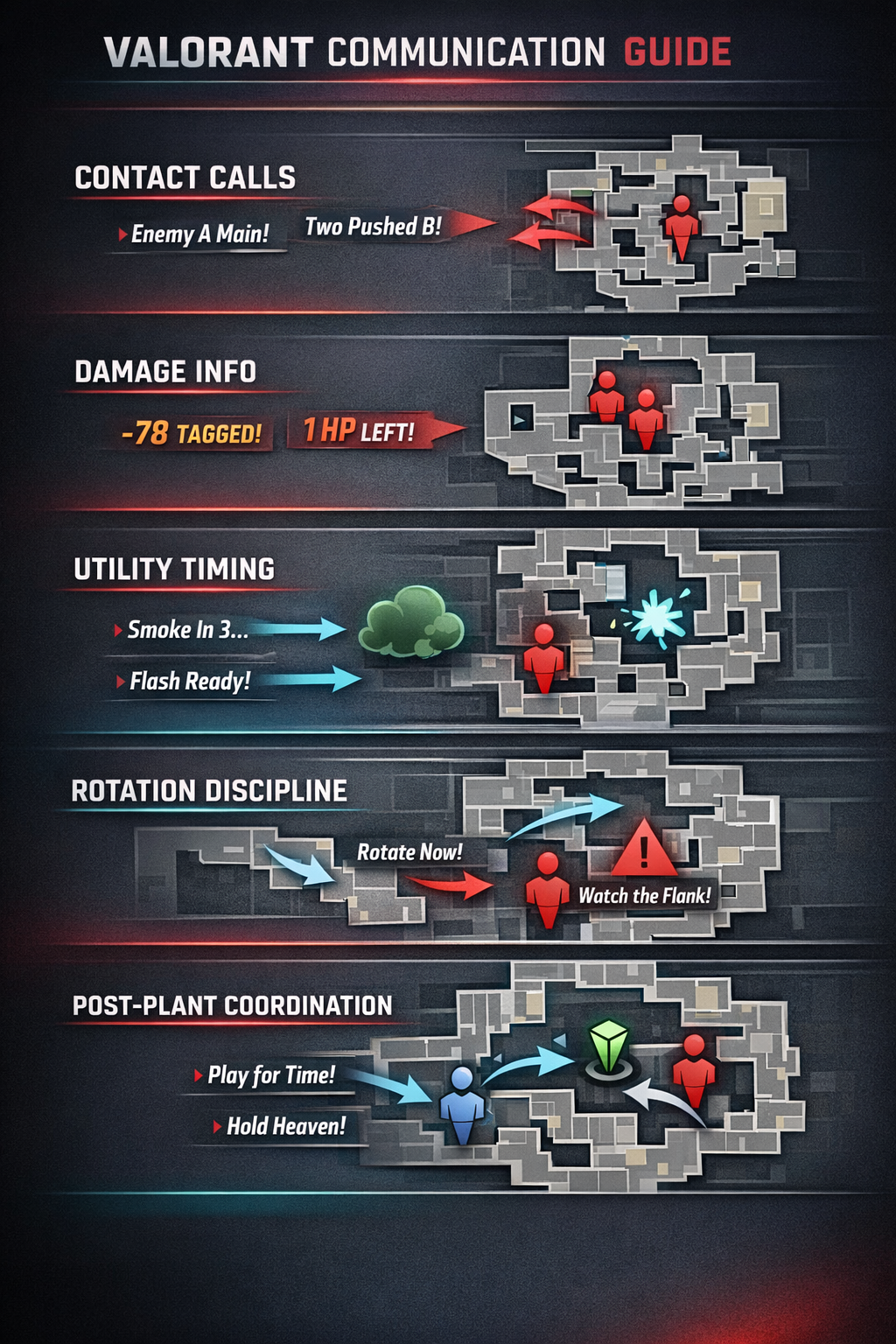
When eliminated, your role changes. You can still help by giving short, high-value info, but do not overwhelm the last alive player with a wall of suggestions.
8. Pair information with intent
“I can flash for you.” “Hold for my swing.” “Play off contact.” “I’m rotating.” Intent turns information into coordination.
The Anatomy of a Perfect Callout
The strongest ranked callouts usually follow a simple structure:
Number + location + action + condition
For example:
- “Two B main, walking.”
- “One heaven, tagged 80.”
- “Spike down mid, don’t overpeek.”
- “I’m flashing out tree, swing on it.”
You do not always need every part. Sometimes only one piece matters. But as a general rule, the more your callout answers these questions, the better it becomes:
- How many?
- Where?
- What are they doing?
- What should we do?
If you want a one-line formula to remember, use this:
See it. Name it. Frame it.
See the information. Name the core fact. Frame the next action.
The 40 Callouts That Win Ranked Games
Below are 40 universal ranked callouts that consistently create value. These are not map-specific nicknames. They are the practical comms that help teams win rounds on any map.
Contact and Position Callouts
1. “One close left.”
This is one of the most important micro-callouts in the game. It prevents teammates from clearing the wrong angle first and saves many entry deaths. Use it when you know an enemy is holding a nearby left-side angle as your team enters.
2. “One close right.”
Same principle as above. Short, direct, and instantly useful. This is stronger than generic danger calls because it narrows the exact threat.
3. “One tucked.”
Use this when an enemy is in a hiding spot that will not be checked by default pathing. “Tucked” tells teammates to slow down and clear carefully instead of assuming the angle is empty.
4. “One wide.”
Say this when the enemy is not hugging the angle and is instead holding farther out. It changes the pre-aim and helps the next player avoid swinging into an unexpected off-angle.
5. “One off-angle.”
Not every player knows the exact spot, but everyone understands the warning. This is useful when a defender is holding an unusual elevation or side position that could break normal clearing patterns.
6. “Two front site.”
Use this when the first line of defense is stacked forward rather than split deep. It helps entries expect immediate resistance and lets supporting players prepare a trade or utility combo.
7. “One back site.”
Clear site-layer communication matters because a lot of ranked teams say only “site” and force others to guess. “Back site” narrows the angle and speeds up the clear.
8. “One heaven.”
Vertical information is high priority in Valorant. Heaven control can break plants, post-plants, and retakes. Always call elevated threats clearly.
9. “One hell.”
When there is a heaven, there is often a hidden lower angle beneath it. Players often die here because they assume the elevated threat is the only one. Call it fast.
10. “One flank.”
Flank timing wins and loses rounds. If you see, hear, or suspect a committed flank, say it immediately. Even suspected flanks matter if enough time has passed and key lanes are open.
Damage and Utility Callouts
11. “Tagged 80.”
Precise damage is gold in ranked. It encourages confident swings and better target priority. If possible, include the agent: “Tagged 80 on Sova.”
12. “One shot.”
Use this only when the enemy is realistically finishable by almost any weapon hit or minimal spam. Overusing “one shot” destroys trust. Reserve it for real cases.
13. “No armor.”
This is especially useful in pistol, half-buy, and force rounds. It changes how aggressively teammates should take duels and whether body shots become enough.
14. “He used dash.”
Movement cooldowns change fight windows. Any time a high-mobility or escape tool is burned, the enemy becomes easier to punish. Similar calls apply to satchels, dismiss, teleport, and other escape tools.
15. “No flash.”
If an enemy initiator or duelist has already used a key flash, your team can hold or retake more confidently. Cooldown information is often undercalled in ranked.
16. “Smoke fading.”
Timing around smokes decides many rounds. This call helps entries prepare to explode, defenders prepare to re-peek, or post-plant players prepare for contact.
17. “Drone out.”
Recon utility often defines tempo. Calling scouting utility tells teammates whether to hide, shoot, reposition, or follow it.
18. “Trap here.”
If you see or hear utility that locks space down, share it clearly. Traps, trips, turrets, alarms, and other hold tools change lurk routes and timing.
19. “Molly on spike.”
In post-plant or defuse denial, this is a must-call. It tells teammates whether to stall, swing, spam, or wait out the utility.
20. “Wall broken.”
When defensive structure changes, the round changes. A broken wall, destroyed trip, or removed anchor utility opens new paths and often signals vulnerability.
Tempo and Map Control Callouts
21. “They’re walking.”
This tells your team to expect a quieter approach with delayed contact. It changes defender expectations and reduces over-rotations caused by missing footsteps.
22. “They’re rushing.”
Speed is the message here. Use it only when the pace truly indicates a committed fast hit. Good defenders hear this and instantly think stall utility, crossfire, and rotate timing.
23. “Contact only.”
On attack, this tells your teammates the hit starts only after someone sees or fights. It prevents wasted utility and reduces the classic ranked problem of half the team exploding before the rest are ready.
24. “Defaulting.”
This announces a slower spread meant to gather info, pressure lanes, and punish aggression. It keeps impatient teammates from forcing a bad five-man hit with no setup.
25. “They gave space.”
If defenders are not contesting an area they often contest, that matters. It may indicate a stack elsewhere, a retake setup, or a trap deeper in the lane.
26. “Mid is open.”
Mid control often decides rotations and splits. If mid is free, say it. If mid is dangerous, say that too. Many ranked teams lose because mid information arrives too late.
27. “Spike spotted.”
One of the strongest defensive calls in the game. Seeing the spike often confirms team direction or punishes lurks. Say it immediately and clearly.
28. “Spike down.”
This is often round-defining information. The moment the spike falls, the entire map changes. Defenders should lock it down. Attackers should communicate recovery plans.
29. “They rotated off.”
Call this when pressure disappears and sound or timing suggests the attackers are leaving. It helps avoid anchoring too hard on dead information.
30. “Hold rotate.”
Excellent anti-overreaction comm. Ranked teams often rotate too early. This call keeps one side honest until more confirmation appears.
Execution and Teamplay Callouts
31. “Flash in three, two, one.”
Countdowns make utility usable. Blindly saying “flashing” a fraction of a second before it pops is worse than giving a clean rhythm teammates can move with.
32. “Swing on my contact.”
One of the best trade-fragging lines in ranked. It tells teammates exactly when to move and turns isolated peeks into coordinated fights.
33. “I can smoke for plant.”
This call creates structure during chaotic site hits. The planter knows help is coming, and the rest know what space the team intends to secure.
34. “Planting safe.”
Short and useful. It tells teammates they do not need to overexpose to cover a risky plant spot and can instead hold the logical retake lanes.
35. “Planting for main.”
Plant location matters because it defines post-plant positions. “For main,” “for long,” or “for heaven” is far more useful than silence.
36. “Play crossfire.”
This is a round-winning post-plant and retake concept. Many ranked players know the idea but fail to state it. Saying it increases discipline and reduces isolated hero peeks.
37. “Play time.”
Simple but crucial. In post-plant or defense-side late-round situations, time pressure is often more important than kills. This call reminds everyone not to overpeek.
38. “Tap spike, I swing.”
Classic anti-post-plant coordination. It is clean, specific, and immediately actionable. Even random teammates usually understand it.
39. “Half it.”
Short retake communication that saves precious seconds. Whether you are asking for half defuse or telling someone your own plan, this single phrase can organize a clutch retake.
40. “Save exit.”
Not every round is winnable. This call helps teams protect economy, hunt smartly, or avoid pointless deaths. Good communication includes disciplined surrender of bad rounds.
How to Communicate on Attack
Attacking teams usually need more structured communication because they are the side choosing where and how to spend time, utility, and bodies. Many failed attack rounds happen not because the idea was bad, but because the team never shared the timing of the idea.
Before the round starts
The pre-round voice line should be short and practical. Good examples:
- “Let’s default and punish push.”
- “Play slow for picks, then end A.”
- “Take mid first, then split.”
- “Contact B, no early util.”
You do not need a professional-level strat. You only need a shared first step. Ranked improves immediately when all five players start the round with the same basic picture.
During the default
The goal is to share contest information without overfilling comms. Good attack-side updates include:
- “No one pushed A.”
- “They smoked mid early.”
- “Sentinel util B main.”
- “One jiggle peeking here.”
- “I can lurk this timing.”
These calls matter because they reveal defensive patterns. Early utility usage often indicates who is anchoring, where a setup is invested, and which area may be weak later in the round.
When committing to a hit
The commit must sound unmistakable. This is where half-committed ranked teams throw rounds. The shot-caller, or simply the first decisive player, should make the next action obvious:
- “We’re hitting now.”
- “Smoke and flash, then go.”
- “Trade the entry.”
- “Ignore flank until spike down.”
- “Clear close first.”
The best attack executions are not necessarily fast. They are synchronized. Even simple synchronization like “flash in three, two, one” often turns a weak ranked hit into a winning one.
After entry
Once the site opens, attack-side communication should shift from entry to conversion. The priorities become:
- Plant location
- Remaining defender positions
- Flank timing
- Post-plant spacing
Useful post-entry lines include:
- “Planting for main.”
- “One heaven still.”
- “Hold flank.”
- “Don’t give 1v1s.”
- “Play contact off bomb.”
Notice how none of these are complicated. Attack-side comms become stronger when they move from raw excitement to practical structure the moment the spike is ready to go down.
How to Communicate on Defense
Defense communication is about three things: confirming pressure, buying time, and controlling rotation discipline. The most common defensive communication mistake in ranked is overreaction. One smoke or one footstep does not always mean a full commit. Good defenders communicate enough to support each other without pulling the entire map too early.
As the round begins
Start with utility and contest expectations:
- “I’ll fight early A.”
- “I’m playing anti-rush B.”
- “I have info util for mid.”
- “Call if you need rotate utility.”
This helps teammates know where the first information is likely to come from and where the weak side might be if pressure appears elsewhere.
When attackers pressure your lane
Your first comm should answer the basic questions: how many, how fast, and whether you need help. The best examples are:
- “Two here, light pressure.”
- “Three or more, could be hit.”
- “They used two flashes.”
- “I need one rotate.”
- “Hold, not sure it’s commit.”
This prevents two classic throws: the anchor who says too little and dies alone, and the anchor who panics and drags the whole team into an empty rotate.
When the hit is confirmed
Now the communication must become decisive. Good defensive lines include:
- “Full hit A.”
- “Spike seen.”
- “Play retake.”
- “Site lost, save utility.”
- “One still lurking mid.”
Notice the balance. You are telling the team both what is happening and how to respond. That second part is vital. “Play retake” is often stronger than five seconds of emotional narrating while the attackers already plant.
Retake staging
Before retaking, defenders should quickly establish three things:
- Which lanes are being retaken from
- What utility is available
- Who taps or halves the spike
Clean retake communication sounds like this:
- “Wait for smoke.”
- “I’ll flash out.”
- “Two from main, one from heaven.”
- “Tap spike, I swing.”
- “Half it if clear.”
Retakes fail most often when players enter at different times. Communication does not need to be advanced. It only needs to align the entry window.
Post-Plant and Retake Communication
This phase deserves special attention because it is where many ranked rounds are thrown by players who stop communicating after the spike is down. In reality, post-plant is an information war. Timing, utility, and spacing matter more than flashy aim moments.
Best post-plant communication habits
1. State the plant orientation.
“Planting for main” or “for long” tells everyone where the team should bias its positions.
2. Call your playable utility.
If you have a molly, shock, smoke, stun, flash, or recon for the retake, say it before the defenders appear. Hidden utility is often wasted utility.
3. Announce discipline.
“Play time.” “No peeking alone.” “Crossfire.” These lines stop the classic ranked mistake of giving defenders isolated duels.
4. Call tap reactions.
Teams should know whether the plan is spam, swing, molly, or delayed swing on first tap.
5. Track flank even after plant.
Many attackers get tunnel vision once the bomb is down. One quiet “flank late” can save the round.
Best retake communication habits
1. Group before you go.
A retake with two players entering early and two players entering late is often lost before the duel starts.
2. Count the utility.
“I have smoke.” “I have flash.” “No util, just swing.” Honest retake planning is stronger than pretending the team has more tools than it does.
3. Assign the spike interaction.
Do not assume. Someone should say “I tap” or “I half.”
4. Call last known positions, not fantasies.
Use concrete info. “Last seen main” is good. “They’re probably all back site” may not be.
5. Respect the clock.
Time pressure changes what matters. Sometimes one body on the spike is worth more than one extra duel taken wide.
Role-Based Communication by Agent Class
All players should communicate, but each role naturally owns certain information. If you understand your class’s communication job, your comms become much more consistent.
Duelists
Duelists should communicate entry timing, first contact, and space gained. Good duelist comms include:
- “I’m dashing in.”
- “Close right dead.”
- “One back site.”
- “Space taken, come in.”
- “I can re-hit after flash.”
The duelist’s voice should help the team know whether the entry created room, where the trade window is, and which angles remain dangerous.
Initiators
Initiators should lead recon timing and setup coordination. Their comms are often the bridge between planning and action:
- “Recon in five.”
- “Flash through smoke on contact.”
- “Two scanned.”
- “Drone saw one close.”
- “Re-clear mid with me.”
Initiators make everyone else smarter. Their communication should make utility readable, predictable, and synchronized.
Controllers
Controllers own tempo control. Their communication should frame where the fight can and cannot happen:
- “Smoking heaven and CT.”
- “One-way up.”
- “Smoke fading soon.”
- “I can re-smoke spike.”
- “Wait for my smoke before plant.”
Many ranked controllers are mechanically fine but verbally invisible. A controller who communicates timing becomes far more valuable.
Sentinels
Sentinels should communicate lane security, flank coverage, and trap state:
- “Flank covered.”
- “Trip broken.”
- “They hit my util.”
- “I’m anchoring, rotate if spike seen.”
- “Play off my setup.”
Because sentinels often control hidden information, their comms are some of the most strategically important in ranked.
Bad Communication Habits That Lose Rounds
Improving comms is not only about adding strong lines. It is also about removing bad ones. Here are the common habits that quietly sabotage ranked games.
Talking too late
If the first useful call comes after you die, your team loses the timing edge. Try to communicate while the situation is still developing, not only when it has already collapsed.
Rambling during fights
Fights require compressed information. Long explanations are for freeze time, not for contact moments.
Using vague danger language
“He’s there” is weak. “One close right” is strong. Precision matters.
Fake certainty
Players often say “all here” or “rotated” with too little proof. Overconfident guesses create bad decisions. It is better to say “three seen, could still be split” than to lie by accident.
Backseating in clutches
One calm info line is great. Continuous control of the last alive player is not. In clutch situations, trim everything down to the most relevant fact.
Emotional comms
Complaining mid-round, blaming after every mistake, or sighing into the mic all reduce team efficiency. Good comms are task-focused, not ego-focused.
Not confirming utility
Many rounds are lost because a flash, smoke, or swing is assumed rather than stated. If your utility matters to the team’s timing, say it.
Calling damage poorly
“One shot” when the enemy is actually 80 health destroys trust. Be careful with health calls. Specific numbers are always better.
A Practice Routine for Better Callouts
Communication is a skill you can train intentionally. You do not need a full team to improve it. Use this routine for one or two weeks and your ranked comms will become noticeably cleaner.
1. Play one focus block with a communication goal
Do not try to fix everything at once. Pick one theme per session:
- Early contact calls
- Damage calls
- Utility countdowns
- Post-plant structure
- Calm tone under pressure
2. Use a three-word rule in fights
When contact starts, force yourself to keep the first call under three to five words if possible: “Two A main,” “One close left,” “Spike down mid.” This trains clarity.
3. Review your own deaths
After tough rounds, ask one question: What did I know before I died, and did I say it early enough? This is one of the fastest ways to see communication leaks.
4. Practice utility countdowns every match
If you play a flash or setup-heavy role, make countdowns automatic. “Flashing in three, two, one” is simple, repeatable, and powerful.
5. Learn the official map names
Even if the community uses its own nicknames, knowing the official layout vocabulary from Riot’s map resources helps you build cleaner spatial language over time.
6. Replace blame with solutions
After a bad round, say something actionable instead of emotional. Replace “Why didn’t you trade?” with “Next time let’s swing on contact.” This keeps the lobby playable.
7. End each match with one note
Write down one communication win and one communication mistake. Improvement compounds when it becomes visible.
How to Adapt Callouts to Different Ranked Environments
Not every ranked lobby communicates the same way. Some teams talk constantly. Some barely speak. Some understand every map nickname. Some only respond to the simplest possible language. Strong communicators adapt rather than complain.
In quiet lobbies
Take the lead without trying to become a full-time coach. Simple, useful lines work best:
- “I hear two A.”
- “Let’s wait my flash.”
- “Plant for main.”
- “Play crossfire.”
One player using clean comms often invites others to join in.
In chaotic lobbies
Your goal is not to out-talk everyone. Your goal is to cut through noise with the highest-value information. Short location and timing lines matter most. Avoid arguing for control of the mic; just make your information efficient enough to survive the noise.
In mixed-language lobbies
Use universal shooter language when possible: close left, close right, heaven, flank, low, spike down, rotate, rush, save, half. Even limited shared vocabulary can be enough to coordinate the key moments of a round.
In stack versus solo queue conditions
Stacks can use more layered plans because trust and timing are higher. Solo queue communication should stay simpler and more literal. In solo queue, the clearer your callout is, the higher the chance it turns into action.
Why the Best Callouts Are Often the Shortest
Ranked communication improves when players stop trying to sound smart and start trying to be useful. The strongest callouts are often plain because plain language arrives faster. “Spike down B” beats a polished speech. “Play time” beats a complicated theory of optimal post-plant spacing. “Tap spike, I swing” beats a ten-second plan nobody has time to process.
This is not about dumbing communication down. It is about compression. Competitive shooters reward compressed meaning. The team that understands the round faster usually gets better positioning, better timing, and better odds.
If you want a memorable communication standard, aim for this:
- Fast enough to matter
- Clear enough to trust
- Short enough to hear
That is the heart of great Valorant comms.
Final Ranked Communication Checklist
Before you queue, use this communication checklist:
- Call the number and location first.
- Use exact damage when possible.
- Announce utility before it lands.
- Do not force fake certainty.
- Do not over-rotate on weak info.
- State the plant orientation.
- Use “play crossfire” and “play time” more often.
- Assign spike tap and half in retakes.
- Keep clutch comms minimal.
- Stay calm, even when the round is fast.
If you consistently apply the 40 callouts in this guide, your ranked games will feel more structured, your teammates will make better decisions around you, and your own decision-making will become sharper because speaking clearly forces clearer thinking. Communication is not a bonus skill in Valorant. It is one of the core mechanics of winning.
Master the map names, understand your role, use short actionable language, and make each round easier for your team to read. That is how comms stop being background chatter and start becoming a win condition.