



LoL Lane Trading Guide 2026: Win Trades and Harass Better
How to Trade Effectively in Lane in LoL 2026: Winning Trades and Harassment Tips
Table of Contents
- Introduction
- Why Lane Trading Decides Games
- What a Winning Trade Really Is
- The 6 Resources That Control Every Trade
- How Wave State Changes Your Trading Options
- Spacing, Tethering, and Threat Range
- Cooldowns, Level Spikes, and Ability Order
- Harassment Patterns That Work Consistently
- Lane-by-Lane Trading Advice
- How Jungle Pressure Changes Every Trade
- Most Common Trading Mistakes
- A Simple Practice Routine to Improve Fast
- Final Lane Trading Checklist
- Image Prompts and SEO Alt Text
Introduction
Most players think lane dominance comes from mechanics alone. Mechanics matter, but lane control in LoL is usually decided by something more repeatable: better trading habits. The player who understands when to step forward, when to back off, when to spend health for pressure, and when to punish a cooldown will win far more lanes than the player who simply clicks faster.
That is why strong laners often look so “clean.” They are not just throwing abilities on cooldown. They are making efficient exchanges over and over until the matchup becomes uncomfortable for the opponent. One auto attack when the enemy walks up for a last hit. One spell after they waste their key ability on the wave. One short burst while your minion wave is larger. One step back before their retaliation window opens. Those small moments stack into plate pressure, recall control, better objective setup, and eventually a winning game state.
This guide focuses on timeless lane trading concepts rather than fragile patch-specific tricks. Champions, items, and numbers change. Good trading does not. Whether you play top, mid, ADC, or support, the principles below will stay useful because they are based on lane geometry, threat range, cooldown logic, wave interaction, and human decision-making.
If you are newer to League fundamentals, Riot’s official how-to-play page is a solid refresher for map structure, lanes, abilities, and progression. If you are still learning champion identities, Riot’s role guide and the official champion directory are useful references when deciding whether your champion wants short trades, long trades, poke, all-ins, or scaling.
By the end of this article, you should understand how to identify a favorable trade before it starts, how to harass without griefing your lane, how to use the wave as a weapon, and how to build repeatable habits that make your laning stronger across many different matchups.
Why Lane Trading Decides Games
Trading is the art of exchanging damage, cooldowns, mana, health, and position in a way that benefits you more than the enemy. In practical terms, it means you are trying to leave every interaction slightly ahead. That lead can be health, mana, summoner spell pressure, wave control, recall timing, plate access, or simply the ability to stand in a stronger position for the next 30 seconds.
A lot of players only notice lane trades when someone loses half their health instantly. But most real lane advantages come from repeated medium and small trades. A ranged mid laner that lands one extra spell every two waves. A top laner that chips the enemy every time they walk up for a melee minion. A support that uses brush control to auto once, drop aggro, then auto again. These interactions slowly turn the lane into a one-sided negotiation.
Why is this so important? Because health is permission. The healthier player gets to stand farther forward, contest more CS, threaten level-up spikes, ward deeper, and move first to river fights. The lower-health player starts making concessions. They give up ranged minions. They stop contesting the wave. They burn teleport or recall awkwardly. They hesitate to help their jungler. Trading is how that pressure begins.
Winning lane is not just about killing the opponent. Often, the best trade is the one that makes a kill unnecessary. If you can force the enemy off the wave, deny them farm, crash a stacked wave, take a plate, and recall first, you have already won the sequence. In many games, that is better than flipping a risky all-in.
Good trading also protects you from inconsistency. Players who rely only on all-ins tend to have unstable results. They either stomp or int. Players who understand trading can still create leads even when there is no clean kill window. That makes them more reliable in solo queue and much harder to punish.
What a Winning Trade Really Is
A winning trade is not simply “I dealt more damage.” That is part of it, but not the whole picture. A winning trade is an exchange where your total lane position improves more than the enemy’s.
Examples of real winning trades
- You deal 120 damage, take 60, and keep the wave in a favorable spot.
- You trade evenly in health, but the enemy spends more mana and now cannot contest the next wave.
- You burn the enemy’s key cooldown, then hold your own, creating a stronger all-in window 10 seconds later.
- You trade under your stacked wave, so the enemy loses minions while trying to hit you back.
- You force a bad recall even without killing them.
- You push them low enough that your jungler gank becomes guaranteed.
- You do a short trade, disengage cleanly, and maintain lane control.
Now compare that with what looks good but often is not actually good:
- You land a big combo but lose wave control.
- You chase too far and get hit by the full enemy minion wave.
- You spend all your mana for damage that does not change the lane.
- You force a flashy trade right before the enemy jungler arrives.
- You “win” the HP exchange but become unable to crash the wave or recall safely.
This is why strong players are so selective. They are not asking, “Can I hit them?” They are asking, “What does this trade buy me?” If the answer is nothing, the trade is probably not worth forcing.
Another key idea: trades must be judged through matchup identity. A short trade that is great for a burst mage may be terrible for a sustained fighter. An extended trade that is ideal for a bruiser may be exactly what a poke champion should avoid. You cannot define good trading without first understanding who benefits from the interaction lasting longer.
Before every lane, ask yourself four questions:
- Does my champion prefer short trades, poke, or long fights?
- What single enemy ability matters most in the matchup?
- Who gets stronger from level 1 to 3, and who spikes harder at 6?
- What wave state helps me trade safely?
If you answer those correctly, your trading decisions instantly become sharper.
The 6 Resources That Control Every Trade
Every lane trade is shaped by six resources. Players who track all six are hard to lane against. Players who only track health are usually inconsistent.
1. Health
Health is your most obvious trading resource. It determines how much space you can occupy and how threatening you are. But elite laners do not treat health as something to preserve at all costs. They treat it as something to spend efficiently. Sometimes taking a small amount of damage to hold a freeze, deny a cannon, or keep level pressure is correct. The question is not “Did I lose HP?” The question is “Was the HP I spent worth the advantage I gained?”
Health also becomes more valuable when sustain is limited and less valuable when you have easy recovery. If your champion has reliable healing, a potion advantage, or can recall into tempo, you can take trades that look risky to less experienced players.
2. Mana or Energy
Many lanes are actually decided by resource drain. If two champions are trading similar health damage but one is losing far more mana, the lane is slowly tilting. That player will eventually stop being able to contest push, threaten punishment, or defend themselves from an all-in.
Mana should be used with purpose. Spending a spell to hit both the enemy and the wave is usually much stronger than spending it on only one. Spending key mana on harassment right before a jungle skirmish may be a mistake. Likewise, forcing the enemy to cast defensively is often more valuable than the immediate damage you dealt.
3. Cooldowns
Cooldowns create the clearest lane windows in all of League. If the enemy uses a primary damage, crowd control, mobility, or shielding ability on the wave, that is your cue to step in. If you throw your own key spell first and miss, the lane flips. Good trading is often just disciplined cooldown recognition.
Think of cooldowns in layers:
- Primary threat cooldown: the spell that makes the enemy dangerous.
- Defensive cooldown: the spell that lets them survive or disengage.
- Wave control cooldown: the spell they need to secure push or clear.
- Summoner spell pressure: Flash, Ignite, Teleport, Heal, Barrier, Exhaust, Ghost, Cleanse.
The cleanest punish windows happen when multiple layers are missing at once. For example, the enemy used their main poke spell on minions and their mobility tool earlier. Now your trade becomes much safer and much harder to answer.
4. Wave State
The wave is not background decoration. It is the battlefield itself. Minion count changes everything. Fighting into a larger enemy wave early can ruin an otherwise good-looking trade. Fighting with a bigger allied wave can turn a small advantage into lane control.
Wave state decides:
- how much minion damage you take,
- how far the enemy must walk for CS,
- who is exposed to ganks,
- who can reset first,
- who gets level-up timing,
- and whether the lane is easy or dangerous to extend.
5. Position and Space
Lane position is a hidden resource. Two players with similar HP can still have completely different lane states because one controls the zone in front of the minions and the other is stuck behind the caster line. When you own space, you make the enemy work harder for every farm attempt. Trading is often less about the damage itself and more about using that damage to claim more space afterward.
6. Information
You trade differently when you know where the jungler is, when you know the enemy support roamed, or when you know the opponent’s ward is down. Information changes how greedy you can be. Many failed trades are actually information errors. Mechanically they were fine. Contextually they were terrible.
Whenever you lose a bad exchange, review it through these six resources. You will usually find the missing piece quickly.
How Wave State Changes Your Trading Options
If you want to trade better immediately, pay more attention to the wave than to the enemy health bar. The wave tells you how aggressive you are allowed to be.
Trading with a larger allied wave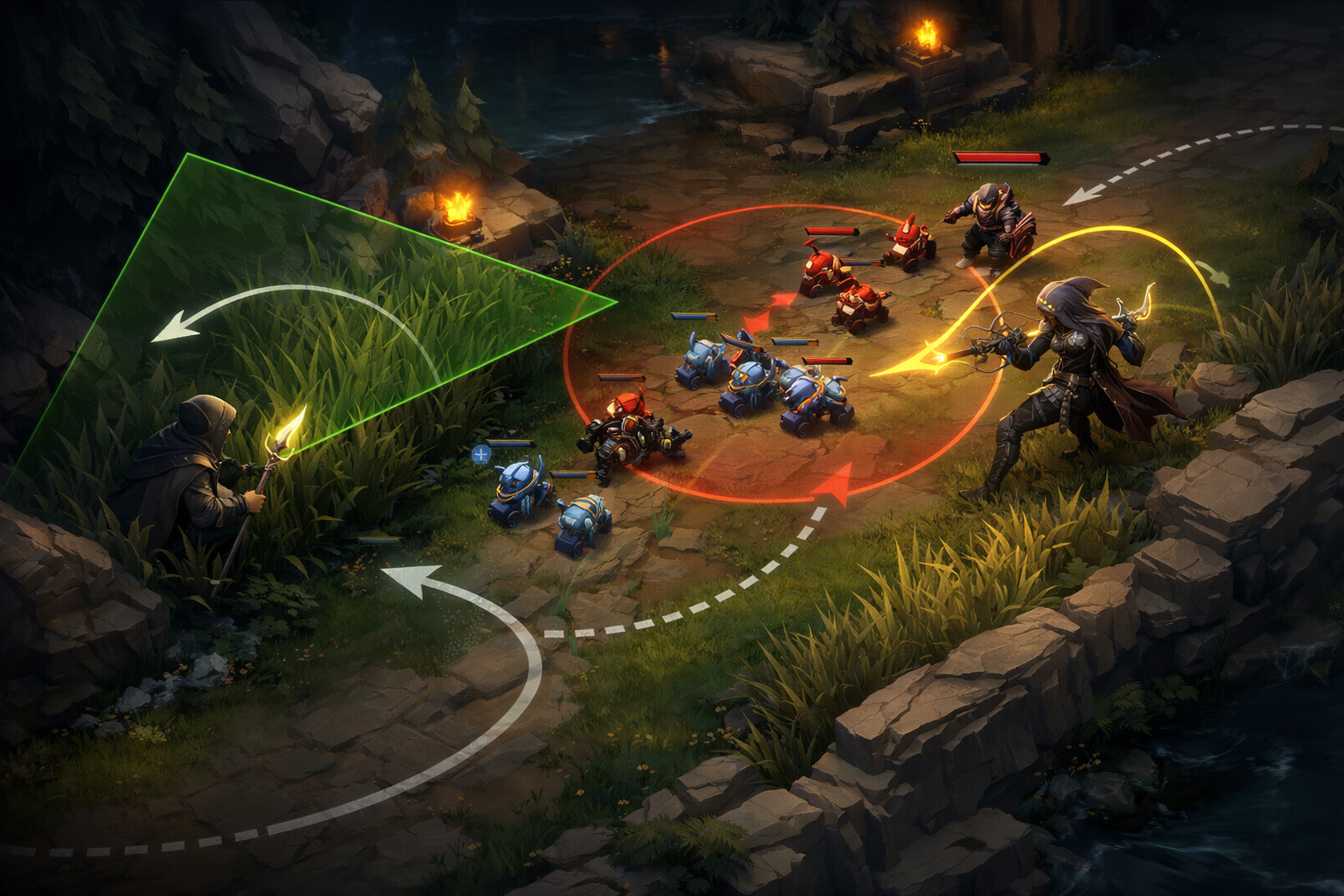
This is one of the safest and most repeatable ways to win lane. When you have more minions, the enemy takes extra punishment if they fight back. This is especially important in early levels when minion damage is meaningful and health pools are smaller.
Use this situation to:
- step up when the enemy walks in for CS,
- force them to choose between farm and health,
- zone them off the wave edge,
- prepare a larger crash,
- or threaten a level-up spike.
Trading into a larger enemy wave
This is where many players throw lane. They see a spell hit and continue the exchange even though the wave makes it bad. Unless you are sure you can end the trade instantly or your champion massively prefers the all-in, this is usually a mistake. Minions will punish you, and the enemy often has shorter retreat distance.
Freezing and trading
A freeze is one of the best harassment setups in the game. The enemy must walk farther forward to farm, which extends their exposure window. If you maintain a freeze near your side, your trading becomes more dangerous for them and safer for you. They have less room to kite backward, you are closer to your tower and jungler path, and they are under constant pressure to break the freeze.
When holding a freeze, do not randomly hard commit every time. Your goal is to make the enemy miserable, not heroic. Harass as they step up. Punish last-hit timing. Make them choose between taking damage or losing farm. If they become desperate and overextend, then you can commit harder.
Slow push into crash
Slow pushing creates one of the cleanest trade patterns in League. As your wave builds, the enemy becomes increasingly uncomfortable contesting it. You can use your growing wave as cover to poke, threaten dives with your jungler, or secure a recall after a hard crash.
The key is discipline. Do not overfight too early and thin your own wave advantage away. Use the slow push to create pressure first, then cash it in when the enemy is stuck under tower, low on health, or forced to clear.
Level-up wave timing
One of the best trade windows in lane happens when you are about to level before the enemy. If you see the level break coming, step forward before the final minion dies. The moment you level, your stats and ability access improve and the enemy must instantly respect it. Many free flashes and early kills happen because one player is ready for the level-up window and the other is not.
Even if you do not all-in, you can often win a powerful trade simply because the enemy backed off too late.
Spacing, Tethering, and Threat Range
Spacing is the skill that makes all trading concepts work. If wave control is the strategic layer, spacing is the mechanical layer.
At a basic level, spacing means standing at a distance where you can threaten the enemy while minimizing their ability to threaten you. Tethering is the repeated movement in and out of that danger zone, baiting the opponent into using a spell or stepping too close.
How good tethering looks
- You hover just outside the enemy’s main ability range.
- You step in when they commit to a last hit or begin an animation.
- You step back as soon as the retaliation window opens.
- You use movement to test their reactions before committing your spell.
Players who struggle with laning often move in predictable straight lines. That makes their intention obvious. Good tethering keeps your threat ambiguous. Are you stepping up to auto? To bait? To crash? To hold the freeze? The more unclear your intent is, the harder you are to trade back against.
Respecting threat range
Every champion has a “real range” and a “practical range.” Real range is what the spell tooltip suggests. Practical range includes dash distance, movement speed, cast animation, follow-up autos, and terrain. When laning, always think in practical range.
For example, some champions look harmless if you only judge their visible spell radius, but become dangerous once they can chain crowd control, mobility, or an empowered auto. Others look threatening at all times, but are actually weak once one key spell is down. Good spacing is impossible without knowing the opponent’s practical threat range.
Positioning relative to minions
The minion line is your first cover system. Standing beside your minions, behind them, or outside them changes how easy it is for the enemy to target you. Against skillshots, minion alignment matters. Against point-and-click poke, brush and range matter more. Against melee engage, your distance from your own retreat path matters most.
A simple rule: if you do not know why you are standing somewhere, you are probably standing in the wrong place.
Cooldowns, Level Spikes, and Ability Order
Most favorable trades come from timing, not raw aggression. Timing is what lets a weaker early champion survive, and it is what lets a stronger early champion press their advantage without coin flipping.
Trade after the enemy uses an ability on the wave
This is one of the oldest and best lane rules in League. If the enemy spends a key spell just to secure CS or push, they temporarily reduce their ability to answer your trade. This is especially valuable against mages, supports with strong utility cooldowns, and champions whose lane pattern depends heavily on one core spell.
Hold your answer until it matters
Many players panic-cast defensively. Strong players are patient. If you know the enemy must use a specific ability to start their trade, save your defensive or disengage tool until that spell appears. Trading gets much easier when you stop reacting early.
Know your level spikes
Level 2, 3, and 6 are the classic pressure points, but the principle is broader: every lane has moments where added stats, added skill ranks, or ultimate access change the trade pattern. Think ahead one wave. If you will be stronger on the next break point, preserve health and mana for it. If the enemy spikes first, avoid ego trading right before it happens.
Skill order changes trade shape
The way you level your first few abilities matters because it determines whether your lane prioritizes push, burst, sustain, utility, or safety. Even in the same matchup, your available trade windows can feel very different based on early points. That is why you should know not just your build, but why the build changes the lane pattern.
As a rule, do not trade blindly into a champion whose major cooldown or level spike you have not accounted for. Many “unlucky” lost lanes are simply untracked timing windows.
Harassment Patterns That Work Consistently
Harassment is repeated lane pressure designed to wear the enemy down without overcommitting. The best harassment is not flashy. It is efficient, low risk, and annoying enough to change enemy behavior.
1. Punish last-hit timing
This is the foundation of lane harassment. When the opponent goes for a minion, their movement becomes predictable and their attention splits. That is your chance to auto, cast a light spell, or step into a better zone. The goal is to attach a cost to farm.
2. Hit the champion and the wave together
Any time you can pressure both at once, the spell becomes much more valuable. You are not just poking health. You are also shaping the lane. These are some of the highest-value casts in the game.
3. Auto once, disengage cleanly
Not every harassment pattern needs a full combo. Sometimes one auto is enough, especially if it is truly free. One free auto every wave becomes a major health lead. Players often lose lane because they turn a good small trade into a bad extended trade out of greed.
4. Use brush control
Side brush and lane brush are excellent harassment tools, especially in bot lane. They break vision, alter auto timing, and can help you drop minion aggro or create uncertainty. Control of brush often turns average poke into oppressive poke.
5. Harass before the important minion
If a cannon wave is arriving, the enemy cares more than usual about securing farm. That gives you a stronger setup to pressure them. Many players become extra predictable around cannons, which makes them easier to punish.
6. Threaten more than you commit
Sometimes the strongest harassment is movement that forces caution. If the enemy knows you might trade when they walk up, they will farm more nervously and often miss value without you spending anything. Presence is part of pressure.
Lane-by-Lane Trading Advice
Top Lane
Top lane is usually the most punishing lane for bad trades because the lane is long, recalls can be brutal, and melee matchups often snowball hard from small mistakes. Here, understanding trade length is everything.
If your champion wants short trades, do not stay in extended combat after your key damage lands. Use your burst, empowered auto, or quick combo, then exit before the enemy sustained damage pattern begins. If your champion wants long trades, you often need to bait the enemy’s short-trade tools first, then re-engage when they have no efficient way to disengage.
Wave location matters more in top than many players realize. Trading when the wave is pushing into you is often excellent because the opponent must walk forward. Trading recklessly while pushing out without vision is often how top laners die to simple jungle timing.
In melee versus ranged top matchups, the ranged player should think in repeated small punishments, not permanent overextension. The melee player should think in health preservation, brush use, wave shaping, and explosive punish windows once space closes. The melee player does not need to win every small exchange. They need to survive efficiently until the lane state favors them.
Mid Lane
Mid lane trades are heavily influenced by wave clear, angle control, and jungle access. Because the lane is shorter, raw kills are sometimes harder to force, but small trade wins matter even more because they affect roam priority, recall timing, and objective movement.
Mid laners should constantly ask:
- Can I hit the enemy while also controlling the wave?
- Am I standing where I can be ganked from both sides?
- Which cooldown matters most here: damage, mobility, or crowd control?
- Who gets first move to river if a fight breaks out?
In ranged versus ranged matchups, many trades are decided by whoever better punishes cast animations. In melee versus ranged, the ranged player wants to chip safely and deny clean engage angles, while the melee player wants to conserve resources, avoid useless poke, and choose specific windows to burst or force summoners.
Do not forget that mid is the lane where “even” trades can still be losing if they cost you push. Sometimes taking a slightly lower-damage trade that lets you keep control of the wave is the better decision.
ADC in Bot Lane
ADC trading is rarely isolated. It is shaped by support matchup, brush control, wave state, and whether both players can actually follow up. Many ADCs lose lane by copying solo-lane habits in a 2v2 environment.
Good ADC trading involves three layers:
- Last-hit and auto spacing: punish enemy ADC farm attempts.
- Support timing: trade when your support can assist or threaten.
- Wave discipline: do not sacrifice the whole wave for one ego trade.
When your support controls brush or threatens engage, your autos become much stronger because the enemy cannot fully step forward. When your support is weak-side in the current pattern, your job may be to trade minimally, maintain wave health, and avoid getting chunked before the next bounce or item timing.
ADCs also need to respect retaliation paths. If you walk up for a “free” auto but have no clean way to disengage from the enemy support angle, the trade was not free. In bot lane, geometry matters. The same auto can be brilliant from one angle and int from another.
Support
Support players often decide the lane’s harassment pattern. Whether you play poke, engage, enchanter, or tank, your positioning influences how much freedom your ADC has.
Poke supports should focus on efficient pressure, not random spell spam. The best poke supports make the lane feel crowded. They stand in uncomfortable zones, control brush, threaten autos between spells, and force the enemy to respect both chip damage and future all-ins.
Engage supports should avoid telegraphing too hard. Sometimes your greatest contribution is just holding the threat. If the enemy ADC cannot step up because they fear your engage window, that alone creates farm pressure. You do not need to hard force constantly.
Enchanter and peel supports should still think proactively. Good harassment does not only mean damage. It also means shielding or speeding your ADC through a favorable trade, timing crowd control to deny the enemy’s return damage, and helping secure wave control that creates safer poke windows later.
Short Trades vs Extended Trades
Every lane player should know the difference between these patterns.
Short trade: fast damage, minimal exposure, quick disengage. Best for burst windows, poke lanes, cooldown-based champions, and matchups where the enemy wins extended combat.
Extended trade: continued fighting through multiple autos, spells, and movement resets. Best for sustained damage champions, stat-check patterns, or matchups where you outlast the enemy once major cooldowns are gone.
If you repeatedly choose the wrong trade length, the lane will feel unfair even when your champion is strong.
How Jungle Pressure Changes Every Trade
No lane trade exists in a vacuum. The jungler is the invisible third party in many supposed 1v1s and 2v2s. Great laners do not only ask whether a trade is favorable mechanically. They ask whether it is favorable in the next 10 to 20 seconds.
Trade harder when you know where the jungler is
If the enemy jungler showed on the opposite side, your lane can often become much more aggressive. This is the time to push a wave, hold a stronger forward position, and convert health advantages into real lane pressure.
Trade lighter when information is missing
If the wave is pushing out and vision is weak, your “winning” trade may be bait. Keep your exchanges short, preserve mobility, and avoid committing important cooldowns unless you know the map state supports it.
Use health leads to set up ganks
A trade does not need to kill. Sometimes it only needs to remove enough health or mobility that the next gank becomes forced. This is why small poke before river skirmishes matters. You are changing the threat map.
Understand lane priority
If your trades help you keep the wave in a state where you can move first, you are helping your whole map. Mid and support players especially should recognize that a good trade can be valuable even if it only wins first move to vision, river control, or objective setup.
Most Common Trading Mistakes
Improving at trading is often about removing repeated errors before adding advanced tricks. Here are the biggest ones.
1. Trading for no reason
If you cannot explain what the trade gets you, it probably is not worth taking. Damage alone is not a plan.
2. Ignoring minion damage
This is one of the most common early-lane mistakes. If you fight in the wrong wave state, you can lose even while landing your combo correctly.
3. Using key cooldowns first without pressure
Many players expose themselves by spending their best spell to “start something” rather than waiting for a cleaner punish window.
4. Overchasing a good trade
A short trade becomes bad the moment you stay longer than your champion should. Learn to end trades on time.
5. Missing the enemy’s last-hit windows
If you are always trying to poke at random times, you are making your life harder. Farm timing gives you free prediction.
6. Not adapting to matchup identity
Some lanes are attrition lanes. Some are burst lanes. Some are survive-and-scale lanes. Trying to play every lane the same way is a fast route to inconsistency.
7. Failing to track summoner spells
A player without Flash, Heal, Barrier, or Teleport may need to lane very differently. If you do not track this, you will miss many windows.
8. Taking even trades while behind
If the enemy has better sustain, stronger extended damage, or a stronger recall timing, “even” may still be bad for you. The lane context matters.
9. Harassing when you should be fixing the wave
Sometimes the correct play is not to hit the enemy. It is to trim, crash, freeze, or recall. Do not let your desire to poke distract you from the lane state that actually wins the matchup.
10. Refusing to respect danger after winning early
A small lead often makes players sloppy. They stop warding, overpush without thought, or take low-value trades simply because they feel ahead. Good laners become more disciplined after gaining a lead, not less.
A Simple Practice Routine to Improve Fast
You do not need endless games to improve trading. You need focused repetition.
Step 1: Narrow your champion pool
Trading becomes easier when your own limits are familiar. Playing too many champions delays pattern recognition. Pick a small pool and learn exactly how each champion wants to exchange damage.
Step 2: Review the first 8 minutes of your lane
After each game, watch only the lane phase. Ignore the rest. Ask:
- Which trade did I start first?
- What wave state was I in?
- Did I know where the jungler was?
- What enemy cooldown did I fail to respect or punish?
- Did I overstay after a good short trade?
Step 3: Pick one improvement theme per session
Do not try to fix everything at once. Spend one day focusing on last-hit punish timing. Another on minion-wave awareness. Another on spacing around the enemy’s key spell. Focus creates faster growth.
Step 4: Practice intentional restraint
For several games, challenge yourself not to force any trade unless one of these is true:
- the enemy used a key cooldown,
- they stepped up for a last hit,
- you have the bigger wave,
- or you are hitting a level spike.
This sounds simple, but it teaches patience and dramatically reduces random losses.
Step 5: Build matchup notes
Keep a short file or note for each common matchup. Not a giant essay. Just quick reminders like:
- their main trade spell,
- my best punish window,
- whether I want short or long trades,
- which wave state feels best,
- and what I must avoid.
These personal notes become extremely valuable over time because they reflect how you process lanes, not just what a generic guide says.
Step 6: Learn from better lane examples
When studying higher-level play, do not only watch kills. Watch the small moments before them. Notice how often strong players trade around wave timing, skill cooldowns, brush control, and last-hit pressure. That is where real lane skill lives.
If you want to turn better laning into more consistent rank progress, you can also check Boosteria’s LoL elo boost pricing page for additional improvement options and service details.
Final Lane Trading Checklist
Before taking a trade, quickly check these points:
- Do I know whether my champion wants short or long trades?
- What is the enemy’s most important cooldown right now?
- Who has the better minion wave?
- Am I trading on their last-hit timing?
- Do I know where the jungler could be?
- Will this trade help me push, freeze, recall, or set up a kill?
- Can I disengage safely after I commit?
- Am I about to hit or lose a level spike?
If you train yourself to answer those questions automatically, your lane phase will become calmer, cleaner, and much more consistent.
The biggest shift is mental: stop seeing lane as random fighting and start seeing it as controlled negotiation. Every minion, step, cooldown, and health point changes the terms. The player who understands those terms better almost always gets the better outcome.
That is how strong laners win trades. Not by hoping for perfect mechanics every time, but by building situations where the correct trade is obvious, repeatable, and hard to answer. Once you learn that skill, harassment becomes smarter, all-ins become cleaner, and winning lane stops feeling like luck.