



LoL Minimap Awareness 2026: Rotations & Anti-Gank
Ultimate Beginner’s Guide to Minimap Awareness in LoL (2026)
Minimap awareness is the fastest “invisible” skill that improves your win rate in LoL, because it converts chaos into decision-making. Players often grind mechanics—combos, last-hitting, trading patterns—then wonder why they still die to ganks or lose objectives “out of nowhere.” The minimap is where the game explains itself. It tells you who can reach you, which lane will collapse first, where the next fight will happen, and whether your team is playing a 5v5 or a 3v5 without realizing it.
This guide is built to stay relevant: it focuses on timeless map-reading fundamentals rather than patch-specific tricks. You will learn how to build a reliable minimap-check habit, how to “read rotations” from wave states and missing icons, how to track the enemy jungler with incomplete information, and how to avoid ganks without playing scared. The outcome is simple: fewer deaths, cleaner recalls, safer side-laning, and more objective control—without needing better aim or faster hands.
If your goal is to climb quickly, map awareness is also the foundation of good macro. It is hard to convert lane leads into wins if you cannot anticipate where the next threat comes from. When you combine fundamentals with high-level decision support, your progress accelerates. If you prefer a faster path to rank goals, you can also review Boosteria’s LoL Elo boost pricing and compare options—many players use coaching or guided play to reinforce these same habits under real pressure.
Table of Contents
- 1) Why the minimap wins games
- 2) Settings and setup that make awareness easier
- 3) The core habit: how to check the minimap without losing lane control
- 4) What to look for on every minimap glance
- 5) Fog-of-war and vision fundamentals (wards that actually matter)
- 6) Beginner-friendly jungle tracking: predict ganks before they happen
- 7) Reading rotations: who is moving, why, and where they will arrive
- 8) Wave states and map safety: why your minions decide your risk level
- 9) Role-by-role minimap priorities (Top/Jungle/Mid/ADC/Support)
- 10) Mid game: side lanes, objective setup, and avoiding collapses
- 11) Pings and communication: turning information into team action
- 12) Training drills and a 10-game improvement plan
- 13) Common minimap mistakes that keep beginners stuck
- 14) Quick-reference cheat sheet
- 15) FAQ
1) Why the minimap wins games
LoL is a game of incomplete information. You cannot see everything, but you can usually see enough to make a good bet. The minimap is the single place where your “betting odds” improve. Every time you die to a gank you did not anticipate, you are paying a tax: lost wave, lost tempo, lost recall timing, and sometimes lost objective. Most players do not lose because they cannot duel—they lose because they fight the wrong fights at the wrong time.
Think of the minimap as a radar with three layers:
- Position: where allies and enemies are right now (or where they were last seen).
- Pathing: the likely route someone is taking to the next play (rotation lines, not just dots).
- Timing: how long it takes them to arrive (distance, movement speed, terrain, and wave priority).
When you start using all three layers, you stop reacting late and start acting early. Early actions are what create leads: you back before the gank, you push before the roam, you ward before the objective, you rotate first instead of second. Your mechanics do not need to change—your timing does.
A final mindset shift: minimap awareness is not “looking at the map.” It is updating your plan. The map is only useful if it changes what you do next: step back, hold the wave, ping missing, mirror rotation, start objective, or trade the other side of the map. The best players check the map often because they make small plan adjustments constantly.
2) Settings and setup that make awareness easier
Before you build habits, remove friction. If your minimap is tiny, your brain has to work harder to read it. If your UI is noisy, you will miss signals. If your camera control is uncomfortable, you will tunnel on lane. These are small fixes that produce large improvements over many games.
2.1 Minimap size and position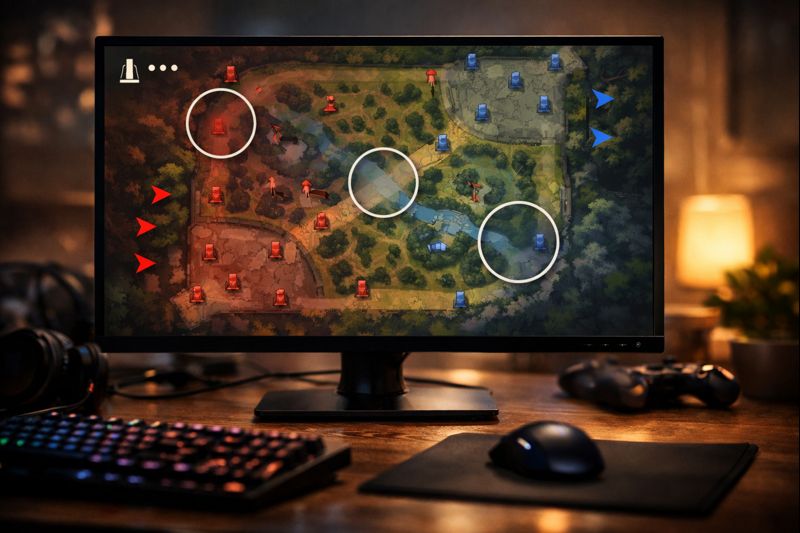
- Increase minimap scale until you can comfortably identify icons and ward coverage at a glance.
- Place the minimap where your eyes naturally rest. Most players keep it bottom right, but the best position is the one you check most. If you never look bottom right, consider repositioning UI elements if your setup allows it.
- Reduce clutter: if you use many overlays or third-party apps, ensure they do not cover minimap edges or ping indicators.
2.2 Camera control (the silent partner of map awareness)
Many beginners fail minimap awareness because their camera habit locks them into a narrow viewpoint. You want to alternate: lane micro (your character) and map macro (where the next threat is). Practice these fundamentals:
- Use quick camera snaps (hotkeys or spacebar behavior) to return to your champion instantly after checking elsewhere.
- Use brief lane-wide camera pans to see river entrances and brush lines without fully leaving your lane context.
- Avoid permanent lock if it prevents you from scanning. If you prefer semi-locked, make sure you can still check river angles easily.
2.3 Audio and feedback loops
Map awareness improves faster when you give your brain a cue. If you tilt, tunnel, or autopilot, you stop checking the map. Consider lightweight cues:
- Ping sounds: treat ally pings as “forced minimap checks.” When a ping happens, your eyes go to the minimap.
- Objective spawns: each time an objective is coming up, your minimap check frequency should increase.
- Wave events: when a wave meets in lane, that is a natural “reset moment” for a minimap glance.
For official basics on game systems and onboarding concepts, you can reference the official how-to-play hub. For general support articles and gameplay settings guidance, the Riot support portal is also a reliable starting point.
3) The core habit: how to check the minimap without losing lane control
Beginners often ask, “How often should I look at the minimap?” The correct answer is: often enough that you never feel surprised. But you still need a starting structure. A practical beginner rhythm is:
- Baseline: glance every few seconds during low-action moments (between last-hits, while walking, while abilities are on cooldown).
- High risk: glance more frequently when you are pushed, missing enemy icons, or objectives are contested.
- High focus micro: even during trades, take “micro-glances” after each key action (after you cast, after you last-hit, after you dodge).
The goal is not to stare at the map. It is to build a repeatable micro-loop:
- Action (last-hit, ability, short trade)
- Check (minimap glance)
- Update (adjust position, decide next 5–10 seconds)
- Commit (execute the plan)
3.1 Where to fit minimap glances in lane
Use “dead time” that already exists:
- During your auto-attack animation after you issue the command.
- While walking to lane, to ward, to reset the wave, or to recall.
- After you spend an ability (your next half-second is often about spacing, not clicking).
- When the enemy is last-hitting (they are briefly less likely to commit to a full trade).
3.2 The “two-second rule” for beginners
Beginners lose lane control because they look at the minimap too long. A good training constraint is: your glance should be short enough that you could still react to a direct engage. In practice, that means a quick scan, not a study session.
3.3 Build a minimap trigger list
Triggers are events that automatically force a glance:
- Enemy laner leaves vision for more than a moment
- Enemy jungler appears anywhere
- Allied jungler pings or moves toward your lane
- Objective timers become relevant
- Your wave is about to crash or bounce
- You are about to push past the river line
Over time, you will not need a list. Your brain will associate these moments with “check the map now.”
4) What to look for on every minimap glance
Most players glance at the minimap but do not extract information. You need a consistent scan pattern. A reliable beginner scan is: enemy icons → ally icons → objective zones → wave lines → vision gaps.
4.1 Enemy icons: count who is visible
Start with a simple question: How many enemies are showing, and where? If fewer enemies are visible than expected, your risk increases. But do not panic—use logic: missing enemies have to be somewhere, and they can only arrive in certain places within certain times.
A helpful mental model is “danger radius.” If an enemy is missing, imagine a circle expanding from their last known position. If that circle overlaps your lane and you are extended, you should play accordingly: step back, ward, or hold a safer wave state.
4.2 Ally icons: who can help you, and who needs you
Beginners often focus only on threats. But ally positions matter just as much:
- If your jungler is near, you can posture more aggressively or set up a bait.
- If your mid is missing, your side lane might be safer (or riskier if the enemy mid is also missing).
- If your support is roaming, your lane dynamics change instantly.
4.3 Objective zones: are people “leaning” toward a side of the map?
Rotations are often about objectives, not lane kills. When you check the minimap, ask: Which side is my team leaning toward, and which side is the enemy leaning toward? If three of your teammates are moving toward a river, you should assume action is coming—even if no one has started it yet.
4.4 Wave lines: which lanes have priority?
You do not need perfect wave theory to read rotations. A simple rule: the team with pushing lanes gets to move first. If your mid wave is pushing into the enemy, your mid can roam sooner. If your mid wave is crashing into your tower, your mid is usually locked in place unless they sacrifice farm and plates.
4.5 Vision gaps: where could someone be hiding?
Not all darkness is equal. Some fog areas are “low value” (unlikely routes), others are “high value” (common gank paths). Over time, you will learn which brush lines are dangerous for your role and your lane state. For beginners, prioritize these:
- River entrances near your lane
- Common jungle ramps and choke points
- Tri-brush and lane brush when you are pushing
- Objective pits and adjacent corridors before major fights
If you want to supplement your learning with match analytics and position heatmaps, common tools include OP.GG, U.GG, and Mobalytics. Use them to review patterns (deaths, roam timings, objective fights), not to replace decision-making in real time.
5) Fog-of-war and vision fundamentals (wards that actually matter)
Warding is not about placing a trinket because you “should.” Wards are a plan. They exist to answer a question: Which route am I afraid of, and when?
5.1 The three purposes of vision
- Early warning: spot the jungler before they reach you so you can back off in time.
- Confirmation: verify where the jungler is so you can safely pressure elsewhere.
- Setup: control an area before an objective to force the enemy to face-check.
5.2 “Good warding” depends on your wave state
Beginners often ward the same brush every game. But the best ward location changes with lane state:
- If you are pushing: you want wards deeper in river/jungle corridors to see ganks early.
- If you are getting pushed: you want wards that protect your tower dive angles and track river rotations.
- If you are freezing: shallow wards can be enough because you are closer to safety, but you still need anti-roam coverage.
5.3 Control vision is not just for supports
Many games are decided by who controls a single corridor before a major fight. If you can afford it, vision tools can be a high-value purchase because they prevent the most expensive mistake in LoL: dying at the wrong time.
5.4 A beginner warding checklist
- Before you push past the river line, confirm at least one “early warning” ward is active.
- If you do not know where the enemy jungler is, assume they are pathing toward the lane that is most extended.
- Refresh wards before objectives; do not wait until the fight starts.
- When you place a ward, immediately look at the minimap and ask: “What path did I just cover?”
Vision improves minimap awareness because it turns fog into facts. But awareness also improves vision because you place wards where the next play will happen, not where the last play happened.
6) Beginner-friendly jungle tracking: predict ganks before they happen
You do not need perfect jungle timers to avoid ganks. You need a working model of where the enemy jungler likely is, and how quickly they can reach you. Jungle tracking becomes much easier when you use multiple small clues together.
6.1 The simplest tracking model: “last seen + next logical place”
Each time the enemy jungler appears, store three pieces of information:
- Where they were seen (which side of the map, which corridor)
- When they were seen (recent or long ago)
- What they were doing (moving to lane, clearing, fighting, recalling)
Then ask one question: What is the next logical place from there? A jungler who shows bot-side can rarely gank top ten seconds later unless they used a special route and you ignored vision. Distance is your friend. Use it.
6.2 The leash clue (early game)
In many games, you can infer the enemy jungler’s starting side by observing which enemy laners arrive late to lane or show suspicious movement. This is not always reliable, but it provides early direction. If you infer the starting side, you can anticipate which lanes are at higher risk during the first few minutes and play accordingly.
6.3 The “gank window” concept
Ganks are not random. They cluster around predictable windows:
- When you are pushed with a long distance to safety
- When your mobility/escape tools are down
- When the enemy has setup (a slow push, a stacked wave for a dive, or a teammate roaming)
- When objectives create gravity (players move toward the same side of the map)
If you are pushed without vision and you do not know where the enemy jungler is, the correct beginner assumption is: you are in the gank window until proven otherwise. That does not mean you must give up lane. It means you trade differently: shorter trades, safer angles, ready to disengage.
6.4 Read the minimap like a detective: “who benefits from my death?”
A surprisingly effective beginner question is: Which enemy role benefits most from coming to my lane right now? If you are low health and pushed, the enemy jungler benefits. If your lane opponent is losing and needs help, the enemy jungler benefits. If a dragon is coming up and you are the nearby lane, rotations benefit. This sounds simple, but it keeps you from autopiloting.
6.5 Tracking without wards: triangulation
Sometimes you have no vision. You can still “triangulate” using:
- Lane behavior: enemies play more confidently when they have backup nearby.
- Missing icons: if mid disappears and you are side lane, treat it as a joint threat.
- Objective pressure: if enemies are grouping early, someone is enabling it (often the jungler).
The objective of jungle tracking is not to be correct every time. It is to be correct often enough that your deaths drop dramatically. Less dying means more gold, more tempo, and more control over when fights happen.
7) Reading rotations: who is moving, why, and where they will arrive
Rotations are the language of macro. A rotation is simply a player moving from one area to another to create an advantage: a numbers advantage, a vision advantage, or an objective advantage. Beginners struggle because rotations are often invisible until you are already dead. Your minimap lets you “see” the rotation early.
7.1 The rotation checklist: four questions
- Who can move? (Who has wave priority, who is not trapped under tower, who just recalled)
- Why are they moving? (Objective timing, lane state, teammate setup, or a punish on a mistake)
- Where can they go? (The limited set of routes that make sense from their position)
- When will they arrive? (Travel time; do you have time to back off or should you commit to a quick play)
7.2 Mid roams: the most common beginner blind spot
Mid lane is centrally located, so mid roams have high impact. Beginners often watch their lane opponent but ignore mid. To read mid roams:
- When the enemy mid disappears, immediately check your wave and your position.
- If you are pushed and your escape route is narrow, back off before you see them.
- If your wave is safe and you have vision, you may be able to punish the roam by pushing, taking plates, or matching.
- Ping early, not after the roam succeeds. “Missing” pings are warnings, not scorekeeping.
7.3 Support roams: recognize the “empty bot lane” signal
Support movement creates sudden spikes in pressure. If you see the enemy support leave lane, it often means: a roam to mid, a vision reset around river, or a setup for an objective. Your minimap response should be:
- Ping the likely destination.
- Adjust your lane risk if you are the destination lane.
- If you are bot, decide whether you can safely pressure the 2v1 or you should respect a potential jungle follow-up.
7.4 Jungle + laner rotations (the “two-man collapse”)
Many deaths happen to a simple pattern: jungler shows briefly, then a laner disappears, and you get collapsed on. Train yourself to connect those events. If you see the enemy jungler near mid and the enemy mid disappears, assume a coordinated play. Even if they do not come to you, you will not be caught by surprise.
7.5 Rotations have costs—learn to punish them
A key minimap skill is recognizing when the enemy rotation is expensive for them:
- If they roam without wave priority, they lose farm and plates.
- If they group too early, they give up side-lane resources.
- If they chase too far, they lose objective tempo.
You do not always need to follow a rotation. Sometimes the best response is to take what they abandoned. The minimap tells you when that trade is available.
8) Wave states and map safety: why your minions decide your risk level
Wave state is your safety system. The further your wave is from your tower, the more time enemies have to reach you before you can retreat. This is why minimap awareness and wave management are inseparable: you cannot “map check” your way out of a permanently unsafe wave.
8.1 The three practical wave states for beginners
- Push: your wave moves forward; you can pressure plates and roam, but you are exposed.
- Neutral: the wave meets near center; risk is moderate; you can choose to push or hold.
- Pull/Freeze: the wave stays closer to your tower; safer vs ganks; better for farming and punishing overextensions.
8.2 “River line” is the danger threshold
A simple rule: once you cross the river line without vision or jungle information, you are gambling. Sometimes gambling is correct, but beginners often gamble without knowing they are doing it. Your minimap should tell you which kind of play you are making:
- Informed pressure: you know where threats are or you have vision to see them early.
- Uninformed pressure: you do not know where threats are and you cannot see routes. This is where most avoidable deaths happen.
8.3 Crash → reset is the safest rhythm
If you can safely crash a wave into the enemy tower, you create time. That time is where minimap awareness becomes proactive: you ward, you roam, you recall, or you help your jungler. Beginners often stay after a crash and overextend for “one more plate,” giving the enemy the exact time they needed to rotate.
8.4 When to stop pushing (even if you are winning)
Many players only respect ganks when they are behind. But when you are ahead, your shutdown is valuable and the enemy will invest more resources to catch you. Stop pushing aggressively if:
- You cannot account for the enemy jungler and a nearby roaming laner.
- Your ward coverage expired and you do not have time to refresh it safely.
- Your team is showing on the opposite side of the map, so you are isolated.
- An objective is creating a rotation window and you are in the corridor they will use.
Awareness is not just “don’t die.” It is “maximize pressure with minimal risk.” Wave state is how you tune that risk.
9) Role-by-role minimap priorities (Top/Jungle/Mid/ADC/Support)
Different roles read the minimap differently because their job and threat model differs. Use these role-specific priorities as your default scan pattern. You can always expand later.
9.1 Top lane: the long lane problem
Top is often isolated, which makes gank timing and wave discipline critical. Your minimap priorities:
- Enemy jungler location (top is punishable when you are extended)
- Mid movement (mid-to-top roams and collapses happen through river corridors)
- Your jungler proximity (know when you can safely pressure for plates or a dive setup)
- Objective trade signals (if teams group bot-side, top can often pressure or take a safe reset)
Top-lane rule of thumb: if you cannot account for the enemy jungler, do not fight long trades past the river line unless you have strong vision and a clear escape angle.
9.2 Jungle: you are the map (and the map is your job)
Junglers should treat minimap awareness as their primary mechanic. Your priorities:
- Lane priority (which lanes can move first to support you)
- Enemy jungler tracking (mirror, avoid, invade, or counter-gank based on information)
- Objective setup (who is moving to river, where vision is contested)
- Kill conversion (after a successful gank: plates, objectives, invade, or reset—minimap tells you the safe option)
A common jungle awareness mistake is forcing plays when lanes cannot move. The minimap prevents this: if your lanes are trapped, your play will often become a 1v2 or 2v3.
9.3 Mid: the rotation engine
Mid reads the map to decide when to roam, when to hold, and when to shadow an ally:
- Side lane wave states (which side lanes are extended and gankable)
- Enemy support position (support roams often collide with mid roams)
- Jungle skirmish zones (mid is closest to most fights; you decide numbers advantages)
- Objective timers (mid priority often decides who starts first)
Mid’s minimap trap: over-focusing on the lane opponent’s HP bar while side lanes are collapsing. Your goal is not to win lane only; it is to use lane priority to win the map.
9.4 ADC: survivability through information
ADC is often the most punished role because your escape options are limited and you attract dives. Your priorities:
- Enemy jungler and mid location (two roles that punish bot the most)
- Support roams (both friendly and enemy)
- Wave crash timing (dives are easier on stacked waves)
- Team grouping cues (when your team is about to fight, you want to be present early and positioned safely)
ADC awareness is often about anticipating when danger increases: when the lane is pushed, when you are low on summoners, when your support leaves, or when mid disappears. A minimap glance before you step up for a risky last-hit saves lives.
9.5 Support: the vision and rotation conductor
Support has the highest ROI on minimap awareness because you can convert information into vision and pings immediately. Priorities:
- Jungle pathing (where to place vision and when to move)
- Mid state (support roams often revolve around mid pressure)
- Objective setup corridors (vision line before fights)
- Protecting ADC (roam timing must respect dive threat and wave condition)
Support’s minimap advantage is that you can create safety for others. Your wards and pings effectively “upgrade” your team’s awareness.
10) Mid game: side lanes, objective setup, and avoiding collapses
Mid game is where many beginners lose control because the map opens up. Lanes are no longer isolated; rotations happen faster and fights start with less warning. If you keep your minimap discipline, mid game becomes easier than lane phase because threats are more predictable: objectives create gravity, and teams move toward them.
10.1 Side-laning without donating shutdowns
Side-laning is where minimap awareness pays dividends. Your job is to collect safe waves and apply pressure without getting collapsed. Use this decision tree:
- Can I see at least three enemies? If yes, side-lane pressure is usually safer.
- Do I have vision on the route they would use to reach me? If yes, you can extend further.
- Is my team near enough to punish a collapse? If no, you must play with tighter limits.
- Is an objective spawning soon? If yes, avoid deep side-lane positions that trap you away from the fight.
10.2 The “collapse pattern” and how to spot it early
Collapses typically look like this on the minimap:
- One enemy disappears from mid.
- Vision goes dark in a corridor.
- Your side lane opponent suddenly plays more aggressively (they know help is coming).
- Two icons appear near you at the same time from different angles.
The key is to respond at step 1 or step 2, not step 4. When you notice the early signal, back up, reset, or move toward your team. You do not need to “outplay” the collapse; you need to avoid being there when it arrives.
10.3 Objective setup: awareness becomes a routine
Objective fights are easier when you treat them like a checklist rather than a scramble:
- Before the objective: identify who has priority and who can move first.
- Vision line: establish a safe corridor for your team to walk through, not just a ward in the pit.
- Minimap monitoring: watch for flanks. Many objective losses come from a single unseen angle.
- After the objective: immediately re-check the minimap to avoid chasing into darkness.
10.4 The “trade the other side” concept
Beginners often feel forced to contest everything. But minimap awareness enables intelligent trades. If you see three enemies committed to one side and your team cannot contest safely, you can often:
- Take a tower on the other side
- Steal camps or establish deep wards
- Force a favorable recall timing
- Create pressure that equalizes the objective loss
The map gives you permission to trade instead of coin-flipping a low-percentage fight.
11) Pings and communication: turning information into team action
Your minimap skill becomes far more valuable when your team can act on it. You do not need to type essays. Use short, timely pings that communicate a plan or a danger. The best ping is early enough that your teammate can avoid the problem without losing resources.
11.1 Ping principles
- Be early: ping when you see the rotation start, not when it arrives.
- Be specific: ping the route or destination, not just “missing.”
- Be consistent: if you ping every time, teammates learn to trust your pings.
- Do not spam: one clear ping sequence is better than noise.
11.2 Convert minimap reads into simple calls
Your call structure can be extremely simple:
- Threat: “Mid missing, could be top.”
- Action: “Back up, I can’t see them.”
- Trade: “They’re bot-side; take top plates / invade top camps.”
11.3 The “shadow” concept for safer plays
If a teammate is extended and you suspect a collapse, you can “shadow” them by moving into the nearby corridor (without necessarily showing). Even if you do not fight, your presence can deter the enemy. Your minimap tells you when shadowing is needed: missing icons, objective gravity, or a teammate pushing alone.
12) Training drills and a 10-game improvement plan
Awareness is a habit, and habits are trained, not wished for. The fastest improvement comes from focused constraints over a small block of games. Below are drills that require no special tools.
12.1 Drill A: “Glance on every last-hit” (lane phase)
For a full match (or at least lane phase), each time you last-hit a minion, take a quick minimap glance. This is difficult at first, but it forces your eyes to connect lane rhythm with map rhythm. If it is too hard, start with “every cannon minion.”
12.2 Drill B: “Missing icon alarm”
Each time an enemy icon disappears from a lane (especially mid), do three things:
- Glance minimap immediately.
- Decide the most likely destination based on wave state and distance.
- Ping that destination early.
12.3 Drill C: “Two wards, one plan”
Every time you ward, say (mentally) what you are protecting against: “This ward covers river gank,” or “This ward covers tri-brush dive.” The goal is to stop mindless warding. You will also start noticing when your ward does not match your lane state.
12.4 Drill D: “Replay death audit” (10 minutes)
After each session, review just your deaths (not the whole replay). For each death, answer:
- Was the enemy visible on the minimap before the play started?
- Was there a missing icon signal I ignored?
- Was my wave state forcing me to be extended?
- What would a safer alternative have been 10 seconds earlier?
12.5 A simple 10-game plan
- Games 1–3: increase minimap size, commit to “last-hit glance” during lane phase.
- Games 4–6: add “missing icon alarm” with early pings.
- Games 7–8: focus on warding with a plan (two wards, one plan).
- Games 9–10: side-lane discipline: only extend when you can account for three enemies or you have clear vision coverage.
If you track only one metric, track deaths before 15 minutes. A major drop here usually correlates with better minimap habits, better recall timing, and more consistent gold income.
13) Common minimap mistakes that keep beginners stuck
13.1 Looking at the minimap only after something happens
If you only look after a ping, after a fight starts, or after you are engaged, you are using the minimap as a scoreboard. You want the minimap to be a forecast.
13.2 Treating “missing” as random
Missing icons are not random; they are constrained by distance, wave priority, and objectives. When you treat missing as random, you either panic (and lose lane pressure) or ignore it (and die). Instead, make a best guess and act accordingly.
13.3 Warding the past
Many players ward where they got ganked last time, not where they will be ganked next. Your ward should match the next 30–60 seconds: where you intend to stand, what you intend to do, and which route enemies will use to punish you.
13.4 Overextending for “just one more wave”
This is the classic minimap failure: you know danger exists, but you gamble because the reward feels close. The fix is to use crash → reset rhythm and accept that safe tempo wins more games than greedy gold.
13.5 Not re-checking after an event
A fight, a recall, a ward, an objective—each of these changes the map. Beginners often check once, then tunnel. Train the follow-up glance: after something major happens, check the minimap again to update your plan.
14) Quick-reference cheat sheet
Use this as a fast checklist during games until habits become automatic.
| Situation | Minimap Question | Best Beginner Response |
|---|---|---|
| You are pushing past river | Can I account for jungler and mid? | Ward first, then pressure; if unsure, shorten trades and keep an exit path |
| Enemy mid disappears | Which side lane is extended? | Ping the likely destination and back up if you are extended |
| Objective is coming up | Who has priority to move? | Reset vision early and group before the fight starts |
| Side-laning mid game | How many enemies are visible? | Extend only with vision and numbers information; avoid dark corridors |
| Enemy jungler shows bot-side | What can I safely take top-side? | Pressure lane, take plates, or invade safely—do not overstay into fog |
| You just warded | What route did this ward cover? | Position to use the information: play toward the warded side |
15) FAQ
How often should I check the minimap as a beginner?
Often enough that ganks feel predictable rather than surprising. Start with short glances during “dead time” (walking, last-hitting, after casts). Increase frequency when you are pushed, missing icons, or objectives are near.
I look at the minimap and still die. Why?
Usually because you are not converting information into action. If you see missing icons and keep pushing without vision, the minimap did its job—you ignored it. The fix is to attach a response: missing mid + you are extended = back up or ward immediately.
Should I always follow roams?
No. Following late often loses more than it gains. Decide based on timing and wave state: if you can match early and arrive with impact, follow. If you cannot, punish by pushing, taking plates, or creating pressure elsewhere. The minimap tells you whether following is realistic.
What’s the biggest single change that improves gank avoidance?
Stop extending past river without either (1) vision coverage on key routes or (2) reliable information on the enemy jungler’s position. Combine that with shorter trades when you are in a gank window.
Do I need third-party tools to build awareness?
No. Tools can help you review patterns, but the core habit is in-game: glance, extract, update, act. If you do use analytics sites, use them for post-game reflection rather than in-game autopilot.
Closing
Minimap awareness is not a “nice to have.” It is the skill that makes your mechanics matter. When you consistently read rotations, track likely jungler positions, and respect wave-based danger windows, you will die less and influence more fights on your terms. Start small: increase minimap size, build short glances into lane rhythm, and commit to a 10-game plan. The improvement is measurable and it compounds over time.