



Smoke of Deceit Guide in Dota 2 2026: Best Ganks & Ambushes
Smoke of Deceit Guide in Dota 2 2026: Best Usage for Ambushes and Ganks
Smoke of Deceit is one of the most game-changing consumables in Dota 2, yet it is still one of the most misused. Many teams buy it automatically, activate it without a clear goal, walk into random areas, reveal themselves too early, and then wonder why the move failed. Strong teams do the opposite. They treat Smoke as a strategic tool, not as a lottery ticket. A good smoke creates information advantage, compresses map distance, hides intention, manipulates enemy positioning, and turns one clean pickoff into towers, Roshan, vision, or complete control of the next minute of the game.
This guide focuses on timeless principles, so it stays useful even as hero metas and patch priorities shift. Instead of teaching you only narrow patch-specific patterns, it explains why smoke works, when it is worth buying, how to prepare it, and how to convert successful ambushes and ganks into real advantages. If you learn these principles, your smokes will become more reliable in pubs, more coordinated in party play, and more dangerous in every stage of the match.
Smoke is not just for surprise kills. It is for reclaiming the map when you are behind, accelerating the game when you are ahead, dodging enemy vision, bypassing predictable ward lines, wrapping around defended objectives, punishing greedy farming patterns, and forcing fights on your terms. In many ranked games, the difference between a team that feels “active” and a team that actually wins map control is simply better smoke discipline.
If you are trying to improve your Dota 2 fundamentals overall, it also helps to study official updates and pro-level competitive resources over time. Useful reference points include Dota 2 official updates, Liquipedia Dota 2, Dotabuff, and STRATZ. And if your goal is faster rank progress with structured gameplay support, you can also explore Dota 2 boosting prices at Boosteria.
Table of Contents
- What Smoke of Deceit Actually Does
- Why Smoke Wins Games
- When to Buy Smoke of Deceit
- Best Timings for Smokes
- Who Should Carry the Smoke
- How to Prepare a Successful Smoke
- Best Smoke Paths for Ambushes and Ganks
- Role-by-Role Smoke Usage
- Hero Synergy and Lineup Types
- Early Game Smoke Usage
- Mid Game Smoke Usage
- Late Game Smoke Usage
- Offensive and Defensive Smokes
- Common Smoke Mistakes
- How to Convert a Successful Smoke
- Communication and Shotcalling Tips
- Smoke Checklist Before You Press It
- Conclusion
- SEO Title, SEO Description, Schema Description, Schema About
- Image Prompts with SEO Alt Text
- Tags
What Smoke of Deceit Actually Does
Before talking strategy, it is important to understand Smoke of Deceit as a tactical resource. The item allows your team to move invisibly and more quickly, which means it does two things at once: it hides your current location and it reduces the time the enemy has to react. That combination is what makes smoke so powerful. Normal movement across visible lanes or common jungle entrances gives away information. Smoked movement does not. Instead of showing your approach step by step, it often reveals you only at the moment when the fight has already started.
That matters because Dota 2 is a game of information. A farming carry decides where to farm based on visible heroes. A support decides where to ward based on known pressure. A mid player shoves one more wave if the minimap looks safe. Smoke attacks all of those assumptions. It punishes players for reading the map lazily and rewards teams that understand timing windows.
Another key idea is that Smoke is not just invisibility. It is hidden initiative. The hidden part means enemies do not know which area you are targeting until it is too late. The initiative part means you are the one choosing where the next engagement happens. Many players think smoke is mainly for surprise, but the deeper value is that it lets you choose the battle instead of walking into one.
Smoke is also at its best when combined with other systems in Dota 2: ward vision, creep equilibrium, tower pressure, rune timing, Roshan pressure, wave shoves, buyback status, and item cooldowns. Used in isolation, smoke is decent. Used as part of a planned map sequence, it is one of the strongest strategic tools in the game.
Why Smoke Wins Games
At a basic level, smoke helps secure kills. At a higher level, smoke wins games because it changes map geometry. It lets five heroes appear in a zone where the enemy expected one, or lets three heroes appear behind the enemy while two are showing elsewhere. It creates temporary asymmetry. Dota is full of moments where one team believes the map is spread out and safe, while the other team knows a collapse is coming. Smoke creates those moments.
There are five main reasons smoke wins games:
- It punishes greed. Any carry or support that stays one camp too long can die.
- It compresses reaction time. The enemy sees you later, so they respond later.
- It bypasses common wards. Good smoke paths attack predictable map vision.
- It sets tempo. Instead of passively farming, your team creates action windows.
- It creates conversions. A single kill often becomes Roshan, towers, or deeper vision.
The last point is the most important. A smoke that gets one support kill and nothing else is fine. A smoke that gets a core kill, forces a glyph, plants deep wards, steals the enemy jungle, and opens the next Roshan is game-winning. The best smoke users do not think in terms of “Can we kill someone?” They think in terms of “What objective opens if this move succeeds?”
That objective-first thinking is what separates random pub smokes from strong strategic smokes. Random smokes search for victims. Strategic smokes search for outcomes.
When to Buy Smoke of Deceit
In many games, the biggest smoke mistake happens before the item is even used: teams simply do not have one when the right timing appears. Smoke should be stocked proactively, especially by supports. You do not buy Smoke only when everyone is already grouped and standing in base. You buy it in advance so your team can act instantly when conditions become favorable.
Good general rules:
- Supports should think about smoke every time they return to base or shop safely.
- If your lineup wants to fight around early ultimates, smoke should already be available.
- If Roshan is important in the next few minutes, keep a smoke ready.
- If your team just lost map control and needs to recover, smoke becomes high priority.
- If your opponent has a greedy farming core pattern, smoke becomes even more valuable.
Buying smoke is especially important when your team’s strength depends on timing spikes. Maybe your offlaner just finished Blink Dagger. Maybe your support has a new saving item or a long-range catch tool. Maybe your carry has a fresh BKB and wants one clean fight before the enemy scales further. These moments do not last forever. A smoke in inventory turns a power spike into real pressure.
It is also correct to buy smoke when your team is behind. Many lower-ranked teams think smoke is an item for the winning team only. That is backwards. The losing team often needs smoke more because visible movement across defensive map lines is too dangerous. A behind team that walks out normally gets seen, split, or kited. A behind team that smokes can reclaim one side of the map, get a kill, plant vision, and regain breathing room.
Best Timings for Smokes
Smoke is strongest when used around timing windows. The more predictable the enemy’s behavior, the better the smoke. Here are the most reliable timeless timing windows:
1. Right after a key item timing
If a hero on your team has just completed a defining item, that is often the best moment to smoke. Blink initiators, damage spikes, save items, and anti-control tools all create fresh kill potential. Use smoke before the enemy has full information about your new strength.
2. Right after pushing out lanes
This is one of the cleanest patterns in Dota 2. Shove one or two lanes first, then disappear. Once lanes are pushed, the enemy has to respond somewhere. Their farming pattern becomes narrower and more readable. A smoke after wave shove is much stronger than a smoke with unprepared lanes because enemy positions become easier to predict.
3. Right before Roshan pressure
Sometimes the smoke is to kill someone. Sometimes the smoke is to secure the zone around Roshan. Both are valid. If the enemy must contest Roshan through a predictable route, smoke can catch them on entry. If the enemy is already nearby, smoke can help your team approach the area unseen and claim better positioning.
4. Right after the enemy shows multiple heroes on lanes
This is one of the highest-value informational timings in the game. If two or three enemy heroes show on lanes and one key core is missing, you can infer where the missing hero is likely farming. If the visible heroes are far from each other, a smoke lets your team hit the isolated section of the map before reinforcements arrive.
5. Right after defending a push
Many teams relax after failing to break high ground or after finishing a push sequence. Their spells are on cooldown, their formation is loose, and some players start farming side camps immediately. Defensive smokes after a successful hold are among the most underrated comeback tools in Dota 2.
6. Around night time or vision swings
Even in a timeless framework, visibility changes matter. Any moment where enemy map confidence drops is a good smoke moment. If their wards expired, if lanes are dark, if they just lost a tower, or if they are forced into uncertain territory, smoke becomes stronger.
Who Should Carry the Smoke
Usually, a support carries smoke. That is standard and efficient, but the real answer is more flexible: the best smoke carrier is the hero who can reliably be present for the move without compromising the rest of the plan.
In most games, position 4 or 5 handles it because supports manage utility inventory and often gather the team. But there are important details:
- The smoke carrier should not be the most vulnerable hero if they risk dying alone before the move.
- The smoke carrier should understand the team’s timing, not just mechanically own the item.
- If one support is warding alone while the other groups the team, the grouped support may be the better holder.
- In high-chaos games, having a second smoke available later can be game-defining.
One subtle point many players miss: ownership is less important than responsibility. Someone on the team must mentally “own” the smoke plan. It is not enough that a support bought the item. Someone must recognize the map state, call the timing, and lead the route. A smoke with no shotcaller is usually just five heroes walking together nervously.
How to Prepare a Successful Smoke
Preparation is what turns smoke from a gamble into a repeatable play. Before pressing the item, ask five questions:
1. What is the exact goal?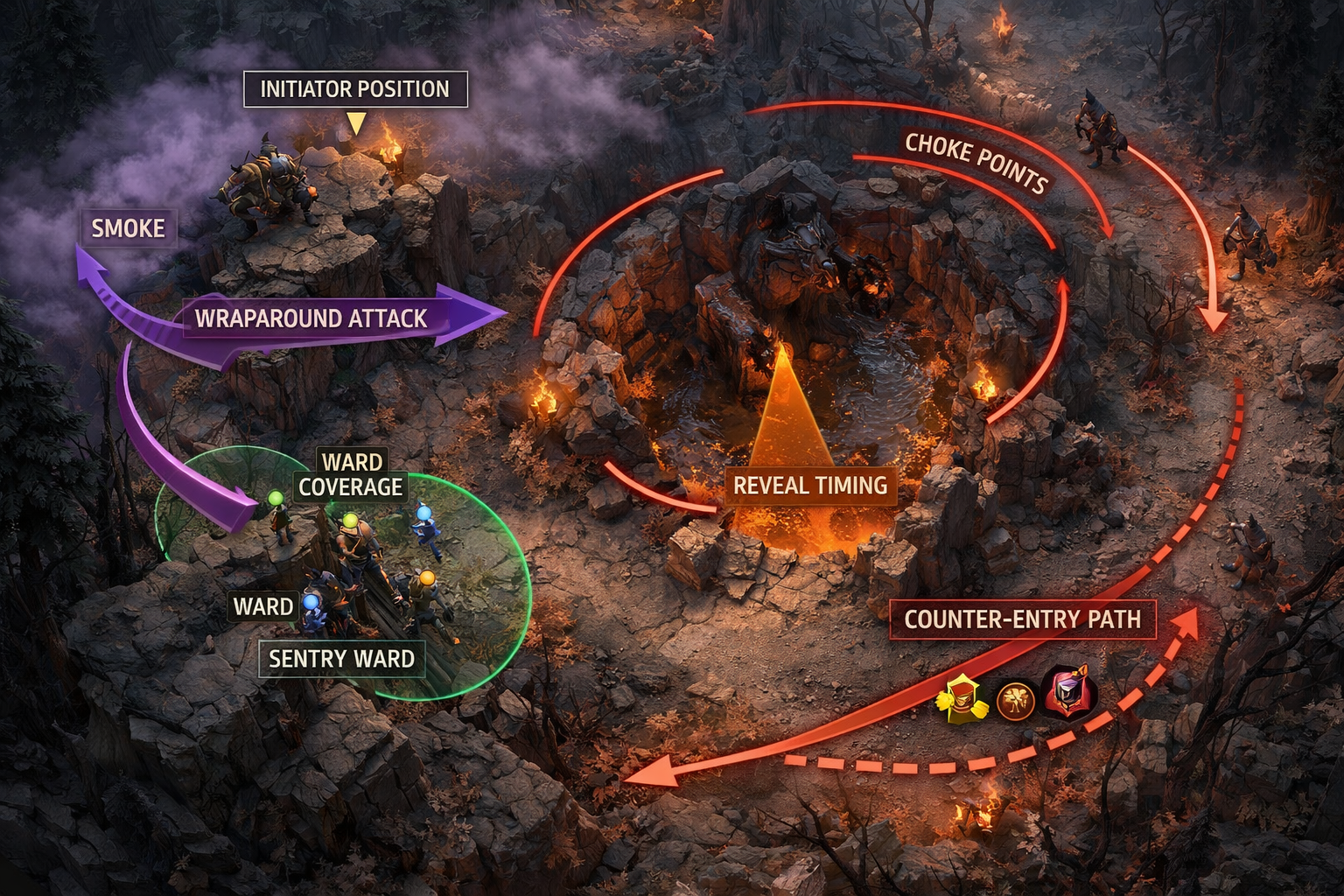
Do not smoke “to do something.” Smoke to kill a farming core, invade triangle, defend Roshan, punish a tower push, plant deep wards, or catch the next wave farmer. The more precise your goal, the cleaner your route and target priority become.
2. Which enemy are you trying to kill or force away?
Target selection matters. Sometimes the obvious target is wrong. Killing a support near a useless area may not matter. Forcing the enemy carry out of a rich farming zone may matter a lot more, even if no kill happens. Think in terms of map value, not only hero value.
3. What happens after the kill?
This is the conversion question. If the answer is “nothing,” rethink the smoke. Great smokes are attached to the next action: tower, Roshan, warding, rune control, triangle invasion, outpost pressure, lane shove, or forcing buyback.
4. Are your lanes prepared?
Smoking with bad lanes is a classic mistake. If your lanes are under your towers or pushing toward your side, enemies can disappear freely and your smoke path becomes hard to read. If lanes are already pushed out, enemies must show to collect them or give up resources. That makes your smoke more accurate and less wasteful.
5. Are your resources ready?
Check big cooldowns, mana, teleport status, buyback implications, and item readiness. Smoke is not magic. If your initiator has no mana, your save support is dead, or your main damage hero is 300 gold from a major item, the smoke may be low quality. Patience often increases smoke success more than speed.
Preparation also includes formation. Do not run in a messy clump with your backline exposed and your initiator trapped behind slower heroes. Arrange the order before moving. Decide who breaks uphill vision, who holds detection, who saves, and who instantly follows the first disable. A smoke is often decided in the first second after reveal.
Best Smoke Paths for Ambushes and Ganks
The best smoke paths are not universal routes but route types. Once you understand the categories, you can adapt them to any map layout and patch.
Wraparound path
This is the classic kill route. Instead of approaching the target head-on through the obvious warded entry, your team circles wide and attacks from the back or side. Wraparound smokes are strongest against farming cores who feel safe because their front ward line is intact. They watch the obvious entrance and die to the angle they did not respect.
Collapse path
Here the goal is not a deep flank but a fast compression of distance. You already know roughly where the enemy is, usually because of lane information or a fresh ward. The smoke path is short and direct. These smokes are common when an enemy hero shoved one more wave or just showed at a predictable camp.
Counter-entry path
This is a defensive smoke. The enemy wants to enter your area, take Roshan, ward your jungle, or pressure your tower. Instead of showing first, your team smokes and waits near the path they must use. This type of smoke is excellent for turning defense into initiative.
Vision bypass path
The whole purpose here is to dodge known or likely ward spots. Many pub players smoke but still walk through the most common vision lines, wasting the informational advantage. Strong teams use terrain, tree lines, unusual ramps, and side angles to stay unpredictable until the reveal point.
Post-push vanish path
Your team shoves a lane, shows briefly, then disappears. The enemy assumes reset or retreat. Instead, the smoke redirects your team to the adjacent jungle, common rotation corridor, or objective entrance. This is one of the best ways to punish defenders who think the wave clear ended the danger.
Good smoke paths are shaped by enemy habits. Watch how the opposing carry farms after showing on lane. Watch which support always dewards first. Watch which offlaner greedily takes one extra wave after defending tower. Smoke paths become much stronger when they are designed around human patterns, not just geometry.
Role-by-Role Smoke Usage
Position 1
Carries are not always the leaders of smoke plays, but they are often the reason the smoke works. When your carry joins a smoke at the correct timing, the enemy dies faster and the conversion becomes easier. Carries should be selective. Do not join every random smoke if it destroys your farm pattern for no reason. But when your team has a major item timing, Roshan window, or critical map pressure opportunity, your presence can decide the game.
A carry should also understand when not to reveal. Sometimes the strongest smoke is actually four heroes creating space while the carry stays hidden and punishes the opposite side of the map. Smoke is not always about taking all five heroes together.
Position 2
Mid heroes often define the smoke’s killing power or tempo. Burst mids, mobile initiators, rune-controlling roamers, and spell combo heroes are natural smoke engines. Mid players should be especially aware of wave state. Because they often influence central map vision and movement, their wave shove before smoke is one of the biggest success factors.
Position 3
Offlaners are frequently the initiators or frontline anchors of smoke plays. If your offlaner has Blink, strong catch, durable entry, or fight-starting control, their positioning matters more than anyone else’s. A common smoke error is letting the offlaner trail behind supports. The hero that starts the fight must be able to do so instantly.
Position 4
The roaming support often connects the map. Position 4 players should be excellent at identifying where enemy greed exists. They are usually the best at reading ward lines, camp habits, and who can be caught alone. A great position 4 turns smoke from a button press into a hunting route.
Position 5
The hard support typically handles logistics, inventory, and communication. That makes position 5 a natural smoke coordinator. A strong position 5 knows whether the team needs a pickoff smoke, a warding smoke, a defensive reclaim smoke, or a post-fight conversion smoke. In many games, the best support contribution is not the cast sequence itself but the timing of the move.
Hero Synergy and Lineup Types
Some lineups naturally love smoke more than others. Understanding your lineup type helps you know how aggressive your smokes should be.
Pickoff lineups
These teams want short, sharp kills and quick retreats or transitions. They usually have instant catch, burst, and one or two heroes who excel at collapsing on isolated targets. Their smokes should be frequent, targeted, and built around reading farming patterns.
Teamfight lineups
These teams may smoke not only for pickoffs but for positioning before a bigger fight. Their smoke may begin a fight around high ground control, objective entry, or choke points. Even if the initial target survives, good pre-positioning can still win the full engagement.
Push lineups
For these teams, smoke is often used to reach tower zones safely, catch defenders, or establish aggressive vision before committing to structures. Sometimes the smoke happens after the push starts, not before, because you want to disappear from one lane and collapse somewhere else.
Greedy scaling lineups
These lineups still need smoke, but often in a more selective way. A greedy lineup uses smoke to protect its map shape, punish overreach, or take one decisive objective around a timing spike. They usually do not want repeated low-value skirmish smokes.
Lineup synergy also changes target priority. If your lineup needs a numbers advantage before hitting an objective, smoke for the easiest pick. If your lineup is strong enough to fight 5v5 but needs positioning, smoke for area control. If your lineup lacks hard catch, smoke only when you can reliably chain disables or attack predictable movement corridors.
Early Game Smoke Usage
Early game smokes are often underused in pubs because players assume smoke is mainly for later map movements. In reality, early smoke can completely change lane recovery and momentum. The key is to keep expectations realistic. Early smokes do not need to create massive objective swings; they just need to create a favorable next few minutes.
Good early game smoke uses include rotating onto an overextended sidelane core, punishing a tower dive, stacking heroes onto a rune timing, or helping an offlane pressure turn into a kill. Because early deaths have lower raw consequence than later deaths, the value often comes from lane control, support movement freedom, and tower pressure rather than only kill count.
One of the best early-game smoke concepts is the power rune or post-rune collapse. Mid activity reveals a lot about both teams. If one hero rotates or shows greedily after rune timing, smoke can punish that predictable movement. Another classic early pattern is the offlane reinforcement smoke, where your team helps a strong lane convert pressure into a tower or zone steal.
Be careful with very early low-information smokes, though. Without good lane information, they can waste precious support time. Early smoke should usually be attached to visible lane pressure, a known target habit, or a clear rune/tower timing.
Mid Game Smoke Usage
Mid game is where Smoke of Deceit becomes one of the most important items in Dota 2. This is when the map opens, farming patterns become greedier, towers fall, side lanes stretch, and Roshan becomes a major threat. Mid game smokes often decide which team gets to play the next five minutes on their terms.
The most valuable mid-game smoke concept is this: push lanes, disappear, strike the richer side of the map. If you shove waves first, the enemy must either defend or give up farm. That narrows their choices. Then your smoke hits the area with the highest expected value: triangle, jungle entrance, side lane connection route, or objective setup area.
Mid game smoke should usually have one of four goals:
- Kill a core farming the dangerous edge of the map.
- Establish control around Roshan or another major objective.
- Punish enemy vision and reclaim your lost jungle.
- Create a numbers advantage before taking a tower.
This is also the stage where fake information becomes useful. For example, showing one hero on a lane while four prepare behind smoke can bait the enemy into a confident response. Or your team can show a retreat pattern after defending and then immediately smoke back into the route the enemy must take. Mid game rewards teams that understand not just movement, but expectation.
Late Game Smoke Usage
Late game smokes are less frequent but more important. At this stage, one death can mean Roshan, high ground, multiple lanes, or even the game. Because buybacks, vision denial, and positioning become more decisive, smoke turns from a tempo tool into a precision weapon.
The biggest late-game mistake is smoking with vague intent. Late game smokes must be disciplined. You need to know whose buyback matters, which objective is next, which enemy hero must die first, and whether your team wants a kill, a forced retreat, or a superior fight location.
Late game smoke often serves one of these purposes:
- Roshan trap: hide near the area and punish the first enemy to approach.
- Base exit punish: catch heroes who split up after defending or shoving lanes.
- Vision reclaim: remove darkness around your half before farming out.
- Pickoff before objective: eliminate one key hero to make the next objective uncontestable.
- Buyback abuse: force a death on a hero without buyback and immediately convert.
Late game also punishes over-committing to the first target. Many smokes fail because the team becomes too focused on one visible support while the real core escapes or counter-initiates. In late game, target discipline is everything. Sometimes the correct move is to let one hero go in order to maintain formation and secure the higher-value fight.
Offensive and Defensive Smokes
Most players think of smoke as an offensive item. That is only half true. Defensive smokes are some of the strongest comeback tools in Dota 2.
Offensive smokes
These are the obvious kind: invade, ambush, collapse, gank, or set up an objective. Offensive smokes are best when your team has stronger immediate fight potential, better information, or a clear target pattern to exploit.
Defensive smokes
These happen when your team is under pressure, lacks safe areas to farm, or expects the enemy to enter a known route. A defensive smoke can do several things:
- Help your team leave base or a dead zone without being picked off.
- Set a trap near your own jungle entrance.
- Reclaim vision around your side of the map.
- Punish enemy greed after they take one objective and stay too long.
- Reset the map when normal movement is too dangerous.
Defensive smokes tend to be strongest when the enemy feels comfortable. Winning teams often become sloppy with formation, especially in pubs. They farm your outer camps, split to ward and deward, or push one lane while others drift apart. A disciplined defensive smoke attacks that comfort directly.
Common Smoke Mistakes
Most failed smokes fail for predictable reasons. If you remove these mistakes, your success rate rises immediately.
Smoking with no goal
This is the biggest error. Wandering the map “hoping to find someone” wastes time, reveals your absence from lanes, and often gives the enemy more information than it gains you. Always attach smoke to a target zone or outcome.
Smoking through bad lane state
If lanes are not prepared, the enemy can disappear freely and your target prediction becomes weak. Push first whenever possible.
Clumping too tightly
A smoked team that reveals in a perfect clump can lose instantly to one area spell or bad staircase entry. Maintain functional spacing and formation even while hidden.
Breaking smoke with the wrong hero
Your most fragile support or least relevant hero should not be the one leading uphill blindly unless that is specifically the plan. Think about reveal order.
Showing too early before smoking
If all five heroes vanish from lanes at the same time after a visible reset, the enemy will often read the smoke instantly. Better teams manage information first and then disappear in a more believable way.
Not converting after the kill
A successful pickoff with no objective follow-up is often only half a win. Ask immediately: tower, Roshan, wards, triangle, wave shove, or reset?
Overcommitting after a partial success
Not every smoke needs to turn into a huge fight. Sometimes you got the one important kill already. Taking that win and converting the map is better than chasing too far and throwing it back.
How to Convert a Successful Smoke
Conversion is the hidden skill behind elite smoke usage. The fight itself is often simple. The difficult part is knowing what comes next fast enough to capitalize before the enemy respawns or reorganizes.
After a successful smoke, immediately think in this priority order:
- Can we take Roshan or secure the Roshan area?
- Can we take a tower safely?
- Can we plant deep wards or remove enemy wards?
- Can we steal a valuable farming zone?
- Can we shove lanes to force the next response?
- Do we need to reset because key resources are low?
The correct conversion depends on which hero died and where. Killing a carry near triangle often means zone occupation and vision first. Killing a support near Roshan may mean start Roshan immediately. Killing a mid hero near a tower may mean tower and then deeper wards. The core idea is simple: do not let the smoke end with the kill animation.
Conversion also includes psychological pressure. If your team repeatedly smokes into one side of the map and gets value, the enemy becomes hesitant to farm there. That fear itself becomes a resource. Even when you are not smoked, the enemy may play as if you are. Strong smoke usage reshapes the entire map through future threat.
Communication and Shotcalling Tips
Even in solo queue, smoke gets better with a few clean calls. You do not need a speech. You need clarity.
Useful smoke communication principles:
- Call the goal before the route: “Smoke for triangle” is better than “Come smoke.”
- Name the target if obvious: “Kill their carry top jungle.”
- Remind lane prep: “Push mid first, then smoke.”
- Assign reveal responsibility: “Let Axe break first,” or “Don’t show support first.”
- Call conversion instantly: “One kill then Roshan,” or “Wards after tower.”
The best shotcallers are calm and specific. They do not over-explain once the team is moving. Long discussions during smoke usually slow the route, ruin formation, and cause hesitation on reveal. Make the decision before activation, not during the walk.
Another underrated shotcalling habit is cancel discipline. If new information makes the smoke bad, abort it. There is no rule saying every activated smoke must force a fight. Sometimes the best smoke is the one that safely repositions the team, establishes vision, and avoids a losing engagement.
Smoke Checklist Before You Press It
Use this quick checklist in ranked games:
- Do we know why we are smoking?
- Which hero or area are we targeting?
- Did we push the nearest important lane first?
- Are our cooldowns, mana, and teleports ready?
- Who starts the fight?
- Who saves the initiator if needed?
- What do we do after the kill?
- Are we attacking a valuable zone, not just a random one?
- Will the enemy likely feel safe there?
- If nobody is there, what is our fallback plan?
If you can answer these questions in a few seconds, your smoke is probably good. If nobody on the team can answer them, delay the play and prepare it properly.
Conclusion
Smoke of Deceit is one of the clearest examples of how Dota 2 rewards planning over impulse. It is cheap, simple to activate, and available in almost every game, yet it remains one of the highest-skill macro tools because its value depends on preparation, timing, route choice, target selection, and conversion.
If you remember only a few things from this guide, remember these:
- Smoke is not for random hunting. It is for deliberate outcomes.
- Push lanes before smoking whenever possible.
- Choose routes that bypass expectation, not only distance.
- Think about the next objective before the first spell is cast.
- Defensive smokes can be just as powerful as offensive ones.
The strongest teams do not use smoke more often just for the sake of activity. They use it at the right moment, with the right formation, into the right area, for the right reward. If you build that discipline, your ambushes become cleaner, your ganks become more reliable, and your overall map control improves dramatically. In Dota 2, one good smoke does not just kill a hero. It can redefine the whole next phase of the game.