



LoL Positioning Guide 2026: Safe Spacing for All Roles
LoL Positioning Guide 2026: Safe Spacing in Teamfights and Laning for All Roles
Positioning is the skill that quietly decides most LoL games. You can have strong mechanics, a good build, and decent macro, yet still lose fights because you stood in the wrong place for two seconds. The good news is that positioning is learnable and repeatable. It is less about “instinct” and more about a set of rules: where you stand, when you move, what you respect, and what you punish.
This guide is designed to be timeless. Instead of patch-specific champion details, you will learn frameworks that work across metas: safe spacing in lane, teamfight formation, threat-range thinking, vision-based movement, and role-by-role positioning priorities. If you apply the checklists and drills here, you will take fewer bad fights, die less to surprise engages, and convert more leads into wins.
Table of Contents
- 1) What “Positioning” Means in LoL
- 2) The Core Principles of Safe Spacing
- 3) Threat Range Thinking: The One Concept That Fixes Most Mistakes
- 4) Laning Spacing Fundamentals (All Roles)
- 5) Top Lane Positioning
- 6) Jungle Positioning and Pathing Safety
- 7) Mid Lane Positioning and Roam-Proofing
- 8) ADC Positioning: Kiting, Angles, and Not Getting One-Shot
- 9) Support Positioning: Engage, Peel, and Vision Anchoring
- 10) Teamfight Spacing: Front-to-Back, Flanks, and Layers
- 11) Objective Setup: Positioning Around Dragon/Baron and Towers
- 12) Vision and Positioning: Safe Movement Without Guessing
- 13) Positioning vs Common Threat Types
- 14) Micro Habits That Upgrade Your Positioning Overnight
- 15) Practical Drills and VOD Review Checklist
- 16) Common Positioning Mistakes and Fixes
- 17) A Simple 10-Game Improvement Plan
- 18) FAQ
1) What “Positioning” Means in LoL
Positioning is the continuous process of placing your champion in a location that maximizes your impact while minimizing your risk. In practical terms, it answers four questions in real time:
- What can hit me if I stand here? (enemy threat range)
- What can I hit if I stand here? (your effective range and angles)
- What happens if a fight starts now? (formation, peel, escape routes)
- What happens if the fight doesn’t start? (wave control, vision, tempo)
Positioning is not just for teamfights. It starts at level 1 in lane, continues through rotations, and determines whether you survive picks in fog-of-war. Great positioning looks “boring” because it avoids drama: fewer coinflips, fewer panic flashes, fewer deaths before objectives.
A helpful mental model: positioning is risk management plus damage uptime (or crowd control uptime). Your job is to keep doing the useful thing your role is meant to do, for as long as possible, without giving the enemy the opening they want.
2) The Core Principles of Safe Spacing
Safe spacing is the habit of staying outside the enemy’s “winning zone” while staying inside your own “impact zone.” These principles apply to every role:
Principle A: Always have a plan for the next 2 seconds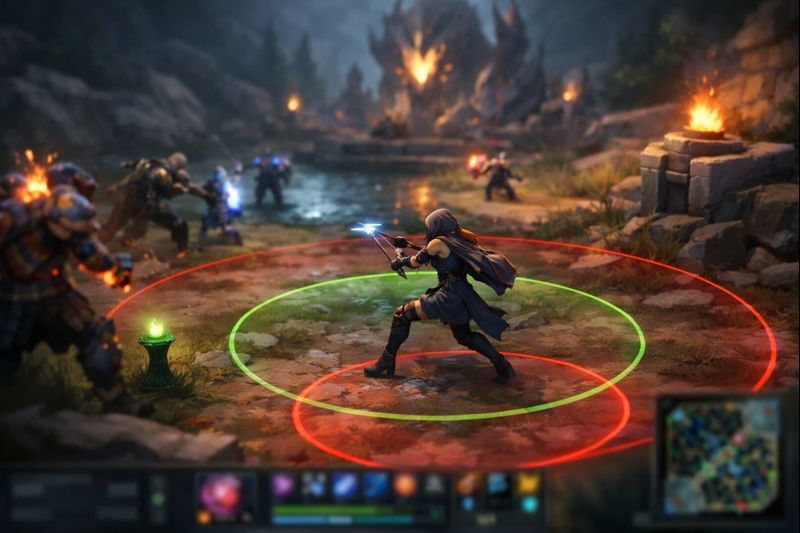
In LoL, fights explode quickly. If you do not pre-plan your next movement, you will react late. Before you walk up for a last hit, a poke, a ward, or a tower hit, quickly decide: “If they engage right now, I go there.”
Principle B: Your nearest safe tile matters more than your target
Many deaths happen because players chase a target and ignore the safe retreat path. When you step forward to trade, keep your body aligned with your exit route. Think in triangles: you, your escape, and the enemy engage angle. If your escape is behind the enemy, you are already in trouble.
Principle C: Fight with layers, not piles
Good teams look “spread” but connected. Bad teams look stacked. Layers means: frontline first, midline second, backline last, with lateral spacing to reduce multi-target abilities and to give backliners kiting room.
Principle D: Respect fog-of-war more than visible champions
Visible enemies are often the least dangerous. The unseen champions are the ones that create flanks, picks, and collapses. If you cannot account for key threats on the minimap, your safe spacing must widen immediately.
Principle E: Cooldowns define permission
You are “allowed” to stand closer when the enemy’s engage tools are down. You are “not allowed” to stand close when those tools are ready. This is the difference between disciplined aggression and random aggression.
3) Threat Range Thinking: The One Concept That Fixes Most Mistakes
Threat range is the distance at which the enemy can realistically start a sequence that kills you or forces your key cooldowns. It is not just the range of one ability. It includes:
- Engage range: dash + crowd control, hook range, flash engage distance, movement speed bursts
- Follow-up range: how far their team can add damage once you’re caught
- Fog range: how close you can safely stand when you lack vision
How to estimate threat range quickly
You do not need exact numbers. You need a conservative mental circle. Ask:
- Can they reach me with one movement tool + one CC tool?
- Can they reach me if they use Flash?
- Can they reach me from fog if I face-check?
If the answer is “yes,” you must either:
- Stand outside that range, or
- Stand inside it only if you have cover (frontline/peel), vision, and your escape ready.
Threat range changes with game state
- When you are ahead: your threat increases, but enemy pick potential can still end the game. Do not “donate” shutdowns by ignoring fog.
- When you are behind: your threat decreases; you must rely on safe wave collection and defensive positioning around towers and vision.
- When objectives spawn: threat spikes because teams group and engage tools are saved for one decisive fight.
A strong habit: whenever a major fight might happen soon, identify the enemy’s #1 engage threat and your team’s #1 peel tool. Your positioning should be shaped around those two facts.
For objective-focused practice and structured improvement (including role coaching and consistent execution), many players combine self-review with a ranked climb service. If you want a faster path to stable results, consider Boosteria’s Elo services here: https://boosteria.org/elo-boost/prices.
4) Laning Spacing Fundamentals (All Roles)
Laning spacing is where positioning habits are built. If you consistently stand in the right places during lane, you will naturally teamfight better. In lane, spacing is mostly about three axes:
- Wave axis: where you stand relative to minions and last-hit timing
- Brush/fog axis: how you respect hidden threat angles
- Cooldown axis: when you can step up to trade or zone
4.1 The “Last-Hit Window” rule
Most laning trades happen during last hits. The enemy must walk forward for a minion, so you pre-position to punish. Conversely, you must pre-position to avoid being punished. A simple rule:
- If you want to trade: stand close enough that your attack/spell lands as they last-hit.
- If you want to farm safely: stand far enough that you can last-hit and immediately retreat without entering their engage range.
This is why wave control and spacing are inseparable. The wave tells you when the enemy is “forced” to step up. If you track those moments, you will get cleaner, lower-risk trades.
4.2 Minions as bodyguards (and as traps)
Minion waves provide:
- Cover: they block many skillshots and create “traffic” that slows engages.
- Damage: early minion damage often decides trades.
- Clutter: they can hide enemy movement and make your pathing awkward.
Positioning tip: avoid standing where the enemy can hit you and the wave at the same time. If you stand on top of your caster minions, you invite splash and multi-hit effects. Keep a small offset so you are not “bundled” with the wave.
4.3 Brush control and “information spacing”
If the enemy can disappear into brush, your safe spacing must widen. In general:
- When brush is unwarded, treat it as occupied.
- When brush is warded, you can stand closer and trade more aggressively.
This is not paranoia; it is probability. The cost of being wrong is often a death. The cost of being conservative is usually just a few minions. Over a full game, the conservative choice wins more often.
4.4 “Trading stance” vs “farming stance”
Train yourself to shift between two stances:
- Farming stance: you are angled back, closer to your safe retreat, and focused on last hits. Your spacing is larger.
- Trading stance: you are angled forward, parallel to the enemy, ready to punish a last hit, and ready to retreat along a safe path.
Players who die in lane often stand in a “half stance” that is bad at both: too far forward to farm safely, too unprepared to trade effectively.
4.5 Jungle influence and “respect timers”
Your lane spacing must adjust based on jungle information. When you do not know where the enemy jungle is, assume they could be near you if:
- Your lane is pushing far past the river
- Scuttle/river vision is dark
- The enemy support or mid is missing
A timeless habit: if you cannot account for the enemy jungle, shift your body closer to your tower side and stop walking into predictable gank angles.
5) Top Lane Positioning
Top lane is a long lane with high punishment potential. Many top champions have strong all-ins, and small spacing errors snowball quickly. Your positioning goals:
- Control the wave so you are not forced into bad spacing
- Respect all-in ranges and jungle timing windows
- Create trades where you can disengage cleanly
5.1 Spacing in a long lane: the “two exits” rule
Before you step up, identify your two exits:
- Short exit: back toward your tower
- Side exit: into river/tri-brush path (only safe with vision)
If both exits are compromised (no vision + wave far up + enemy missing), your only correct positioning is to play defensively, even if it costs minions.
5.2 Wave position defines permissible aggression
Top lane positioning becomes dramatically easier when the wave is closer to your side. When the wave is near your tower but not under it, you have:
- short retreat distance
- easier gank escapes
- more room to kite backward
When the wave is near the enemy tower, your spacing must be perfect. That is why consistent climbers focus on wave management: it reduces the number of “must outplay” moments.
5.3 Trading around cooldowns
Top lane duels often hinge on one key tool (a gap-closer, a defensive ability, or a sustain window). Build the habit:
- When their key engage tool is up, keep spacing larger.
- When it is down, step into trading stance and punish.
If you do this consistently, you will trade more safely while taking fewer “coinflip” fights.
5.4 Avoiding jungle collapses
Top lane ganks are lethal because you have far to run. Positioning fix:
- Do not hug the wall on the river side when unwarded; you cut off your own escape.
- Stand slightly toward the center of the lane so you can choose the safer exit.
- When you see the enemy jungle elsewhere, you can widen your spacing and pressure.
5.5 Teamfight positioning as a top laner
Top laners often become either a frontline anchor or a side threat. Your positioning job depends on your role in the comp:
- Frontline: stand between threats and your backline; do not drift so far forward that your carries lose cover.
- Flank/side threat: approach from angles that force enemy backliners to move without instantly exposing yourself to peel.
A common mistake is “half flanking”: you walk into a side angle but arrive late and alone, giving the enemy a free collapse. If you flank, do it with timing and vision.
6) Jungle Positioning and Pathing Safety
Jungle positioning is not about standing in lane; it is about moving through fog safely and arriving to fights with the right angle. The jungle’s positioning mistakes are usually:
- face-checking without support
- approaching fights from predictable paths
- starting objectives without formation
6.1 Safe movement rule: “move from information to information”
You should rarely walk into an unlit area alone when enemies are missing. Instead, move from a warded area to another warded area, or move with a teammate. If you must enter darkness, do it with tools (trinket, control ward, skillshot check, or ally body).
6.2 Gank angles and spacing
When you gank, your positioning should minimize the enemy’s escape routes. But you also must avoid over-committing before your laner can follow. A simple method:
- Approach from the angle that forces the enemy toward your teammate, not away.
- Hold your gap-closer until the enemy commits to an escape direction.
- If the gank fails, exit along the safer vision route; don’t “linger” in the lane where collapse is likely.
6.3 Objective positioning: you are the formation starter
For major objectives, the jungle often sets the team’s posture. Your job is not only to deal damage to the objective; it is to control the entrances, coordinate vision, and keep your team layered.
A practical rule: do not start the objective if your team cannot control at least one main entrance. If you start while your lanes are late, you are forcing your team into bad positioning. You can often win more reliably by delaying and setting vision first.
6.4 Teamfight positioning for junglers
Most junglers fall into two categories:
- Engage/Initiation: you must be close enough to start fights, but not so early that you get poked out or caught before your team is ready.
- Skirmish/Damage: you must play around cooldown windows and avoid entering first unless you have clear follow-up.
If you are the engager, your positioning should look patient: present threat, wait for the enemy misstep, then commit with team support.
7) Mid Lane Positioning and Roam-Proofing
Mid lane is short, but it is surrounded by danger. Mid positioning is about staying safe while maintaining wave control and map influence. Key priorities:
- Minimize gank exposure through lane centering and vision
- Hold safe spacing while managing wave states
- Roam without donating plates and tempo
7.1 Centering in lane
Mid laners often die because they stand on one side of the lane without vision. A timeless rule:
- If your river side is unwarded, stand slightly toward the opposite side.
- If both sides are dark, stand nearer to your tower and farm conservatively.
Your goal is to keep both escape lines available. Hugging one side makes you easy to cut off.
7.2 Spacing vs burst threats
Mid lane frequently features burst patterns. Your positioning should track:
- Enemy’s engage/burst cooldowns
- Your defensive cooldowns and summoners
- Minion positions that block key skillshots
When enemy kill tools are up, you should not stand in “one-combo range” unless your wave and vision protect you.
7.3 Roaming without losing spacing discipline
Many roams fail because the mid laner walks through fog without preparation. Use this structure:
- Push the wave enough that your opponent must answer.
- Place/confirm vision on the route you plan to take.
- Approach from the safe side and avoid face-checking common ambush spots.
- Abort quickly if the roam is not clean; do not waste time hovering in darkness.
Roam positioning is less about hero plays and more about protecting your tempo. Good roams are fast, informed, and low risk.
7.4 Teamfight positioning for mid laners
Mid champions vary, but most fall into:
- Backline damage: similar positioning principles to ADC, but with different ranges and cooldown windows
- Control/zone: you position to deny space and protect your carries, not necessarily to chase
- Assassination: you position in fog and threaten angles, committing only when the target is isolated or key cooldowns are down
If you deal sustained damage, your biggest enemy is getting forced to move before you can output. If you deal burst, your biggest enemy is committing too early into peel and vision.
8) ADC Positioning: Kiting, Angles, and Not Getting One-Shot
ADC positioning is the most discussed for a reason: your damage decides fights, but your survivability is fragile. “Perfect” ADC positioning is not standing far away forever; it is standing close enough to do damage while keeping an escape plan and maintaining peel access.
8.1 The ADC positioning contract
In most comps, your team is built around keeping you alive long enough to deal damage. In return, you must:
- not walk away from peel
- not chase into fog alone
- not stand in multi-target engage zones
If you consistently break this contract, even strong teammates cannot save you.
8.2 “Arc positioning”: stand on a curve behind your frontline
A reliable teamfight shape for ADCs is to stand behind your frontline but not directly in a straight line behind them. Instead, stand slightly offset, forming an arc. This reduces:
- line skillshots passing through frontline into you
- front-to-back engage that reaches you easily
- stacked AoE that hits multiple teammates
As the fight moves, you move along the arc, maintaining distance while keeping your frontline between you and threats.
8.3 Kiting fundamentals: spacing is movement, not a location
Kiting is not simply “walking back.” It is alternating damage and movement to maintain your preferred distance. The positioning rule:
- Attack only when you have a safe tile to step to next.
If you click forward to finish a kill but your next safe tile is behind you, you are breaking spacing discipline. Over time, this is the difference between surviving fights with low HP and dying after “almost” carrying.
8.4 Angles beat raw distance
Many ADC deaths happen at “safe distance” because the ADC is on a bad angle. Example patterns:
- standing parallel to a flank corridor with no ward coverage
- standing close to a wall that limits kiting space
- standing in a narrow choke where engage covers the entire width
Prefer open space with multiple exits. If you must fight in a choke, you need stronger peel and stricter cooldown tracking.
8.5 Target selection is a positioning tool
Hitting the nearest safe target is not only a damage principle; it is a positioning principle. If you swap targets to chase a backliner, you often move into danger. In most fights, the “correct” target is the one that lets you keep safe spacing while maintaining uptime.
8.6 ADC positioning in lane (bot lane spacing)
Bot lane is a 2v2 where spacing is heavily influenced by support threat. Rules:
- If enemy engage tools are up, keep a minion buffer and respect brush angles.
- Stand so that if a fight starts, you can kite toward your tower and your support, not away.
- When you have level/item advantage, step forward in trading stance only if you have vision and wave support.
A key habit: do not auto-pilot into the same lane position every wave. Each wave has different last-hit timings, and each timing changes your safe spacing window.
9) Support Positioning: Engage, Peel, and Vision Anchoring
Support positioning is the “shape” of the game. You decide where fights can start and where vision is safe to place. Support mistakes often pull the entire team into bad positioning (face-checking, late vision, scattered formation).
9.1 Support has two positioning identities
- Lane identity: trading posture, brush control, threat representation
- Map identity: vision anchoring, escorting teammates, controlling entrances
If you only play lane identity and ignore map identity, you will lose more mid-games even with winning lane.
9.2 Engage support positioning
Engage supports must be close enough to threaten. But the best engage supports do not constantly fight; they represent engage. Practical rules:
- Stand in positions where your engage angle is credible, forcing enemy carries to respect spacing.
- Do not walk too far ahead of your team when objectives are near; you become a free pick.
- Track enemy disengage tools. If they are up, your engage “permission” is lower.
9.3 Peel support positioning
Peel supports should position in “peel radius” of the carry they must protect. This is not necessarily standing directly on top of them; it is standing where you can intercept threats.
- Stand between your carry and the most likely engage corridor.
- Mirror enemy flankers: if they move to one side, you shift to cut off their path.
- Hold key peel cooldowns for the real threat, not for random poke.
9.4 Vision positioning: escort, don’t solo
Many supports die warding because they try to do it alone. A timeless vision rule:
- Deep vision is a team activity, not a solo mission.
- If enemies are missing, bring at least one teammate for risky wards.
To improve warding routes and vision concepts, you can also reference official resources and community map tools. A good starting point is Riot’s support site for general game fundamentals and mechanics, including vision-related topics: https://support-leagueoflegends.riotgames.com/.
10) Teamfight Spacing: Front-to-Back, Flanks, and Layers
Teamfight positioning is where safe spacing becomes a shared team structure. The simplest framework is to think in layers:
- Frontline: absorbs engage, creates space, blocks access
- Midline: follows up, controls zones, protects entrances
- Backline: sustained damage and fight cleanup
- Flank line: threats that attack from sides or fog
10.1 The front-to-back default
In most solo queue games, the highest win-rate approach is front-to-back: hit what you can hit safely while maintaining formation. This is not “low skill”; it is consistency. You win more fights by staying alive and dealing damage than by diving deep and hoping.
10.2 Formation rules that prevent disaster
- Do not stack in a straight line behind your tank. Offset laterally.
- Do not enter chokes as a clump. Send one durable member first, then follow in layers.
- Do not let your backline drift away from peel. If your carry cannot be protected, your comp collapses.
10.3 Spacing for AoE and multi-target engage
If the enemy has strong AoE, your team must maintain lateral spacing. A simple team cue:
- Frontline can be closer together.
- Midline should be slightly spread.
- Backline should have the widest spacing, especially between carries.
You are trying to force the enemy to “choose” a target rather than hitting multiple at once.
10.4 The “three zones” of a teamfight
You can visualize every teamfight as three zones:
- Safe zone: you can stand and output without immediate punishment
- Contested zone: you can enter briefly with cooldowns/peel support
- Death zone: if you enter, you get engaged or collapsed on
Your job is not to “never enter contested.” Your job is to enter contested only when you have a plan and the right cooldown state.
10.5 When to step forward (the permission checklist)
Before stepping forward in a teamfight, confirm at least two of these:
- enemy key engage tool is down
- you have vision on flank angles
- your frontline is between you and threats
- your escape tool is ready
- your team has follow-up positioning
If you cannot confirm these, your forward step is usually a gamble.
11) Objective Setup: Positioning Around Dragon/Baron and Towers
Objectives are where positioning wins games because the map constrains movement and forces teams into predictable chokes. Strong objective positioning is mostly about arriving early and controlling space before the fight starts.
11.1 The “arrive early” advantage
If you arrive first, you get to:
- place vision safely
- choose formation and angles
- force the enemy to face-check
Arriving late forces you into fog and chokes, which shrinks safe spacing and increases pick risk.
11.2 Entrance control beats objective damage
Many teams lose because they all hit the objective while leaving entrances uncontrolled. Positioning rule:
- At least one or two members must control the nearest entrance(s) while the rest do the objective.
If nobody controls entrances, the enemy walks in for free and you end up fighting from a cramped pit or with split formation.
11.3 Tower siege positioning
Sieging towers is spacing discipline: you want to pressure the structure without giving the enemy a clean engage. Rules:
- Keep vision on flank routes and side brush.
- Maintain lateral spacing; do not clump near the tower.
- Hit tower only when enemy engage threats are not in range or are on cooldown.
If the enemy has strong engage, your siege should look like a “poke and reset” rhythm rather than a continuous standstill.
11.4 Defending objectives when behind
When behind, your positioning goal is not to walk into darkness and hope. It is to:
- protect your carries from picks
- trade vision carefully
- look for mistakes near chokepoints where enemy oversteps
Often, the correct play is to concede the objective if contesting would require face-checking without setup.
12) Vision and Positioning: Safe Movement Without Guessing
Vision is not just information; it is permission. With vision, you can stand closer, rotate faster, and take better fights. Without vision, you must expand safe spacing and reduce risk.
12.1 Vision creates “safe corridors”
When you ward properly, you create corridors where your team can move without fear of surprise engage. Good positioning uses these corridors:
- rotate through warded routes
- avoid walking through dead zones when enemies are missing
- anchor around control wards before objectives
12.2 The face-check hierarchy
If someone must face-check, choose the correct person:
- durable frontline with escape tools
- support with vision tools (with backup nearby)
- never a fragile carry unless the area is already safe
Many games are lost by a single carry face-checking 40 seconds before an objective. Build a team habit: “tank checks first.”
12.3 Using public tools to learn vision patterns
If you want to study common ward spots and map flow, community resources and stat sites can help you see typical setups and timings. For example, LoLEsports VODs show how pro teams structure vision and spacing around objectives: https://lolesports.com/.
For champion matchups and common role builds (useful for anticipating threat ranges and engage patterns), reputable stat sites can help you quickly understand what you’re likely facing: https://www.op.gg/ and https://u.gg/.
13) Positioning vs Common Threat Types
You can dramatically improve positioning by categorizing enemy threats. Instead of remembering every champion, think in threat archetypes:
13.1 Versus hard engage (reliable initiation)
Hard engage punishes clumping and late reactions. Your positioning solutions:
- increase lateral spacing
- keep frontline slightly forward to intercept
- hold peel cooldowns; do not waste them on poke
- avoid narrow chokes without vision control
13.2 Versus pick comps (hooks, catches, fog punish)
Pick comps win before the fight starts. Your positioning solutions:
- do not walk alone in darkness
- move as pairs when vision is contested
- use minions/terrain to break line-of-sight
- respect brush and corners; assume they are occupied when unwarded
13.3 Versus dive (backline access)
Dive threats aim to cross your frontline and kill carries. Your positioning solutions:
- tighten your formation so peel is within reach
- keep carries near terrain that increases kiting options (open space, not dead ends)
- force dive threats to choose between overcommitting or failing
- save escape tools for the second phase of the dive, not the first feint
13.4 Versus poke (range and zone control)
Poke comps punish slow setups. Your positioning solutions:
- avoid standing still in predictable lines
- use fog and angles to reduce poke uptime
- commit decisively when you have an engage window, rather than bleeding out
- don’t clump under objectives where poke hits multiple targets
13.5 Versus split pressure
Split pressure changes positioning because numbers vary across the map. Your solutions:
- avoid over-rotating in a clump that gives up side waves
- keep vision and safe spacing during rotations; split comps punish picks
- don’t start objectives without accounting for the split threat’s position
14) Micro Habits That Upgrade Your Positioning Overnight
Positioning improves fastest when you train small habits that run automatically:
14.1 “Cursor discipline” and pre-clicking escapes
Many players die because they click late. In risky moments, keep your cursor oriented toward your next safe tile. When you attack, your cursor should already be prepared for the next step.
14.2 Always keep one screen of “exit awareness”
As fights start, quickly identify:
- the nearest safe retreat direction
- the nearest terrain that could trap you
- the flank corridor you must respect
14.3 Delay your commitment by half a second
In chaotic fights, stepping in too early is more dangerous than stepping in slightly late. A half-second delay lets enemy engage tools show themselves. Once they are used, your safe spacing can shrink and you can output more confidently.
14.4 “Two-threat rule” for carries
Carries should always track two main threats:
- the primary engage/dive threat
- the primary flank/pick threat
If you don’t know where one of these is, widen spacing and reposition.
14.5 Play fights like a funnel
Your teamfight movement should “funnel” enemies into your frontline and zones, not funnel you into theirs. If you find yourself walking into enemy fog to keep hitting, you are moving the wrong way.
15) Practical Drills and VOD Review Checklist
To make positioning improvements stick, you need repeatable drills and a review process. Use these:
15.1 The “death audit” (fastest improvement method)
After every game, review each death and label it:
- Spacing error (stood inside threat range)
- Vision error (moved into fog without information)
- Cooldown error (stepped up while enemy engage tools were ready)
- Formation error (separated from peel/frontline)
- Decision error (took a fight you didn’t need)
Most players find that 70–90% of deaths fall into just two categories. Fixing those two categories alone creates massive rank stability.
15.2 Lane spacing drill (10 minutes)
- In your next 3 games, focus only on spacing during last-hit windows.
- Before every cannon minion, decide whether you are in trading stance or farming stance.
- If you take damage while last-hitting, note the reason: wave position, brush, or cooldown.
15.3 Teamfight spacing drill (one objective per game)
Pick one major objective fight per game and set a single rule:
- Rule: “I will not cross into contested zone until enemy engage tool #1 is used or revealed.”
This one rule prevents countless “insta-deaths” and teaches patience-based positioning.
15.4 “Angle review” (advanced but powerful)
In VODs, pause right before a fight starts and answer:
- Where is my nearest safe tile?
- Which flank corridor is most dangerous?
- Am I aligned with peel or isolated?
- Am I standing on a wall/choke that limits my movement?
If your answer is unclear, your in-game positioning was likely unclear too.
16) Common Positioning Mistakes and Fixes
Mistake 1: “I died instantly; there was nothing I could do.”
Usually false. Instant deaths are often created 3–5 seconds earlier by positioning in fog or stepping into threat range without cooldown awareness.
Fix: Identify the moment you crossed into contested/death zone. Train the permission checklist.
Mistake 2: Fighting without vision while key enemies are missing
This is the classic throw: pushing a side lane or hitting a tower while two enemies are off-map.
Fix: When threats are missing, widen spacing and play closer to safe routes. Do not “finish one more wave” if it requires face-checking.
Mistake 3: Clumping in chokes
Teams often stack at jungle entrances and get hit by multi-target engage.
Fix: Spread laterally and enter in layers. Assign one durable champion to control the choke first.
Mistake 4: Chasing past your frontline
Chasing feels like winning, but it often flips formation: your carries become frontline.
Fix: Stop at the line where your peel can still protect you. Let frontline lead the chase.
Mistake 5: Standing still when you are the carry
Static carries are easy to engage on.
Fix: Use micro-stutter steps even when not kiting. Always be ready to move to the next safe tile.
17) A Simple 10-Game Improvement Plan
If you want a practical way to apply this guide without overload, follow this 10-game plan:
- Games 1–2: Track enemy engage tool #1 and never step inside its threat range without an escape.
- Games 3–4: Focus on laning stance (farming vs trading) every cannon wave.
- Games 5–6: Do not face-check; move with a teammate for all vision contests.
- Games 7–8: Teamfight arc positioning: stay offset behind frontline and kite along the curve.
- Games 9–10: Objective setup: arrive earlier and control entrances before hitting the objective.
After these 10 games, review your deaths. You should see a noticeable reduction in “unforced errors,” which is one of the most reliable drivers of rank climb.
18) FAQ
How do I position if my team has no frontline?
If you lack a true frontline, your positioning must be more conservative and angle-based. Use vision, avoid chokes, and fight around terrain that gives you kiting space. You will often win by poking, picking, or splitting rather than committing to front-to-back brawls.
Should I ever “sacrifice” myself for position?
Sometimes, but be careful. A sacrifice only makes sense if it guarantees an objective or wins the fight decisively. Most solo queue “sacrifices” are actually avoidable positioning errors that snowball the enemy.
Why do I die even when I’m far back?
Distance is not safety if your angle is bad. You can be “far back” while standing next to a flank corridor, next to a wall with no exit, or isolated from peel. Focus on angles and escape routes, not only distance.
How do I practice positioning without thinking about everything at once?
Pick one rule per session (for example: “I will not enter contested zone until enemy engage tool #1 is used”). Repeat it for multiple games until it becomes automatic. Positioning is habit-building, not theory memorization.
Conclusion
LoL positioning is not magic. It is a consistent set of decisions about threat ranges, vision, cooldowns, and formation. When you master safe spacing, your gameplay becomes stable: fewer random deaths, cleaner fights, and more control over when and how you commit.
If you want to accelerate improvement, treat positioning as a measurable skill: audit deaths, review one objective fight per game, and drill one rule at a time. Over weeks, this compounds into a noticeable rank shift.
And if you prefer a faster, more structured route to climbing while maintaining consistent performance standards, you can review Boosteria’s Elo options here: https://boosteria.org/elo-boost/prices.