



TFT Economy Guide: Interest, Level Timers, Rolling Windows
Teamfight Tactics Economy Fundamentals: Interest, Level Timers, Rolling Windows
Economy is the hidden engine behind almost every strong Teamfight Tactics game. Players often focus on comps, item combinations, augments, and late-game boards, but those things usually become possible only because of good economy decisions made much earlier. In TFT, gold is not just a resource you spend. It is a tool that shapes your tempo, your level timings, your shop quality, your board strength, and ultimately your placement.
If you have ever felt that another player somehow reaches Level 8 faster, rolls deeper, upgrades more units, and still has gold left over, the difference usually is not luck alone. More often, it is the compound effect of better interest management, cleaner streak planning, smarter leveling, and understanding when a roll-down is actually worth it.
This guide explains the timeless part of TFT economy: how interest works, why level timers matter, and how to recognize the best rolling windows for different game plans. The goal is not to teach one patch-specific line. The goal is to give you a framework that still makes sense when sets rotate, units change, and the meta moves around.
For current set pages and official game information, you can always check the official Teamfight Tactics website and Riot’s TFT ranked support page. For live strategy references and community learning, resources like Mobalytics’ TFT economy guide and their standard leveling guide are useful companions. If your main goal is simply climbing faster rather than learning every detail yourself, you can also compare TFT boosting prices here.
Table of Contents
- What economy really means in TFT
- Where your gold comes from
- Interest fundamentals and breakpoints
- Bench discipline and hidden gold leaks
- Win streaks, lose streaks, and HP as a resource
- Why level timers matter
- The standard leveling curve
- What rolling windows are
- 1-cost reroll windows
- 2-cost reroll windows
- 3-cost reroll windows
- Standard boards and 4-cost carries
- How to choose between leveling and rolling
- A stage-by-stage economy plan
- Common TFT economy mistakes
- Quick economy checklist
- FAQ
What economy really means in TFT
Many players think TFT economy means one simple rule: save to 50 gold. That rule is useful, but it is incomplete. Real economy is the relationship between gold, health, board strength, and timing. Good economy is not about hoarding money at all costs. It is about turning your gold into the strongest possible future while taking the least unnecessary damage on the way there.
In practical terms, economy answers questions like these: Should you hold pairs on the bench or sell them to make interest? Should you level on 2-1 to preserve a strong opener? Should you wait until 3-2 to roll, or do you need to stabilize earlier? Is your game aiming for a 3-star reroll carry, a Level 8 4-cost board, or an expensive fast-nine transition? Every one of those choices is economic.
That is why strong TFT players do not just count gold. They compare outcomes. Spending 8 gold to level can be correct if it keeps a win streak alive. Rolling 20 gold early can be correct if it prevents a disastrous HP collapse. Selling a useful-looking unit can be correct if that one sale lets you hit 30 or 40 gold and starts snowballing interest.
Think of TFT economy as controlled investment. You invest in tempo when you need safety. You invest in greed when your board can afford patience. You invest in reroll when the shop odds and board state line up. And you avoid “fake value,” which is any purchase or bench hold that looks smart in the moment but weakens your real game plan.
Where your gold comes from
Your TFT economy is built from multiple income streams, not just one. Base round income gives your game a foundation. Streak gold rewards consistent winning or disciplined losing. Interest rewards unspent gold. PvE rounds and loot systems can add extra income. Some augments, encounters, portals, or set mechanics may modify the pace, but the core lesson remains: players who understand all their income channels make cleaner decisions than players who only watch their current gold total.
The first mistake many players make is underestimating compound value. One extra gold now is not always just one extra gold. If it helps you reach the next interest breakpoint, it may become two. If that higher economy helps you level one round sooner and preserve a streak, it can become much more than that. TFT rewards chain reactions.
This is why early game decisions feel small but matter so much. A greedy player who survives with clean economy can enter Stage 4 richer than the whole lobby. A tempo player who protects a long win streak can generate enough extra gold to reach the same destination through a different route. Neither approach is automatically right. What matters is whether the line matches your opener.
Gold management also becomes easier once you stop thinking in isolated rounds. Do not ask only, “Can I buy this unit?” Ask, “What does buying this unit do to my next two rounds, my next breakpoint, and my next power spike?” Good TFT economy is always planning forward.
Interest fundamentals and breakpoints
Interest is the most important baseline mechanic in TFT economy. If you end a round with enough saved gold, you earn extra gold as interest. In normal TFT structure, this is tied to 10-gold breakpoints, up to a cap at 50 gold. That means 10, 20, 30, 40, and 50 are not random numbers. They are the key checkpoints that shape most economic choices.
The biggest skill here is not memorizing that interest exists. It is learning to respect clean breakpoints. Ending a round at 19 instead of 20 is more expensive than it looks. Ending at 29 instead of 30 can delay an entire future level timing. Ending at 49 instead of 50 often means you paid real compounding cost for something that did not immediately strengthen your board.
This is why strong players constantly ask themselves whether a bench slot is worth one interest. They do not mindlessly greed. They compare. If holding that extra unit gives a real chance to improve the board next round, it may be worth it. If it is just a random “maybe later” pair with no role in the current line, selling is often better.
Interest also teaches one of the most useful TFT habits: think in end-of-round numbers, not mid-round numbers. You may spend, sell, or reorganize during a turn, but what matters is where your gold lands before the round fully resolves. That final number determines whether your economy keeps snowballing.
Another important point: 50 gold is a powerful benchmark, but it is not a religion. Saving to 50 while losing every fight hard is not disciplined economy. It is delayed defeat. The reason 50 matters is that it gives you maximum interest and future flexibility. But if spending 10 or 20 now saves a large chunk of HP and creates a stable board, that can be the higher-value play.
A simple rule helps here: break interest only for a reason, not from habit. If you are spending to protect a streak, stabilize against a losing board, hit a major level timer, or complete a meaningful roll window, that is real purpose. If you are spending because you feel uncomfortable holding gold, that is panic.
How to use breakpoints in real games
Imagine you are at 28 gold with a weak bench and no immediate upgrade. Selling one unnecessary unit to reach 30 is usually correct. Imagine you are at 39 gold with a pair that gives you a strong chance to hit a frontline upgrade next turn while winstreaking. Holding that pair at 39 may be stronger than forcing 40. The difference is context.
Good players constantly compare the value of one interest against the value of one upgrade chance. Newer players usually do only one of two things: they either greed too hard and never protect HP, or they buy every shiny unit and destroy their economy. The middle ground is where most consistent top-four play lives.
Bench discipline and hidden gold leaks
One of the most common TFT economy leaks is bench clutter. Players tell themselves they are “staying flexible,” but in reality they are holding random units, extra copies, and side paths that no longer make sense. Every bench slot can represent stolen interest. Over several rounds, that hidden leak becomes a major disadvantage.
Bench discipline is not about playing narrow from the first carousel. It is about distinguishing useful flexibility from fake optionality. Useful flexibility means holding pieces that match your items, your opener, your expected pivot, or your immediate upgrades. Fake optionality means holding three unrelated branches because you are afraid to commit.
For example, holding pairs early can be strong if they are cheap and likely to improve your board soon. Holding a complete side package for a comp you are not actually playing can be expensive bait. If your bench prevents 10, 20, or 30 gold breakpoints without improving your current board, that gold may be doing more harm than good.
This is especially important in Stage 2 and early Stage 3. You do not yet have unlimited resources. Every two or three gold trapped on the bench can delay your ability to hit interest thresholds, which then delays your later levels or reroll windows. In a game built on compounding edges, those delays matter.
A practical habit is to review your bench every round with three questions. Does this unit improve my board now? Does it realistically support the line I am playing? Is it worth missing an interest breakpoint? If the answer is no to all three, sell it. Clean economy is often less about brilliant spending than about disciplined selling.
Win streaks, lose streaks, and HP as a resource
Streaks are where TFT economy stops being passive and becomes strategic. Win streaking and lose streaking both create extra income, but they require very different discipline. A win streak is about protecting tempo. A lose streak is about controlling damage while staying rich enough to spike later.
Many players understand win streaking more easily. If your opener is strong, leveling earlier and fielding your best board can be worth more than preserving perfect interest. Every extra round won adds gold, preserves HP, and often makes your future leveling easier. Spending to protect a streak is one of the best reasons to break economy.
Lose streaking is more delicate. A good lose streak is not the same as being weak by accident. Intentional lose streaking means accepting some short-term HP loss in exchange for cleaner economy, priority in carousel, and a larger future spike. But the key word is intentional. If you lose too much HP, too hard, for too long, your later spike may come after the game is already effectively over.
This is where health becomes part of economy. HP is a resource you can spend, but like gold, it should be spent for value. Taking small losses while building a strong economy can be correct. Taking repeated heavy losses because you refused to stabilize is usually not. The best greedy players are not reckless. They know exactly how much damage they can afford before the line becomes too dangerous.
A useful rule: preserve streak identity. If you are clearly strong, lean into strength and keep winning. If you are clearly weak, do not waste gold on tiny upgrades that neither save HP nor flip fights. The most expensive boards in TFT are often the indecisive ones: too weak to win, too poor to spike, too unhealthy to recover.
That said, streaking is not binary forever. Good economy players know when to exit the early game identity they started with. A lose streak should eventually cash into a stabilizing level or roll. A win streak can justify greed later because it banked enough HP and gold already. Economy is dynamic, not scripted.
Why level timers matter
Level timers are one of the most misunderstood TFT concepts. Many players know the common timings by memory, but they do not understand why those rounds matter. Level timers are important because they connect three things at once: board slots, shop quality, and relative tempo against the lobby.
Leveling gives you an extra unit slot, which directly increases board strength. It also changes what kind of shop your gold can buy, because different levels are better for finding different unit costs. Finally, level timers matter because TFT is a lobby game. It is not enough to be strong in theory. You need to be strong when the rest of the lobby spikes.
That is why a timing like 3-2 matters so much. It is not just a random convention. It is a moment when many players become stronger, often after additional loot and a key game decision point. If you stay too low in level without a specific reroll reason, you are not just being greedy. You are risking larger losses against opponents who used the timer correctly.
The same logic applies later. Around 4-1 and 5-1, many boards either spike or collapse depending on whether they can keep pace. These rounds are famous because they are natural turning points in a TFT game. If you understand them, your gold starts to feel intentional. If you ignore them, your game often becomes reactive and expensive.
Level timers also help you avoid panic. When you know which rounds are likely to matter, you stop rolling randomly on quiet turns. You begin saving for planned spikes instead of spending from fear. That alone improves most players’ economy more than any advanced trick.
The standard leveling curve
For “normal” TFT boards built around eventual 4-cost carries or balanced mid-to-late-game transitions, the common economy skeleton is simple: optional Level 4 on 2-1, optional Level 5 on 2-5 or by 2-7, Level 6 on 3-2, Level 7 on 4-1, and Level 8 on 5-1. This curve exists because it lines up with the lobby’s typical power spikes and keeps your board from falling behind without overspending.
That does not mean you must follow it in every single game. It means you should treat it as the baseline from which you deviate intentionally. A standard curve is like a road map. You can take a different road, but you should know why.
In Stage 2, the early optional levels are mostly about tempo. If your opener is strong, you can invest in early levels to improve your odds of preserving a win streak. If your opener is weak or your econ line is built around greed, you may delay. The key is being consistent with the story of your board.
At 3-2, Level 6 is usually the first major reality check. Regular boards want that extra unit and improved access to midgame units. If you are playing a standard line and refuse to hit 6 on time, you often pay with HP. This is one of the most common reasons newer players feel like they are “suddenly weak” in Stage 3.
At 4-1, Level 7 is a major midpoint because it gives you a stronger board and a more realistic path to stabilize before the late game. Some games call for a heavy roll here. Others only need a light touch. The decision depends on whether you are ahead, healthy, contested, or already holding key upgrades.
At 5-1, Level 8 is the classic destination for many standard boards. This is where 4-cost carry compositions often become fully real. Players with clean economy arrive here able to roll meaningfully, upgrade frontline and backline, and position for top-four or first. Players who bled too much or wasted gold earlier often hit this round with too little money to complete the transition.
The biggest mistake with the standard curve is treating it as autopilot. The strongest players use the curve as structure, then adjust based on streaks, shops, HP, items, contesting, and set mechanics. The curve tells you where strong decisions often happen. It does not replace judgment.
What rolling windows are
A rolling window is the point in the game where spending gold on shops has the highest strategic value for your specific line. This value comes from a combination of shop odds, level, board urgency, and timing relative to the lobby. In simple terms, your rolling window is when your gold is most likely to turn into meaningful strength.
Not all rolling is equal. Rolling 20 gold on a random Stage 2 turn because you feel weak is usually inefficient. Rolling that same amount on the correct level, at the correct stage, while hunting the correct unit cost, can completely transform a game. The difference is not the gold amount. It is the window.
There are several common rolling windows in TFT. Reroll comps have windows built around staying on a certain level where target units are easier to find. Standard boards usually have windows built around planned level spikes like 4-1 or 5-1. Emergency stabilization windows happen when your HP is too low to keep greeting for future value.
The key question before rolling should be: what exactly am I rolling for? If the answer is vague, you probably should not be rolling yet. Good answers sound like this: “I am Level 6, my 2-cost carry line is live, and I need to 2-star my board while slow rolling for triples.” Or: “I am going 8 on 5-1 and need two frontline upgrades plus my 4-cost carry pair.”
Rolling windows also depend on your condition. A healthy player can often delay and preserve econ for a cleaner spike later. A low-HP player may need to roll earlier and accept a lower-ceiling line in exchange for survival. Optimal economy is not always maximal greed. Sometimes the best economic play is the one that gives your game another four rounds to exist.
1-cost reroll windows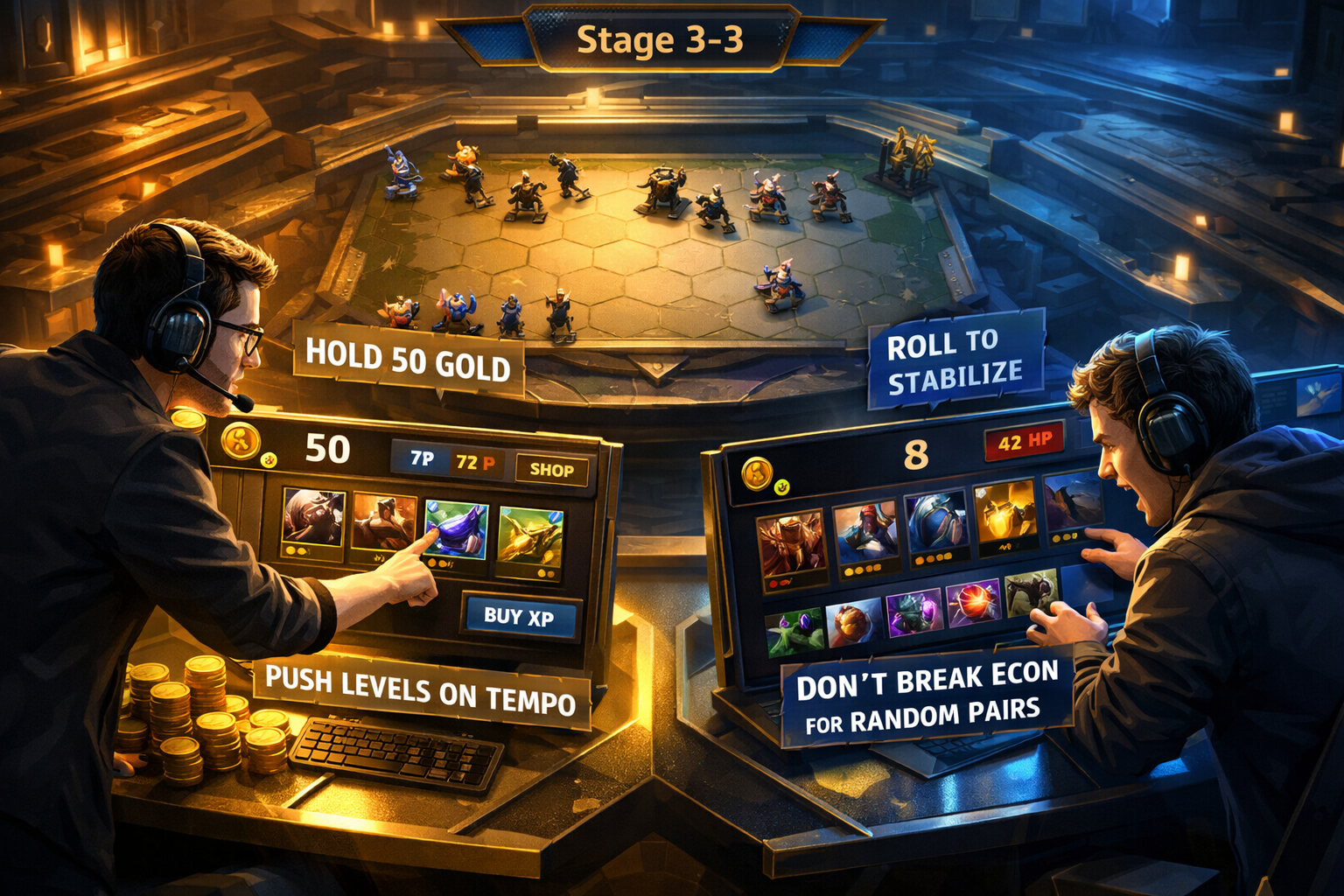
1-cost reroll strategies are among the clearest examples of a defined rolling window. If your game plan revolves around 3-starring a 1-cost carry, you usually want to spend your gold while staying at the level where 1-cost access is best. That is why these lines often center on the early Stage 3 window before normal boards fully move on.
The logic is simple. If you level too quickly, your shop gets better for higher-cost units but worse for your 1-cost target. That means your gold starts working against your win condition. So unlike a standard board, a 1-cost reroll line intentionally stays lower for longer and uses that window to convert copies into stars.
This strategy works best when your opener supports it naturally. If you already have many copies, strong items for the unit, and a board that can survive the delay, rerolling is logical. If you are forcing a 1-cost reroll with poor copies and bad items just because you know the pattern, the economy may look correct on paper but fail in practice.
Another important point is tempo after the hit. The goal is not to stay low forever. Once your carry and key supporting pieces are upgraded, your economy should pivot from “find copies” to “catch up in levels.” Too many players tunnel on 3-starring every possible unit and miss the moment when the board should start growing again.
In other words, the reroll window is a phase, not an identity for the entire match. Use it to hit your power spike, then cash that spike into future tempo.
2-cost reroll windows
2-cost reroll lines are some of the most common and practical economy strategies in TFT because they often offer a strong balance between accessibility and power. These boards usually care a lot about Level 6, because that is where your gold often has the best relationship with 2-cost shop odds and midgame timing.
The classic pattern is to reach Level 6 around 3-2, stabilize your board, and then decide whether to roll aggressively or slow roll depending on your HP, copies, and lobby pace. If you are weak and in danger, an aggressive spend can be right. If you are healthy and already holding many copies, slow rolling above an economic floor often gives better long-term value.
This is where many players misunderstand “slow roll.” Slow roll does not mean never spend. It means preserve the part of your economy that keeps generating interest while using excess gold each round to search for upgrades. In practice, that often means building back to 50 and spending only what is above it, unless the situation becomes urgent.
2-cost reroll also teaches one of TFT’s most useful truths: board strength and reroll planning are not separate. You are not only chasing your final 3-star carry. You are also trying to 2-star enough of your board that the game remains stable while you search. A 2-cost reroll line that greedily holds all gold and stays weak can easily die before the reroll value ever pays off.
If you hit early, you can convert into levels sooner. If you miss late, you may need to cut losses and play for placement rather than perfection. Good TFT economy is not just about following the best-case line. It is about adapting when the shops refuse to cooperate.
3-cost reroll windows
3-cost reroll lines usually shift the economy conversation later, most commonly around Level 7. These strategies are often more delicate than 1-cost or 2-cost reroll because they compete with standard boards that are trying to stabilize and prepare for Level 8 at the same time. That means your rolling window can be powerful, but it also tends to be more expensive.
The attraction of 3-cost reroll is obvious: strong 3-star 3-cost units can anchor a board deep into the game. The risk is that you are searching for expensive copies in a stage where fights already hurt more. That makes timing and health management especially important.
In many games, the decision is not simply “slow roll or don’t.” It is “am I close enough to justify staying here?” If you already hold many copies of your core 3-cost and the board is stable enough, slow rolling at 7 can be excellent. If you are far away, low on HP, and the lobby is spiking fast, pushing levels and playing a more standard cap may be the better economy line.
This is why 3-cost reroll requires honesty. It is easy to become emotionally attached to the idea of hitting. But gold spent chasing a dream with poor odds and bad timing is still wasted gold. Strong players constantly reevaluate: is the window still open, or has the lobby moved on?
A good rule is that reroll windows become worse when your game state loses stability. The lower your health and the further behind you are, the less luxury you have to keep chasing narrow outcomes. Sometimes the right decision is to abandon the high-roll fantasy and buy the strongest possible present.
Standard boards and 4-cost carries
Most beginner and intermediate TFT players eventually learn that many stable top-four lines revolve around reaching Level 8 with enough gold to find and upgrade a 4-cost carry board. That is one reason the standard leveling curve is so important. It is designed to help you arrive at 5-1 with both access and spending power.
The hardest part is understanding that “fast 8” does not mean blindly refusing to roll until 5-1. It means managing the earlier stages in a way that preserves the option to reach 8 with meaningful economy. Sometimes that involves small stabilization at 3-2 or 4-1. Sometimes it means protecting a win streak with early levels. Sometimes it means greeting harder because your board and HP allow it.
What matters is that your gold at 5-1 still has agency. Hitting Level 8 with 8 gold left is not the same as hitting Level 8 with 40 gold left. The first line is often a desperate level. The second line is a real power spike. Good TFT economy is about arriving at your target level still able to shop.
This is also why Stage 4 decisions feel so important. Every lazy hold, random roll, and missed interest breakpoint from earlier stages shows up here. By the time you want your 4-cost carry online, the game reveals whether your economy had structure or not.
Standard boards also benefit from flexible thinking. If you do not find the perfect carry immediately, you may need to hold your strongest available upgrades and stabilize with a temporary board. Economy is not only about reaching a comp. It is also about surviving the turns before the comp is fully assembled.
How to choose between leveling and rolling
This is the central TFT economy question. Every game asks it repeatedly: should you spend gold to level, spend gold to roll, or spend nothing and keep building economy? There is no universal answer, but there is a strong framework.
Level when the extra unit slot and improved shop profile give immediate or near-immediate value. This is especially true when protecting a win streak, matching a major lobby timer, or moving into the level where your target units become more realistic. Leveling is often the cleaner use of gold when your board is fundamentally sound and simply needs a larger shell.
Roll when your current board is not good enough to survive the next phase of the game or when you are inside your best shop window for target units. Rolling should have a clear purpose. It should solve a board problem, not just reduce anxiety. If you cannot name the units or upgrades you need, you are probably not ready to roll.
Save when your board is healthy enough and the next spike matters more than the current one. This is where the best players create future winning positions. They resist the urge to spend on quiet turns, then use that saved gold on the rounds that matter most.
Health is the tiebreaker. At high HP, you can usually afford to preserve economy longer. At low HP, your economy becomes less theoretical and more urgent. A player at 85 HP can plan for two stages ahead. A player at 28 HP may need to spend now, even if the timing is slightly imperfect.
Another tiebreaker is contesting. If several players are on your line, your roll window becomes less efficient. That can push you toward leveling, pivoting, or accepting a lower-ceiling version of your board. Economy is not just about your plan in isolation. It is about your plan inside this specific lobby.
A stage-by-stage economy plan
Stage 2: Build identity
Stage 2 is where you decide what kind of economy game you are playing. Are you strong enough to winstreak? Weak enough to intentionally lose streak? Flexible enough to wait? This is not the stage to force final answers, but it is the stage to choose a direction.
If your opener is strong, consider leveling early and preserving tempo. If your opener is weak, avoid random spending that breaks your future economy without fixing the board. The biggest Stage 2 mistake is indecision: spending enough to miss breakpoints, but not enough to actually become strong.
Stage 3: Define your line
Stage 3 is where many TFT games become honest. Standard boards usually want to respect the Level 6 timing and avoid free HP loss. Reroll boards begin to commit to their real window. Economy decisions here should be clearer than in Stage 2. By now, your items, pairs, streak, and health should point toward a more concrete plan.
If you are playing a standard line, do not bleed because of lazy greed. If you are playing reroll, make sure the reroll is truly live. This stage punishes vague intentions.
Stage 4: Stabilize or accelerate
Stage 4 is where a large part of the lobby either stabilizes or starts collapsing. Level 7 decisions matter a lot. Some players need to roll to survive. Others can stay disciplined and save for Level 8. Your job is to evaluate honestly. Do not compare your board to an imaginary ideal. Compare it to the actual lobby you are facing.
If your board is solid and your health is high, preserving economy for the next spike is powerful. If your board is weak and damage is mounting, a disciplined stabilization roll is often the correct economic decision.
Stage 5 and beyond: Convert economy into placement
From Stage 5 onward, economy becomes about conversion. Can your saved gold actually become upgrades? Can you cap your board? Can you position for top four or first? The richer player still has an edge, but the difference now lies in how effectively that gold becomes final board strength.
This is also where many players waste money by chasing luxury upgrades before fixing essentials. In late game TFT, always prioritize the upgrades that immediately change fight outcomes: frontline durability, main carry stability, core synergy completion, and positioning flexibility. Economy is only valuable if it turns into power before you die.
Common TFT economy mistakes
1. Saving to 50 no matter what. This is probably the most famous mistake. Fifty gold is great, but not if you are taking enormous damage every round. Economy exists to create stronger future turns, not to make you proud of a number.
2. Rolling without a plan. Panic rolling is one of the fastest ways to ruin a TFT game. Gold disappears, the board barely improves, and suddenly the next real timer arrives with no resources left.
3. Holding too many units. Bench clutter quietly destroys interest. If a unit does not improve your board, support your line, or justify missing a breakpoint, it may be costing more than it gives.
4. Following leveling guides blindly. Standard timings are useful, but they are not mandatory in every state. A reroll board that mindlessly levels like a standard board kills its own odds. A weak standard board that refuses to level on time often gets crushed.
5. Ignoring health while greeting. HP is a resource, but it is a limited one. Some players learn greed before they learn damage control. The result is rich boards that never get to spend their gold properly because they are already one loss from death.
6. Refusing to pivot when the window closes. Not every reroll line is meant to be completed. Not every fast-8 game is meant to be greedy. Economy skill includes the ability to admit when the original plan is no longer the highest-value option.
7. Spending on fake upgrades. A fake upgrade is any purchase that feels good but does not materially change your board. Rolling for random side units, leveling without a meaningful add, or holding expensive dream pivots can all fall into this trap.
Quick economy checklist
- Am I ending the round on a clean interest breakpoint when possible?
- Is my bench helping my current plan, or just costing me gold?
- Am I protecting a win streak, managing a lose streak, or drifting between both?
- Do I know my next important level timer?
- If I roll now, what exact upgrades am I looking for?
- Is my HP high enough to wait, or low enough that I must stabilize now?
- Is my line a reroll line, a standard Level 8 line, or a high-cap greed line?
- Am I spending for real strength, or just to feel busy?
FAQ
Should I always stay above 50 gold in TFT?
No. Fifty gold is the ideal economy floor only when your board is stable enough to afford it. If spending below 50 protects a streak, saves major HP, or helps you stabilize at an important timer, that spend can be correct.
What is the simplest way to improve my TFT economy?
Respect interest breakpoints, stop holding random bench units, and plan your spending around real stage timers instead of panic rolling. Those three changes alone improve most players immediately.
When should I roll in TFT?
Roll when you are inside your best window for the units you need or when your board is too weak to survive future rounds comfortably. Never roll just because you feel nervous. Roll for a specific reason.
What is a rolling window in TFT?
A rolling window is the point where spending gold on shops gives the best value for your strategy. That depends on your level, target unit cost, health, stage, and board strength.
Why do good TFT players sometimes level early and ruin interest?
Because preserving a win streak or matching a lobby spike can be worth more than one extra interest gold. Strong TFT economy is about value, not greed for its own sake.
Is reroll better than standard leveling?
Neither is universally better. Reroll is stronger when your opener naturally supports it and you can exploit the correct shop window. Standard leveling is stronger when your game is heading toward stable midgame tempo and a Level 8 board.
How do I know whether to greed or stabilize?
Check three things: health, board strength, and distance to your next spike. If your HP is low and your board is weak, stabilize. If your HP is healthy and your next spike is close, greed can be correct.
Final Thoughts
TFT economy is not a trick. It is a language. Once you understand it, the game stops feeling random and starts feeling readable. You begin to see why one player can afford a huge Level 8 roll-down while another arrives broke. You start recognizing that a missed 10-gold breakpoint in Stage 2 can echo all the way into Stage 5. You realize that rolling is strongest when it is attached to a real window, not just fear.
The timeless lesson is simple: gold should always serve a plan. Sometimes that plan is to protect a streak. Sometimes it is to hit a reroll carry. Sometimes it is to arrive at Level 8 rich enough to build a real late-game board. The exact units will change from set to set. The economy logic will not.
If you want to improve quickly, focus less on memorizing every patch-specific trick and more on the fundamentals in this guide. Clean interest. Clear streak identity. Smart level timers. Intentional rolling windows. Those are the habits that keep paying you back in every TFT set.