



Mobile Legends Drafting Guide: Build a Balanced Winning Comp
Mobile Legends — Drafting & Role Balance: Building a Comp That Wins Fights
In Mobile Legends, many players blame losses on mechanics, teammates, or hero balance. Sometimes that is true. But a huge number of games are decided much earlier: in draft. A team can enter the Land of Dawn with strong individual players and still lose repeatedly because the lineup asks the wrong questions. It has no clean engage, no safe damage profile, no answer to dive, no reliable frontline, or no way to control the pace around Turtle, Lord, and tower fights. A bad draft forces perfect execution. A good draft makes ordinary execution look coordinated.
This guide is built to stay useful for a long time. Instead of chasing one temporary patch or a short-lived hero tier list, we are focusing on principles that keep working: role balance, win conditions, damage profile, engage tools, peel, wave control, side-lane pressure, and how to make five picks function like one team. If you understand these foundations, you will draft better even when specific heroes rise or fall.
That matters whether you are climbing solo, queuing with a duo, or studying coordinated play. The official MLBB hero page is useful for checking role and lane tags, while the official esports portal and Liquipedia’s MLBB hub are excellent for reviewing pro drafts and seeing how teams structure compositions at a higher level. If your goal is simply to climb faster while still learning what makes a draft work, you can also review Boosteria’s Mobile Legends boost pricing and compare that with the time you would spend grinding through difficult lobbies.
Table of Contents
- Why Draft Matters More Than Most Players Think
- What Role Balance Actually Means
- The Five Jobs of a Winning Team Composition
- Understanding the Standard MLBB Draft Structure
- Start Every Draft With a Win Condition
- How to Think Through Each Draft Phase
- Drafting Each Role the Smart Way
- Common Winning Draft Archetypes
- Counter-Drafting Without Ruining Your Own Comp
- Classic Draft Mistakes That Lose Fights
- Solo Queue vs Duo/Trio vs Full Stack Drafting
- How to Play Around Your Draft After Picks Lock
- Fast Draft Checklist
- Final Thoughts
- SEO Title
- SEO Description
- Schema Description
- Schema About
- Image Prompts With SEO Alt Text
- Tags
Why Draft Matters More Than Most Players Think
Drafting is not just about counter-picking one hero. It is about building a lineup that can consistently create favorable fights. When players talk about “good picks,” they often mean mechanically strong heroes. But a hero can be powerful in isolation and still be a weak choice in context. If your team already lacks engage, picking another damage dealer may make the problem worse. If your team has engage but no stable follow-up, the initiation becomes wasted. If your team scales well but cannot survive the first few major objectives, your late game never arrives.
Think of the draft as a blueprint for every important moment in the match. Who starts fights? Who protects the main damage dealer? Who checks bushes safely? Who holds side lanes? Who clears mid quickly so your team can move first? Who threatens backline access? Who finishes objectives without exposing the team to a bad coin flip? When a composition can answer those questions clearly, fights become easier to read and easier to execute.
That is why drafting often decides whether a teamfight feels clean or chaotic. A balanced comp does not need every player to improvise. Each role naturally fits into a sequence. Frontline reveals space. Control or burst threatens entry points. Core damage gets protected windows. Flankers know whether they are diving or peeling. Objective setups become structured rather than random.
Many ranked losses happen because a team loads into the game with conflicting ideas. One hero wants to hard engage. Another wants slow poke. Another needs long scaling time. Another needs instant skirmish support. The result is not just low synergy. It is incompatible timing. Players blame execution, but the comp itself never agreed on how fights should look.
So the real goal of draft is not to collect the strongest individual heroes. The goal is to create alignment: aligned timing, aligned damage pattern, aligned engage profile, and aligned map play. Once you understand that, drafting becomes much more than banning an annoying pick.
What Role Balance Actually Means
Role balance does not mean blindly locking one hero from each label and calling it perfect. It means your five picks cover enough strategic responsibilities to handle real fights and real map states. In Mobile Legends, teams often think in terms of Jungle, Mid, Gold, EXP, and Roam. That structure is useful, but the better question is this: what practical jobs do those five heroes cover together?
A balanced draft usually has some form of frontline presence, some type of reliable damage, some kind of crowd control, enough waveclear to avoid losing map control, and enough mobility or positioning tools to contest objectives without walking into death. That balance can appear in different forms. Sometimes your frontline comes mostly from Roam and EXP. Sometimes your engage starts from Jungle. Sometimes your peel comes from Mid instead of Support. Sometimes your side-lane pressure is the real reason the draft works.
So do not reduce role balance to labels alone. Two teams can both have a standard-looking role setup, yet only one is truly balanced. One lineup might have an EXP laner who cannot front line well, a Roam pick that prefers disengage, a jungler that needs protection, and a Gold hero that is vulnerable to dive. On paper the roles are covered. In reality the team has no stable access to fights.
Likewise, a lineup can look unusual and still be well-balanced if the functions are covered. What matters is whether the comp can start, survive, and finish teamfights against different enemy patterns. Balance is functional, not cosmetic.
| Draft Concept | Weak Interpretation | Strong Interpretation |
|---|---|---|
| Role Balance | We have all five lanes filled | We have engage, damage, peel, map control, and objective tools |
| Counter Pick | I beat my lane opponent | I help my team solve the enemy’s main win condition |
| Comfort Pick | I play this hero every game | I can execute this hero inside the team’s plan |
| Synergy | Two heroes combo in theory | The whole draft shares timing and fight logic |
The Five Jobs of a Winning Team Composition
Every strong draft covers five essential jobs. The exact heroes can change, but the jobs do not disappear.
1. Someone must create or threaten space
This is the frontline, engage, or zone-control layer of the draft. Without it, your team gets pushed backward before the fight starts. Space can be created by hard engage, durable body presence, choke control, or flank threat. The important part is that the enemy must respect your entry into the fight.
2. Someone must deal reliable damage in real conditions
The word reliable matters. Theoretical damage is not enough. If your damage only works when enemies stand still, or only works after a perfect combo, it may fail in ranked chaos. Reliable damage means your comp can actually finish targets during realistic fight windows.
3. Someone must help control tempo through waveclear or rotation speed
Teams that clear waves efficiently often arrive first to important areas. Arriving first means better vision, better bush control, better zoning, and cleaner objective setups. If your draft is slow to clear or rotate, you are permanently reacting instead of dictating.
4. Someone must protect value
Protection is not only healing or shielding. It includes peel, body-blocking, zone denial, crowd control, threat interception, and fight pacing. Many drafts fail because they build great access to the enemy backline but no way to protect their own.
5. Someone must convert pressure into objectives
A comp that wins skirmishes but struggles to take Turtle, Lord, towers, or map space is incomplete. Teamfights are not the final goal. They are a route to advantages. Good drafts convert kills into structure and objective control.
When reviewing your draft, ask whether all five jobs are covered. If not, you already know what the enemy should attack.
Understanding the Standard MLBB Draft Structure
Most Mobile Legends drafts still revolve around a familiar map structure: EXP lane, Jungle, Mid lane, Gold lane, and Roam. This structure matters because each slot tends to influence different types of fights.
EXP Lane
The EXP slot often gives your comp one of three things: durable frontline, side-lane pressure, or dependable initiation. A good EXP pick can absorb pressure, anchor the edge of a fight, or punish overextension. When teams ignore this slot and pick a hero that offers little stability, their comp often feels fragile even if everyone else is strong.
Jungle
The jungler is usually tied to tempo, objective pressure, and fight entry timing. Some jungle picks want early pace and repeated skirmishes. Others prefer clean setup around priority targets. In either case, the jungler strongly affects whether your comp is proactive or reactive.
Mid Lane
Mid often determines rotation quality, zone control, and the safety of group movement. A good mid pick helps your team reach neutral objectives first, control choke points, and punish reckless movement. Mid is one of the roles that makes a draft feel “smooth” even when players are not mechanically perfect.
Gold Lane
Gold lane usually represents steady teamfight damage, tower pressure, or scaling threat. Your gold pick does not always need to be the only carry, but it usually represents an important damage insurance policy. If you draft a vulnerable gold hero, the rest of the team must acknowledge that and provide protection or counter-engage.
Roam
Roam is the glue. This role often decides whether the draft can start fights, protect carries, face-check dangerous areas, or punish mistakes. Roam also shapes the emotional feel of the comp. A confident roam makes the whole team play clearer. A passive or mismatched roam can leave four teammates guessing when to commit.
These roles are not prison cells. Heroes can flex, and responsibilities can overlap. But in a good draft, the overlap is deliberate. You are not hoping for balance by accident. You are creating it on purpose.
Start Every Draft With a Win Condition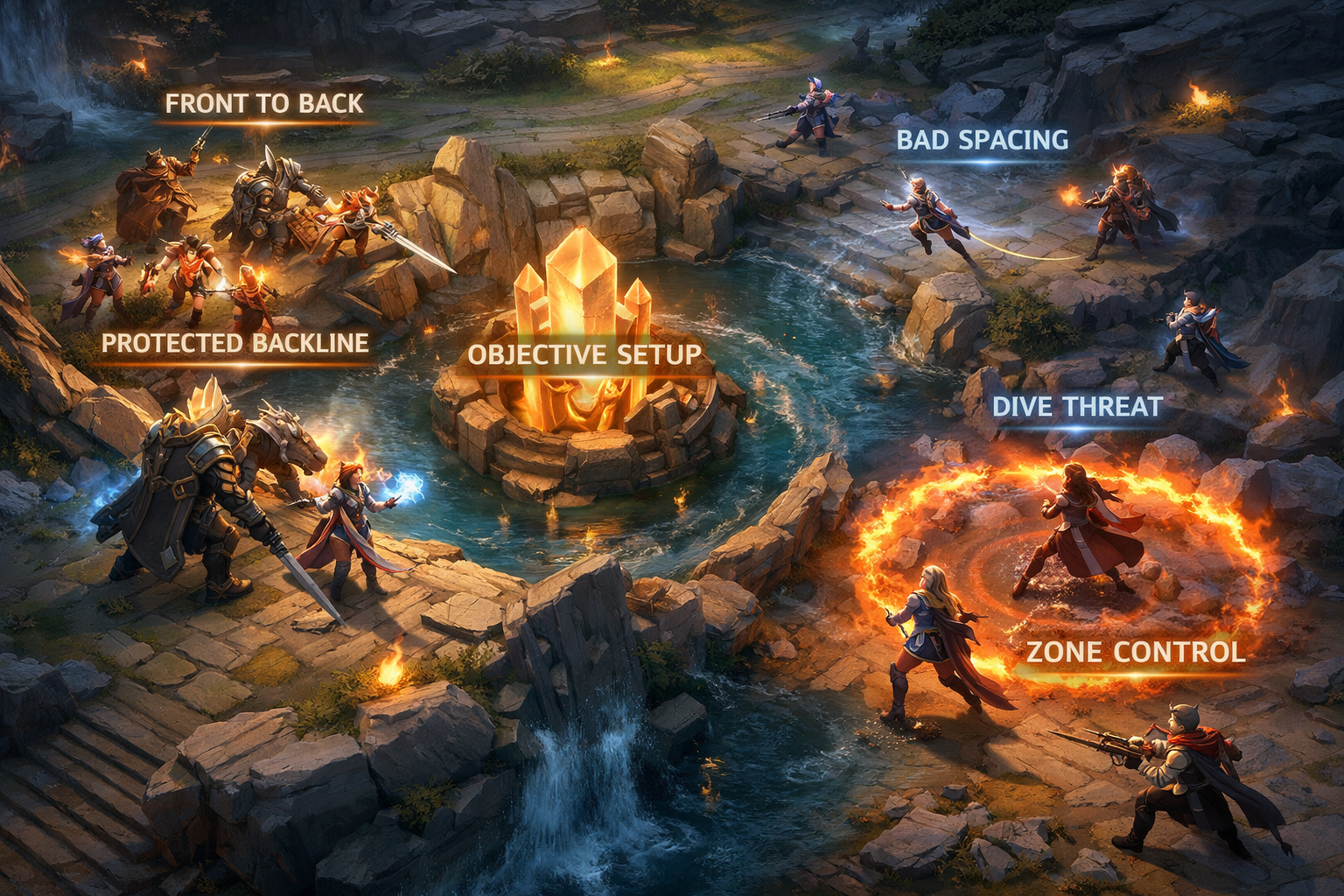
Before you worry about counters, ask a more important question: how does our comp want to win? Drafts become far better when they begin with a clear win condition.
A win condition is the core pattern your team wants to repeat. It might be:
- front-to-back teamfighting around a protected damage dealer,
- rapid pick-offs before objectives,
- high-tempo skirmishing and snowballing,
- split pressure that forces uneven fights,
- heavy dive onto immobile backliners,
- poke and zone control that softens targets before commit.
If you do not know your win condition, your draft choices become random. One player picks for lane comfort. Another picks for highlight potential. Another picks to survive. Another picks to scale. The comp ends up with five individual plans instead of one team plan.
Here is a simple rule: your first two or three picks should already suggest the kind of fights you want. Not every detail must be decided early, but your direction should be visible. Once that direction is clear, later picks can reinforce it or patch the obvious weakness.
For example, if you begin with stable front line and backline damage, your later picks should strengthen protection, zone control, or objective setup. If you begin with aggressive engage and mobile follow-up, your later picks should support tempo and burst windows. The worst thing you can do is start building one type of comp, panic during bans or counters, and finish with a draft that no longer understands itself.
How to Think Through Each Draft Phase
Early draft: secure strength without revealing everything
In the early phase, strong teams usually want one of two things: a powerful generalist pick that remains useful in many matchups, or a role that stabilizes the whole draft. Early picks should be hard to punish and easy to build around. This is not always the time to reveal your most vulnerable win condition.
Look for heroes that do at least two valuable things. A pick that offers waveclear and control, or durability and engage, or damage and mobility, is easier to support later. These “flexible strength” heroes keep your draft open.
Mid draft: define shape and close weaknesses
The middle phase is where real drafting happens. This is the moment to ask what is still missing. Do you lack engage? Are you too all-in with no disengage? Are you overly physical or overly magic in damage profile? Are you drafting a backline that cannot survive dive? Is your team too slow around objectives?
Strong drafters do not only ask what counters the enemy. They ask what completes themselves. If you are already ahead in synergy, you do not need to gamble for a narrow hard counter that damages your structure.
Late draft: solve the last hard problem
The last pick is most valuable when it solves the enemy’s clearest threat or protects your own clearest weakness. It should not be wasted on a flashy ego pick that adds nothing new. The best last picks often make the whole lineup look smarter: a protective tool against dive, a stable side-lane answer, a control pick for bush-heavy setups, or a damage profile that the enemy cannot easily itemize against.
Late picks should sharpen the draft, not confuse it.
Drafting Each Role the Smart Way
Drafting EXP Lane
When choosing EXP, ask what kind of edge your comp needs. Do you need a durable wall? A side-lane duelist? A second engager? A bridge between frontline and backline? EXP is often where teams decide whether they want stability or pressure.
A stable EXP pick is valuable when your jungle or gold pick is vulnerable. This gives your team a second body that can stand in dangerous space, start fights, or buy time. A more aggressive EXP pick makes sense when your team already has enough durability and wants stronger side pressure or dive support.
Bad EXP drafting often creates one of two problems: either the team has no durable edge and melts when contesting space, or the team adds another bruiser without enough follow-up damage. Remember that good EXP drafting is not about winning lane alone. It is about what the hero contributes to grouped fights and side-lane map pressure later.
Drafting Jungle
Your jungler influences pace more than almost any other slot. Ask whether the comp wants early activity, controlled setup, fast punish windows, or scaling carry pressure. Then make sure the team can support that style.
An aggressive jungle pick without lane support often becomes a trap. The hero wants to invade or skirmish, but mid cannot move first and side lanes cannot collapse. On the other hand, a scaling jungle pick in a low-control comp can be starved before the draft gets online.
Jungle also shapes objective confidence. A good jungle choice is not just a damage number. It is a timing signal. It tells the team when it wants to contest, where it wants to enter, and how it converts small leads into neutral control.
Drafting Mid Lane
Mid is the role many ranked players underrate in draft. They focus on flashy damage numbers and forget that mid often determines whether the team moves together correctly. Mid can give your draft waveclear, zone pressure, pick threat, crowd control layering, anti-dive support, or safe chip before all-in.
If your team already has strong engage, mid can help secure the follow-up and stop escapes. If your team is vulnerable to being rushed, mid can add the control necessary to slow the enemy’s entry. If your team wants to play for picks, mid often becomes the bridge between information and punishment.
Drafting a selfish mid into a comp that already struggles with structure is a common ranked mistake. Mid should often be chosen with the entire map in mind, not just lane identity.
Drafting Gold Lane
Gold lane is where many drafts gain or lose their teamfight insurance. This slot often provides the most visible sustained damage in later fights, but that only matters if the hero can actually hit. So gold drafting should never be separated from peel and frontline discussion.
If your gold pick is highly vulnerable, then your roam, mid, and EXP picks must acknowledge that. If your gold pick is safer or more self-sufficient, your other roles can spend more resources on engage and tempo. The mistake is drafting a greedy damage core and then surrounding it with heroes that also need protection.
Ask three questions: can this gold hero survive the enemy’s best engage pattern, can this hero contribute damage in objective fights, and does this pick still make sense if the game is messy rather than perfect? If the answer is weak, rethink the slot.
Drafting Roam
Roam should be drafted as the composition’s problem-solver. Need stronger engage? Roam can provide it. Need peel? Roam can provide it. Need safer bush control? Roam can provide it. Need a tempo connector between lanes and jungle? Roam can provide it.
The worst roam drafts happen when players choose only for comfort without asking what the lineup lacks. A composition with fragile backline often wants peel or anti-dive. A lineup with slow access often wants cleaner initiation. A team that already has strong engage may need roam to stabilize space rather than over-stack initiation.
Think of roam as the role that turns a list of heroes into a functioning unit.
Common Winning Draft Archetypes
1. Front-to-back teamfight comp
This is one of the most timeless drafting styles. You build durable space in front, consistent damage behind it, and enough peel or control to stop enemy access. The win condition is simple: absorb the first wave, hold formation, and let your damage layer win longer fights.
This archetype is strong in ranked because it is easy to understand. It also scales well across communication levels. Even without perfect voice coordination, players usually understand where to stand and what to protect.
2. Dive comp
Dive drafts want to collapse quickly onto vulnerable targets, often from multiple angles. They are strongest when the enemy comp depends on one or two fragile damage pieces and lacks reliable disengage. But dive requires commitment. If you draft half-dive and half-front-to-back, the comp often tears itself apart.
A good dive comp needs entry, follow-up, and enough threat overlap that the enemy backline cannot kite forever. It also needs some plan for what happens if the first kill does not happen instantly.
3. Pick comp
Pick comps are designed to punish positioning mistakes before the full teamfight starts. These drafts love bush control, vision denial, rotation prediction, and quick burst windows. They can feel oppressive in ranked because not every team respects map danger equally.
The weakness is that pick comps can stall if they fail to find isolated targets. They need enough fallback structure that they are not helpless in standard 5v5s.
4. Poke and zone comp
This draft style damages the enemy before they can fight on even terms. It works best when your team can control choke points, soften frontline, and deny clean access to the objective area. But pure poke without disengage or objective control can collapse when the enemy finally commits.
So a good poke comp still needs structure. You are not just irritating the enemy. You are preparing a favorable fight state.
5. Side-pressure comp
This archetype uses side-lane threat to distort enemy positioning. If opponents answer the side lane poorly, they lose structures or fight with bad numbers. If they over-respond, the rest of the map becomes open. Side-pressure comps do not always need to hard split push forever; often they just force awkward decisions that make objective setups cleaner.
The risk is over-drafting split pressure without enough grouped stability. If your side pressure never creates real map advantage, you are just playing 4v5 too often.
Counter-Drafting Without Ruining Your Own Comp
Counter-drafting is useful, but many players misuse it. They see one enemy pick and tunnel on “countering” it with a hero that damages their own lineup. This is one of the biggest drafting traps in ranked.
True counter-drafting asks: what is the enemy’s actual win condition, and how do we make that harder without breaking our own? Sometimes the answer is direct. If the enemy relies on one fragile carry, access tools and flank pressure become more valuable. If the enemy has unstoppable dive, peel and disengage matter more. If the enemy wants long front-to-back fights, burst or pick threat can interrupt that script.
But sometimes the best counter is indirect. You do not need a hard lane answer if you can win objective setups, control tempo, or outscale their damage pattern. Drafts should respond to the enemy’s plan, not just the enemy’s labels.
Here is a practical hierarchy:
- Protect your own win condition.
- Cover essential team functions.
- Reduce the enemy’s easiest fight pattern.
- Only then chase narrow hero-specific punishment.
That order prevents panic drafting.
Classic Draft Mistakes That Lose Fights
No reliable engage
If your team cannot start a fight on its own terms, the enemy gets to choose every entry. That usually means your damage dealers are under pressure before they can play. Some comps can win without hard engage, but they still need strong zone control, superior poke, or excellent counter-engage. Passive drafts with no coherent fallback are rarely good.
No peel for a vulnerable core
If you pick a high-value backliner and then give them no protection, the draft becomes self-sabotage. You are telling the enemy exactly where to aim.
Too much one-type damage
Compositions become easier to itemize against when damage profiles are too predictable. Mixed threat forces harder defensive choices and usually makes your fights more flexible.
Too many heroes that need resources
Some heroes are strongest when the game flows through them. One or two such picks can work. Too many creates internal starvation. Your team stops being a team and becomes a queue of competing priorities.
Too much scaling, not enough early map control
Scaling is great only if you can reach it without bleeding everything. Drafts that surrender early wave control, objective setup, and movement priority often fall too far behind to cash in later.
All comfort, no synergy
Comfort matters, especially in solo queue. But five comfort picks that do not fit together are still bad drafting. The ideal is comfort inside function.
Too much engage, not enough damage follow-up
Another common problem. Teams see initiation tools and assume the draft is strong. But if the engage lands and nobody can convert, the comp runs out of gas quickly.
No side-lane answer
Some drafts look good in straight river fights but cannot manage side pressure. If the enemy can drag your team across the map and create uneven fights, objective control becomes much harder.
Solo Queue vs Duo/Trio vs Full Stack Drafting
Draft values change depending on how coordinated your environment is.
Solo queue
In solo queue, simplicity and self-sufficiency become more valuable. Front-to-back drafts, clean engage structures, durable roam choices, and clear win conditions perform well because they reduce interpretation errors. Heroes that require layered timing, perfect flank sync, or high trust are usually weaker unless your team unexpectedly aligns.
Comfort has higher value in solo queue, but it still should not erase basic comp logic. The best solo queue drafts are clear, forgiving, and hard to misunderstand.
Duo or trio queue
Here you can begin drafting around mini-synergies. Jungle-mid coordination, roam-gold protection, or EXP-jungle dive windows become much more realistic. Small communication pockets can stabilize the whole comp if they control the right responsibilities.
Full stack
Coordinated teams can draft more specialized archetypes because execution is more reliable. Complex pick comps, disciplined poke structures, layered dive, or side-pressure systems all get stronger when five players share timing. But even in full stack, the fundamentals remain the same: balance functions first, then sharpen identity.
How to Play Around Your Draft After Picks Lock
A good draft only matters if you play according to what it was built to do. Many teams draft well and then ignore their own identity in game.
If you drafted front-to-back, do not over-force low-percentage dives. If you drafted dive, do not stand around poking forever. If you drafted pick potential, do not give the enemy free, slow, predictable 5v5s. If you drafted side pressure, do not mindlessly ARAM mid and abandon the map.
The draft should inform your first objective contests, your lane assignments, your bush behavior, and your target priority. In fact, one of the easiest ways to improve as a player is to ask during loading screen: what kind of fight does our comp want, and what kind of fight does theirs want? That single question instantly makes your decisions sharper.
Also remember that a weak draft does not make the game unwinnable. It just changes what you must avoid. If your comp is worse in full 5v5s, stop gifting full 5v5s. If your draft loses slow front-to-back fights, look for picks, flanks, or tempo skirmishes. Adaptation matters. But adaptation is easier when the draft began from sound principles.
Fast Draft Checklist
Use this quick checklist before lock-in:
- What is our win condition?
- Who starts fights for us?
- Who protects our main damage source?
- Do we have enough reliable damage, not just theoretical burst?
- Can we contest space safely around Turtle and Lord?
- Can we clear waves and rotate without losing control?
- Are we too vulnerable to dive or too slow to punish greed?
- Do we have balanced damage and resource distribution?
- Are we countering the enemy’s actual plan, or just one hero?
- Does our last pick solve a real problem?
If several of those answers feel weak, the draft likely needs to change.
Final Thoughts
The best Mobile Legends drafts are not built by memorizing a patch note screenshot and blindly copying whatever won yesterday. They are built by understanding what a team composition must accomplish in order to win real fights against real resistance. That is why timeless drafting principles matter so much. Heroes change. Small numbers change. Some lane matchups shift. But the logic of team balance remains.
A winning comp normally does not happen by accident. It has a reason for every slot. It knows how fights begin, how damage is delivered, how value is protected, and how pressure becomes objectives. It either controls the pace or clearly punishes the enemy when they overreach. It understands whether it wants long fights, fast picks, deep dive, side pressure, or front-to-back stability.
Once you start thinking this way, drafting stops feeling random. You stop asking only, “Is this hero good?” and start asking, “Is this hero good here, with these teammates, into this enemy plan, for the kind of game we want to play?” That one shift separates average drafting from winning drafting.
And that is the real edge. Better drafting does not only increase your chance to win. It also makes the game easier to read, easier to coordinate, and easier to improve at over time.