



Overwatch 2 Ultimate Economy: Track, Trade & Win Fights
Overwatch 2 — Ultimate Economy 101: Track, Trade, and Win Teamfights
Ultimate economy is the hidden scoreboard that decides most Overwatch 2 games. If your team reliably knows (1) what ultimates are online, (2) what the next fight should cost, and (3) when to hold or spend, you’ll win “unwinnable” fights and stop throwing “won” games. This guide teaches a patch-resistant system you can use in any rank, any map, and any meta.
We’ll cover a complete framework: how ult charge is generated, how to track both teams without guessing, how to plan win-conditions for each fight, and how to trade ults efficiently so you keep the advantage across multiple fights—not just one highlight moment.
1) What Ultimate Economy Really Means
In Overwatch 2, every fight is an investment. Ultimates are your most expensive resources, and the team that spends them with a plan usually wins. Ultimate economy is the discipline of managing those resources across a sequence of fights:
- Track: Who has what ults (both teams), and who will get them soon.
- Trade: Spend the minimum to win a fight, while forcing the enemy to overspend.
- Roll: Use your advantage to win the next fight too (not just the current one).
This is why “we won the fight but lost the round” happens. Winning one fight with four ults often loses the next two fights because your team is broke while the enemy is loaded.
The Core Objective: Win More Fights Than You Pay For
A strong ult economy team follows a simple rule:
- If you’re even: spend 1–2 ults to win.
- If you’re ahead: spend fewer than they do (force a bad trade).
- If you’re behind: aim for a high-value swing (a fight that flips momentum), not a “pretty” fight.
Ultimate Economy Is Not “Save Every Ult”
Holding ults forever is also losing. If your team dies with 3–4 ults in pocket, you didn’t “have economy”—you wasted time and gave the enemy free charge. Good economy means spending at the right time and not spending when the fight is already won or already lost.
2) How Ultimates Are Built (Timeless Rules)
You don’t need exact numbers to master ult economy. You need the rules that never change:
- Damage builds ult. Consistent poke and safe pressure matter.
- Healing builds ult. Supports with high uptime (and safe healing) tend to charge faster.
- Some damage gives less ult than you think. Tanks and certain forms of damage/heal interactions often create less ult per “screen number” than players assume, so tracking should be based on patterns and timings—not raw scoreboard stats.
- Deaths reset tempo. Dying early can delay your ultimate by an entire fight cycle.
- Clean wins reduce enemy ult charge. If you win a fight fast (with minimal feeding), you deny enemy economy.
Charging Speed Depends on “Uptime” More Than Aim
Players often believe ult charge is mostly about mechanical skill. In reality, uptime (how long you are actively dealing damage/healing without dying) is the biggest driver. A consistent player with safe positioning will often outpace a “fraggy” player who dies early.
Hero Swaps and “Retained Charge” (The Practical Takeaway)
Overwatch 2 allows some ultimate charge to carry over when swapping heroes. The exact percentage can change between seasons, but the strategic truth stays the same:
- Swapping early is cheaper than swapping late. If you know you must swap, do it before you build a big ult bank.
- Swapping after using your ultimate is usually optimal. You spent the resource; now you can flex to the next problem.
- Counter-swapping can be “economy bait.” If the enemy swaps repeatedly, they may never reach key ults and will be forced to win purely on neutral play.
3) Ultimate Types and What They’re For
Ultimates feel unique, but most fall into repeatable categories. Understanding the category helps you plan fights without relying on patch-specific metas.
A) Fight-Ending (Pick / Wipe) Ultimates
These ults can win a fight quickly by deleting targets or trapping teams. Examples include large burst, kill setups, or area denial that forces deaths. The economy rule is simple: use them when follow-up is guaranteed, not when the enemy can calmly kite and live.
- Best use: when the enemy has limited escape routes, limited defensive cooldowns, or already used mobility.
- Common error: using them “because it’s ready” in a neutral fight with full enemy cooldowns.
B) Tempo (Engage / Space) Ultimates
These ults don’t always kill immediately. They give you space, force movement, and start a fight on your terms. Economy-wise, they’re great because they often cost one ult to force multiple enemy resources.
C) Defensive / Stabilization Ultimates
These ults stop the enemy’s best play. Their value is measured in denial, not kills. The economy secret: you want the enemy to spend a large ult and get little to nothing.
- Best use: counter a known win-condition, save multiple teammates, or buy time for your own counter-ult.
- Common error: using defensive ults to “win harder” when the enemy already lost the fight.
D) Empowerment / Buff Ultimates
These ults amplify your team’s ability to win a fair fight. Think: faster rotations, stronger healing, increased damage pressure, or a window of enhanced plays. The economy trick: you must convert the buff into a concrete outcome (a pick, objective progress, or forced enemy ult).
4) A Simple Ult-Tracking System That Works in Ranked
Ult tracking fails in ranked because people make it too complicated. Use a lightweight system that fits inside your brain while you aim and survive.
The Three-Bucket Method
For each enemy hero, place their ultimate into one of three buckets:
- Online: they almost certainly have it (or can have it this fight).
- Close: likely 70–90%; they will get it soon if the fight lasts.
- Far: unlikely; they need more than a fight’s worth of charge.
That’s it. You don’t need exact percentages. You need accurate “danger windows.”
How to Update the Buckets (The Reset Triggers)
After each fight, ask three questions:
- What ults did they use? Any used ult goes to Far (unless it charges very fast and the fight was long).
- Who popped off? The enemy who farmed damage/healing without dying moves up a bucket.
- Who died early? Early deaths often delay ult by a full fight—move them down a bucket.
Use Natural “Timing Heuristics”
Even across patches, ultimate timings tend to be consistent relative to fight cycles:
- Fast ults: can appear every 1–2 fights with good uptime.
- Medium ults: often every 2–3 fights.
- Slow/expensive ults: may take multiple full fights or heavy farming.
You don’t need to memorize lists. You need to notice patterns: “Their support ult was last fight; it won’t be here yet,” or “Their DPS has been alive for three fights and farming—expect it now.”
Ranked-Friendly Callouts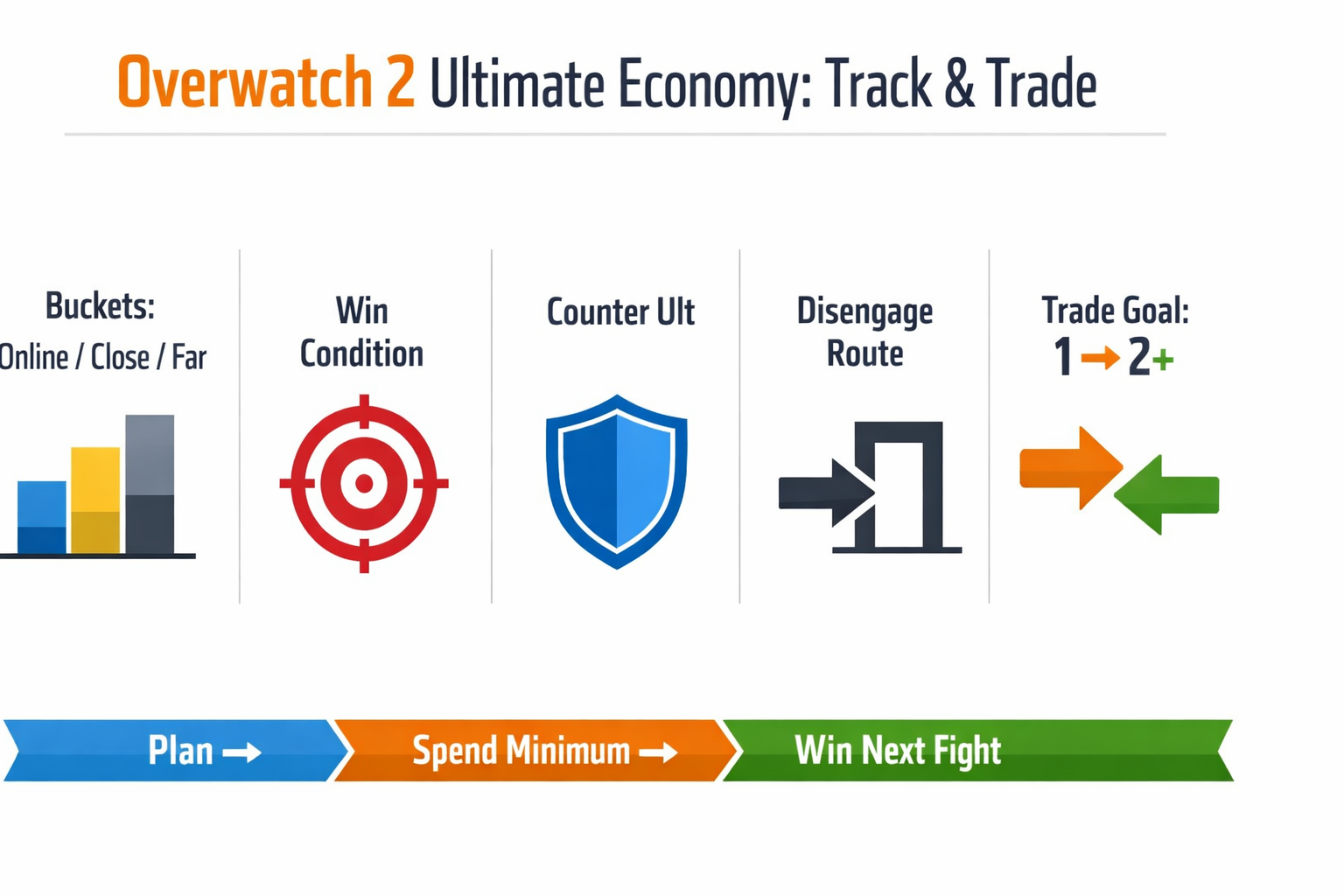
Most teammates won’t process long speeches. Use short, actionable lines:
- “They likely have defensive ult—don’t commit our big combo first.”
- “Watch engage ult this fight; play corner and keep escape.”
- “We win with one ult; save the rest.”
- “If they invest two, we kite and re-fight.”
Tracking Your Team: The “Spend List”
For your own team, track not just what’s ready, but what’s spendable. A ready ult is not always usable. Ask:
- Do we have positioning to convert it?
- Do we have follow-up damage?
- Do we have survival tools to stay in the fight?
5) Tempo, Stagger, and Why “One More Fight” Matters
Ultimate economy is inseparable from tempo. Tempo is the pace at which fights happen and resources refresh. You can “win” a fight but lose tempo by allowing staggers, taking slow resets, or feeding late.
Staggering Is an Economy Weapon
If you kill one enemy late and stagger them, they miss the next fight and they lose ult charge opportunities. Staggers are effectively economy denial.
- After a won fight, prioritize cleaning up safely instead of chasing 1v5 into spawn.
- If you’re the losing team, die quickly or escape cleanly—don’t trickle.
Ult Economy and “Fight Count”
Most rounds are decided by a small number of real fights. If you can force the enemy to spend 2–3 ults in a fight you still win (or you fully disengage), you can win the next two fights with minimal investment.
Disengaging Is Not Cowardice
One of the most important economy skills is knowing when a fight is lost and leaving early. If you save two players and deny the enemy extra damage/healing, you protect your own economy and reduce theirs.
6) Fight Planning: Win Condition, Counter, Escape Plan
Every fight should have a simple plan. A plan prevents panic ults and removes indecision.
Step 1: Choose Your Win Condition (WC)
Your win condition is the smallest set of resources that should win the fight if executed well.
- WC examples: “Use one engage ult to force movement, then secure a pick,” or “Use empowerment ult to take space and win neutral,” or “Hold ults and win with cooldown discipline.”
Step 2: Identify Their Best Counter
Ask: what stops our win condition? Usually it’s a defensive ult, a peel ultimate, or a tempo ult that disrupts your setup. This tells you whether you should bait first, or commit first.
Step 3: Decide the Escape Plan
Escape plans are a major economy advantage. If the enemy invests a big ult, your escape plan is how you make it worthless.
- Play corners and short sightlines.
- Save mobility cooldowns for the enemy’s engage window.
- Pre-plan where you will kite (high ground, mega health pack room, choke backline).
A Practical 20-Second Shotcall Template
You can literally say this in voice chat or type it between fights:
- “They used X and Y last. Expect Z. We win with A. If they use Z, kite back and re-fight.”
7) Trading Ultimates: The Value Rules
Trading means exchanging ultimates between teams. Your goal is not “use more ults,” it’s gain more value per ult.
Rule 1: Don’t Stack Ults Into a Won Fight
If your team gets an early pick and the enemy has no immediate counter, you already have an advantage. Adding two more ults often converts a likely win into an expensive win.
Rule 2: Don’t Ult Into a Lost Fight
If you’re down players and the enemy still has defensive tools, most ults become low-value. The exception is a guaranteed “swing” ult that can immediately equalize or flip the fight. If you can’t name the swing, don’t spend.
Rule 3: Force Defensive Ults, Then Win the Next Fight
Many teams waste their best combo into enemy defensive ults and then have nothing for the follow-up. A better plan:
- Use a smaller ult to force the defensive ult.
- Back out or stabilize.
- Win the next fight with your big combo while their defense is gone.
Rule 4: Trade “Small for Big”
The best economy plays use a smaller resource to negate a bigger one. Examples:
- A defensive ult that nullifies a high-cost wipe ult.
- A zoning ult that forces the enemy to invest multiple ultimates to touch objective.
- A single pick ult that removes the enemy’s key carry before their combo starts.
Rule 5: The Two-Fight Lens
Evaluate every ult spend across two fights. Ask: if we spend this now, do we still have a plan for the next fight? Most throws happen because teams ignore the next fight.
A Simple Trade Scorecard
| Result | What Happened | Economy Verdict |
|---|---|---|
| Win + Enemy overspends | You spend 1, they spend 2–3 | Excellent (snowball next fight) |
| Win + Even spend | Both spend 2 | Fine (reset to neutral) |
| Win + You overspend | You spend 3–4, they spend 1 | Bad (likely lose next) |
| Lose + You spent | Spent 2+ and still lost | Very bad (spiral risk) |
| Lose + You saved | Disengage, keep ults | Often good (set up swing) |
8) Support Ultimate Economy: The “Bank” That Decides Games
Support ultimates often decide whether your team survives the enemy’s best play. In many ranks, the team with better support ult discipline wins more consistently than the team with the flashiest DPS ults.
Defensive Ult Discipline: Hold for Their Win Condition
If you have a major defensive ultimate (or a strong stabilization tool), do not spend it randomly. Spend it to deny their biggest conversion window. That usually means:
- They committed an engage ult and are fully in.
- Your team is grouped enough to gain value (not split in three rooms).
- Your defensive ult will save multiple people or prevent objective loss.
Empowerment Ults: Convert Buff Into a Concrete Outcome
Empowerment ultimates are strongest when they create a clear advantage: a pick, forced retreat, objective progress, or forced enemy defensive ults. Before using, ask:
- Where is the enemy forced to stand?
- What angle do we gain?
- Which target becomes killable?
- What ult do we force out?
Nano-Style Thinking (Works for Any “Single-Target Power” Ult)
If your ultimate empowers one teammate heavily, don’t treat it as “press Q to win.” Treat it as a contract:
- Who receives it? (the hero with uptime and a safe entry)
- What is the goal? (one pick? force defensive ult? hold space?)
- What is the timing? (after enemy mobility is used, or to start the engage?)
Support Ult Economy and Healing Choices
Ult charge is an economy race. If you tunnel-heal a full-health tank while your damage dealers are taking duels, you may be “healing” but not winning fights. Smart healing priorities increase your team’s fight win rate and your ult timings.
- Keep key duelists alive during their pressure window.
- Stabilize after burst, then return to enabling aggression.
- Don’t feed ult charge by healing into lost fights—disengage first.
9) Tank Ult Economy: Space Is Value
Tank ultimates often win fights by forcing movement, breaking formations, or creating guaranteed follow-up. Their economy value is not only kills; it’s space gained and cooldowns forced.
Tank Ult Rule: Spend to Secure Position, Not to Chase Highlights
In objective-based modes, winning space is frequently more valuable than getting a flashy elimination. A tank ult that forces the enemy off high ground or off a choke can win the next 20 seconds even if it gets zero kills.
Tank Ult Timing: “After They Commit” Is Often Best
Many tank ults become more reliable after the enemy uses mobility and defensive cooldowns. If you ult too early, they escape. If you ult right after they commit, they’re trapped in the fight.
Peel vs Engage
Tank ultimates can be used defensively too. Sometimes your best economy play is to stop the enemy’s dive or protect your supports so your team can win neutral with fewer ults.
10) DPS Ult Economy: Picks, Pressure, Setup
DPS ultimates are often the most famous, but they’re also the most misused. Economy mistakes from DPS usually come from two mindsets:
- “I must get 3 kills.” (So they wait forever and miss timing.)
- “My ult is up, I should use it.” (So they press Q into full enemy counters.)
Pick Ults: Aim for One Guaranteed Advantage
If your ultimate can realistically secure one kill, that is often enough. A single pick at the start of the fight can be worth more than a risky attempt at a 5K.
Pressure Ults: Force Defensive Resources
Some DPS ults are best used to force movement, force cooldowns, or force a defensive ult. That is a winning trade if your team then wins the fight with fewer total ultimates.
Setup Ults: Don’t Start the Fight Alone
If your ult needs setup (space, distraction, or crowd control), communicate the setup quickly: “I’m ulting after we force them back,” or “Hold corner; I’ll ult when they walk in.”
Angle Discipline = Ult Value
Great ult users are great at angles. If your ultimate is predictable from main, it gets countered. If you take a safe off-angle and ult from a place that cuts off escape, your ult becomes twice as valuable—without any balance changes.
11) Combos and Anti-Combos (Without Reliance on Meta)
Combos win fights, but bad combos lose rounds. A good combo is a two-step conversion: one ult creates a situation, the second ult converts it. If both ults do the same job, you’re overpaying.
Economy-Friendly Combo Rules
- One creates, one converts. Example: displacement/setup → burst/cleanup.
- Don’t triple-stack unless it’s last fight.
- Plan the counter. If the enemy has a defensive ult online, either bait it first or pair your combo with a way to negate it.
Anti-Combo Thinking: Identify the “Key Piece”
Most enemy combo plans have one key piece (a specific ultimate or hero). If you deny that piece—by forcing it early, eliminating the user, or disengaging—you often break the entire enemy plan and win with fewer resources.
12) Last-Fight and Overtime Ult Rules
Last fight is where normal economy rules bend. When there are no future fights, spending becomes correct. But discipline still matters: you want the right ults in the right order.
Last-Fight Priority Order
- Touch / Stabilize first: keep someone alive on objective.
- Secure space second: push the enemy away from the point/cart.
- Convert kills last: once the enemy is committed and clustered.
Overtime Trap
In overtime, players often panic-ult one-by-one. The fix is simple: commit in layers. Use one stabilizer/defensive ult to survive the first push, then one conversion ult to win the fight. Avoid five solo ults that don’t overlap meaningfully.
13) Most Common Ult Economy Mistakes (and Fixes)
Mistake 1: “We Have 5 Ults, Let’s Use 5 Ults”
Fix: Decide the minimum win condition. Start with 1–2 ults. Only add more if the enemy invests or you fail to convert.
Mistake 2: Using Defensive Ults When No One Is Dying
Fix: Save defensive ults for enemy commitment windows. If the enemy is poking from far away, you likely don’t need it.
Mistake 3: Ulting After the Fight Is Already Won
Fix: If you get an early pick, slow down, call “no more ults,” and win cleanly. Discipline here wins rounds.
Mistake 4: Ulting After the Fight Is Already Lost
Fix: Recognize lost fights early (down 2, or your backline died with no trades). Either hard-commit a true swing ult instantly or disengage and save.
Mistake 5: Ignoring Enemy Support Ults
Fix: Track enemy defensive/stabilization ultimates as the primary threat. Many DPS ults are worthless into them unless you bait first.
Mistake 6: No Disengage Plan
Fix: Between fights, pick a “kite route.” If the enemy engages with a big ult, you already know where you’re backing up.
14) Practice Drills: Improve Ult Tracking in 7 Days
You can train ult economy like a skill. Here’s a simple plan:
Day 1–2: Post-Fight Recap Habit
- After every fight, say out loud: “They used __ and __.”
- Then say: “Next fight, expect __.”
Day 3–4: The Two-Fight Lens
- Before spending an ult, ask: “Do we still have a plan for next fight if this fails?”
- If the answer is no, look for a cheaper win condition.
Day 5: Defensive Ult Discipline
- As support (or shotcaller), choose one enemy ult you will counter this game.
- Hold your defensive ult for that moment only. Track it every fight.
Day 6: Disengage Training
- Practice leaving lost fights early.
- Goal: save 1–2 players per lost fight and reduce enemy ult farming.
Day 7: Spend Calls
- At the start of each fight, call: “We win with __.”
- After winning, call: “No more ults.”
15) Quick Cheat Sheet
- Track in buckets: Online / Close / Far.
- Win condition: minimum resources to win the fight.
- Save when: fight is already won or already lost.
- Trade goal: spend 1–2, force them to spend 2–3.
- Disengage: deny enemy farming; protect your next-fight plan.
- Defensive ults: counter their biggest win condition, not random poke.
- Last fight: spend in layers (stabilize → space → convert).
Want Faster, Cleaner Climb?
If you want to accelerate your ranked progress with structured improvement and consistent results, check Boosteria’s Overwatch pricing page here: Overwatch Boosting Prices. Whether you’re focused on better ult tracking, smarter teamfight trading, or more reliable win conditions, targeted help can cut weeks of trial-and-error.
16) Trusted Resources
- Official Overwatch site (news, heroes, updates)
- Official patch notes (for balance changes)
- Liquipedia Overwatch (competitive references)
- Overwatch Wiki: Ultimate ability reference
- Overbuff (stats and trends)
Tip: Use official patch notes only to update hero-specific details. The economy framework in this guide stays useful even when the meta shifts.