



Wild Rift Teamfight Fundamentals: Engage, Peel, Target Priority
Wild Rift — Teamfight Fundamentals: Engage, Peel, and Target Priority
Guide
Wild Rift is full of champions, flashy ultimates, highlight moments, and quick mechanical outplays, but ranked games are rarely decided by a single button press. Most matches swing on one simple question: which team understands teamfights better? Mechanics matter, of course, but the difference between a clean win and a chaotic throw usually comes down to three timeless ideas—engage, peel, and target priority.
These three concepts sound simple on paper. Engage means starting the fight. Peel means protecting your vulnerable allies. Target priority means deciding who should die first. Yet in real matches, players constantly blur them together. Tanks dive when they should hold space. Damage dealers tunnel on the enemy backline while a bruiser deletes their own carry. Supports panic-burn every cooldown on the first ally who loses health instead of saving tools for the real threat. Teams lose not because they lack damage, but because they misunderstand what the fight is asking from them.
This guide is built to stay useful for a long time. Champions, items, and balance numbers change. Meta trends rise and fall. Certain picks become stronger, weaker, safer, or more explosive. But the core logic of a strong Wild Rift teamfight remains stable. Good players recognize who can start, who must survive, who is easiest to reach, and when a fight is actually favorable. They do not treat every skirmish the same. They read the shape of the fight before it happens.
That is the goal here. Instead of teaching one patch-specific combo or one champion-specific trick, this article explains the durable rules that apply across team compositions and ranks. Whether you main tanks, supports, fighters, assassins, mages, or marksmen, you will gain a framework for making better decisions in 5v5 fights. You will learn when to engage, when not to engage, how peel changes the outcome of close fights, why target priority is really about accessible threats, and how to review your own mistakes with more clarity.
For official game resources, champion pages, and ongoing updates, you can browse the official Wild Rift site, official patch notes, Riot’s role guide, and Riot’s ranked overview. Players who prefer a faster ranked climb while practicing these principles can also review Boosteria’s Wild Rift boosting prices.
Table of Contents
- 1. Why Teamfights Win Games
- 2. The Three Pillars: Engage, Peel, and Target Priority
- 3. What Matters Before the Fight Starts
- 4. Engage Fundamentals
- 5. Peel Fundamentals
- 6. Target Priority Fundamentals
- 7. Role-by-Role Teamfight Jobs
- 8. Common Teamfight Structures
- 9. Dragon, Baron, and Choke-Point Fights
- 10. Common Teamfight Mistakes
- 11. Communication and Shotcalling
- 12. Practice Drills to Improve Faster
- 13. How to Review Your Teamfights
- 14. Final Thoughts
1. Why Teamfights Win Games
In Wild Rift, not every match is decided by lane dominance. A player can win lane and still lose the game because they misplay every dragon fight. Another player can go even in lane and carry later because they understand positioning and target selection better than everyone else. The reason is simple: objectives force teams together, and once teams group, execution matters more than isolated lane mechanics.
Think about what usually creates separation in ranked games. A team wins a dragon fight and converts it into map control. A team catches one enemy before Baron and turns the numbers advantage into a major objective. A team survives the enemy dive, kills the overextended frontliner, and marches down mid. In each of these examples, the actual turning point is not just damage dealt. It is decision quality under pressure.
Strong teamfighting gives you consistency. It helps you win games where your draft is merely average. It helps you recover from weak early games. It helps you punish enemy overconfidence. Most importantly, it teaches you to stop treating every close-range fight like a brawl. Teamfights are not random. They have a structure. Someone creates the opening. Someone absorbs pressure. Someone protects the carry. Someone identifies the best reachable target. The team that does these things in the correct order usually wins.
This is why players who want to climb should stop asking only, “How do I deal more damage?” and start asking, “What is my actual job in this fight?” A marksman who survives and hits the nearest threat can outcarry a mechanically better player who greedily chases a low-health support into fog. A support who saves crowd control for a diver can decide the entire fight with one ability. A tank who waits two extra seconds for a better angle often wins harder than the tank who starts first.
When you understand engage, peel, and target priority, you stop playing teamfights emotionally. You stop chasing because it feels good. You stop engaging because your cooldowns are up. You stop calling every low-health enemy the highest priority. Instead, you begin to see the whole picture: formation, cooldown layers, threat access, and survival windows.
2. The Three Pillars: Engage, Peel, and Target Priority
Before diving deeper, let’s define the three pillars clearly.
Engage is the act of starting a fight on your terms. A good engage does not simply mean touching the enemy with crowd control. It means creating an opening that your team can follow, usually by attacking a vulnerable target, forcing defensive cooldowns, or catching enemies in bad positions.
Peel is the act of protecting your damage sources or other high-value allies from immediate threats. Peel can be crowd control, shielding, healing, body-blocking, zoning, threatening counter-engage, or simply standing in the correct place so the enemy cannot walk forward freely.
Target priority is the process of deciding which enemy matters most to kill, pressure, or neutralize first. Many players misunderstand this and think target priority always means “kill the enemy carry.” In reality, good target priority is about the best target your team can reach without breaking formation or sacrificing its own win condition.
These three ideas are tightly connected. An engage that ignores peel may expose your carry. Peel that never transitions into offense can keep you alive but lose the fight slowly. Target priority without context leads to tunnel vision. High-level teamfighting comes from balancing all three.
Imagine your team has a tank, an enchanter, a marksman, a control mage, and a bruiser. The enemy has a dive fighter and assassin aiming for your backline. If your tank hard-engages too deep, your marksman may die before dealing meaningful damage. If your support panics and uses everything early, the assassin enters freely later. If your marksman ignores the diving fighter to chase the enemy backline, your own team collapses. The winning team is often not the one with the flashiest engage. It is the one that understands which pillar matters most at that exact second.
3. What Matters Before the Fight Starts
Many “bad teamfights” are decided before the first spell is cast. Players love analyzing the visible moment of failure—the missed engage, the late ultimate, the wrong target—but the deeper cause is often positioning or timing beforehand.
The first pre-fight factor is numbers. A 5v4 with equal health and cooldowns is not equal. A team that forces while one enemy is showing in side lane often wins even with imperfect mechanics. Conversely, engaging 4v5 because one teammate is a few steps behind is a classic ranked mistake.
The second factor is cooldowns. The strongest team on paper may lose if its key engage or defensive tools are unavailable. Before forcing, ask: do we have our main initiation? Do we have our carry’s cleanse, mobility, or protection? Did the enemy burn a major ultimate in the last skirmish? Some fights are won because one side is stronger. Others are won because one side is simply more ready.
The third factor is formation. Teamfights get easier when your frontliners are actually in front and your damage dealers are positioned to hit safely. Bad formation creates panic. Your backline starts stepping too far forward. Your tank is too far to threaten. Your support has to choose between saving one ally or abandoning another. Proper spacing reduces these impossible choices.
The fourth factor is vision and information. Engaging into darkness is rarely brave; it is usually lazy. If the enemy diver is missing, your carry must assume the dive is coming. If you do not know where the flank is, you should fight as though it exists. A team with information can hold skill shots, angle better, and react earlier.
The fifth factor is terrain. Choke points favor area control, layered crowd control, and wombo combinations. Open space favors kiting and spread formations. Tight entrances make certain engages far more reliable. Before the fight starts, ask whether the battlefield helps your composition or theirs.
The final factor is objective urgency. Not every fight needs to happen immediately. Teams often throw because they feel forced to fight the second an objective spawns. Sometimes the better play is to poke first, reset formation, mark a flank, or wait for the enemy to step forward impatiently. The team that feels rushed usually gives the cleaner opening.
A useful pre-fight checklist is simple:
- Are we fighting with equal or better numbers?
- Do we have the cooldowns that matter?
- Is our carry protected?
- Do we know where enemy flankers are?
- Does this terrain help us or them?
- Are we forcing because it is good, or because we are nervous?
Answering these questions takes only a second or two, but it dramatically improves your engage decisions and your survival rate in close objective fights.
4. Engage Fundamentals
Engage is the most misunderstood part of teamfighting because it is the most visible. Everyone notices who started the fight, so many players assume engaging is automatically leadership. In reality, bad engages lose more games than timid play does. A bad engage hands the enemy an easy response window. A good engage removes their options.
The first rule of engage is this: do not confuse range with permission. Just because your champion can start the fight does not mean you should start it now. Engage should happen when your team is close enough to follow, when the target is valuable or exposed, and when the enemy cannot easily punish the attempt.
The second rule is engage on a reason, not on a feeling. Good reasons include catching an isolated target, forcing after a key cooldown is missing, attacking when the enemy formation is split, punishing a bad step into choke terrain, or collapsing with a numbers advantage. Bad reasons include boredom, impatience, and the vague feeling that “something should happen.”
The third rule is engage with a follow-up plan. Ask what happens after the first contact. Does your team burst the caught target? Does your backline step forward safely? Are you starting front-to-back, or are you diving through their formation? A strong engage creates a sequence, not just a collision.
4.1 Engage Types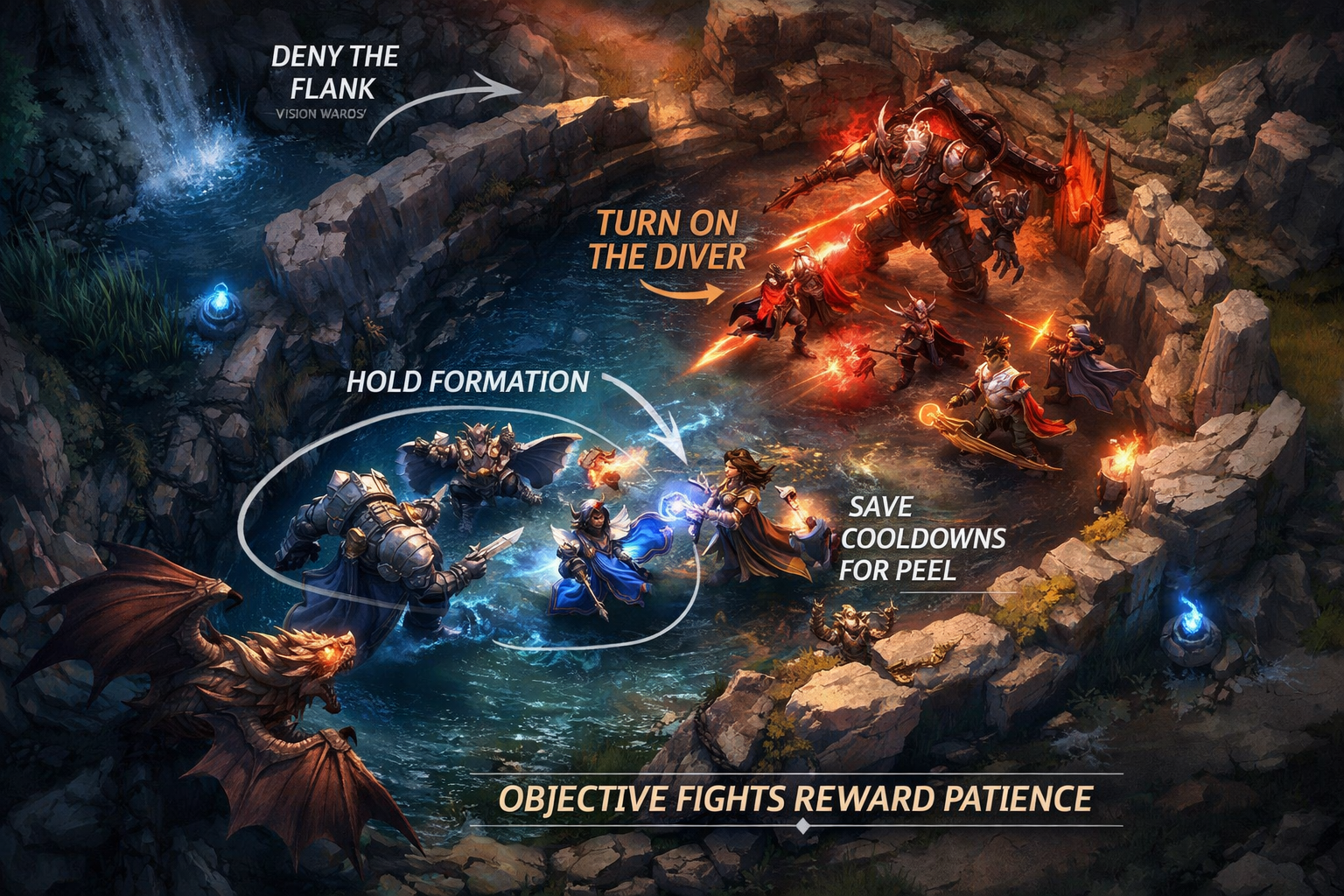
Direct engage is the classic hard-start: a tank or initiator goes in with crowd control, locking down one or more targets. This is strongest when your team is already in range and ready to layer damage.
Counter-engage happens when you let the enemy step first, then punish the dive. This is especially strong when your composition has better peel, better short-range damage, or defensive tools that turn their aggression against them.
Flank engage comes from side angles rather than the front. It can be devastating, but only if timed with your team’s pressure. A lonely flanker arriving too early is just an isolated death.
Zone engage does not begin with hard crowd control. Instead, it starts by threatening an area so strongly that the enemy has to move into a bad position. This is common around objectives where terrain does half the work for you.
4.2 What Makes an Engage Good?
A good engage usually has at least three of the following qualities:
- It hits a target your team can actually damage.
- It starts when your allies are already prepared to follow.
- It removes enemy mobility or defensive response.
- It preserves enough structure that your carry remains safe.
- It happens in terrain that benefits your side.
- It forces the enemy to burn major cooldowns immediately.
Notice what is not on that list: style points. A five-man dream engage is memorable, but ranked games are more often won by disciplined two-target or even one-target engagements that produce a clean numbers edge.
4.3 When Not to Engage
You should hesitate to engage when your damage is too far away, when the enemy has obvious counter-dive access to your backline, when your support’s defensive tools are down, or when the target you are jumping on is simply too durable relative to your burst. Another warning sign is when your engage path forces you past the enemy front line and into unclear space. Many players call this “going for the carry,” but in practice they are just leaving their team behind.
Sometimes the best engage is patience. Hold your crowd control. Walk forward and claim ground. Make the enemy uncomfortable. The moment they step too close, split their formation, or waste a major spell, the fight becomes much easier. Wild Rift rewards decisiveness, but mature decisiveness includes knowing when not to be first.
4.4 Engage Timing Around Enemy Cooldowns
One of the easiest ways to improve engagement quality is to think in terms of defensive answers. Before starting, ask what the enemy can do to stop you. Can they disengage? Can they save the target instantly? Can they turn on your carry the second you commit? If the answer is yes, you should often bait those responses first.
This is why partial pressure is so useful. A poke spell, a step into fog, a threatened flank, or a small trade can force enemy cooldowns without fully committing. Once those tools are gone, your actual engage becomes much stronger. Good teams are rarely “fearless.” They are prepared.
4.5 Engage and Your Win Condition
Your engage should serve your composition, not your ego. If your team wins long fights because of sustained damage, your engage should prioritize structure and protection. If your team is built around fast burst, then explosive isolation matters more. If your carry is the main source of damage, your engage cannot leave them exposed. The whole point of starting the fight is to create favorable conditions for your best damage pattern.
Ask yourself one question before forcing: does this start make the fight easier for my team’s win condition? If not, hold it.
5. Peel Fundamentals
Peel is often described too narrowly, as if it only means shielding the marksman. In reality, peel is any action that reduces enemy access to your valuable allies. That can be crowd control, healing, zoning, threat presence, spacing, body positioning, slowing a diver, displacing an assassin, or simply walking into the path that the enemy wants to use.
Players undervalue peel because it looks less glamorous than diving. But peel wins an enormous number of fights in Wild Rift, especially when both teams have enough damage to kill targets quickly. In high-pressure fights, survival time is damage time. Every extra second your carry stays alive can decide the whole exchange.
5.1 Identify the Real Threat
Peel begins with correct threat recognition. Not every enemy on your screen needs immediate attention. The real threat is the champion most likely to reach and kill your high-value ally in the next few seconds. That might be an assassin in fog, a bruiser charging forward, a diver waiting for your support to use a shield, or a mage lining up control tools for a follow-up dive.
If you peel the wrong thing, the real threat goes through untouched. This is why experience matters. Good players learn to watch not just health bars but pathways. Who has access? Who has cooldowns ready? Who becomes dangerous once the fight compresses?
5.2 Peel Is Proactive, Not Just Reactive
Average players peel only after their carry is already in danger. Strong players set up peel before the dive lands. They position closer to the carry. They hold a key stun instead of wasting it on the frontline. They stand where the flanker wants to enter. They make the enemy think twice before diving.
This is one of the biggest differences between panic-defense and real peel. Panic-defense is late. Real peel changes the enemy’s choice before it is made.
5.3 The Layers of Peel
Soft peel includes zoning, slowing, threatening skill shots, and standing in the correct place. It discourages access.
Hard peel includes stuns, knockups, knockbacks, roots, and displacement. It interrupts access.
Sustain peel includes shields, heals, and damage reduction. It buys time.
Positional peel is spacing your formation so enemies must overextend to reach the carry. It punishes access.
The best teamfights often use all four layers. A diver is slowed on entry, stunned when they commit, forced to eat damage while crossing the frontline, and then sees the original target saved by a shield. At that point, the diver is usually the one who dies first.
5.4 Peel Versus Chase
A common ranked mistake happens after your team gets a small health lead. Frontliners and supports start walking forward to finish low enemies, but by doing so they abandon the carry. The enemy bruiser or assassin, who looked useless a second earlier, suddenly gets a clean angle and deletes your backline. The fight flips instantly.
This is why peel discipline matters. Once the enemy has obvious dive tools, someone must remain responsible for protection. Not everyone gets to chase. In fact, the better your carry is, the less your team needs to chase. If you keep your damage source alive, the fight often wins itself.
5.5 When Peel Matters More Than Engage
Some team compositions should actively prefer defensive fights. If your team has excellent scaling damage, strong disengage, or tools that punish overcommitment, you do not always need to start first. Let the enemy become impatient. Let them try to force through your formation. Peel, survive, and then collapse on the exposed diver. Many games become much easier once you realize your composition is better at receiving than initiating.
6. Target Priority Fundamentals
Target priority is one of the most repeated phrases in MOBA strategy, but also one of the most poorly applied. People say “focus the carry” as if target selection were that simple. It is not. Real target priority is a balance between value, accessibility, and risk.
The highest-value target is not always the best first target. The best first target is often the enemy who is both dangerous and realistically killable from your current formation.
6.1 Value, Access, and Cost
To choose the right target, think about three questions:
- Value: How important is this enemy to the opposing team’s fight?
- Access: Can we reach this enemy right now without breaking our structure?
- Cost: What do we lose by trying to hit them?
An enemy marksman may be the highest-value target, but if reaching them requires your bruiser, support, and mage to sprint through choke terrain while their own diver is untouched, then the cost is too high. Meanwhile, the enemy frontliner diving too deep may be a lower-value target on paper, but if killing them protects your carry and creates a 5v4, they become the correct first target.
6.2 The Nearest Correct Target
A powerful rule for many backline players is this: hit the nearest correct target. The nearest target is not always correct, but the correct target is often closer than players think. If a bruiser or tank is overextended, isolated from support, or threatening your backline, burning them down can be the highest-value play. Front-to-back teamfighting wins games because it is stable, repeatable, and easy to execute under pressure.
This does not mean always hit tanks. It means do not throw your own fight by ignoring the enemy champion who is actively winning it. Accessible threats take priority over fantasy kills.
6.3 Threat Priority Versus Elimination Priority
Sometimes you do not need to kill the most dangerous enemy immediately. You only need to neutralize them long enough for your team to win elsewhere. A support can exhaust a diver, a tank can body-block an assassin, a mage can zone a corridor, and suddenly the enemy carry has no frontline left. In that case, the neutralized diver was the top threat, but not necessarily the first kill target.
This is an important distinction. Teamfights are not solved only by death counts. They are solved by removing impact. If an enemy is stunned, zoned, or forced out of range, they may be functionally absent during the crucial first seconds.
6.4 Target Switching
Rigid target fixation loses fights. Good players switch targets when the fight changes shape. Maybe the original dive target uses mobility and escapes. Maybe a bruiser steps too deep. Maybe the enemy backline is suddenly exposed because their frontline died. The first correct target may not remain correct ten seconds later.
The key is to switch for a reason, not from impatience. Ask: is this new target easier to secure, more threatening, or more important to the current fight state? If yes, switch cleanly and communicate it. If no, stay disciplined.
6.5 Why Low Health Is Not Always High Priority
Many players chase low-health enemies simply because the visual cue is irresistible. But low health without access is bait. A nearly dead enemy across the fight, behind peel, or inside dangerous fog can lure multiple players out of position. Meanwhile, the enemy diver or bruiser kills the teammates left behind.
The right question is not “Who is low?” It is “Who can we kill safely, and what happens if we ignore the other threats to do it?” In ranked, the enemy team benefits every time you abandon the real fight for a vanity kill.
7. Role-by-Role Teamfight Jobs
Every champion is unique, but most teamfight responsibilities still follow role patterns. Understanding the default job of your role makes decision-making much easier.
7.1 Tanks and Primary Initiators
Your job is not “go in first no matter what.” Your job is to create order. Sometimes that means engaging. Sometimes that means holding a space the enemy cannot cross. Sometimes that means threatening engage so the enemy backline cannot step up. Great tanks know the difference.
When you do engage, look for moments where your team can instantly follow. When you do not engage, preserve structure around your carry and mark enemy divers. A tank who peels at the correct moment often provides more value than a tank who lands a flashy but unsupported initiation.
Think in terms of layers. First, control space. Second, deny access. Third, engage only when the opening is real. A tank who burns every cooldown on the first visible target becomes harmless once the real fight starts.
7.2 Supports and Enchanters
Your biggest mistake to avoid is early panic. Many support players use shields, heals, or crowd control the second an ally gets touched, leaving no answer when the real burst arrives. Strong support play is about timing and restraint.
Track enemy dive patterns. Decide before the fight whether your main responsibility is to help engage, protect the carry, or counter a specific threat. In many compositions, your cooldowns are the difference between your marksman surviving at 20% health and dying instantly. Treat those cooldowns like game-winning resources, not decoration.
Positioning is everything. If you stand too far forward, you die first or force your own carry to move awkwardly. If you stand too far back, you cannot reach the ally who needs help. The best support position is usually close enough to react, far enough to survive, and angled in a way that both your carry and frontline remain in your influence zone.
7.3 Marksmen
Your default teamfight rule is simple: stay alive and keep damaging the nearest correct target. That sounds basic, but many marksman players sabotage themselves by drifting too far forward, greedily chasing a low-health carry, or using mobility aggressively before key threats are accounted for.
You are often the center of peel decisions, which means your positioning affects everyone. If you step too far forward, your team has to overcommit to save you. If you position too far back, you lose uptime and surrender space. The sweet spot is where you can hit safely while making enemy access expensive.
Do not be ashamed to hit a tank or bruiser when they are the right target. Damage dealt safely and continuously wins more fights than one reckless dive for a glamorous kill. Your job is not to look heroic. Your job is to remain a stable damage source throughout the fight.
7.4 Mages and Control Casters
Mages often decide whether a fight is clean or chaotic. Your tools may start the fight, split terrain, punish dives, or control retreat paths. The most important skill is recognizing whether your value comes from burst, zoning, or protection in that moment.
Do not waste major control spells on low-value targets just because they are visible. Many mages lose fights by throwing their best tools at the enemy tank and then having nothing left when a diver reaches the backline. Save decisive abilities for decisive moments.
If your spells define space, treat terrain as part of your damage. Choke points become more dangerous when you hold the angle patiently. Teams that respect your zone control may give up ground for free. That is still a win.
7.5 Assassins
Your target priority is more specialized than other roles. You often do want the enemy carry—but only when access is real and escape or exit pressure is manageable. Diving too early, from the wrong angle, or without allied pressure turns you into a one-for-none donation.
The best assassin timings happen when frontline pressure has already occupied enemy vision and cooldowns. Let the fight become noisy. Let defensive tools commit elsewhere. Then attack the isolated or exposed damage source. Your patience matters more than your bravery.
Also remember that assassins can create pressure without always killing. Forcing the enemy carry to play terrified, hold mobility, or stay far back can reduce their fight impact massively even before you fully commit.
7.6 Bruisers and Fighters
Bruisers live in the gray zone between engage, disruption, and target pressure. Some fights call for diving the enemy backline. Others call for shadowing your carry and deleting the first diver who enters. The correct choice depends on access and composition.
A good bruiser reads the fight like a hinge. Where is the fight likely to bend? If your carry is under huge threat, stay closer and punish access. If the enemy backline is exposed and lightly protected, create chaos there. Your value comes from being durable enough to enter danger and threatening enough that the enemy cannot ignore you.
8. Common Teamfight Structures
Most Wild Rift teamfights follow one of a few familiar shapes. Recognizing the structure helps you choose better engage and target decisions quickly.
8.1 Front-to-Back
This is the cleanest and most reliable structure. Frontliners meet first, backliners hit what is reachable, and peel matters heavily. Teams with stable damage, strong protection, and disciplined spacing usually thrive here. If your team is better at structured fights than the enemy, front-to-back is often your safest path.
8.2 Dive Versus Protect
One team sends multiple threats into the backline while the other tries to keep its damage dealer alive. These fights are decided by peel quality, access angles, and whether the divers arrive together or one by one. When facing dive, never let your formation stretch too much. When playing dive, never arrive in staggered waves.
8.3 Pick Into Collapse
Someone gets caught, and the fight begins unevenly. In this structure, discipline matters more than desperation. If your team loses one player first, sometimes the correct play is disengage. If the enemy loses one first, do not overchase and hand them a counter-opening. Numbers advantages are won by clean conversion, not by emotional pursuit.
8.4 Split Fight
The fight breaks into two smaller battles—often a frontline skirmish and a backline dive. These are the hardest fights to play because players lose track of where their help is. In split fights, communication and target clarity matter more than ever. Decide quickly whether your team wins by collapsing back to save one side or by winning faster on the other side.
8.5 Choke-Point Explosion
This happens around jungle corridors, river entrances, and objective pits. Area control, layered crowd control, and engage timing are amplified here. One bad step can decide everything. The team that arrives first, claims vision, and holds patience usually creates the better opening.
9. Dragon, Baron, and Choke-Point Fights
Objective fights add urgency and terrain pressure to normal teamfighting. That makes engage, peel, and target priority even more important.
The biggest objective-fight mistake is forcing too early without formation. Teams rush because they feel the clock ticking. But the objective itself is pressure. You do not always need to hard-start immediately. Sometimes you can let the enemy walk into your zone control, step into bad terrain, or expose a flank while trying to contest.
At dragon or Baron, ask three questions:
- Do we want to finish the objective, turn to fight, or bait a face-check?
- Who on their team must be marked before our carry can hit safely?
- Which entrance is most dangerous for us, and who is responsible for it?
Objective pits also create target priority traps. A team sees the enemy carry near the back and tunnels on them through a narrow choke, ignoring the bruiser controlling the entrance. The result is predictable: the diving team gets shredded before ever reaching its “priority” target. In tight terrain, the nearest correct target becomes even more important because access is restricted.
Peel becomes stronger near objectives because enemy divers have fewer clean routes. Supports and tanks who hold the right angle can completely ruin a dive path. At the same time, engage becomes stronger if you catch enemies entering one by one. This is why vision control around objectives is so valuable. The first team with information usually decides whether the fight is a collapse, a turn, or a full commit.
Another timeless principle: do not split your attention between fighting and securing. Either commit enough damage and tools to finish the objective safely, or turn decisively and fight. Half-committing to both often loses both. A confused team neither bursts the monster nor protects its own backline.
10. Common Teamfight Mistakes
Most players do not lose teamfights because they know nothing. They lose because they repeat a few damaging habits. Fixing these habits can raise your win rate quickly.
10.1 Engaging Without Follow-Up
This is the classic solo queue disaster. The initiator sees an opening that only exists for them, not for the team. The result is overextension, wasted ultimates, and a fight that begins 4v5 while one player dies alone.
10.2 Overchasing Low Targets
A low-health enemy pulls multiple players out of formation. The carry gets abandoned. The enemy counter-engages. What looked like cleanup turns into a throw.
10.3 Using Peel Too Early
Defensive tools are burned on harmless poke or the first contact. When the true dive arrives, there is nothing left. Good opponents wait for this.
10.4 Hitting the Wrong Frontliner
Not every frontline target deserves focus. But when a bruiser or diver is the active threat to your backline, ignoring them to chase the enemy carry is often game-losing. Recognize which frontliner is merely present and which one is actually winning the fight.
10.5 Splitting the Team’s Identity
Half the team wants to dive, half wants to front-to-back. That usually means nobody gets proper support. Decide the fight pattern quickly and commit to it.
10.6 Fighting Before Setup
Bad vision, awkward spacing, missing teammates, no cooldown check, and rushed objective pressure create messy fights. Setup is part of teamfighting, not a separate skill.
10.7 Panicking After One Mistake
Even if the start is imperfect, the fight can still be winnable. Players often lose twice: once from the initial error, and again from emotional overreaction. Stabilize, identify the new priority, and continue.
11. Communication and Shotcalling
Wild Rift is faster and more compact than many PC MOBAs, which makes clear communication even more valuable. You do not need long speeches. You need simple, repeatable signals.
Useful teamfight calls include:
- “Wait for me”
- “Hold engage”
- “Peel back”
- “Hit front”
- “Mark diver”
- “Turn now”
- “Reset, no fight”
The best shotcalls reduce ambiguity. “Focus carry” is often too vague and too ambitious. “Hit front, peel backline” is much clearer. “Turn on the diver” is better than “Help me.” Communication should describe the fight you want, not just the enemy you dislike.
Another underrated habit is pre-fight communication. Before dragon spawns, identify whether your team wants to engage first, counter-engage, or hold choke. Marking this earlier reduces panic later. Teamfights become cleaner when roles are mentally assigned in advance.
12. Practice Drills to Improve Faster
Many players improve slowly because they try to fix everything at once. A better method is to isolate one teamfight skill per set of games.
12.1 The Engage Filter Drill
For five matches, only engage when you can answer three questions positively: do I have follow-up, is the target reachable, and is our carry reasonably safe? This drill will immediately reduce reckless initiations.
12.2 The Peel Awareness Drill
In your next games, focus less on chasing kills and more on identifying the enemy’s most dangerous dive path. Ask yourself every fight: who is threatening our carry right now? This trains proactive peel.
12.3 The Nearest Correct Target Drill
As a damage dealer, spend several matches consciously hitting the nearest correct target instead of hunting deep backline kills. You will learn how many fights are won simply by staying alive and burning the active threat.
12.4 The Cooldown Patience Drill
Pick one key spell on your champion and refuse to use it at the start of every fight unless the target is clearly decisive. This builds restraint and helps you stop wasting fight-winning abilities on low-impact moments.
12.5 The Replay Pause Drill
After each important loss, pause the replay three seconds before the fight starts. Ask what information was available, who the threats were, and what the fight should have looked like ideally. This improves your pre-fight reading faster than grinding games mindlessly.
13. How to Review Your Teamfights
Replay review becomes powerful when you stop asking, “Who played badly?” and start asking, “What was the fight asking from me?” Use this sequence:
- What was our win condition? Front-to-back, dive, pick, or counter-engage?
- Who was our most important damage source?
- Who was their biggest immediate threat?
- Was the engage good, late, early, or unsupported?
- Did peel arrive on time?
- Did we hit the nearest correct target or tunnel on fantasy kills?
- Was the fight already bad because of setup?
This review method keeps you honest. Sometimes your mechanics were fine and your decision was wrong. Sometimes your target choice was right but your positioning made it impossible. Sometimes the fight itself should never have happened. Good review separates these categories.
One especially useful habit is to identify the first irreversible mistake. It is often earlier than players think. Maybe the support stepped too far from the carry. Maybe the tank engaged while the mage was still rotating. Maybe the marksman used mobility aggressively before the bruiser showed. Once you find the first irreversible mistake, improvement becomes far easier.
14. Final Thoughts
Teamfighting in Wild Rift is not about memorizing one universal rule. It is about reading the moment correctly. Sometimes the answer is to engage first and overwhelm a split formation. Sometimes the answer is to hold cooldowns, protect your carry, and punish the enemy dive. Sometimes the right target is the fragile backliner. Sometimes it is the bruiser charging straight at your marksman. Great players climb because they recognize which version of the fight is happening in real time.
If you remember only a few lessons from this guide, make them these:
- Do not engage just because you can. Engage because the fight is favorable and your team can follow.
- Peel is not passive. It is active threat denial that keeps your damage source alive.
- Target priority is not “always kill the carry.” It is “hit the most valuable reachable threat at the right cost.”
- Most bad fights are decided before they start, through setup, vision, cooldowns, and formation.
- Front-to-back discipline wins more ranked games than reckless hero plays.
As you practice, teamfights will start to feel slower even when they happen fast. You will notice flank angles earlier. You will identify the real threat sooner. You will stop wasting abilities on low-impact moments. Most importantly, you will become the kind of player who gives structure to chaos.
That is what strong teamfighting really is. Not random brilliance. Not desperation. Not flashy mistakes that happen to work once. It is disciplined awareness repeated over and over until your decisions become reliable. And in Wild Rift, reliability is one of the most valuable climbing tools you can build.
For continued official game resources, you can revisit Wild Rift’s official homepage, explore champion information on the official champion hub, and keep an eye on official patch notes. For players who want outside help converting better decisions into a faster rank climb, Boosteria’s Wild Rift boosting page is the most natural fit for this topic.