



LoL Armor & Magic Resist Guide (Upd 2026): Effective Health, True Damage
ARMOR AND MAGIC RESISTANCE CALCULATIONS (LoL)
Armor and Magic Resistance are two of the most important defensive stats in League (LoL).
They reduce incoming damage from specific sources (physical and magic) by changing the damage multiplier applied to each hit.
This guide explains the math in a practical way (with real examples), then shows how to use it for smarter builds, better item timing,
and correct penetration choices.
Updated for 2026: the core formulas for resistances and effective health are timeless, so most of this guide stays relevant
across seasons. However, specific items, runes, and champion kits can change over time—when that happens, we keep the main theory intact
and move older, season-specific references into a Legacy section at the end.
Quick note: throughout the guide we’ll often combine Armor and Magic Resistance under one word—resistance—when the concept is the same.
When it matters, we’ll split them into physical vs magic.
Table of Contents
- 1) The Core Idea: What Resistance Actually Does
- 2) The Formula: Damage Multiplier, Reduction, and Effective Health
- 3) Examples With Real Numbers (25/50/100/200/300)
- 4) What Happens With Negative Armor/MR
- 5) Effective Health: The Stat That Explains “Tankiness”
- 6) Armor/MR vs Health: How to Spend Gold Efficiently
- 7) Shields + Resistances: Why Shields Get Stronger
- 8) Penetration & Reduction: How You Break Through Tanks
- 9) Order of Operations: What Applies First
- 10) Lethality: Scaling Flat Penetration (Practical Use)
- 11) Magic Penetration: Flat vs Percent
- 12) Build Frameworks: “What Do I Buy Into X?”
- 13) True Damage: Definition, Myths, and Interactions
- 14) Common Mistakes (And How to Fix Them)
- 15) FAQ
- 16) Extra Resources & Tools
- Legacy Section: Outdated Items/Systems & Historical Notes
1) The Core Idea: What Resistance Actually Does
Resistances don’t “add health” directly. Instead, they reduce the damage you take by changing the multiplier applied to incoming hits.
This makes your existing HP last longer against that damage type.
A common beginner-friendly way to think about it:
- Each 1 point of resistance increases your effective health by ~1% against that damage type (when the resistance is above 0).
-
So if you have 1000 HP and 50 Armor, your effective health versus physical damage is about
1500. The enemy must deal ~1500 raw physical damage to kill you (ignoring healing/shields for the moment).
That “1 resistance ≈ 1% effective HP” rule is why tanks can feel immortal when they stack the right defensive stat into the enemy’s damage profile.
But it also hints at the most important limitation:
Armor does nothing against magic damage, and Magic Resistance does nothing against physical damage.
2) The Formula: Damage Multiplier, Reduction, and Effective Health
The standard formula (for Armor or Magic Resistance, when the value is 0 or higher) is:
- Damage Multiplier = 100 / (100 + Resistance)
- Damage Taken = Raw Damage × Damage Multiplier
- Damage Reduction = 1 − Damage Multiplier
- Effective Health vs that damage type = HP × (1 + Resistance/100)
Your original image is still perfectly useful for the multiplier idea:

The most practical takeaway is the effective health equation:
EH = HP × (1 + Resist/100).
If you remember only one thing from this entire guide, remember that.
3) Examples With Real Numbers (25 / 50 / 100 / 200 / 300)
Examples with real numbers:
25 resistance:
80% incoming damage → 20% reduction → 125% effective health
50 resistance:
66.67% incoming damage → 33.33% reduction → 150% effective health
100 resistance:
50% incoming damage → 50% reduction → 200% effective health
200 resistance:
33.33% incoming damage → 66.67% reduction → 300% effective health
300 resistance:
25% incoming damage → 75% reduction → 400% effective health
Notice the pattern: the damage multiplier keeps shrinking, but you never reach 0.
This is why “100% physical damage immunity” isn’t realistically achievable through Armor alone.
4) What Happens With Negative Armor / Magic Resistance
Most of the time, champions sit at positive Armor and MR.
But it’s still important to understand negative resistance because it explains:
- Why shredding low-resistance targets feels insanely strong
- Why “over-pen” doesn’t always add value
- Why reducing below zero can create big damage spikes
When resistance is negative, the multiplier becomes greater than 1 (you take increased damage).
The common implementation used in LoL can be described as:
- If Resist ≥ 0: Multiplier = 100 / (100 + Resist)
- If Resist < 0: Multiplier = 2 − 100 / (100 − Resist)
Quick example: at -25 MR, incoming magic damage is multiplied by about 1.20
(around 20% more damage taken).
In real games, you won’t often see massively negative Armor/MR on champions, but you will see situations where a target’s “effective”
resistance is pushed near zero—especially squishy carries—so the next penetration source gives little or no extra value.
5) Effective Health: The Stat That Explains “Tankiness”
Effective Health (EH) is how much raw damage the enemy must deal (of a given type) to kill you.
It’s the best way to compare defensive options because it turns different stats into one number.
For positive resistances:
- EH vs physical = HP × (1 + Armor/100)
- EH vs magic = HP × (1 + MR/100)
This instantly explains why “HP stacking” and “Armor stacking” both work—but in different situations:
- If you already have big Armor, adding HP becomes more valuable because the HP gets multiplied by that Armor.
- If you already have huge HP, adding Armor/MR becomes more valuable because it multiplies that large HP pool.
It also explains why balanced tank builds feel better than “all Armor” into mixed damage.
A bruiser with 300 Armor but low MR can still get deleted by strong magic burst.
6) Armor / MR Versus Health (HP): How to Spend Gold Efficiently
A classic question in LoL is: “Do I buy HP or resistances first?”
The correct answer depends on:
- Your current stat distribution (how much HP vs resist you already have)
- The enemy damage split (mostly physical, mostly magic, or mixed)
- Whether the enemy has percentage penetration / shred
- Whether fights are short burst windows or long DPS brawls
- Your champion’s kit (self-heal, shields, damage reduction, scaling, etc.)
Your graph is still a very useful visual guideline for “healthy” stat ratios:
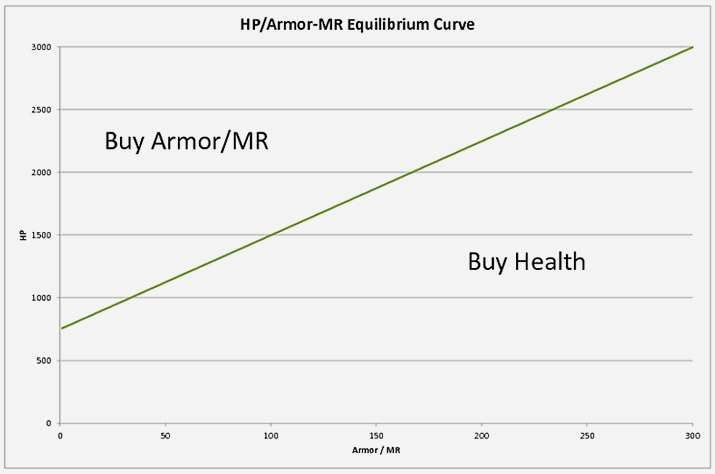
Examples showing how you can use this graph for decisions:
- At 50 Armor/MR, aim for at least ~1100 HP
- At 100 Armor/MR, aim for at least ~1500 HP
- At 150 Armor/MR, aim for at least ~1900 HP
- At 200 Armor/MR, aim for at least ~2400 HP
In general: if you have no defensive items yet, it’s often better to start with a health component first.
After midgame (roughly levels 9–11+ depending on role and tempo), you usually want to start adding the correct resistance,
especially if the enemy threats are already ahead.
A Gold-Efficiency Mindset (Simple Checklist)
- Enemy is mostly physical DPS (marksman + AD bruiser): prioritize Armor + HP
- Enemy is mostly magic burst (mid + AP jungle): prioritize MR + HP
- Enemy has big % pen or shred: mix HP more heavily (and consider anti-burst tools)
- You’re getting one-shot: resistances often help more immediately than slow, scaling HP builds
- Fights are long: HP + resist + sustain/regen usually outperforms “one-time” defenses
If you want the “fastest” way to improve as a player, train yourself to identify the two biggest enemy damage sources
and build primarily against them. That habit alone wins a lot of games.
7) Armor/MR + Shields: Why Shields Get Stronger
Shields are basically “temporary HP,” so resistances multiply their value the same way they multiply your real HP.
Example:
a 250 HP magic shield on a champion with 100 MR effectively behaves like about
500 HP versus magic damage, because you only take 50% of incoming magic damage.
This is why supports and tanks can feel impossible to kill when:
shielding + the correct resistance line up against the enemy’s main damage type.
Shield Practical Tips
- If you are being burst by magic damage, MR often makes every shield in your team comp stronger.
- If the enemy has strong physical crit DPS, Armor makes shield windows more durable—especially in objective fights.
- If you’re facing mixed damage, consider balancing defenses so your shield isn’t instantly deleted by the “other” damage type.
ARMOR PENETRATION AND MAGIC PENETRATION
Resistances are strong—so LoL also includes tools to counter them:
penetration and reduction (shred).
These mechanics let damage dealers stay relevant against tanks and bruisers.
The most important difference:
- Reduction (shred) lowers the target’s Armor/MR for everyone (team-wide value).
- Penetration ignores part of the target’s Armor/MR only for your damage.
Both are valuable, but they shine in different contexts:
shred is amazing in coordinated team fights, while penetration is often best for solo carry damage.
9) Order of Operations: What Applies First (The Stacking Rule)
When you hit a target, the game effectively computes an “effective resistance” by applying modifiers in a specific order.
This order matters a lot because the same stats can produce different results depending on sequence.
Common order used for physical damage:
- Armor reduction/shred (target’s Armor is lowered first; helps allies too)
- % Armor penetration (ignores a percentage of the remaining Armor)
- Flat penetration (ignores a flat amount after the percentage step)
- Lethality (a scaling form of flat armor penetration applied in the flat step)
Common order used for magic damage:
- MR reduction/shred
- % Magic penetration
- Flat magic penetration
The big consequence: % penetration becomes more valuable against high-resistance targets,
while flat penetration becomes more valuable against low-resistance targets.
10) Lethality: Scaling Flat Penetration (Practical Use)
Lethality is essentially flat armor penetration that scales with the target’s level.
In practice:
- It’s strongest when you’re hitting low-Armor targets (most carries early/midgame).
- It becomes less impressive into heavy Armor stacking, where % pen and sustained DPS often matter more.
A commonly referenced scaling rule looks like:
Effective Flat Pen = Lethality × (0.6 + 0.4 × TargetLevel / 18).
In plain language: you get a smaller fraction of your Lethality against low-level targets, and close to full value at level 18.
When Lethality Is Usually Best
- You’re an AD assassin trying to delete a carry during a short window
- The enemy team has multiple squishies and limited frontline
- You can snowball and end before the enemy stacks multiple Armor items
When Lethality Is Usually Worse
- The enemy frontline is stacking Armor and HP early
- You need to win through long fights and sustained damage
- The enemy team has heavy shielding + heal + peel (burst windows are unreliable)
The simplest rule: if your job is bursting a carry, Lethality often feels great.
If your job is melting tanks, % pen and DPS patterns are usually more consistent.
11) Magic Penetration: Flat vs Percent
Magic penetration mirrors physical penetration, but the builds and matchups feel different because:
- Many champions start with the same baseline MR (and MR growth is often lower than Armor growth)
- MR items can be more situational, especially on carries
- Some champions get significant defensive value from kit tools rather than pure MR stacking
Flat magic penetration is excellent versus low-MR targets (most carries),
while % magic penetration shines when enemies buy strong MR items.
If you’re a mage and you’re unsure what to do:
- If the enemy has little MR: flat pen and raw AP often feel best.
- If the enemy is building multiple MR items: % magic pen is usually required to stay relevant.
12) Build Frameworks: “What Do I Buy Into X?”
Instead of memorizing a fixed list of “best items,” use frameworks.
LoL rewards adaptation: damage types, win conditions, and fight shapes change every game.
A) You’re a Tank Into Double AD (ADC + AD Top/Jungle)
- Prioritize Armor + HP
- Value anti-crit / anti-attack-speed effects if the enemy carry is ahead
- Remember: if their team is mostly physical, one strong MR item is often enough later
B) You’re a Tank Into Double AP (AP Mid + AP Jungle)
- Prioritize MR + HP
- Buy tools that protect you from burst windows (especially around objectives)
- If you get chunked before fights, consider sustain/regen patterns too
C) Enemy Team Is Mixed Damage (The Most Common Case)
- Start with the defense that counters the biggest fed threat
- Then balance: one-sided stacking is punished by the “other” damage type
- If you’re unsure, balanced builds often outperform extreme builds in average solo queue games
D) Enemy Has Big % Penetration
- Mix in HP so your defenses don’t get “cut in half” too easily
- Think in terms of time to die: you need to survive long enough to use your CC/engage
- Consider anti-burst options: shields, damage reduction windows, reposition tools, or team peel
If you want to sharpen your decision-making fast, do this after each death:
identify whether you died to physical, magic, or true/mixed damage,
then buy the next component that best increases your effective health against that damage type.
TRUE DAMAGE DEFINITION (LoL)
True damage is a damage type that is not reduced by Armor or Magic Resistance.
In other words, it ignores the resistance formulas described above.
True damage is used to:
- Give certain champions reliable tank-killing patterns
- Create high-stakes “execute” moments
- Prevent resistance stacking from completely shutting down specific kits
Important Clarification: True Damage Still Has Counterplay
- Shields still block true damage (most shields are simply extra HP, so they absorb any damage type).
- Invulnerability and certain “cannot take damage” effects can prevent it entirely.
- Many true-damage patterns are conditional (stacking hits, specific abilities, or execution thresholds).
True damage is scary, but it’s rarely “unfair” when you understand the trigger and play around the window.
14) Common Mistakes (And How to Fix Them)
Mistake #1: Building the Wrong Resistance
If the enemy threats are mostly physical and you buy MR first, you’re essentially buying “nothing” for the next few fights.
Always build against the damage that is actually killing you.
Mistake #2: Over-Penetrating a Low-Resistance Target
If a target’s effective resistance is already at or near 0, additional flat penetration gives little value.
Against squishies, raw damage stats can sometimes outperform more pen.
Mistake #3: Ignoring HP When Everyone Has % Pen
When percentage penetration is common in a match, pure resistance stacking can lose efficiency.
In those games, mixing in HP keeps your overall effective health higher.
Mistake #4: Forgetting That Shields Scale With Resistances
If your team has strong shields (enchanters, item shields, kit shields), buying the correct resistance often multiplies that value.
Tanks with shield support can look unkillable if built correctly.
Mistake #5: Treating “Tankiness” as a Single Stat
Tankiness is a combination of: HP + resists + sustain + shielding + positioning + cooldown windows.
The math is important—but fights are still won by timing, spacing, and knowing what the enemy can do.
15) FAQ
Q: Is 100 Armor “a lot”?
100 Armor means you take about 50% of incoming physical damage (if Armor is positive and no modifiers apply).
Whether it’s “a lot” depends on the game state—into a fed ADC with % pen, it can feel like “not enough,” while into low-pen teams it’s huge.
Q: Why does Armor feel like diminishing returns?
The damage reduction percentage increases slower as you stack more resistance.
However, your effective health versus that damage type scales linearly with resistance (each +100 adds another full HP bar of EH).
That’s why tanks can still scale well even when the % reduction number looks smaller than expected.
Q: Should I buy HP or Armor/MR first?
Early game: HP is often a stable first layer (especially if you’re unsure who will be fed).
Midgame+: buy the resistance that counters the biggest threat, then balance.
Use effective health thinking instead of habits.
Q: Does true damage ignore shields?
Generally, no—shields still absorb true damage because shields are like extra HP.
(Some effects can bypass or break shields, but that’s a separate mechanic from damage type.)
Q: Does penetration work on turrets?
In most common LoL cases, “penetration” stats are primarily designed for champion-vs-champion interactions,
and turret damage rules are handled differently. If you’re optimizing for tower-taking, focus on stats and effects that specifically enhance
structure damage or empower basic attacks rather than assuming penetration will behave the same way.
16) Extra Resources & Tools
If you want to go deeper into the math (or double-check values when Riot changes item/rune ecosystems),
here are a few reliable, high-signal references:
-
Riot Developer Portal (official data access)
-
Penetration calculator & breakdown (LoL math tool)
-
Formula explanation and negative-resistance note (StackExchange)
And if you want more LoL guides and services on Boosteria, here are some helpful internal links:
- Boosteria main page
- TFT pricing (Teamfight Tactics)
- How to get free skins in LoL
- LoL split pushing guide
- Best LoL teams EU
LEGACY SECTION (Older Items/Systems & Historical Notes)
This section contains older references from past seasons. LoL evolves: items are removed, renamed, or reworked; runes and masteries change;
and champion kits get updated. The math remains mostly stable, but the examples can become outdated.
If you spot something here that no longer exists in your current patch, treat it as historical context.
Legacy: Older Item Mentions
- Zz’Rot Portal — removed in a past season and no longer part of modern builds.
- Athene’s Unholy Grail — removed/retired in modern item systems.
- Abyssal Scepter — older name; modern ecosystems use different variants (e.g., Abyssal Mask).
Legacy: “Season 7 Added Lethality” Explanation
Older guides often describe Lethality as a Season 7 replacement for old armor penetration. The concept is still useful historically, but modern LoL
generally treats Lethality as a scaling form of flat armor penetration. If you’re learning today, focus on the stacking order and practical use
rather than the season history.
Legacy: Long Item Lists, Old Runes/Masteries, and Kit-Specific Shreds
If you’re updating an older article (or reading one), beware of:
- Old mastery names (the system was replaced)
- Old rune names/values
- Champion abilities that used to shred Armor/MR but were changed
The best timeless approach is to keep the formulas, then let readers verify modern values via in-game tooltips or current patch sources.
(Optional) Video Reference: AD vs Armor Penetration
There is an instructional video about the difference between attack damage and armor penetration with detailed numbers and calculations:


