



LoL Quick Cast (Smart Cast) Guide: Settings, Indicators, Tips, and Best Use Cases (2026)
INTRODUCTION TO SMART CAST IN LoL GUIDE
Mechanical skill and decision-making win games in League (LoL), but there’s a third pillar many players ignore: how fast and accurately you communicate with the game. Your camera settings, hotkeys, cursor discipline, and casting method decide whether your intent becomes an instant ability… or a delayed misclick.
One of the biggest “input upgrades” you can make is learning Quick Cast (commonly called Smart Cast). Many older guides and players still say “smart cast,” while modern clients and communities often use “quick cast.” In this guide, we’ll use both terms so you can recognize them anywhere.
This is a timeless guide designed to stay useful beyond a single patch cycle. We’ll mention 2026 once for SEO freshness, but the core concepts—targeting types, range awareness, and practical drills—will still matter in 2027 and beyond.
You’ll learn:
- What Quick Cast / Smart Cast really does (and what it doesn’t)
- How to enable it and build a clean hotkey layout
- When to use normal cast vs quick cast vs quick cast with indicator
- Which ability archetypes benefit most—and which ones you may want to keep on normal cast
- Drills to gain range memory without griefing your ranked games
- Advanced tips: self-cast, spell buffering, vector spells, and avoiding “panic casts”
Table of Contents
- What is LoL Quick Cast and how does it work?
- Cast modes explained: Normal, Quick Cast, Indicator, Self-Cast
- How to enable Quick Cast in LoL
- Best-practice setup: hotkeys, indicators, and consistency
- When normal cast is better (precision > speed)
- When Quick Cast is better (speed > friction)
- Abilities that feel “always quick cast” (and why)
- Special ability types: vector, charged, and toggles
- Practice drills to build range memory fast
- Advanced performance tips: buffering, camera, cursor control
- Common Quick Cast mistakes (and fixes)
- FAQ: Smart Cast vs Quick Cast, indicators, and comfort
- Legacy notes (older terms, older settings, and myths)
- Wrap-up and more guides
WHAT IS LoL QUICK CAST AND HOW DOES IT WORK?
Quick Cast (Smart Cast) makes your ability fire immediately at your cursor position (or toward your cursor direction) when you press the key. With normal cast, the game typically shows a targeting indicator and waits for an additional confirmation click (usually left-click).
In simple terms:
- Normal cast: press ability → see indicator → click to confirm
- Quick cast: press ability → it casts instantly
That “one extra click” sounds small, but it changes everything: it affects how quickly you can punish mistakes, how reliably you can combo, and how cleanly you can react in chaotic fights.
The tradeoff is also simple: quick cast is faster but removes the built-in “range reminder” you get from normal cast. You replace the indicator with range memory—and range memory is trainable.
Quick cast applies to almost every ability type in League:
- Skillshots (lines, circles, cones)
- Unit-targeted spells (click a champion/minion)
- Ground-targeted spells (place on terrain)
- Self-cast spells (shield/heal yourself)
- Item actives (some behave like abilities)
If you’ve ever felt like you “knew what to do” but your champion didn’t do it quickly enough, quick cast is one of the biggest quality-of-life upgrades you can make—especially when combined with good hotkey habits.
For official controls references and settings terminology, Riot’s support pages are a solid starting point: support.riotgames.com. For general game context, leagueoflegends.com and Wikipedia’s overview can help newer players.
CAST MODES EXPLAINED: NORMAL, QUICK CAST, INDICATOR, SELF-CAST
Before you flip every key to quick cast, it helps to understand the four casting “flavors” most players use. Think of these as tools in your toolkit—not a single permanent lifestyle choice.
1) Normal Cast (Indicator + Click)
Normal cast shows you the ability’s range/shape before you commit. It’s slower, but it’s the best mode for:
- Learning a champion for the first time
- High-impact abilities where missing is catastrophic
- Abilities with tricky placement (walls, cages, knockbacks)
- Moments where precision matters more than speed
2) Quick Cast (Instant)
Quick cast removes a step. You press a key and the spell happens immediately. It’s best when:
- You already know the approximate range
- You need to cast during movement (kiting, weaving autos)
- You’re executing combos
- You’re reacting, not planning
3) Quick Cast with Indicator (Hold → See → Release)
This is the “golden mean” many players love. While you hold the key down, you see the indicator. When you release the key, the ability casts. You can cancel with right-click.
Why it’s so good:
- You keep most of the speed benefits
- You still get a quick range reminder
- You reduce panic casts because you can cancel
- It feels natural for abilities where you want “confidence” without full normal-cast friction
4) Self-Cast (ALT + Key, or Quick Cast + Self Cast)
Self-cast is the difference between instantly shielding yourself and accidentally shielding a minion. Common approaches:
- ALT + ability key: cast on yourself (works for many self-targetable spells)
- Quick Cast + Self Cast setting: if no valid target, it self-casts
Self-cast is most valuable for reactive defensive spells—especially when you’re being jumped and your cursor is not perfectly placed.
HOW TO ENABLE SMARTCAST IN LoL?
Enabling Quick Cast is simple, but setting it up smartly is what makes it feel good long-term. Most players do better with a hybrid setup than an “everything quick cast, no exceptions” approach.
- Open Options in-game.
- Go to Hotkeys (or the equivalent tab in your client language).
- Use Quick Cast All if you want a fast baseline.
- Then customize individual abilities in Additional Hotkeys / Ability-specific sections.
If you’re following the structure from your existing article, these images still work well as visual references:
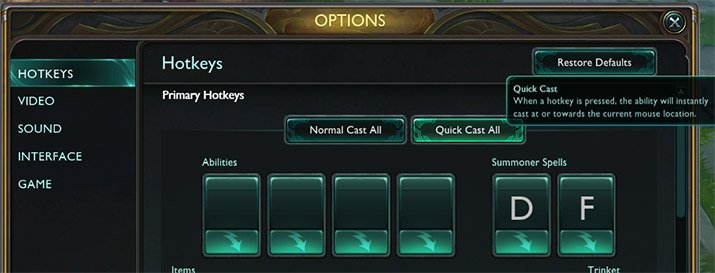
Enabling Quick Cast (Smart Cast) in LoL
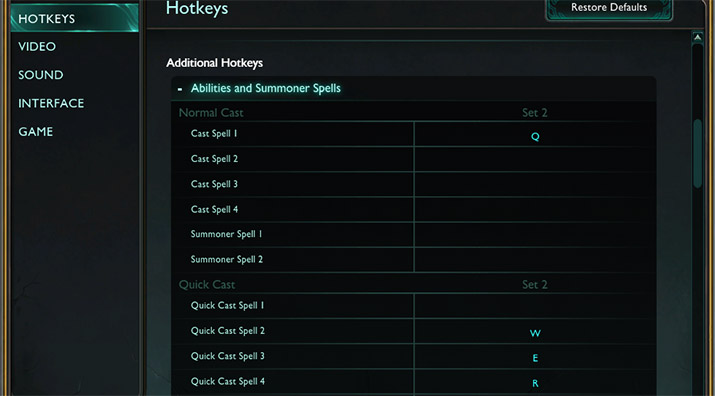
Custom per-ability setup is where Quick Cast becomes truly comfortable.
BEST-PRACTICE SETUP: HOTKEYS, INDICATORS, AND CONSISTENCY
Many players enable quick cast and then stop—only to turn it off later because they “can’t aim without indicators.” That usually happens because the setup is incomplete. The best Quick Cast setups solve two problems:
- They reduce friction for the abilities you need to cast instantly.
- They preserve clarity for the abilities you need to place precisely.
A simple, stable default layout (recommended)
If you want a setup that works for most champions and roles:
- Q/W/E/R: Quick Cast for most abilities
- One “precision” key per champion: Normal cast or Quick Cast with Indicator for the high-impact skill
- Shift + Q/W/E/R: Bind to normal-cast versions (if you like flexibility)
- ALT + Q/W/E/R: Self-cast (shields/heals)
Why this works: you get speed by default, but you keep a “precision brake pedal” when you need it.
Quick Cast with Indicator: your training wheels that can stay forever
Quick Cast with Indicator is not “for beginners only.” Many experienced players keep it on select spells because it improves placement and reduces mistakes under pressure.
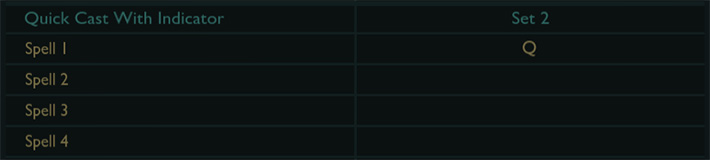
Quick Cast with Indicator is the sweet spot for many players.
Self-cast: stop losing fights to cursor placement
Defensive spells are often miscast because your cursor is on the enemy while you need to protect yourself. Self-cast solves that. If your client includes a “Quick Cast + Self Cast” behavior, it can feel extremely smooth on shielders.
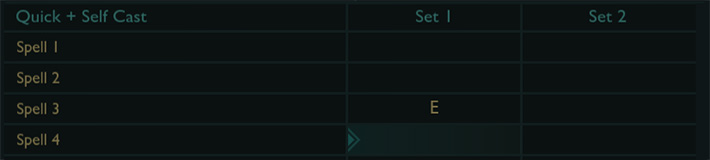
Self-cast options remove panic from defensive play.
Consistency beats “perfect” settings
The #1 mistake is changing your setup every few games. Your hands learn patterns through repetition. Pick a setup, practice it in Tool, and only adjust one thing at a time.
WHEN NORMAL CAST IS BETTER: PRECISION & INFORMATION
Quick cast is powerful, but some situations reward information more than speed. Normal cast gives you a fast “reality check”: Am I in range? Is the placement correct? Will this hit the target I want?
Here’s a practical way to decide: if missing the spell costs you the fight, consider normal cast or indicator.
Ability archetypes that often deserve normal cast (or indicator)
1) Long cooldown, game-breaking engage
Missing a major engage tool can lose a dragon fight, a baron fight, or a lane phase. Normal cast helps you confirm range and angle before you commit.
2) “Placement spells” where inches matter
Anything that relies on precise terrain placement—cages, knockbacks, zoning circles—benefits from an indicator at least while you learn it.
3) Spells you’re still learning
When you don’t know the exact range, don’t guess in ranked. Use normal cast in Tool until it becomes muscle memory.
Examples (classic “precision first” spells)
Your original list is a strong starting point. Here are examples where many players keep indicator/normal cast at least while learning:
- Blitzcrank Q – big cooldown, high consequence; aim and patience win lanes.
- Nami Q – missing often means you lose the trade window.
- Veigar E – placement determines instant stun or “free escape route.”
- Ziggs R – huge value spell; knowing range/placement matters.
- Pantheon R – misplacement can ruin macro plays.
- Cho’Gath Q – missing removes your threat; indicator helps while learning.
- Amumu Q – engage tool that starts fights; accuracy matters.
- Fizz R – all-in ult; precision often outweighs speed.
- Gragas R – one kick can win or lose a team fight.
- Lee Sin Q – many plays depend on landing it; indicator helps while you build confidence.
Important: none of these are “must normal cast forever.” Many experienced players quick-cast all of them. The real rule is: use normal cast until your range memory becomes reliable, then switch.
WHEN QUICK CAST IS BETTER: SPEED, FLOW, AND REACTION
Quick cast shines when you need to execute without hesitation. It improves:
- Reaction speed (punish mistakes instantly)
- Combo reliability (fewer input steps)
- Kiting and weaving (cast while moving without extra clicks)
- Teamfight clarity (less time “staring at indicators”)
Where Quick Cast creates immediate value
1) Single-target spells you cast constantly
These spells are often used mid-trade, mid-chase, or mid-kite. Quick cast reduces delay and makes your champion feel “snappier.” Examples:
- Point-and-click damage
- Fast debuffs
- Instant gap-closers
- Defensive reactions (shields, speed-ups)
2) Low cooldown “spam” spells
If the spell is used every few seconds, normal-cast friction adds up quickly. Quick cast keeps your tempo high and your hands focused on movement and spacing.
3) Mobility spells
Dashes and blinks are commonly used in panic situations. Quick cast makes them reliable when your brain is in fight-or-flight mode.
4) CC that must happen at the exact moment
Some CC is about timing more than perfect geometry. Quick cast helps you “snap” a catch during a brief window.
Examples by category (practical, not exhaustive)
Fast single-targeted abilities
- Singed E (Fling)
- Annie Q (Disintegrate)
- Malzahar E (Malefic Visions)
- Teemo Q (Blinding Dart)
- Zed R (Death Mark)
- Veigar R (Primordial Burst)
Spammable low-cooldown abilities
- Ahri Q
- Caitlyn Q
- Janna E
- Ziggs Q
- Talon W
Dashes, escapes, gap closers
- Irelia Q
- Katarina E
- Ezreal E
- Shen E
- Master Yi Q
- Tryndamere E
- Shaco Q
CC you often want instantly
- Lux Q
- Leona E
- Maokai R
- Janna Q (depending on your playstyle)
The pattern is simple: the more frequently you use the spell and the more timing-sensitive it is, the more Quick Cast helps.
ABILITIES THAT FEEL “ALWAYS QUICK CAST” (AND WHY)
Your original section about “abilities where quick cast is always enabled” captures a real player experience: some abilities feel terrible without quick cast because they’re designed for fast chaining or repeated casts.
More broadly, here’s why certain abilities feel “built for quick cast”:
- Multi-cast kits where you press the same key repeatedly
- Dash chains where speed is the whole identity
- High APM champions whose power is partly in rapid execution
- Spells used during movement (kite-casting)
Examples players often keep on quick cast because it matches the kit’s rhythm:
- Repeated dash/strike spells
- Low cooldown “weave between autos” spells
- Rapid reposition tools
- Spells that function like enhanced basic attacks
Your list of icons is fine to keep if it matches your site formatting. Just remember: the goal isn’t “these must be quick cast,” it’s “these are commonly quick cast because it feels natural.”
SPECIAL ABILITY TYPES: VECTOR, CHARGED, AND TOGGLES
Not all spells behave the same under quick cast. Some require special handling—especially abilities that involve dragging, charging, or re-casting. Understanding these will save you from the frustrating “why did my spell go there?” moments.
1) Vector or “line-drawn” spells
You already mentioned the classic examples:
- Rumble R (The Equalizer)
- Viktor E (Death Ray)
With vector-like spells, Quick Cast can work differently: you may need to press and hold to choose a direction/line, then release to cast. If you only tap the key, the spell may fire in an unintended default direction.
Tip: if a spell “draws a line,” test it in Practice Tool and decide whether:
- Quick Cast feels natural for you, or
- Quick Cast with Indicator gives better control, or
- Normal cast prevents expensive mistakes
2) Charged spells (hold to increase range/power)
Charged abilities often involve holding a key to “wind up” and releasing to fire. Quick Cast can be great here, but it also makes accidental releases more punishing.
If you often misfire charged spells: try Quick Cast with Indicator so you can confirm direction before release.
3) Toggle spells and auras
Toggle abilities (turn on/turn off) can feel fine on quick cast, but they’re also prone to “double tap” mistakes. If you frequently turn an ability off by accident, consider:
- Slowing down your key press rhythm
- Ensuring your keyboard repeat behavior isn’t too sensitive
- Binding toggles to a comfortable key to reduce accidental spam
4) Ground-targeted zone spells
Many zone spells feel amazing on quick cast once you have range memory. But if you’re placing them precisely (behind a target, on an escape route, on a choke), indicator mode can be the best compromise.
PRACTICE DRILLS: BUILD RANGE MEMORY WITHOUT RUINING RANKED
The real barrier to quick cast isn’t “aim.” It’s confidence. Confidence comes from repetition. The good news: you can train Quick Cast efficiently without playing 200 games of chaos.
Drill 1: Range snapping (3 minutes)
- Enter Practice Tool with your champion.
- Place a training dummy.
- Walk to what you believe is max range for your key spell.
- Cast with quick cast.
- If it fails (out of range), take one step forward and repeat.
Do this for your key spells (usually one skillshot and one mobility spell). In 3 minutes, your brain calibrates quickly.
Drill 2: Cursor discipline (movement + cast)
Many Quick Cast misses are not range problems—they’re cursor problems. Practice moving and casting with your cursor staying near the target instead of drifting to random screen edges.
- Spawn a dummy.
- Circle around it with right-click movement.
- Cast your spell every time it’s off cooldown.
- Focus on keeping the cursor near the dummy when you press the key.
Drill 3: Combo cadence (the “no hesitation” test)
Pick a simple combo for your champion (for example: CC → damage spell → follow-up). Cast it 10 times in a row without pausing between steps.
If you pause, it usually means your brain is waiting for an indicator. Switch that spell to Indicator mode temporarily, then migrate it to full quick cast once it feels natural.
Drill 4: Defensive self-cast reaction
If you play shielding/healing champions:
- Bind self-cast (ALT + key or your preferred setting).
- Practice: move cursor away from your champion, then instantly self-cast.
- Repeat 20 times until it becomes a reflex.
This drill matters because in real fights your cursor is rarely “perfectly placed” on yourself.
Drill 5: “Indicator off” graduation
Here’s a simple progression plan:
- Week 1: normal cast on key spell
- Week 2: quick cast with indicator on key spell
- Week 3: quick cast on key spell
You can compress this into days if you practice consistently.
<h2


